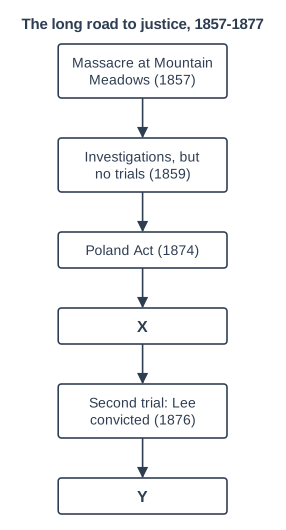
Read Interpretations A and B about the trial and execution of John D. Lee for the Mountain Meadows Massacre.
Interpretation A: from a letter written in March 1877 to a New York newspaper by a non-Mormon lawyer living in Salt Lake City. (Written for practice.)
'Justice has at last been done at Mountain Meadows. For twenty years the murderers of the Arkansas emigrants hid behind the Church, and Mormon juries refused to convict them. Only when Congress passed the Poland Act and took the courts out of Mormon hands could the law reach them. John D. Lee was a willing butcher who deserved to die on the spot where his victims fell. The nation has shown that the Mormons are not above its laws.'
Interpretation B: from the memoirs of a Mormon farmer from southern Utah who had known John D. Lee, written in 1910. (Written for practice.)
'John D. Lee was no worse than many others who were at the Meadows that day, and he had obeyed the orders of men above him. When the government at last pressed for a trial, the leaders found it easier to let one man carry the blame for all. At his first trial the jury could not agree; at the second, men who had once protected him spoke against him. He was a sacrifice, offered to bring peace to the Church and to satisfy the Gentiles.'
Why might the authors of Interpretations A and B have a different interpretation about the trial and execution of John D. Lee?
Explain your answer using Interpretations A and B and your contextual knowledge.
Model answer
The authors may differ because of their position and purpose. Author A was a non-Mormon lawyer living in Salt Lake City. Non-Mormons there had complained for years that Mormon juries protected their own people, and as a lawyer he would see the Poland Act of 1874, which gave federal courts control over criminal trials, as the breakthrough. He was writing to a New York newspaper, whose readers were already hostile to the Mormons, in March 1877 at the very moment of the execution, so it is not surprising that he presents it as a triumph of 'justice' and of the nation's laws.
Author B, on the other hand, was a Mormon farmer from southern Utah who had known Lee personally, so he would have sympathy for him and would know how many local men had been involved. Writing his memoirs in 1910, he also knew that in more than thirty years after the execution nobody else, such as Isaac Haight or John Higbee, had ever been punished. This explains why he sees Lee as 'a sacrifice' made by Church leaders to end the matter.
Explanation
A non-Mormon lawyer writing to an Eastern paper at the time of the execution saw it as federal law finally beating Mormon resistance; a Mormon neighbour of Lee writing decades later, knowing no one else was punished, saw a scapegoat. Level 2 develops these provenance points and links them to what each interpretation says.