
Level:
Correct: 0
Incorrect: 0
Marks: 0/0
Exam Practice
Subject:
Topics:
Avg
score:
–
Topics
done:
0/9

The continued settlement of the west

Practise 44 exam-style questions on The continued settlement of the west for AQA GCSE History (America 1840-1895). Write your answer as you would in the exam and get it marked in seconds against the mark scheme, point by point, with an AI tutor on hand if you get stuck.

  • 44 questions
  • 2–12 marks each
  • Instant marking
  • No sign-up needed
20 questions, marked as you go

Sample questions with model answers

Here are 4 of the questions in this topic, each with a model answer, an explanation of why it earns the marks and the mark scheme an examiner would use.

Question 1

2 marks

The flow chart shows how a settler gained land under the Homestead Act of 1862.

What should replace X? Explain why the government included this condition.
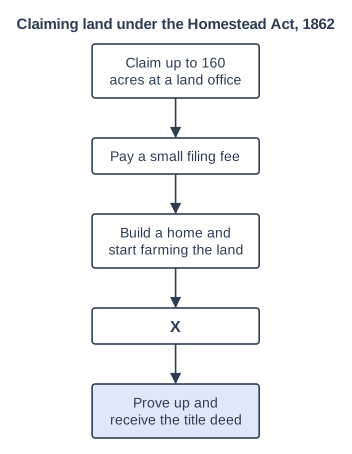
Claiming land under the Homestead Act, 1862. Flow chart of 5 boxes joined by arrows, read from top to bottom. The first box is "Claim up to 160 acres at a land office", which leads to "Pay a small filing fee", which leads to "Build a home and start farming the land", which leads to box X, which leads to "Prove up and receive the title deed" (shaded).

Model answer

X should be 'live on the land and farm it for five years'. The government included this condition so that the land would go to genuine settlers who would farm it and build communities, rather than to speculators who wanted to buy land cheaply and sell it for a profit.

Explanation

After five years the homesteader 'proved up', with neighbours as witnesses, and received the title deed. The rule did not stop all fraud, because speculators used false claimants and commutation (buying after six months at 1.25 dollars an acre).

Mark scheme
  1. 1 mark

    X: live on the land and farm it (improve it) for five years.

    Must include the five years. Accept: live there for five years / farm it for five years.

  2. 1 mark

    To make sure the land went to genuine settlers who would farm it and build communities, not to speculators who would buy it up and sell it on for profit.

    Accept: to stop speculators / to encourage permanent farming families / to make sure the land was developed.

Question 2

4 marks

Interpretation A: from a book about women in the American West written by a historian in 1985. (Written for practice.)
For many women the Great Plains offered chances they would never have had in the East. A single woman or widow could claim 160 acres in her own name, and thousands did. Wives ran farms while husbands worked away, managed the family's money and made decisions as equals. Women founded the schools, churches and societies that turned scattered homesteads into communities. It is no accident that Wyoming, a western territory, was the first to give women the vote, in 1869.

Interpretation B: from the memoirs of a woman who grew up on a homestead in Dakota Territory in the 1880s, written in 1940. (Written for practice.)
I remember my mother as always working. She cooked over a fire of cow chips, carried water from the creek, made our clothes and soap, and nursed us through fevers with no doctor for forty miles. Our sod house leaked mud when it rained, and snakes fell from the roof. In the winter of the great blizzard she did not see another woman for months. She had come west to please my father, and I think the loneliness never left her.

How does Interpretation B differ from Interpretation A about the lives of women on the Great Plains?

Explain your answer based on what it says in Interpretations A and B.

Model answer

Interpretation A presents the Great Plains as a place of opportunity for women, while Interpretation B presents it as a place of hardship and loneliness. A says women had 'chances they would never have had in the East': single women and widows could claim 160 acres in their own name, wives ran farms and made decisions as equals, and women founded the schools and churches that created communities. B, by contrast, describes a mother who was 'always working' - cooking over cow chips, carrying water and nursing sick children with no doctor for forty miles - in a sod house that leaked mud. While A stresses women's independence and community, B says the mother came west only to please her husband and was so isolated that she did not see another woman for months, so that the loneliness 'never left her'.

Explanation

Level 2 needs a developed difference supported by detail from both - opportunity, independence and community in A against toil, isolation and lack of choice in B. A simple 'good versus bad' contrast without textual support is Level 1.

Mark scheme
  1. 4 marks

    Levels of response (4 marks).
    Level 2 (3-4 marks): Developed analysis of both interpretations: explains how they differ about women's lives on the Plains (e.g. A stresses opportunity, independence and community-building, B stresses hard work, hardship and loneliness), supported by detail from each.
    Level 1 (1-2 marks): Simple analysis: identifies a difference (e.g. A says life was good for women, B says it was hard) with little or no support from the interpretations.
    0 marks: nothing worthy of credit.

    Indicative content (not a checklist; credit other valid points): A says the Plains gave women 'chances they would never have had in the East', while B describes a life of constant work; A stresses independence - women claiming 160 acres in their own name and making decisions as equals - whereas B's mother came west 'to please my father', suggesting little choice; A says women built communities (schools, churches, societies), while B stresses isolation - not seeing another woman for months; B gives details of hardship (cooking on cow chips, carrying water, a leaking sod house, no doctor for forty miles) that A does not mention; A links the West to women's rights (the vote in Wyoming, 1869); B says loneliness 'never left her'.

Question 3

8 marks

Interpretation A: from a popular history of the American West written in 1950. (Written for practice.)
The men and women who settled the Great Plains went west because they chose to. They were drawn by a dream as old as America itself: to own their own land and be their own masters. The Homestead Act made that dream possible, and they seized their chance with courage. Many believed it was the destiny of their nation to fill the continent from sea to sea, and they were proud to play their part in that great work.

Interpretation B: from a book about emigration from Europe to the American Plains, written by a historian in 1995. (Written for practice.)
For many settlers the journey west was less a free choice than an escape. Poor harvests and a shortage of land drove families from Norway, Sweden and Germany; others fled debt, unemployment or, like the Mennonites of Russia, threats to their religious freedom. Railroad companies and western states sent agents across Europe with pamphlets that described the Plains as a garden where rain follows the plough. Settlers arrived with high hopes, but those hopes had been carefully manufactured by companies with land to sell.

Which interpretation gives the more convincing opinion about why people settled on the Great Plains?

Explain your answer based on your contextual knowledge and what it says in Interpretations A and B.

Model answer

Interpretation A is convincing in stressing the attraction of owning land. The Homestead Act of 1862 offered 160 acres of free land to anyone who farmed it for five years, and hundreds of thousands of people filed claims. Owning land was a powerful American ideal, and many Americans believed in Manifest Destiny, the idea that the USA was meant to spread across the continent. Many Plains settlers were Americans from the Midwest and East, including Union veterans, who chose to move further west for a better life. However, A presents every settler as a free and courageous volunteer and ignores the hardship that drove many to leave and the advertising that persuaded them.

Interpretation B is convincing about these other factors. In Europe, land shortages and poverty pushed people out of Scandinavia and Germany - Sweden suffered crop failures and famine in the late 1860s - and Mennonites left Russia from 1874 when they lost their exemption from military service. Railroad companies, which had huge land grants to sell, and western states did send agents and pamphlets across Europe, and the Santa Fe helped the Mennonites settle in Kansas. The claim that 'rain follows the plough' was promoted during wet years in the late 1870s and early 1880s and proved false when drought struck from 1887, which supports B's view that hopes were 'manufactured'. But B focuses on European emigrants, who were only part of the story.

Overall, Interpretation B is more convincing. It recognises the pull of land that A describes but explains it more fully, showing that people were both pushed by real hardship and pulled by deliberate advertising. A's idea that settlers simply 'chose' ignores the pressures and persuasion that shaped their choices, and it fits only some American-born settlers.

Explanation

Level 4 needs both interpretations tested against precise knowledge - such as the Homestead Act, Manifest Destiny, conditions in Europe, railroad advertising and 'rain follows the plough' - with a judgement argued throughout. A good answer may decide that each is convincing for different groups of settlers, as long as it explains why.

Mark scheme
  1. 8 marks

    Levels of response (8 marks).
    Level 4 (7-8 marks): Complex evaluation of both interpretations: uses precise contextual knowledge about the reasons for going west (e.g. the Homestead Act, Manifest Destiny, conditions in Europe and the East, railroad advertising) to test what each says, leading to a sustained judgement about which is more convincing.
    Level 3 (5-6 marks): Developed evaluation of both interpretations using relevant contextual knowledge, but the judgement is not sustained or is unbalanced.
    Level 2 (3-4 marks): Simple evaluation of one interpretation using some contextual knowledge.
    Level 1 (1-2 marks): Basic analysis of one or both interpretations: assertion or paraphrase with little or no contextual knowledge.
    0 marks: nothing worthy of credit. Evaluation of provenance alone is not credited at this question.

    Indicative content (not a checklist; credit other valid points): Supporting A: the Homestead Act (1862) offered 160 acres of free land, and hundreds of thousands of claims were filed; owning land was a long-standing American ideal of independence; many Americans believed in Manifest Destiny (a phrase from 1845); many settlers were Americans from the Midwest and East moving further west by choice, including Union veterans; Exodusters chose Kansas for land and freedom. Challenging A: it ignores push factors and the role of advertising, and presents all settlers as heroic volunteers. Supporting B: crop failures and famine in Sweden in the late 1860s and land shortages in Scandinavia and Germany; Mennonites left Russia from 1874 after losing their exemption from military service, and the Santa Fe railroad helped them settle in Kansas; railroads with land grants (e.g. the Northern Pacific, the Burlington, the Santa Fe) and western states sent agents and pamphlets in several languages to Europe; the theory that 'rain follows the plough' was promoted in the early 1880s during a run of wet years, and drought from 1887 proved it false; unemployment in the East after the Panic of 1873; Exodusters fled violence after 1877. Challenging B: it focuses on European emigrants, who were a minority of Plains settlers; advertising worked because people already wanted land, which supports A. Possible judgements: B is more convincing because it explains both push and pull and shows how hopes were shaped; or A is more convincing for American-born settlers; or each is convincing for different groups.

Question 4

12 marks

Which of the following was the more important reason why the Great Plains had been settled by 1890:
- the actions of the federal government
- the efforts of the settlers themselves?

Explain your answer with reference to both bullet points.

Model answer

The actions of the federal government were an important reason why the Great Plains had been settled by 1890. The Homestead Act of 1862 offered 160 acres of free land, and later laws such as the Timber Culture Act (1873) and the Desert Land Act (1877) offered more. Government surveyors divided the land into townships and quarter-sections so that it could be claimed. Through the Pacific Railroad Acts of 1862 and 1864 the government gave the land and loans that paid for the first transcontinental railroad, completed in 1869, and later lines also received land grants. Above all, the government used the army to force the Plains Indians onto reservations, through treaties such as Medicine Lodge (1867) and Fort Laramie (1868) and wars such as the Red River War of 1874-75 and the Great Sioux War of 1876-77, which cleared land for settlement and made it seem safe.

However, the settlers themselves did the actual work of settling the Plains, often in spite of the government. Its 160-acre plots were too small for the dry climate, and fraud by speculators meant many settlers ended up with poorer land. Homesteaders built sod houses, burned buffalo and cow chips for fuel, broke the tough sod and dug deep wells. They adapted their farming: Mennonite immigrants brought Turkey Red wheat in 1874, and farmers learned dry-farming methods to save moisture. When disasters such as the grasshopper plague of 1874 struck, neighbours and churches helped each other, and from 1867 the Grange brought farmers together. The inventions that solved Plains problems, such as Joseph Glidden's barbed wire of 1874, came from private individuals, not the government.

Overall, the actions of the federal government were the more important reason, because they created the conditions for everything else. The settlers' hard work and ingenuity were essential to make individual farms survive, but there would have been no free land to claim, no railroad to bring settlers and supplies, and no protection from Native American resistance without the government's laws, land grants and army. Many hard-working settlers still failed, which shows that effort alone was not enough. The settlers did the work, but the government decided that the Plains would be opened up and made settlement possible.

Explanation

The government provided land, railroad grants and military force against the Plains Indians; the settlers provided the labour, adaptation and co-operation that made farms survive. Level 4 needs both explained with specific detail and a judgement sustained through the answer, such as whether government action was the precondition for the settlers' efforts.

Mark scheme
  1. 12 marks

    Levels of response (12 marks).
    Level 4 (10-12 marks): Complex explanation of both bullet points: explains how government actions (laws, land grants, the army and reservations) and the settlers' own efforts (hard work, adaptation, co-operation) each contributed to the settlement of the Plains, supported by specific, accurate knowledge, leading to a sustained judgement about which was more important.
    Level 3 (7-9 marks): Developed explanation of both bullet points, supported by relevant knowledge.
    Level 2 (4-6 marks): Simple explanation of one or both bullet points.
    Level 1 (1-3 marks): Basic explanation of one or both bullet points: general statements with little specific knowledge.
    0 marks: nothing worthy of credit.

    Indicative content (not a checklist; credit other valid points): Federal government: the Homestead Act (1862) offered 160 acres free; the Timber Culture Act (1873), Desert Land Act (1877) and Timber and Stone Act (1878) offered more land; surveys divided land into townships and quarter-sections; the Pacific Railroad Acts (1862, 1864) gave land and loans for the transcontinental railroad (1869), and later lines also received land grants; the army forced Plains Indians onto reservations through treaties (Medicine Lodge 1867, Fort Laramie 1868) and wars (Red River War 1874-75, the Great Sioux War 1876-77), making the Plains safe for settlers; the Morrill Act and Department of Agriculture (both 1862). Settlers: built sod houses and dugouts, burned buffalo and cow chips, broke the tough sod and dug deep wells; adapted farming - Mennonites brought Turkey Red wheat (1874), farmers learned dry farming; helped one another through disasters such as the grasshopper plague of 1874; built churches, schools and the Grange (from 1867); women's work kept homesteads going; inventions such as Glidden's barbed wire (1874) came from private individuals; the government's laws were badly designed (160 acres too small) and abused by speculators, so settlers succeeded despite them. Judgements: government created the conditions (land, railroads, removal of Native Americans) without which settlers could not have come; or settlers' adaptation was decisive because the government's own plans did not suit the Plains; many settlers also failed despite hard work, which suggests wider conditions mattered most.

Ready to try the rest? Every answer you write is marked against the mark scheme, so you can see exactly where the marks are.

AI Tutor Hints first, answers after you try

Hi! Stuck? Ask me for a hint and I’ll help you work it out. Once you’ve checked your answer I can explain exactly where the marks are.