
Level:
Correct: 0
Incorrect: 0
Marks: 0/0
Exam Practice
Subject:
Topics:
Avg
score:
–
Topics
done:
0/9

The geography of North America

Practise 44 exam-style questions on The geography of North America for AQA GCSE History (America 1840-1895). Write your answer as you would in the exam and get it marked in seconds against the mark scheme, point by point, with an AI tutor on hand if you get stuck.

  • 44 questions
  • 1–12 marks each
  • Instant marking
  • No sign-up needed
20 questions, marked as you go

Sample questions with model answers

Here are 4 of the questions in this topic, each with a model answer, an explanation of why it earns the marks and the mark scheme an examiner would use.

Question 1

2 marks

Source A: from an article by John L. O'Sullivan in the New York Morning News, December 1845, during the dispute with Britain over Oregon. It speaks of 'the right of our manifest destiny to overspread and to possess the whole of the continent which Providence has given us for the development of the great experiment of liberty and federated self-government entrusted to us.'

Give two beliefs about the United States that are shown in Source A.

Model answer

Source A shows the belief that the United States had a right to spread across and possess the whole continent, and that this was God's will, because Providence had given the land to Americans so that they could spread their 'great experiment' of liberty and self-government.

Explanation

O'Sullivan's words sum up Manifest Destiny: expansion across the whole continent was a right, it was ordained by God (Providence), and it had a purpose - spreading American liberty and democracy. He wrote this to argue that the USA should take all of Oregon rather than share it with Britain.

Mark scheme
  1. 1 mark

    That the USA had a right to expand across / possess the whole continent (including all of Oregon).

  2. 1 mark

    That this was God's will: Providence (God) had given the continent to Americans.

  3. 1 mark

    That Americans had a mission / duty to spread liberty, democracy and self-government (the 'great experiment').

    Also accept: that the USA was special or superior to other nations (such as Britain) / that its claim to Oregon was stronger than Britain's because of this destiny. Max 2 marks in total.
Question 2

4 marks

Describe two features of the geography of North America that lay between the Missouri River and the Pacific coast in the 1840s.

Model answer

One feature was the Great Plains, a vast, flat grassland stretching west from about the Missouri River for hundreds of miles to the foot of the Rocky Mountains. It had little rain (often under 20 inches a year), almost no trees and an extreme climate of scorching summers and freezing winters, so Americans called it the Great American Desert and crossed it rather than settling there.

A second feature was the high mountain ranges of the West. The Rocky Mountains, with peaks over 14,000 feet such as Pikes Peak, ran from Canada to New Mexico, and wagons could only cross them easily at South Pass in Wyoming. Further west, beyond the dry Great Basin around the Great Salt Lake, the Sierra Nevada and the Cascade mountains blocked the way to the fertile valleys of the Pacific coast. Deep snow fell early there, as the Donner Party found when it was trapped in the Sierra Nevada in the winter of 1846-1847 and nearly half its members died.

Explanation

West of the Missouri lay the Great Plains, the Rocky Mountains, the dry Great Basin, the Sierra Nevada and Cascades, and the fertile valleys of Oregon and California. Level 2 describes two features with specific detail (where they were, what they were like, how they affected Americans); naming 'mountains' and 'plains' is Level 1.

Mark scheme
  1. 4 marks

    Levels of response (4 marks).
    Level 2 (3-4 marks): Demonstrates knowledge and understanding of two features, each developed with specific detail of where it was and what it was like, e.g. the Great Plains described as a vast, dry, treeless grassland stretching from about the Missouri to the Rocky Mountains, which Americans called the Great American Desert; the Rocky Mountains described as a high range that wagons could cross only at South Pass.
    Level 1 (1-2 marks): Demonstrates basic knowledge of one or two features, simply stated, e.g. 'there were mountains' or 'there were the Plains'.
    0 marks: nothing worthy of credit.

    Indicative content (not a checklist; credit other valid points): The Great Plains: a vast, flat grassland stretching hundreds of miles west from about the Missouri to the foot of the Rockies; low rainfall (often under about 20 inches a year west of the 98th meridian), almost no trees, extreme heat and cold; home to the Plains nations and tens of millions of buffalo; called the Great American Desert. The Rocky Mountains: a high range from Canada to New Mexico with peaks over 14,000 feet, such as Pikes Peak; wagons crossed at South Pass in Wyoming. The Great Basin: a dry desert region between the Rockies and the Sierra Nevada, including the Great Salt Lake, with little water; the Mormons settled there in 1847. The Sierra Nevada and the Cascade Range: steep mountains near the Pacific with deep winter snow; the Donner Party was trapped in the Sierra Nevada in 1846-1847 and nearly half died. Fertile Pacific valleys: the Willamette Valley in Oregon (rich soil, mild climate, plentiful rain) and the Sacramento Valley in California. Rivers such as the Platte, the Snake and the Columbia, which the trails followed. Deserts of the South-West.

Question 3

8 marks

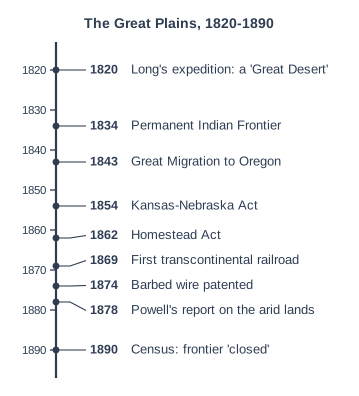
Study Figure 1, a timeline of events affecting the Great Plains between 1820 and 1890. In what ways did American attitudes to the Great Plains change between 1820 and 1890? Explain your answer.

Vertical timeline titled "The Great Plains, 1820-1890", running from 1815 at the top to 1895 at the bottom, with the years marked every 10 years (1820 to 1890). Events marked by dots on the line, in date order: 1820: Long's expedition: a 'Great Desert'; 1834: Permanent Indian Frontier; 1843: Great Migration to Oregon; 1854: Kansas-Nebraska Act; 1862: Homestead Act; 1869: First transcontinental railroad; 1874: Barbed wire patented; 1878: Powell's report on the arid lands; 1890: Census: frontier 'closed'.

Model answer

In the 1820s and 1830s most Americans saw the Great Plains as a worthless desert. Stephen Long's expedition of 1820 called the region almost wholly unfit for cultivation, and maps and school books labelled it the Great American Desert. As the timeline shows, in 1834 the government made the land west of the Permanent Indian Frontier into Indian Country: the Plains were seen as a barrier and a place for Native Americans, not for white farmers.

In the 1840s the Plains came to be seen as an obstacle to cross. From the Great Migration of 1843 thousands of emigrants travelled the Oregon Trail, but their goal was the fertile land of Oregon and California, and guidebooks told them to cross the Plains as quickly as possible.

In the 1850s and 1860s attitudes began to change, because Americans now wanted the land for settlement and for railroads to the Pacific. The Kansas-Nebraska Act of 1854 opened the eastern Plains to settlers, and the Homestead Act of 1862 offered 160 acres free to settlers who lived on and farmed the land for five years. The government now actively encouraged settlement, and after the first transcontinental railroad was completed in 1869 railroad companies advertised the Plains as a 'garden'.

By the 1870s and 1880s new technology, such as barbed wire (patented in 1874), wind pumps and hardy Turkey Red wheat, made farming possible, and some people even claimed that 'rain follows the plough'. However, there was some continuity: in 1878 John Wesley Powell warned that the land west of the 100th meridian was arid and could only be farmed with irrigation and larger farms, and droughts in the late 1880s ruined many homesteaders.

So attitudes changed from seeing the Plains as a desert for Native Americans, to an obstacle, to a land of opportunity for farmers - and in 1890 the Census Bureau declared that the frontier of settlement had closed.

Explanation

Attitudes moved from 'desert and Indian land' (1820s-1830s) to 'obstacle to cross' (1840s) to 'land to be settled' (1850s-1860s) to 'farming region' (1870s-1880s), with some continuing doubts about the driest areas. Level 4 explains several changes with specific knowledge and links them (for example, to government laws, railroads and technology); listing the events on the timeline is Level 1.

Mark scheme
  1. 8 marks

    Levels of response (8 marks).
    Level 4 (7-8 marks): Complex explanation of several changes in attitude, each developed with specific knowledge and linked, e.g. explains the change from seeing the Plains as a worthless desert and Indian land (1820s-1830s), to an obstacle to be crossed (1840s), to land the government wanted settled (Kansas-Nebraska Act 1854, Homestead Act 1862) and finally a farming region made possible by railroads and new technology (1870s-1880s), and may note continuity, such as continuing doubts about the dry western Plains.
    Level 3 (5-6 marks): Developed explanation of two or more changes, supported by specific knowledge.
    Level 2 (3-4 marks): Simple explanation of one change, e.g. explains that the Plains were first seen as a desert but later farmed.
    Level 1 (1-2 marks): Basic explanation: general statements or a list of the events on the timeline with little explanation.
    0 marks: nothing worthy of credit.

    Indicative content (not a checklist; credit other valid points): 1820s-1830s - a worthless desert: Stephen Long's expedition (1820) called it almost wholly unfit for cultivation; maps and school books showed the Great American Desert; the Plains were seen as a barrier and a place for Native Americans (Indian Removal Act 1830, Permanent Indian Frontier 1834). 1840s - an obstacle to cross: the Great Migration of 1843 and later emigrants crossed to Oregon and California; guidebooks advised crossing quickly. 1850s - land for settlement and railroads: the Fort Laramie Treaty (1851) began concentration; the Kansas-Nebraska Act (1854) opened Kansas and Nebraska to white settlers. 1860s - the government actively encouraged settlement: the Homestead Act (1862) offered 160 acres free to settlers who lived on and farmed the land for five years; the Pacific Railroad Act (1862); the first transcontinental railroad (1869); railroad companies advertised the Plains as a 'garden'. 1870s-1880s - a farming region: steel ploughs, wind pumps, barbed wire (patented by Joseph Glidden in 1874), Turkey Red wheat (1874), dry farming; wetter years encouraged the belief that 'rain follows the plough'. Continuity: John Wesley Powell's report (1878) warned that land west of about the 100th meridian was arid and needed irrigation and larger farms; droughts in the late 1880s ruined many homesteaders. 1890: the Census Bureau declared the frontier of settlement closed. Attitudes to the Plains nations also changed, from leaving them the Plains to confining them on reservations.

Question 4

12 marks

Which of the following was the more important consequence of the belief that the Great Plains were a 'Great American Desert':
- the US government's decision to use the Plains as land for Native Americans
- emigrants crossing the Plains to Oregon and California instead of settling on them?
Explain your answer with reference to both bullet points.

Model answer

The belief that the Plains were a desert led the government to treat them as land for Native Americans. If white farmers would never want the land, it seemed a convenient place to send eastern nations who stood in the way of settlement. Under the Indian Removal Act of 1830, nations such as the Cherokee, Creek, Choctaw, Chickasaw and Seminole were forced to move to Indian Territory; thousands died, especially on the Cherokee 'Trail of Tears' of 1838-1839. In 1834 the Indian Intercourse Act declared the land west of Missouri and Arkansas to be Indian Country behind the Permanent Indian Frontier, guarded by forts such as Fort Leavenworth. For a time this left the Plains nations largely free to follow their buffalo-hunting way of life.

The same belief led emigrants to cross the Plains to Oregon and California instead of settling on them. From the Great Migration of 1843 thousands of farming families travelled the Oregon Trail to the fertile Willamette Valley, and after gold was found in 1848 hundreds of thousands went to California. This had huge effects: American settlers in Oregon strengthened the US claim against Britain, leading to the Oregon Treaty of 1846, and California's population grew so fast that it became a state in 1850. The traffic along the trails also disturbed the buffalo and spread disease among the Plains nations, which led to conflict and the Fort Laramie Treaty of 1851.

The emigration across the Plains was the more important consequence because it transformed the nation and in the end destroyed the government's policy. By settling on the Pacific coast, emigrants helped make the USA a nation stretching from sea to sea within a few years, as believers in Manifest Destiny wanted. Their crossings also showed that Indian Country could not stay closed: the government soon needed safe routes, forts and eventually a railroad across the Plains, so it gave up the idea of a permanent frontier, moving towards concentration in 1851 and opening Kansas and Nebraska in 1854. The removal policy was devastating for the eastern nations and shaped relations for years, but it rested on an assumption - that the Plains would always be left alone - that the emigrants themselves helped to overturn. In that sense the emigrants' journeys mattered more, because they set off the chain of events that drew American settlement back onto the Plains and ended the Plains nations' independence.

Explanation

The 'desert' belief made the Plains a place to put Native Americans (Indian Removal, the Permanent Indian Frontier) and a place to cross on the way to the Pacific coast. Level 4 explains both consequences with specific knowledge and reaches a sustained judgement, for example by showing how the emigrants' crossings undermined the government's 'permanent' frontier.

Mark scheme
  1. 12 marks

    Levels of response (12 marks).
    Level 4 (10-12 marks): Complex explanation of both bullet points: explains with specific knowledge the effects of using the Plains as Indian land (Indian Removal, the Permanent Indian Frontier) and of emigrants crossing to Oregon and California (settlement of the Pacific coast, the Oregon Treaty, California statehood, pressure on the Plains nations), showing how the two were linked and reaching a sustained judgement about which consequence was more important.
    Level 3 (7-9 marks): Developed explanation of both bullet points, supported by specific knowledge; a judgement may be given but is not fully sustained.
    Level 2 (4-6 marks): Simple explanation of one or both bullet points, with some knowledge.
    Level 1 (1-3 marks): Basic explanation of one or both bullet points, with general knowledge.
    0 marks: nothing worthy of credit.

    Indicative content (not a checklist; credit other valid points): Land for Native Americans: the Indian Removal Act (1830, President Andrew Jackson) moved the Cherokee, Creek, Choctaw, Chickasaw, Seminole and others to Indian Territory; thousands died, especially on the Cherokee 'Trail of Tears' (1838-1839); the Indian Intercourse Act (1834) created Indian Country behind the Permanent Indian Frontier, guarded by forts such as Fort Leavenworth; the Plains nations were largely left alone in the 1830s; the policy shaped US-Native American relations, but it was temporary - concentration (Fort Laramie Treaty 1851), the Kansas-Nebraska Act (1854) and later reservations replaced it. Emigrants crossing: the Great Migration of 1843 (about 1,000 people) and thousands more to Oregon's Willamette Valley; American settlers strengthened the US claim against Britain, leading to the Oregon Treaty (1846, 49th parallel); after gold was found in 1848 hundreds of thousands went to California, which became a state in 1850; the Mormons reached the Great Basin in 1847; the USA became a nation stretching from sea to sea; trail traffic disturbed the buffalo, used up grass and timber along the Platte and spread cholera (1849) among the Plains nations, leading to conflict and the Fort Laramie Treaty (1851); Pacific settlement created demand for a transcontinental railroad (completed 1869) across the Plains. Judgement: emigration more important because it transformed the nation and broke down the policy of a permanent Indian frontier; or the government's policy more important because of its devastating human cost for tens of thousands of Native Americans and because it set the pattern of moving Native Americans onto land white Americans did not yet want.

Ready to try the rest? Every answer you write is marked against the mark scheme, so you can see exactly where the marks are.

AI Tutor Hints first, answers after you try

Hi! Stuck? Ask me for a hint and I’ll help you work it out. Once you’ve checked your answer I can explain exactly where the marks are.