Level:
Correct: 0
Incorrect: 0
Marks: 0/0
Exam Practice
Subject:
Topics:
Avg
score:
–
Topics
done:
0/9

Increasing conflict on the Plains

Practise 44 exam-style questions on Increasing conflict on the Plains for AQA GCSE History (America 1840-1895). Write your answer as you would in the exam and get it marked in seconds against the mark scheme, point by point, with an AI tutor on hand if you get stuck.

  • 44 questions
  • 1–12 marks each
  • Instant marking
  • No sign-up needed
20 questions, marked as you go

Sample questions with model answers

Here are 4 of the questions in this topic, each with a model answer, an explanation of why it earns the marks and the mark scheme an examiner would use.

Question 1

2 marks

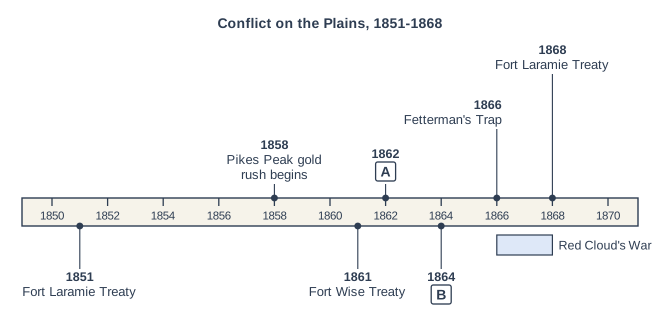
Figure 1 is a timeline of conflict on the Plains, 1851-1868.

Name the events marked A and B. A was a rising by Plains Indians in August 1862; B was an attack on a Cheyenne and Arapaho camp in November 1864.

Horizontal timeline titled "Conflict on the Plains, 1851-1868", running from 1850 on the left to 1870 on the right, with the years marked every 2 years (1850 to 1870). Events marked by dots on the line, in date order: 1851: Fort Laramie Treaty; 1858: Pikes Peak gold rush begins; 1861: Fort Wise Treaty; 1862: label A; 1864: label B; 1866: Fetterman's Trap; 1868: Fort Laramie Treaty. Periods shown as bars below the line, each bar as long as the period: Red Cloud's War (1866 to 1868).

Model answer

A is the Santee (Dakota) Sioux rising in Minnesota in 1862 (Little Crow's War). B is the Sand Creek Massacre (29 November 1864).

Explanation

The Indian Wars of 1862-1867 included the Dakota rising in Minnesota (1862), the war in Colorado that ended in the Sand Creek Massacre (1864), and Red Cloud's War (1866-1868), which included Fetterman's Trap.

Mark scheme
  1. 1 mark

    A: the Santee (Dakota) Sioux rising in Minnesota / Little Crow's War.

    Accept: the Minnesota uprising; the Dakota War; the Santee Sioux rebellion; Little Crow's rising.

  2. 1 mark

    B: the Sand Creek Massacre.

    Accept: Sand Creek; the attack on Black Kettle's camp at Sand Creek. Do not accept: Fetterman's Trap; the Battle of the Washita (1868).

Question 2

4 marks

Describe two problems the Pikes Peak gold rush of 1858-1859 caused for the Cheyenne and Arapaho.

Model answer

One problem was that the gold seekers took over land that had been promised to the tribes. The Fort Laramie Treaty of 1851 had given the Cheyenne and Arapaho the land between the North Platte and the Arkansas rivers, but in 1858-59 perhaps 100,000 prospectors rushed into it, and towns such as Denver were built on Indian camping grounds. The government did nothing to remove them. Instead, in the Fort Wise Treaty of 1861, some chiefs were pressed into giving up most of their land in exchange for a small reservation at Sand Creek, which many Cheyenne refused to accept.

A second problem was the damage to their food supply. The miners and travellers cut down the trees along the rivers, used up the grass and water and killed or drove away the buffalo and other game. This made it harder for the Cheyenne and Arapaho to feed themselves, and growing hunger and anger led to raids and the Colorado war of 1864.

Explanation

The Pikes Peak gold rush broke the 1851 settlement: prospectors and towns occupied Cheyenne and Arapaho land, damaged their hunting, and led to the Fort Wise Treaty. Level 2 needs two problems, each developed with specific detail.

Mark scheme
  1. 4 marks

    Levels of response (4 marks).
    Level 2 (3-4 marks): Knowledge and understanding of two developed problems, each supported by specific, accurate detail (e.g. prospectors and new towns such as Denver occupying land guaranteed to the tribes in 1851; the loss of most of their land in the Fort Wise Treaty of 1861).
    Level 1 (1-2 marks): Knowledge of one or two problems, simply stated (e.g. 'miners took their land').
    0 marks: nothing worthy of credit.

    Indicative content (not a checklist; credit other valid points): Perhaps 100,000 prospectors ('Pikes Peak or Bust') crossed or settled on land between the North Platte and the Arkansas rivers that the Fort Laramie Treaty (1851) had guaranteed to the Cheyenne and Arapaho, and the government did not remove them. Towns such as Denver (founded 1858) were built on Indian camping grounds along Cherry Creek and the South Platte. Miners and travellers cut timber, used up grass and water along the river valleys and killed or drove away the game and buffalo, causing hunger. Colorado Territory was created in 1861, with settlers and leaders who wanted the Indians removed. The Fort Wise Treaty (1861) made some chiefs give up most of their land for a small reservation at Sand Creek, on poor land with little game, which divided the Cheyenne: many, including the Dog Soldiers, rejected it. Rising tension led to raids, the Colorado war of 1864 and the Sand Creek Massacre.

Question 3

8 marks

Interpretation A: from a history of the American West, written by an American historian in 1962. (Written for practice.)
'The policy of concentration failed above all because the Plains Indians could not, or would not, change their way of life. Their whole society was built on hunting the buffalo wherever the herds went, and on young men winning honour through raiding. No chief could promise that his warriors would stay inside lines drawn on a government map. Raids on wagon trains and between the tribes went on, and the soldiers were bound to respond.'

Interpretation B: from a history of relations between the United States and the Plains peoples, written by a historian in 2009. (Written for practice.)
'Concentration failed because the government would not keep its side of the bargain. The Senate cut the promised payments, agents cheated the tribes, and the goods often arrived late or rotten. Worst of all, when gold was found near Pikes Peak in 1858, nothing was done to keep prospectors out of land that had been guaranteed to the Cheyenne and Arapaho. Instead the tribes were pressed to give that land up. The Indians did not break the treaty; it was broken for them.'

Which interpretation gives the more convincing opinion about why the policy of concentration failed? Explain your answer based on your contextual knowledge and what it says in Interpretations A and B.

Model answer

Interpretation A argues that concentration failed because the Plains Indians would not change their way of life. There is some truth in this. The Plains peoples were nomadic buffalo hunters, and boundaries drawn in 1851 cut across the way they had always followed the herds. The government insisted on dealing with head chiefs, but Plains bands were independent, and young men won honour by raiding, so no chief could guarantee peace. Raids between tribes, and by groups such as the Cheyenne Dog Soldiers, did continue. However, A blames only the Indians and ignores the many ways the treaty was broken by the other side.

Interpretation B argues that the government broke the treaty, and my knowledge strongly supports this. The Senate cut the annuities from 50 years to 10, and goods were often late, poor or stolen by corrupt agents. When the Pikes Peak gold rush brought perhaps 100,000 prospectors into land guaranteed to the Cheyenne and Arapaho in 1858-59, the government did not protect the tribes as promised; Denver was built on their land, and in the Fort Wise Treaty of 1861 some chiefs were pressed to give most of it up. B is weaker in suggesting the Indians played no part, because raids did happen.

Overall, B is more convincing. A identifies a real weakness in the policy, but the decisive reason it collapsed was the government's choice to allow the gold rush and then rewrite the treaty in the settlers' favour at Fort Wise. The Indians' way of life made concentration difficult; the government's actions made it impossible.

Explanation

A good answer tests both interpretations against knowledge: chiefs' limited authority and nomadic hunting (for A), and cut annuities, corrupt agents, Pikes Peak and Fort Wise (for B). Level 4 needs both evaluated and a sustained judgement about which is more convincing, not just a description of each.

Mark scheme
  1. 8 marks

    Levels of response (8 marks).
    Level 4 (7-8 marks): Complex evaluation of both interpretations, testing each against accurate contextual knowledge, leading to a sustained judgement about which is more convincing about why concentration failed (e.g. B is more convincing because the Pikes Peak gold rush and the Fort Wise Treaty show the government breaking the treaty, though A is right that chiefs could not control all their warriors).
    Level 3 (5-6 marks): Developed evaluation of both interpretations, using relevant contextual knowledge to test what each says.
    Level 2 (3-4 marks): Simple evaluation of one interpretation, using some relevant contextual knowledge.
    Level 1 (1-2 marks): Basic analysis of one or both interpretations, e.g. paraphrase or assertion without contextual knowledge.
    0 marks: nothing worthy of credit.

    Indicative content (not a checklist; credit other valid points): Support for A: Plains peoples were nomadic buffalo hunters and the boundaries of 1851 cut across this way of life; the government insisted on head chiefs, but bands were independent and young men gained honour through raiding and counting coup; intertribal raiding continued (e.g. Lakota against Crow and Pawnee); some young Cheyenne (the Dog Soldiers) raided settlements and the Platte road. Limits of A: it blames only the Indians and ignores the government's broken promises and the gold rush; violence often began with white actions (e.g. the Grattan incident, 1854; Harney's attack, 1855). Support for B: the Senate cut annuities from 50 years to 10; corrupt agents and traders stole or sold goods; the Pikes Peak gold rush (1858-59) brought perhaps 100,000 prospectors into land guaranteed to the Cheyenne and Arapaho and Denver was built there; the government promised protection but did nothing; the Fort Wise Treaty (1861) took most of their land. Limits of B: it ignores Indian raids and the difficulty any government faced in controlling thousands of migrants; some failures came from misunderstanding on both sides. Possible judgement: B is more convincing because the decisive collapse came when the government allowed the gold rush and rewrote the treaty at Fort Wise; A identifies a real weakness but not the main cause.

Question 4

12 marks

Which of the following was the more important reason why Captain Fetterman's command was destroyed in December 1866:
- Fetterman's own mistakes
- the tactics of Red Cloud and his allies?
Explain your answer with reference to both bullet points.

Model answer

Fetterman's own mistakes were an important reason for the disaster. He was a Civil War veteran who had little experience of fighting on the Plains, and he had contempt for the Lakota as fighters; he is reported to have boasted that with 80 men he could ride through the whole Sioux nation, and he criticised Colonel Carrington for being too cautious. On 21 December 1866 he was sent out of Fort Phil Kearny to relieve a wood train under attack. According to Carrington, his orders were not to pursue beyond Lodge Trail Ridge, but he followed a small group of warriors over the ridge, and his cavalry and infantry became separated. With only about 80 men, he was badly exposed once he left the protection of the fort.

However, the tactics of Red Cloud and his allies were also crucial. Red Cloud had united Lakota, Cheyenne and Arapaho warriors against the Bozeman Trail forts, and for months they had attacked wood trains and travellers, learning exactly how the soldiers reacted. A skirmish earlier in December had shown that soldiers would chase decoys. On 21 December a decoy party, traditionally said to include Crazy Horse, attacked the wood train and then pretended to retreat, while perhaps 1,500-2,000 warriors waited hidden beyond the ridge. Once the soldiers crossed, they were surrounded and all 81 were killed, probably in less than an hour.

Overall, the tactics of Red Cloud and his allies were the more important reason. Fetterman's overconfidence made the trap easier to spring, but the plan was designed precisely to draw out an overconfident officer, and it had been prepared over weeks. The numbers involved meant that any force of 80 men that crossed the ridge would probably have been destroyed. Some historians also argue that the evidence of Fetterman's disobedience came mainly from Carrington, who had reasons to blame him. Fetterman made the mistake, but it was the skill and planning of the Lakota and their allies that turned a mistake into a total defeat.

Explanation

Fetterman's overconfidence and (probable) disobedience combined with a carefully planned decoy and ambush by perhaps 1,500-2,000 warriors. Level 4 needs both bullets explained with specific detail and a sustained judgement, for example that the plan was built to exploit rash officers.

Mark scheme
  1. 12 marks

    Levels of response (12 marks).
    Level 4 (10-12 marks): Complex explanation of both bullet points, leading to a sustained judgement about which was the more important reason why Fetterman's command was destroyed (e.g. arguing that the decoy and ambush were designed to exploit exactly the overconfidence Fetterman showed), supported by specific, accurate knowledge.
    Level 3 (7-9 marks): Developed explanation of both bullet points, with specific knowledge, but the judgement is missing, unsupported or not sustained.
    Level 2 (4-6 marks): Simple explanation of one or both bullet points.
    Level 1 (1-3 marks): Basic explanation of one or both bullet points, e.g. general statements.
    0 marks: nothing worthy of credit.

    Indicative content (not a checklist; credit other valid points): Fetterman's mistakes: a Civil War veteran with little experience of Plains warfare, contemptuous of Indian fighters; reportedly boasted that with 80 men he could ride through the Sioux nation; criticised Carrington's caution; on 21 December 1866 he was sent to relieve the wood train with orders (as Carrington reported them) not to pursue beyond Lodge Trail Ridge; he followed the decoys over the ridge; his cavalry and infantry became separated; his force of about 80 was far too small. (Credit awareness that historians debate how far he disobeyed, as Carrington's supporters had reason to blame him.) Red Cloud and his allies: Red Cloud (Oglala Lakota) united Lakota, Cheyenne and Arapaho warriors against the Bozeman Trail forts from 1866; months of attacks on wood trains and travellers taught them how the soldiers reacted; an earlier skirmish on 6 December 1866 had shown that soldiers would chase decoys; a decoy party, traditionally said to include Crazy Horse, pretended to retreat; perhaps 1,500-2,000 warriors hid beyond the ridge; the soldiers were surrounded and all 81 killed, probably in under an hour. Other factors (credit if linked): poor weapons (old muzzle-loaders), few soldiers and little ammunition at Fort Phil Kearny, government underestimation of the Lakota. Possible judgements: the tactics were more important because the trap was planned to exploit any rash officer and the numbers made escape impossible; or Fetterman's mistakes were more important because without crossing the ridge the trap could not have worked; or linked.

Ready to try the rest? Every answer you write is marked against the mark scheme, so you can see exactly where the marks are.

AI Tutor Hints first, answers after you try

Hi! Stuck? Ask me for a hint and I’ll help you work it out. Once you’ve checked your answer I can explain exactly where the marks are.