Level:
Correct: 0
Incorrect: 0
Marks: 0/0
Exam Practice
Subject:
Topics:
Avg
score:
–
Topics
done:
0/9

The aftermath of the American Civil War

Practise 44 exam-style questions on The aftermath of the American Civil War for AQA GCSE History (America 1840-1895). Write your answer as you would in the exam and get it marked in seconds against the mark scheme, point by point, with an AI tutor on hand if you get stuck.

  • 44 questions
  • 1–12 marks each
  • Instant marking
  • No sign-up needed
20 questions, marked as you go

Sample questions with model answers

Here are 4 of the questions in this topic, each with a model answer, an explanation of why it earns the marks and the mark scheme an examiner would use.

Question 1

2 marks

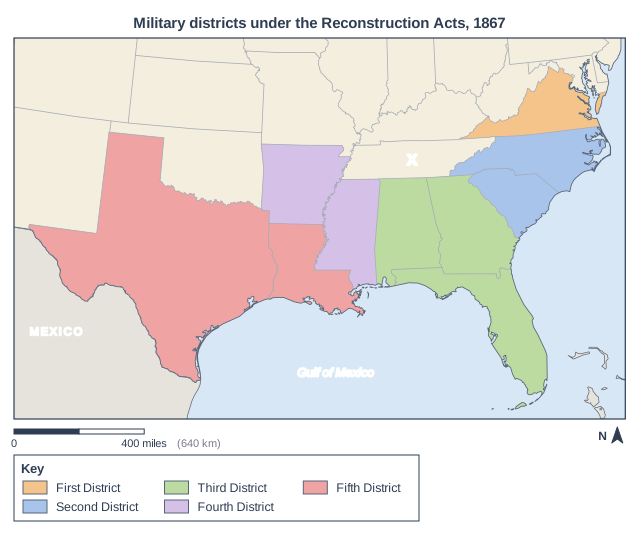
Figure 1 shows the five military districts set up in the South by the Reconstruction Acts of 1867.

Name the former Confederate state marked X, which was not placed in a military district, and explain why it was left out.

Map of the southern and south-eastern United States, titled "Military districts under the Reconstruction Acts, 1867", showing modern state borders (thin grey lines). Land is pale buff, neighbouring countries pale grey, and the sea and lakes pale blue; the borders are today's, not those of the time; a north arrow shows north at the top; the scale bar is 400 miles (640 km) long. Also named on the map: Mexico and the Gulf of Mexico. States shaded pale orange (key: "First District"): Virginia. States shaded pale blue (key: "Second District"): North Carolina and South Carolina. States shaded pale green (key: "Third District"): Georgia, Alabama and Florida. States shaded pale purple (key: "Fourth District"): Mississippi and Arkansas. States shaded pale red (key: "Fifth District"): Louisiana and Texas. The letter X is printed on a state near the centre of the map (about 65% of the way across and 35% of the way down). The key (below the map) shows: "First District", "Second District", "Third District", "Fourth District" and "Fifth District".

Model answer

X is Tennessee. It was left out because it had ratified the 14th Amendment and been readmitted to the Union in 1866.

Explanation

Tennessee, President Johnson's home state, ratified the 14th Amendment in July 1866 and was readmitted to Congress that month. The other ten former Confederate states refused to ratify it, so the Reconstruction Acts placed them under military rule in five districts.

Mark scheme
  1. 1 mark

    X: Tennessee

  2. 1 mark

    It had already been readmitted to the Union (in 1866) after ratifying the 14th Amendment

    Accept 'it had ratified the 14th Amendment' or 'it had already rejoined the Union'. Do not accept 'it had not joined the Confederacy' (it had).

Question 2

4 marks

Describe two features of the Reconstruction Acts passed by Congress in 1867.

Model answer

One feature of the Reconstruction Acts was military rule. Passed in March 1867 over President Johnson's veto, they divided the ten former Confederate states that had not been readmitted, every one except Tennessee, into five military districts. Each district was commanded by a Union general with troops, whose job was to keep order, protect freed people and supervise the creation of new state governments.

A second feature was the conditions a state had to meet to rejoin the Union. Each state had to hold a convention elected by all adult men, including Black men, and write a new constitution that guaranteed Black men the vote. It then had to ratify the 14th Amendment before Congress would readmit it. Former Confederate leaders barred from office by the 14th Amendment could not vote for these conventions, so for the first time Black men voted in large numbers.

Explanation

The Reconstruction Acts (1867) put ten Southern states under military rule in five districts and required new constitutions with Black male suffrage and ratification of the 14th Amendment before readmission. Level 2 needs two features each developed with precise detail.

Mark scheme
  1. 4 marks

    Levels of response (4 marks).
    Level 2 (3-4 marks): Knowledge and understanding of two features of the Reconstruction Acts, each developed with specific, accurate detail, e.g. the division of ten former Confederate states into five military districts under army generals, or the requirement that states write new constitutions giving Black men the vote and ratify the 14th Amendment before readmission. One developed and one simple feature: 3 marks.
    Level 1 (1-2 marks): Knowledge of one or two features, simply stated, e.g. 'the South was put under the army'.
    0 marks: nothing worthy of credit.

    Indicative content (not a checklist; credit other valid points): The first Reconstruction Act was passed in March 1867 over President Johnson's veto, after Republicans won two-thirds majorities in the 1866 elections; further Acts followed in 1867-68. Military rule: the ten former Confederate states that had not been readmitted (all except Tennessee) were divided into five military districts, each commanded by a Union general with troops to keep order and protect freed people. Conditions for readmission: each state had to hold a convention elected by all adult men, including Black men, write a new constitution guaranteeing Black men the vote, and ratify the 14th Amendment; Congress then had to approve. Former Confederate leaders who were barred from office by the 14th Amendment could not vote for the conventions. The army registered voters, and Black men voted in large numbers for the first time. Results: seven states were readmitted in 1868 and the last (Virginia, Mississippi, Texas and Georgia) in 1870; the Acts marked the start of 'Radical' or Congressional Reconstruction and a great increase in federal power over the states.

Question 3

8 marks

In what ways were the lives of African Americans in the South affected by Reconstruction, 1866-1877?

Explain your answer.

Model answer

One way African Americans' lives were affected was that they gained political rights for the first time. The Reconstruction Acts of 1867 gave Black men in the South the vote, and the 15th Amendment of 1870 protected it across the nation. About 2,000 African Americans held public office during Reconstruction, from local sheriffs to members of Congress; Hiram Revels of Mississippi became the first Black US senator in 1870, and Black men formed a majority in South Carolina's lower house. People who had been enslaved only a few years earlier now helped make the laws.

A second way was through education and community life. The Freedmen's Bureau and Northern missionary societies opened schools, and the Reconstruction governments created the South's first state public school systems; colleges such as Fisk and Howard were founded. Freed people built their own churches, which became the centre of community life, and reunited families separated by slavery.

However, economic change was limited, and this was linked to their vulnerability. The promise of 'forty acres and a mule' was broken when Johnson returned confiscated land to its former owners, so most freed people became sharecroppers, farming a white landowner's land for a share of the crop and often falling into debt. Without economic independence, they were exposed to pressure and violence. The Ku Klux Klan murdered and beat Black voters and burned schools and churches; federal laws in 1870-71 weakened the Klan, but other groups such as the White League used terror in the mid-1870s. By 1877, as Democrats regained control of the Southern states, many of the political gains of Reconstruction were being taken away.

Explanation

Reconstruction brought African Americans the vote, office-holding, schools and churches, but little land, so most became sharecroppers, and Klan violence undermined their gains before 1877. Level 4 needs several developed and linked ways, and strong answers show how economic weakness and violence limited the political gains.

Mark scheme
  1. 8 marks

    Levels of response (8 marks).
    Level 4 (7-8 marks): Complex explanation of several ways in which African Americans' lives were affected, each developed with specific knowledge and linked, e.g. new political rights (voting from 1867, about 2,000 Black office-holders, Hiram Revels in the Senate), new educational opportunities (Freedmen's Bureau schools, public school systems, colleges), limited economic change (sharecropping and debt instead of land) and violence from the Ku Klux Klan; may show how gains were undermined by 1877.
    Level 3 (5-6 marks): Developed explanation of two or more ways, supported by relevant knowledge.
    Level 2 (3-4 marks): Simple explanation of one way, or several stated with little support.
    Level 1 (1-2 marks): Basic explanation: general statements with little specific knowledge.
    0 marks: nothing worthy of credit.

    Indicative content (not a checklist; credit other valid points): Political rights: the Reconstruction Acts (1867) gave Black men the vote in the South and the 15th Amendment (1870) protected it nationally; about 2,000 African Americans held public office at local, state and national level; 16 served in Congress, including Hiram Revels of Mississippi, the first Black senator (1870), and Blanche K. Bruce; Black men formed a majority in South Carolina's lower house. Education: the Freedmen's Bureau (1865) and Northern missionary societies set up schools; Reconstruction governments created the South's first state public school systems; colleges such as Fisk (1866) and Howard (1867) were founded; literacy rose. Community: independent Black churches grew and became centres of community life; families were reunited and marriages legalised. Economic life: 'forty acres and a mule' did not come - Johnson returned confiscated land to former owners - so most freed people became sharecroppers, renting land for a share of the crop, often trapped in debt by the crop-lien system; a minority bought land. Violence: the Ku Klux Klan (founded 1865-66 in Pulaski, Tennessee) murdered, beat and intimidated Black voters and burned schools and churches; the Enforcement Acts (1870-71) and the Ku Klux Klan Act (1871) weakened it, but groups such as the White League and Red Shirts used violence in the mid-1870s (Colfax Massacre, 1873). By 1877 Democrats had regained control of every Southern state and many gains were being reversed.

Question 4

12 marks

Which of the following was the more important reason why the Radical Republicans gained control of Reconstruction in 1866-67?

• President Johnson's own actions
• events in the South, such as the Black Codes and violence against African Americans

Explain your answer with reference to both bullet points.

Model answer

President Johnson's own actions played a large part in the Radicals' rise. In 1865 he pardoned many former Confederates and allowed Southern states back with few conditions. In 1866 he vetoed the bill to extend the Freedmen's Bureau and then the Civil Rights Act, measures that moderate Republicans, not just Radicals, had supported. This pushed the moderates towards the Radicals, and in April 1866 Congress overrode his veto of the Civil Rights Act. Johnson made things worse by attacking Republican leaders such as Thaddeus Stevens and Charles Sumner by name, by opposing the 14th Amendment, and by his 'Swing Around the Circle' speaking tour in 1866, where he traded insults with hecklers and looked undignified.

Events in the South were also very important. From late 1865 Southern states passed Black Codes that seemed to bring back slavery under another name, and they elected former Confederate leaders, including the Confederate vice-president Alexander Stephens, to Congress. Every Southern state except Tennessee refused to ratify the 14th Amendment. Most shocking of all were the riots of 1866: in May white mobs, including police, attacked Black residents of Memphis, and in July a meeting of Black and white Republicans in New Orleans was attacked; dozens of African Americans were killed in each. To many Northerners, it seemed that the South had learned nothing from defeat.

Overall, events in the South were the more important reason. Johnson's behaviour was unwise, but what made Northern voters turn against him was the evidence that his policy was failing: the Black Codes, the return of Confederate leaders and the killings in Memphis and New Orleans. These events turned the November 1866 elections into a verdict on Johnson's Reconstruction, and the Republicans won more than two-thirds of both houses of Congress. With veto-proof majorities, Congress passed the Reconstruction Acts in March 1867. Johnson's actions made the defeat worse, but events in the South gave the Radicals their case.

Explanation

Johnson's vetoes, attacks on Republicans and disastrous 1866 tour alienated moderates, while the Black Codes, the election of former Confederates and the Memphis and New Orleans riots convinced Northern voters his policy had failed, giving Republicans veto-proof majorities in 1866. Level 4 needs a sustained judgement linking the factors to the 1866 elections and the Reconstruction Acts.

Mark scheme
  1. 12 marks

    Levels of response (12 marks).
    Level 4 (10-12 marks): Complex explanation of both bullet points leading to a sustained judgement about which was more important, e.g. weighing how Johnson's vetoes, his attacks on Republican leaders, his opposition to the 14th Amendment and his disastrous 1866 speaking tour alienated moderate Republicans and Northern voters, against how the Black Codes, the election of former Confederates and the Memphis and New Orleans riots of 1866 convinced the North that the South was unrepentant; explaining how the 1866 elections gave Republicans the two-thirds majorities needed to pass the Reconstruction Acts. Supported throughout by specific, accurate knowledge.
    Level 3 (7-9 marks): Developed explanation of both bullet points with relevant knowledge; a judgement may be given but is not sustained.
    Level 2 (4-6 marks): Simple explanation of one or both bullet points, often descriptive.
    Level 1 (1-3 marks): Basic explanation with little relevant knowledge.
    0 marks: nothing worthy of credit.

    Indicative content (not a checklist; credit other valid points): Johnson's actions: his lenient pardons and quick restoration of Southern states in 1865; his veto of the Freedmen's Bureau Bill (February 1866) and the Civil Rights Act (March 1866) - moderate Republicans, not just Radicals, had supported these, so the vetoes pushed moderates towards the Radicals, and Congress overrode the Civil Rights Act veto in April 1866; in a speech in February 1866 he attacked Republican leaders such as Thaddeus Stevens and Charles Sumner by name; he opposed the 14th Amendment and urged Southern states to reject it; his 'Swing Around the Circle' speaking tour (August-September 1866) saw him trading insults with hecklers, which damaged his reputation. Events in the South: the Black Codes (from late 1865) seemed to restore slavery in another form; Southern voters elected former Confederate leaders such as Alexander Stephens to Congress; every Southern state except Tennessee refused to ratify the 14th Amendment; in May 1866 white mobs, including police, attacked Black residents in Memphis, and in July 1866 a meeting of Black and white Republicans in New Orleans was attacked, with dozens of African Americans killed in each riot. Outcome: in the November 1866 elections Republicans won more than two-thirds of both houses, enough to override vetoes; Congress passed the Reconstruction Acts (March 1867), placing the South under military rule. Possible judgements: events in the South were more important because they convinced Northern voters that Johnson's policy had failed; or Johnson's actions were more important because his refusal to compromise turned moderates against him and made the 1866 election a vote on his leadership.

Ready to try the rest? Every answer you write is marked against the mark scheme, so you can see exactly where the marks are.

AI Tutor Hints first, answers after you try

Hi! Stuck? Ask me for a hint and I’ll help you work it out. Once you’ve checked your answer I can explain exactly where the marks are.