Practise 20 exam-style questions on Types of feedback for OCR GCSE Physical Education (Paper 2). Write your answer as you would in the exam and get it marked in seconds against the mark scheme, point by point, with the Study Helper on hand if you get stuck.
20 questions
1–6 marks each
Instant marking
No sign-up needed
20 questions, marked as you go
Sample questions with model answers
Here are 4 of the questions in this topic, each with a model answer, an explanation of why it earns the marks and the mark scheme an examiner would use.
Question 1
1 mark
Which statement about feedback is true?
A Intrinsic feedback comes from a coach or teammate. B Knowledge of results is information about the outcome of a performance. C Negative feedback should never be given to a performer. D Beginners rely mostly on intrinsic feedback.
Choose your answer.
A
B
C
D
Model answer
B
Explanation
Knowledge of results tells a performer the outcome, such as a score or a time. Intrinsic feedback comes from within the performer, not from a coach. Negative feedback is useful because it identifies errors to correct. Beginners rely mostly on extrinsic feedback because they cannot yet feel whether a movement is correct.
Mark scheme
1 mark
B / Knowledge of results is information about the outcome of a performance
Accept the letter or the statement written out. If more than one option is given, 0 marks.
Question 2
2 marks
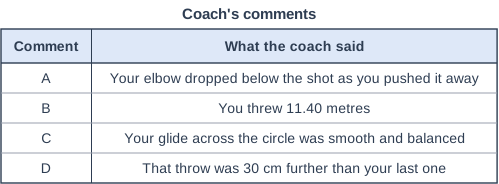
The table shows four comments a coach made to a shot putter during a training session.
Identify the two comments that give knowledge of results.
Model answer
B and D.
Explanation
B and D give the outcome of the throw - its distance - so they are knowledge of results. A and C describe how the throw was performed (the elbow position and the glide), so they are knowledge of performance. Ask yourself: is this about the result, or about the technique?
Mark scheme
1 mark
B / 'You threw 11.40 metres'
Mark the first two answers only. Accept the letter or the comment.
1 mark
D / 'That throw was 30 cm further than your last one'
Question 3
2 marks
During a downhill ski race, a skier cannot receive any feedback from her coach.
Explain how intrinsic feedback could help her during the race.
Model answer
Intrinsic feedback lets the skier feel her body position, for example that she is leaning too far back on a turn. She can then correct it immediately, keeping her balance and speed, without waiting for her coach.
Explanation
Intrinsic feedback comes from the feel of the movement. In a fast race where no coach can help, being able to sense and correct errors straight away is essential. Experienced performers have the kinaesthetic awareness to do this; beginners usually do not.
Mark scheme
1 mark
She can feel her body position / balance / the movement (kinaesthesis), e.g. feel that she is leaning too far back
Max 2.
1 mark
So she can correct errors immediately / adjust her position straight away without waiting for the coach
1 mark
This helps her stay in control / keep her speed / avoid falling
Do not accept: 'she will win' on its own.
Question 4
4 marks
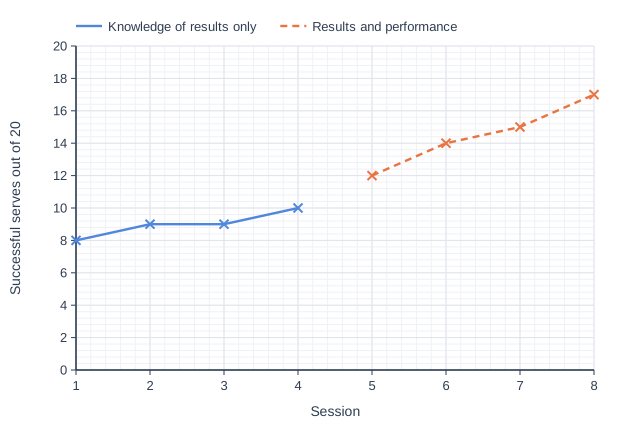
Zoe is learning the volleyball serve. In sessions 1 to 4 her coach only told her how many of her 20 serves landed in (knowledge of results). In sessions 5 to 8 the coach also told her what was wrong with her technique (knowledge of performance). The graph shows her results. (The data is invented.)
Analyse the data to evaluate the effect of adding knowledge of performance.
Model answer
Zoe improved slowly in sessions 1 to 4, from 8 to 10 successful serves. After knowledge of performance was added, she improved much faster, from 12 to 17. This suggests KP helped, because it told her what was wrong with her technique, such as her ball toss, so she knew what to correct, whereas knowledge of results only told her how many serves went in. However, she might have improved anyway with more practice, and this is only one player, so we cannot be sure KP caused all of the improvement.
Explanation
Quote the data for both phases (10 - 8 = 2 serves, then 17 - 12 = 5 serves), explain why knowledge of performance speeds up learning, and evaluate the evidence - more practice or one performer could explain some of the change. Describing the line without explaining it cannot reach full marks.
Mark scheme
1 mark
In sessions 1 to 4 she improved slowly, from 8 to 10 successful serves / by 2 serves
Max 4. Max 2 if no data is quoted.
1 mark
In sessions 5 to 8 she improved faster, from 12 to 17 successful serves / by 5 serves
Accept: from 10 in session 4 to 17 in session 8 / by 7 serves.
1 mark
Knowledge of performance tells her what is wrong with her technique (e.g. her ball toss or contact point), so she knows what to correct
1 mark
Knowledge of results only told her how many serves went in, not why they failed, so she could not correct her errors as easily
1 mark
Evaluation: other factors may explain the faster improvement, e.g. more practice / she would have improved anyway over time / only one performer was tested, so we cannot be certain
Ready to try the rest? Every answer you write is marked against the mark scheme, so you can see exactly where the marks are.
Ctrl + Enter to check
Study HelperHints first, answers after you try
Stuck on this one? Ask for a hint and I’ll point you in the right direction, without giving the answer away. Once you’ve checked your answer, I’ll show you how the marks are awarded.