
Level:
Correct: 0
Incorrect: 0
Marks: 0/0
Exam Practice
Course:
Topics:
Avg
score:
–
Topics
done:
0/14

Characteristics of skilful movement

Practise 18 exam-style questions on Characteristics of skilful movement for OCR GCSE Physical Education (Paper 2). Write your answer as you would in the exam and get it marked in seconds against the mark scheme, point by point, with the Study Helper on hand if you get stuck.

  • 18 questions
  • 1–6 marks each
  • Instant marking
  • No sign-up needed
18 questions, marked as you go

Sample questions with model answers

Here are 4 of the questions in this topic, each with a model answer, an explanation of why it earns the marks and the mark scheme an examiner would use.

Question 1

1 mark

Which of these is not a characteristic of skilful movement?

Choose your answer.

  • co-ordinated
  • pre-determined
  • powerful
  • fluent

Model answer

Powerful.

Explanation

The characteristics of skilful movement are efficient, pre-determined, co-ordinated, fluent and aesthetic. Power is a component of fitness, not a characteristic of skill - a performer can be very powerful but still unskilful. Mixing up fitness and skill is a common mistake.

Mark scheme
  1. 1 mark

    powerful

    Co-ordinated, pre-determined and fluent are all characteristics of skilful movement. If more than one option is given, 0 marks.
Question 2

2 marks

Using a practical example from rowing, explain why skilful movement is described as efficient.

Model answer

Skilful movement is efficient because it achieves its goal with no wasted energy or effort. A skilful rower places the blade in the water and takes it out cleanly, so all the effort of the stroke drives the boat forward and they do not tire too early in the race.

Explanation

Efficiency means getting the result with the least possible energy and no unnecessary movement. In rowing, a skilful stroke turns nearly all the rower's effort into forward movement, while a beginner splashes and wastes energy. Answers must link the example to saving energy or effort, not just say the rower is good or fast.

Mark scheme
  1. 1 mark

    there is no wasted energy / effort / movement / the goal is achieved with the minimum of energy or time

  2. 1 mark

    rowing example, e.g. the blade goes in and comes out of the water cleanly, so all the effort drives the boat forward / the rower's legs, back and arms work in sequence with no unnecessary movement / the rower keeps a steady, economical stroke so they do not tire early in a 2000 m race

    Example must be from rowing. Do not accept 'rows well' or 'is fast' with no reference to energy or effort - TV.

Question 3

3 marks

Identify three characteristics of skilful movement.

Model answer

Efficient, fluent and aesthetic.

Explanation

The five characteristics of skilful movement are efficient, pre-determined, co-ordinated, fluent and aesthetic. A useful way to remember them is to picture an elite performer: they use no wasted energy, know what they are aiming for, move their body parts in time, flow smoothly and look good. Fitness words such as 'powerful' or 'fast' are not characteristics of skill.

Mark scheme
  1. 1 mark

    efficient / efficiency

    Max 3 from points 1-5.

  2. 1 mark

    pre-determined

  3. 1 mark

    co-ordinated / co-ordination

  4. 1 mark

    fluent / fluency

  5. 1 mark

    aesthetic / aesthetically pleasing

    Do not accept terms that are not among these characteristics, e.g. powerful, fast, strong, fit. Mark the first three given.

Question 4

4 marks

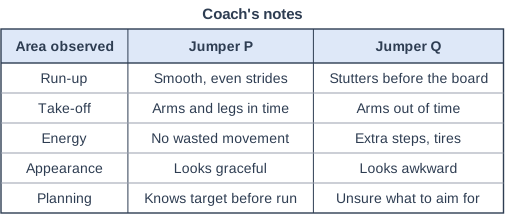
A coach made notes on two long jumpers, P and Q, during a competition. The table shows the coach's notes.

Using the table, identify which jumper shows more skilful movement. Explain your answer by referring to three characteristics of skilful movement.

Coach's notes. Table with columns "Area observed", "Jumper P", "Jumper Q". Area observed: Run-up; Jumper P: Smooth, even strides; Jumper Q: Stutters before the board | Area observed: Take-off; Jumper P: Arms and legs in time; Jumper Q: Arms out of time | Area observed: Energy; Jumper P: No wasted movement; Jumper Q: Extra steps, tires | Area observed: Appearance; Jumper P: Looks graceful; Jumper Q: Looks awkward | Area observed: Planning; Jumper P: Knows target before run; Jumper Q: Unsure what to aim for.

Model answer

Jumper P shows more skilful movement. P's run-up is fluent, because it is smooth with even strides, while Q stutters before the board. P is co-ordinated, because P's arms and legs are in time at take-off, whereas Q's arms are out of time. P is also efficient, with no wasted movement, while Q takes extra steps and tires.

Explanation

Each row of the table matches one characteristic: a smooth run-up shows fluency, arms and legs in time show co-ordination, no wasted movement shows efficiency, a graceful look is aesthetic and knowing the target is pre-determined. To score, name the characteristic and support it with the evidence. Students often give the evidence but forget to name the characteristic.

Mark scheme
  1. 1 mark

    Jumper P

  2. 1 mark

    fluent: P's run-up is smooth with even strides, whereas Q stutters before the board

    Max 3 from points 2-6. Each point needs the correct characteristic linked to evidence from the table. A characteristic named without evidence, or evidence with no (or the wrong) characteristic, scores 0.

  3. 1 mark

    co-ordinated: P's arms and legs are in time at take-off, whereas Q's arms are out of time

  4. 1 mark

    efficient: P has no wasted movement, whereas Q takes extra steps and tires

  5. 1 mark

    aesthetic: P looks graceful, whereas Q looks awkward

  6. 1 mark

    pre-determined: P knows the target before the run-up, whereas Q is unsure what to aim for

    Points 2-6 can be credited for the correct characteristic and evidence about P alone; the comparison with Q is not required.

Ready to try the rest? Every answer you write is marked against the mark scheme, so you can see exactly where the marks are.

Study Helper Hints first, answers after you try

Stuck on this one? Ask for a hint and I’ll point you in the right direction, without giving the answer away. Once you’ve checked your answer, I’ll show you how the marks are awarded.