Practise 24 exam-style questions on Health, fitness and well-being for OCR GCSE Physical Education (Paper 2). Write your answer as you would in the exam and get it marked in seconds against the mark scheme, point by point, with the Study Helper on hand if you get stuck.
24 questions
1–6 marks each
Instant marking
No sign-up needed
20 questions, marked as you go
Sample questions with model answers
Here are 4 of the questions in this topic, each with a model answer, an explanation of why it earns the marks and the mark scheme an examiner would use.
Question 1
1 mark
Which one of the following statements is true?
Choose your answer.
regular physical activity decreases bone density
a sedentary lifestyle increases the risk of Type 2 diabetes
A sedentary lifestyle increases the risk of Type 2 diabetes.
Explanation
A sedentary lifestyle involves little or no physical activity, which makes weight gain and obesity more likely and the body less able to control blood sugar, so the risk of Type 2 diabetes rises. Each wrong option reverses a real benefit of activity: it increases bone density, lowers blood pressure and helps posture.
Mark scheme
1 mark
a sedentary lifestyle increases the risk of Type 2 diabetes
The other three statements are false: physical activity increases bone density and lowers resting blood pressure, and a sedentary lifestyle tends to lead to poor posture. If more than one option is given, 0 marks.
Question 2
2 marks
Explain the link between a sedentary lifestyle, obesity and Type 2 diabetes.
Model answer
A sedentary person burns fewer calories than they eat, so the extra energy is stored as fat and they are more likely to become obese. Excess body fat makes it harder for the body to control blood sugar levels, which greatly increases the risk of Type 2 diabetes.
Explanation
The chain is: inactivity means energy in is greater than energy out, so fat is stored, leading to obesity; obesity makes it harder to control blood sugar, raising the risk of Type 2 diabetes. Each step needs explaining. Physical activity breaks the chain by using energy and helping to control blood sugar.
Mark scheme
1 mark
A sedentary person uses less energy / burns fewer calories than they take in, so the extra energy is stored as fat, leading to obesity
Do not accept: 'they get fat' with no explanation = TV.
1 mark
Obesity / excess body fat increases the risk of Type 2 diabetes OR the body becomes less able to control blood sugar (glucose) levels
Accept: physical activity helps to control blood sugar levels, so inactive people are at greater risk. Accept: 'obesity can cause Type 2 diabetes' = BOD. Do not accept: 'diabetes' with no link to obesity or blood sugar = TV.
Question 3
2 marks
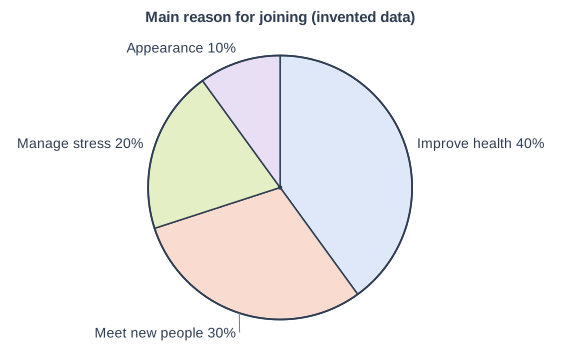
An exercise class for people aged over 60 asked its members for their main reason for joining. The pie chart shows the invented results.
Using the chart, identify the reason that is a social benefit and the two reasons that are emotional benefits.
Model answer
'Meet new people' is a social benefit. 'Manage stress' and 'Appearance' are emotional benefits.
Explanation
Match each reason to OCR's categories: meeting people is friendship, a social benefit; managing stress and feeling better about appearance (image) are emotional benefits; improving health is physical. Together the two emotional reasons account for 30% of members, the same as the social reason.
Mark scheme
1 mark
Social benefit: meet new people
Do not accept: improve health (physical).
1 mark
Emotional benefits: manage stress AND appearance
Both are needed for the mark. Appearance links to image; manage stress links to stress management. Do not accept: improve health.
Question 4
4 marks
Compare the main health benefits of regular physical activity for a 16-year-old and for an 80-year-old.
Model answer
For the 16-year-old, activity builds bone density while the skeleton is still growing, whereas for the 80-year-old it slows the loss of bone density and reduces the risk of osteoporosis. The teenager gains confidence and better body image at a time when self-esteem can be fragile, and a way to manage exam stress. The 80-year-old benefits most from keeping strength and balance, so they are less likely to fall and can stay independent, and from meeting people, which reduces loneliness. Both lower their risk of obesity and CHD.
Explanation
'Compare' means showing how the benefits differ or are similar between the two ages, ideally with linking words such as 'whereas' and 'both'. The same benefit can play out differently: teenagers build bone density, older people slow its loss. Writing only about one age group limits the answer to two marks.
Mark scheme
4 marks
16-year-old, e.g.: 1. Builds bone density while still growing 2. Maintains a healthy weight / reduces the risk of obesity 3. Improves fitness for sport and everyday life 4. Self-esteem / confidence / body image during adolescence 5. Stress management, e.g. during exams 6. Friendship / belonging to a team 80-year-old, e.g.: 7. Slows the loss of bone density / reduces the risk of osteoporosis and fractures 8. Maintains strength / balance / flexibility, so fewer falls / stays independent 9. Reduces the risk of CHD / high blood pressure / Type 2 diabetes, which rises with age 10. Reduces loneliness / isolation, e.g. after retirement or bereavement Comparisons, e.g.: 11. Both benefit from a lower risk of obesity / CHD / better mood 12. Bone density: the teenager is building it, whereas the older person is slowing its loss
1 mark per point. Max 4. Max 2 for one age group only, so both age groups must be covered for full marks. Points must be relevant to the age group given.
Ready to try the rest? Every answer you write is marked against the mark scheme, so you can see exactly where the marks are.
Ctrl + Enter to check
Study HelperHints first, answers after you try
Stuck on this one? Ask for a hint and I’ll point you in the right direction, without giving the answer away. Once you’ve checked your answer, I’ll show you how the marks are awarded.