Practise 18 exam-style questions on Mental preparation techniques for OCR GCSE Physical Education (Paper 2). Write your answer as you would in the exam and get it marked in seconds against the mark scheme, point by point, with the Study Helper on hand if you get stuck.
18 questions
1–6 marks each
Instant marking
No sign-up needed
18 questions, marked as you go
Sample questions with model answers
Here are 4 of the questions in this topic, each with a model answer, an explanation of why it earns the marks and the mark scheme an examiner would use.
Question 1
1 mark
A tennis player is about to serve for the match. She says to herself, 'I have practised this serve hundreds of times. I can do this.'
Which mental preparation technique is she using?
Choose your answer.
Imagery
Mental rehearsal
Positive thinking
Selective attention
Model answer
Positive thinking
Explanation
Telling yourself that you can succeed, and reminding yourself of good preparation, is positive thinking (positive self-talk). It builds confidence and pushes out negative thoughts. She is not picturing anything, so it is not imagery or mental rehearsal.
Mark scheme
1 mark
Positive thinking
If more than one option is given, 0 marks. Accept: positive self-talk.
Question 2
2 marks
A volleyball player is about to receive a serve. She is being distracted by loud noise from the crowd.
Name the mental preparation technique that would best help her deal with this distraction, and describe how she would use it.
Model answer
Selective attention. She would focus only on the server and the ball as it is hit, and block out the noise of the crowd.
Explanation
Selective attention filters information: the server, the ball and its flight are relevant, while crowd noise is not. Focusing on the right cues lets her judge the serve earlier and react more quickly. Remember to say both what she focuses on and what she ignores.
Mark scheme
1 mark
Selective attention
1 mark
She focuses on the relevant cues - the server / the ball / the server's arm action - and blocks out / ignores the crowd noise
The technique must be correct to access this mark. Must be applied to receiving the serve. Do not accept: 'she concentrates' on its own.
Question 3
2 marks
A hockey goalkeeper is facing a penalty corner.
Explain two ways selective attention could help her performance.
Model answer
She can focus on the ball and the hitter's stick, so she reacts more quickly to the shot. She also blocks out the noise of the crowd, so she is not distracted and makes fewer mistakes.
Explanation
Selective attention lets a performer process the cues that matter quickly while ignoring distractions. For a goalkeeper, that means faster reactions and better decisions. Each way should say what she focuses on or blocks out and how that helps.
Mark scheme
1 mark
She focuses on the relevant cues - the ball / the player hitting the ball / the hitter's stick - so she can react / make decisions more quickly
Max 2. Points must be linked to the goalkeeper or the penalty corner.
1 mark
She blocks out irrelevant information, e.g. crowd noise / the scoreboard / a previous mistake, so she is not distracted
1 mark
Better concentration means she makes fewer errors / makes more saves
Do not accept: 'she will save it' on its own.
Question 4
4 marks
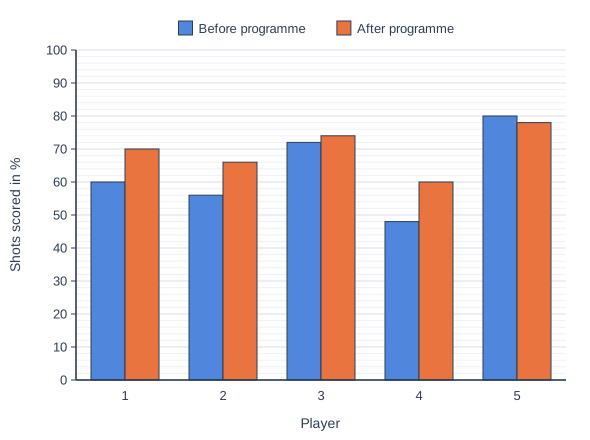
A netball coach ran a six-week mental rehearsal programme for five shooters. The graph shows the percentage of shots at goal each player scored in practice before and after the programme. (The data is invented.)
Analyse the data to evaluate how effective the programme was.
Model answer
The programme was mostly effective: four of the five players improved. Player 4 improved the most, from 48% to 60%, and Players 1 and 2 both improved by 10 percentage points. This could be because mental rehearsal reinforces the movement pattern of the shot and builds confidence. However, Player 5 got slightly worse (80% to 78%) and Player 3 only improved by 2 percentage points, so it did not help everyone. With only five players, and the possibility that extra physical practice caused the improvement, we cannot be certain the programme was the cause.
Explanation
Evaluate means weigh up: quote data showing improvement (Player 4: 60 - 48 = 12 percentage points), quote data that goes against it (Player 5: 80% to 78%), explain why mental rehearsal could help, and consider the limits of the evidence. An answer that only describes the bars cannot reach full marks.
Mark scheme
1 mark
Four of the five players improved / most players improved after the programme
Max 4. Max 2 if no data is quoted. Accept values read to within 2%.
1 mark
The biggest improvement was Player 4, from 48% to 60% / by 12 percentage points (Players 1 and 2 improved by 10)
1 mark
Player 5's success fell slightly, from 80% to 78% / Player 3 improved by only 2 percentage points, so the programme did not help every player / the best players had least room to improve
1 mark
Explanation: mental rehearsal reinforces the motor programme / movement pattern of the shot / increases confidence or concentration, so more shots are scored
1 mark
Evaluation: only five players were tested / other factors (e.g. extra physical practice, motivation) may have caused the improvement, so we cannot be sure the programme caused it
Ready to try the rest? Every answer you write is marked against the mark scheme, so you can see exactly where the marks are.
Ctrl + Enter to check
Study HelperHints first, answers after you try
Stuck on this one? Ask for a hint and I’ll point you in the right direction, without giving the answer away. Once you’ve checked your answer, I’ll show you how the marks are awarded.