Practise 20 exam-style questions on Goal setting and the SMART principle for OCR GCSE Physical Education (Paper 2). Write your answer as you would in the exam and get it marked in seconds against the mark scheme, point by point, with the Study Helper on hand if you get stuck.
20 questions
1–6 marks each
Instant marking
No sign-up needed
20 questions, marked as you go
Sample questions with model answers
Here are 4 of the questions in this topic, each with a model answer, an explanation of why it earns the marks and the mark scheme an examiner would use.
Question 1
1 mark
Which statement about goal setting is false?
A Setting goals can increase a performer's motivation. B Recording progress lets a performer see how much they have improved. C A goal should be so hard that the performer is unlikely ever to reach it. D Setting goals can help people to keep going with an exercise programme.
Choose your answer.
A
B
C
D
Model answer
C
Explanation
Goals should be achievable: challenging, but within the performer's reach. A goal the performer is unlikely ever to reach leads to failure, which lowers confidence and motivation and may make them give up. The other three statements are true uses of goal setting: motivation, monitoring progress and exercise adherence.
Mark scheme
1 mark
C / A goal should be so hard that the performer is unlikely ever to reach it
Accept the letter or the statement written out. If more than one option is given, 0 marks.
Question 2
2 marks
Using a practical example, explain how setting a goal can motivate a sports performer.
Model answer
A goal gives the performer a clear target, so they put more effort into training to reach it. For example, a high jumper who sets the goal of clearing 1.60 m by the end of the season will work harder in each session, and when she clears it she feels a sense of achievement that makes her want to set a new goal.
Explanation
Goals motivate because they give a clear target to strive for, and reaching one brings a sense of achievement that encourages further effort. OCR expects 'Using a practical example' questions to include a real activity and goal - an answer with no example scores only 1 mark.
Mark scheme
1 mark
Explanation: a goal gives a clear target, so the performer tries harder / puts more effort into training / wants to train; OR reaching the goal gives a sense of achievement / pride / confidence, which makes them want to carry on / set a new goal
Do not accept: 'gives them something to work towards' on its own - too vague.
1 mark
Practical example: a named activity and goal, e.g. a high jumper sets a goal to clear 1.60 m by the end of the season, so trains harder in every session / a netball shooter aims to score 8 out of 10 shots in practice
A point without a practical example scores max 1. The example must name an activity or performer and a goal.
Question 3
3 marks
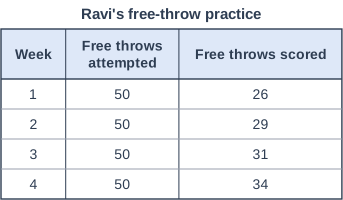
Ravi is a basketball player. He sets himself this goal: 'In practice, I will score at least 38 of my 50 free throws by the end of week 6.' He writes his results in a training diary. The table shows his results for the first four weeks.
Explain how Ravi's goal meets three of the SMART principles.
Model answer
The goal is specific because it is about one skill, his free throws. It is measurable because he can count how many of his 50 shots go in and compare the total with 38. It is timed because he must reach it by the end of week 6.
Explanation
For each mark, link the principle to the goal: what makes it specific, how it is measured, when the deadline is. Achievable can be argued from the table: he improved by 8 free throws from week 1 to week 4, so 4 more in two weeks is realistic. Writing only 'it is specific, measurable and timed' scores nothing.
Mark scheme
1 mark
Specific: it focuses on one skill - his free throws
Max 3. Each principle must be applied to Ravi's goal; naming the principle alone (e.g. 'it is measurable') scores 0. Credit each principle once.
1 mark
Measurable: his success can be counted - the number scored out of 50 / 38 out of 50
1 mark
Achievable / realistic: he has improved every week (from 26 to 34), so 38 by week 6 is within reach / challenging but possible
Must refer to his improving results or current level.
1 mark
Recorded: he writes his results down in a training diary / table
1 mark
Timed: there is a deadline - the end of week 6
Do not accept: 'time' on its own.
Question 4
4 marks
A hockey coach sets her team the goal 'Play better in matches.'
Identify two SMART principles that this goal does not meet. For each one, explain how the coach could change the goal so that it meets that principle.
Model answer
The goal is not specific, because 'play better' does not say which part of the game to improve. The coach could make it about one skill, such as 'improve our passing accuracy'. It is also not timed, because there is no deadline. She could add 'by the end of the next six matches', so the team knows when progress will be checked.
Explanation
'Play better' is vague: it names no particular skill, gives no number to measure, has no deadline and no way of recording progress. Each improvement must match the principle you named - adding a deadline fixes 'timed', adding a number fixes 'measurable'. A strong rewrite might be: 'complete 75% of our passes in each of the next six matches, recorded on a match sheet'.
Mark scheme
1 mark
First principle not met correctly identified: specific / measurable / recorded / timed / achievable (realistic)
Principles may be given in any order. Do not credit the same principle twice. Do not accept: 'time' on its own for timed.
1 mark
A change to the goal that meets the first principle, applied to hockey: e.g. specific - focus on one aspect such as passing accuracy / defending short corners / shots on target; measurable - add a number, e.g. complete 75% of passes / concede fewer than two goals a match; achievable - base the target on the team's current statistics so it is challenging but realistic; recorded - keep statistics on a match sheet / app / video after each match; timed - add a deadline, e.g. within the next six matches / by the end of the season
The principle must be correct to access this mark. The change must match the principle identified.
1 mark
Second principle not met correctly identified (different from the first)
1 mark
A change to the goal that meets the second principle, applied to hockey (as listed above)
The principle must be correct to access this mark.
Ready to try the rest? Every answer you write is marked against the mark scheme, so you can see exactly where the marks are.
Ctrl + Enter to check
Study HelperHints first, answers after you try
Stuck on this one? Ask for a hint and I’ll point you in the right direction, without giving the answer away. Once you’ve checked your answer, I’ll show you how the marks are awarded.