
Level:
Correct: 0
Incorrect: 0
Marks: 0/0
Exam Practice
Subject:
Topics:
Avg
score:
–
Topics
done:
0/17

The Roman family: the paterfamilias, patrons and clients

Practise 30 exam-style questions on The Roman family: the paterfamilias, patrons and clients for OCR GCSE Classical Civilisation (Roman City Life). Write your answer as you would in the exam and get it marked in seconds against the mark scheme, point by point, with an AI tutor on hand if you get stuck.

  • 30 questions
  • 1–15 marks each
  • Instant marking
  • No sign-up needed
20 questions, marked as you go

Sample questions with model answers

Here are 4 of the questions in this topic, each with a model answer, an explanation of why it earns the marks and the mark scheme an examiner would use.

Question 1

1 mark

Figure 1 shows what happened after a baby was born into a Roman family.

What happened to the baby at the stage labelled A?
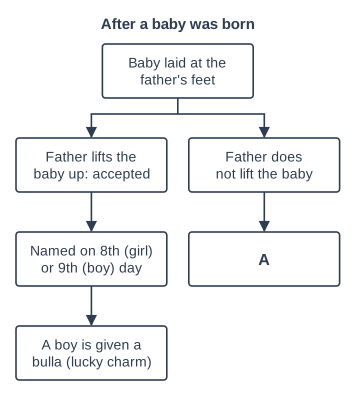
After a baby was born. Flow chart of 6 boxes joined by arrows, read from top to bottom. The first box is "Baby laid at the father's feet". From "Baby laid at the father's feet", 2 arrows branch out side by side: the left arrow leads to "Father lifts the baby up: accepted", which leads to "Named on 8th (girl) or 9th (boy) day", which leads to "A boy is given a bulla (lucky charm)"; the right arrow leads to "Father does not lift the baby", which leads to box A.

Model answer

The baby was exposed - left outside to die or to be picked up by a stranger, who might bring it up as a slave.

Explanation

The paterfamilias decided whether a new-born child would be raised. If he lifted the baby up, it was accepted into the family; if not, it was exposed. Girls, sickly or deformed babies and the children of poor families were most at risk; some exposed babies were rescued and brought up as slaves.

Mark scheme
  1. 1 mark

    The baby was exposed: left outside (e.g. on a rubbish heap or at a roadside) to die, or to be taken by someone else.

    Accept 'abandoned', 'left to die', 'left outside the house', 'exposed (and might be picked up and raised as a slave)'. Do not accept 'killed by the father' alone or 'given away for adoption'.
Question 2

2 marks

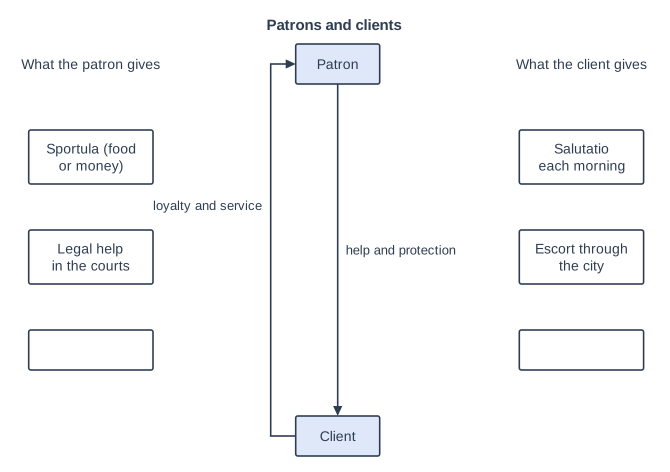
Figure 1 shows some of the things that patrons and clients gave each other.

Suggest what could go in each of the two blank boxes.

Patrons and clients. Block diagram with ten parts in five rows. Top row, left to right: the text "What the patron gives", a box "Patron" (shaded) and the text "What the client gives". Second row, left to right: a box "Sportula (food or money)" and a box "Salutatio each morning". Third row, left to right: a box "Legal help in the courts" and a box "Escort through the city". Fourth row, left to right: a blank box and a blank box. Bottom row: a box "Client" (shaded). Connections: an arrow from "Patron" to "Client", labelled "help and protection" (drawn side by side with the other line between them); an arrow from "Client" to "Patron", labelled "loyalty and service" (drawn side by side with the other line between them), going round on the left.

Model answer

The patron's blank box could be 'dinner invitations', and the client's blank box could be 'votes and canvassing at elections'.

Explanation

The relationship was one of mutual obligation (fides): the patron gave material help and protection, and the client gave loyalty, time and public support. A large crowd of clients at the salutatio and in the forum was a sign of the patron's power. Answers must not repeat items already in the figure.

Mark scheme
  1. 1 mark

    Left-hand blank (what the patron gives): one from dinner invitations; gifts or loans of money; protection; help with a career or business; a gift of a toga or other present; recommendations to influential people.

    Do not credit the sportula or legal help (already shown).

  2. 1 mark

    Right-hand blank (what the client gives): one from votes and canvassing at elections; applause for his speeches (in the courts or at recitations); swelling his crowd of followers / acting as a bodyguard; services or days of work (from freedmen clients).

    Do not credit the salutatio or escort (already shown).

Question 3

4 marks

Source A: Martial, Epigrams 3.36

'What a new friend, only recently made, does for you, Fabianus, you order me to do: to greet you always at first light, shivering, and to be dragged through the middle of the mud by your sedan chair; to follow you, worn out, at the tenth hour or later to the Baths of Agrippa, when I myself bathe at the Baths of Titus. Is this what I have earned, Fabianus, after thirty Decembers - to be forever a beginner in your friendship? Is this what I have earned, Fabianus, in my worn toga - my own - that you do not think I have yet earned my wooden sword [the sign of a gladiator's retirement]?'

What impressions of the life of a client does Source A give? Make two points.

Model answer

Martial gives the impression that a client's life was exhausting, because he had to greet his patron 'at first light, shivering' and still be following him, 'worn out', at the tenth hour. He also suggests it was unrewarding and humiliating: after 'thirty Decembers' of service he is still treated as 'a beginner', and he compares himself to a gladiator who has not yet been given his wooden sword of retirement.

Explanation

Martial exaggerates for comic effect, but the duties match other evidence: dawn salutatio in a toga, escorting the sedan chair through the streets and following the patron to the baths. A 'December' stands for a year (the Saturnalia), and the rudis was the wooden sword given to a gladiator when he was released.

Mark scheme
  1. 2 marks

    First point with supporting evidence from Source A: 1 mark for a valid impression of a client's life, 1 mark for a relevant reference or quotation from the passage that supports it. The two marks are independent: award 1 for a valid point even if no evidence is given, and 1 for a relevant quotation from, reference to or close paraphrase of the source even if the point is missing, weak or wrong.

    Two pairs from, e.g.: it was exhausting (1) - 'worn out', following him 'at the tenth hour or later' (1); it was uncomfortable / began very early (1) - 'at first light, shivering' (1); it was humiliating / degrading (1) - 'dragged through the middle of the mud by your sedan chair' (1); long service brought no reward or promotion (1) - 'after thirty Decembers - to be forever a beginner' (1); it was costly - clients wore out their own togas (1) - 'my worn toga - my own' (1); the client had to fit in with the patron's wishes (1) - going to the Baths of Agrippa when he uses the Baths of Titus (1); it was like slavery / gladiatorial service (1) - he has not 'earned my wooden sword', the sign of a gladiator's retirement (1). The second pair must make a different point from the first. Points must come from the passage.

  2. 2 marks

    Second, different point with supporting evidence from Source A: 1 mark for a valid impression, 1 mark for a relevant reference or quotation from the passage that supports it. The two marks are independent: award 1 for a valid point even if no evidence is given, and 1 for a relevant quotation from, reference to or close paraphrase of the source even if the point is missing, weak or wrong.

    As above; must be a different impression from the first point.

Question 4

8 marks

Source A: Pliny, Letters 5.19 (Pliny writes to his friend Paulinus)

'I see how kindly you treat your own household, so I will admit to you all the more frankly how indulgently I treat mine. I always keep in mind that line of Homer, "he was as gentle as a father", and our own phrase "father of the household". But even if I were harsher and tougher by nature, I would be broken by the illness of my freedman Zosimus, to whom I must show all the more kindness now that he needs it more. ... So I ask you to write to your people and tell them to open your villa and your house to him, and to pay any expenses he may need.'

To what extent did freedmen benefit from their relationship with their former masters? Use Source A as a starting point and your own knowledge.

Model answer

Source A suggests that a freedman could benefit greatly from his relationship with his former master. Pliny says he treats his household 'indulgently' and thinks of himself as a 'father of the household', so his freedmen were still part of his family. When Zosimus falls ill, Pliny shows him 'all the more kindness' and arranges for him to stay at his friend's villa, with all his expenses paid; earlier in the letter we learn that he had already sent Zosimus to Egypt to recover.

Other evidence shows further benefits. A freedman became his former master's client and took his name, as Cicero's secretary became Marcus Tullius Tiro. Patrons often gave their freedmen money or property to set up in business, and many ran shops and workshops for them. Some freedmen became very rich: in Petronius, Trimalchio inherits his master's fortune, and the Vettii brothers, probably freedmen, owned one of the finest houses in Pompeii. The sons of freedmen were born free citizens with full rights.

However, the relationship also had costs. Freedmen owed their former master respect (obsequium) and often a number of days' work each year, and they had to attend his salutatio and support him like any client. They could not hold public office, and some hosts treated them as the lowest guests: Pliny describes a dinner where the freedmen were served the worst wine. Pliny's letters were written for publication, so he may present himself as a better master than most.

Overall, freedmen benefited to a large extent, because their former master provided protection, money and opportunities that most poor freeborn citizens lacked. But the benefits depended on the patron's goodwill and the freedman's usefulness, and they came at the price of continued dependence.

Explanation

Top answers use Pliny's care for Zosimus but question how typical it was, given that Pliny wrote for publication and Zosimus was a talented favourite. They balance benefits (protection, business, wealth, citizen children) against obligations and limits (obsequium, operae, no office, social prejudice) and reach a clear judgement.

Mark scheme
  1. 8 marks

    Levels of response (8 marks). AO1 (4) and AO2 (4) are equally weighted.
    Level 4 (7-8 marks): consistently accurate and detailed knowledge of the relationship between freedmen and their former masters (obligations and benefits), using both Source A and own wider knowledge; very good understanding of the cultural context and of Pliny's self-presentation; a well-argued response with a clear, substantiated judgement on how far freedmen benefited, supported by a range of well-selected evidence, including critical analysis.
    Level 3 (5-6 marks): accurate knowledge, using both Source A and own knowledge; good understanding of the context; a focused response with relevant analysis and a judgement on the question.
    Level 2 (3-4 marks): sound, mostly accurate knowledge; engages with the general topic of freedmen using a limited range of evidence (may rely mainly on Source A); some analysis; any judgement is asserted rather than supported.
    Level 1 (1-2 marks): limited knowledge, may only use the source given; isolated analysis; little or no judgement.
    0 marks: no response or no response worthy of credit.
    A mainly descriptive or narrative answer with little analysis or judgement cannot go above Level 2.

    Indicative content (not a checklist; credit other valid points): AO1: Source A - Pliny treats his household 'indulgently', thinks of himself as a 'father of the household'; he cares for his sick freedman Zosimus and arranges and pays for him to stay at Paulinus' estate (elsewhere in the letter, Zosimus is described as honest, obliging and educated - a comic actor, reader and lyre-player - and Pliny had earlier sent him to Egypt to recover). Own knowledge - freedmen became clients of their former masters and took their names (Marcus Tullius Tiro, Cicero's secretary); they owed respect (obsequium) and often agreed days of work (operae); they attended the salutatio and supported their patron; benefits - protection, legal help, money or capital to set up in business (many ran shops and workshops for their patrons), inheritance (in Petronius, Trimalchio inherits his master's fortune); some became very rich (the Vettii brothers, Juvenal's freedman with five shops); freedmen could serve as Augustales; their freeborn sons were full citizens. Limits - freedmen could not hold magistracies; they could be punished for ingratitude; some hosts gave freedmen the worst wine (Pliny 2.6); dependence on the patron's goodwill. AO2: Pliny's letters were written for publication and present him as an ideal master, so Zosimus may be an exceptional favourite; benefits depended on the freedman's skills and the patron's character; the relationship gave security but limited independence; judgement required.

Ready to try the rest? Every answer you write is marked against the mark scheme, so you can see exactly where the marks are.

AI Tutor Hints first, answers after you try

Hi! Stuck? Ask me for a hint and I’ll help you work it out. Once you’ve checked your answer I can explain exactly where the marks are.