Level:
Correct: 0
Incorrect: 0
Marks: 0/0
Exam Practice
Subject:
Topics:
Avg
score:
–
Topics
done:
0/17

The baths

Practise 30 exam-style questions on The baths for OCR GCSE Classical Civilisation (Roman City Life). Write your answer as you would in the exam and get it marked in seconds against the mark scheme, point by point, with an AI tutor on hand if you get stuck.

  • 30 questions
  • 1–15 marks each
  • Instant marking
  • No sign-up needed
20 questions, marked as you go

Sample questions with model answers

Here are 4 of the questions in this topic, each with a model answer, an explanation of why it earns the marks and the mark scheme an examiner would use.

Question 1

1 mark

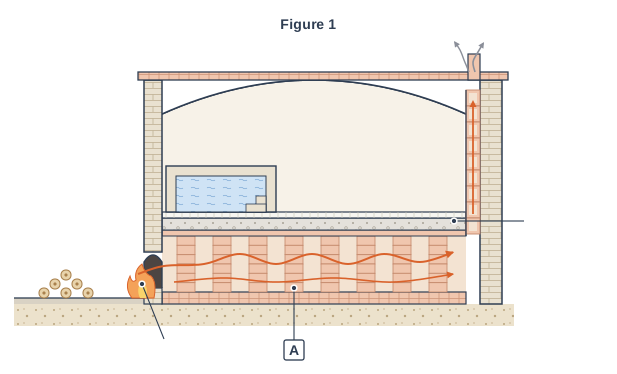
Figure 1 is a section through a hypocaust under the hot room of a bath house.

Name the part labelled A.

Cross-section of part of a Roman building. Its heading is "Figure 1". On the left is a lower room with logs stacked on its floor and a fire burning in an arched opening at the bottom of the wall. The room to the right (with a vaulted ceiling) has a thick floor made of layers of tile, concrete and mosaic, standing on short columns of square tiles above a lower floor. Orange arrows flow from the fire through the space under the floor, between the columns of tiles, and up a column of hollow tiles lining the inside of the right-hand wall; grey arrows leave through a vent at the top. A pool of water stands on the floor at the left-hand end, next to the fire. Label A points to the short columns of square tiles under the floor; the label "Praefurnium (furnace)" points to the fire burning in the arched opening at the bottom of the left-hand wall; the label "Raised floor" points to the thick floor made of layers of tile, concrete and mosaic, standing on the stacks of tiles.

Model answer

The pilae, the stacks of tiles that held up the floor.

Explanation

The pilae were short pillars of square tiles that held up the raised floor (suspensura), leaving a space through which hot air and smoke from the furnace could flow and heat the floor from below. Students sometimes confuse them with the tubuli, the hollow box-tiles in the walls.

Mark scheme
  1. 1 mark

    Pilae (stacks / pillars of tiles)

    Accept 'pillars of tiles or bricks', 'stacks of tiles', pila. Do not accept tubuli, suspensura or 'columns' alone.

Question 2

2 marks

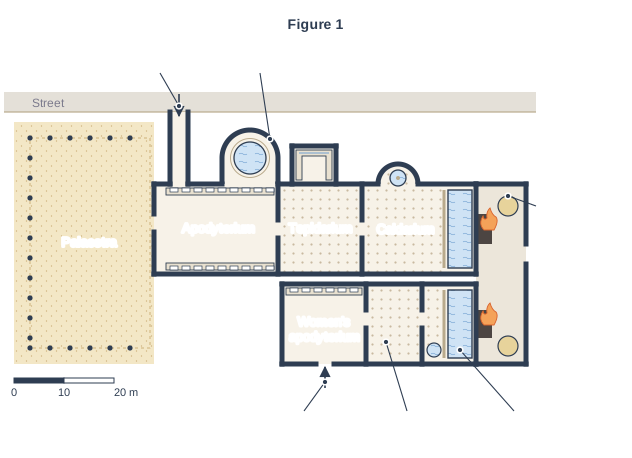
Figure 1 is a plan of a bath complex like the Central (Forum) Baths at Herculaneum, with the men's baths at the top and the women's baths at the bottom.

Give two differences between the men's baths and the women's baths shown in Figure 1.

Plan of a Roman public building. Its heading is "Figure 1". Seen from above, with the street along the top and a scale bar of 20 m. On the left is a large sandy courtyard with columns (drawn as dots) round three sides. A passage leads in from the street (an arrow) to a long room with benches along the walls and rows of small compartments; a door also leads from it to the courtyard. Off this room are a round room with a round pool in the middle, on the street side, and a row of two further rooms with dotted floors; the end room has a long pool along its end wall and a round basin in a semicircular recess. A small room with a stone bench round three walls lies on the street side. Beyond the end room is a service room at the far right with a fire and a round boiler. Below this is a separate, smaller row of three rooms with its own entrance arrow from below: a room with a bench and compartments, a dotted-floor middle room and a dotted-floor end room with its own long pool and a small basin, next to the same service room, which has a second fire and boiler for them. The label "Palaestra" is written in the large sandy courtyard on the left, with columns round three sides; the label "Frigidarium" points to the round room at the top with a round pool in the middle; the label "Apodyterium" is written in the long room entered from the passage, with benches along the walls; the label "Tepidarium" is written in the room in the middle of the row, between the long room and the end room; the label "Caldarium" is written in the room at the right-hand end of the row, next to the service room with the fire; the label "Praefurnium" points to the service room at the far right with the fire and a round boiler; the label "Women's apodyterium" is written in the left-hand room of the smaller suite at the bottom; the label "Women's tepidarium" points to the middle room of the smaller suite at the bottom; the label "Women's caldarium" points to the right-hand room of the smaller suite at the bottom, next to the service room; the label "Women's entrance" points to the arrow leading into the smaller suite from below; the label "Men's entrance" points to the arrow and passage leading in from the street at the top.

Model answer

The women's baths were much smaller than the men's and had no frigidarium, so women could not take a cold plunge. The women also had no palaestra for exercise, while the men had a large exercise yard.

Explanation

The plan shows that women's bathing was provided for, with its own entrance, apodyterium, tepidarium and caldarium heated by the same furnace, but on a smaller scale and without a cold room or exercise yard. This suggests women were expected to bathe but not to exercise or socialise there as men did.

Mark scheme
  1. 2 marks

    Any two from: the women's baths were smaller / had smaller rooms; the women had no frigidarium (cold room); the women had no palaestra (exercise yard); the women had their own separate entrance; the women's suite had fewer rooms (no latrine shown in their suite).

    1 mark for each different difference, max 2. Do not credit the shared furnace, which is a similarity.

Question 3

4 marks

Source A: Petronius, Satyricon 27. The narrator and his friends are at the baths.

'Meanwhile, still dressed, we began to wander about, or rather to joke and go up to the groups of people, when suddenly we saw a bald old man in a reddish tunic playing ball among some long-haired slave boys. It was not so much the boys, though they were worth seeing, that drew us to watch, as the master of the house himself, who was taking his exercise in slippers with a green ball. He never picked up a ball that had touched the ground; instead a slave held a bag full of them and supplied the players. We noticed other novelties too: two eunuchs stood at different points of the circle, one holding a silver chamber pot, the other counting the balls - not the ones flying from hand to hand in the game, but the ones that fell on the ground.'

The old man is Trimalchio. What impressions do you gain of Trimalchio in this passage? Make two points.

Model answer

Trimalchio is very rich and loves to show it off: he has a slave with a whole bag of balls and another holding a silver chamber pot. He is also extravagant and lazy, since he never picks up a ball that has touched the ground but has a new one handed to him.

Explanation

Petronius' Trimalchio is a vulgar, enormously rich freedman whose every action shows off his wealth; even his exercise at the baths is a performance with servants and luxury objects. The scene also shows ball games and exercise as normal activities at the baths before bathing.

Mark scheme
  1. 2 marks

    First point with supporting evidence from Source A: 1 mark for a valid impression of Trimalchio, 1 mark for a relevant reference or quotation from the passage that supports it. The two marks are independent: award 1 for a valid point even if no evidence is given, and 1 for a relevant quotation from, reference to or close paraphrase of the source even if the point is missing, weak or wrong.

    Two pairs from, e.g.: he is very rich / shows off his wealth (1) - a slave with a bag full of balls, a silver chamber pot, eunuchs to serve him (1); he is extravagant / wasteful (1) - he never picks up a ball that has touched the ground (1); he is lazy / will not do anything for himself (1) - a slave supplies the balls (1); he is vulgar / has bad manners (1) - a slave holds a silver chamber pot for him during the game (1); he is eccentric / does things strangely (1) - a eunuch counts only the balls that are dropped, the narrator calls them 'novelties' (1); he is an attention-seeker / likes to be watched (1) - the visitors are drawn to watch him rather than the boys (1); he is an old man trying to seem young (1) - bald and old, playing ball with boys (1). The second pair must make a different point from the first. Credit a relevant reference (1) even if the impression is weak. Points must come from the passage.

  2. 2 marks

    Second, different point with supporting evidence from Source A: 1 mark for a valid impression of Trimalchio, 1 mark for a relevant reference or quotation from the passage that supports it. The two marks are independent: award 1 for a valid point even if no evidence is given, and 1 for a relevant quotation from, reference to or close paraphrase of the source even if the point is missing, weak or wrong.

    As above; must be a different impression from the first point.

Question 4

8 marks

Source A: Petronius, Satyricon 28. Trimalchio, a very rich freedman, has just finished bathing.

'Trimalchio, drenched in perfume, was being rubbed dry, not with linen towels, but with cloths made of the softest wool. Meanwhile three masseurs were drinking Falernian wine in front of him, and when they quarrelled and spilled most of it, Trimalchio said they were drinking his health. Then he was wrapped in a scarlet woollen cloak and put into a litter, with four runners in decorated harness going ahead of him, and a little hand-cart in which his favourite rode, an old-looking, bleary-eyed boy even uglier than his master.'

To what extent were the baths a place where Romans showed off their wealth and status? Use Source A as a starting point and your own knowledge.

Model answer

Source A suggests that the baths could be a stage for showing off wealth. Trimalchio is rubbed dry with the softest wool instead of linen, three masseurs drink expensive Falernian wine in front of him, and he leaves wrapped in scarlet in a litter with four runners going ahead. Earlier, he plays ball with a slave supplying new balls and another holding a silver chamber pot. Everything is designed to be seen.

Other evidence shows that wealth and status were visible at the baths. Rich bathers brought slaves to carry their oil and strigils, guard their clothes and scrape them clean; Pliny tells how Larcius Macedo's slave pushed through a crowded public bath to make way for his master. Martial's Menogenes flatters rich bathers about their towels and hair in the hope of a dinner invitation, which shows that people knew exactly who was worth knowing. Seneca complains that the wealthy expected marble walls and silver taps in their baths.

However, the baths were also one of the most equal places in Roman life. Entry cost only a quadrans, children were let in free, and benefactors sometimes paid for everyone to bathe. Bathers were undressed, so the toga and other signs of rank disappeared, and the eques who struck Macedo shows that a senator's rank brought little protection there. Emperors built the great thermae for the whole people, and some emperors, such as Hadrian, are said to have bathed in public baths alongside ordinary Romans.

Petronius also exaggerates for comic effect: Trimalchio is a caricature of a vulgar freedman, so he shows what was thought tasteless rather than normal. Overall, the baths were open to everyone and partly levelled society, but the rich still found ways to display their wealth through slaves, luxuries and behaviour.

Explanation

Strong answers use Source A critically, recognising Petronius' satire, and balance evidence of display (slaves, luxury, flatterers) against evidence of equality (tiny fee, nakedness, mixing of ranks, imperial provision). The judgement should explain how status could be shown even when everyone was undressed.

Mark scheme
  1. 8 marks

    Levels of response (8 marks). AO1 (4) and AO2 (4) are equally weighted.
    Level 4 (7-8 marks): consistently accurate and detailed knowledge of the evidence for wealth, status and equality at the baths (literary sources, bath buildings, fees, slaves and attendants), using both Source A and own wider knowledge; very good understanding of the cultural context and possible interpretations, including Petronius' satire; a well-argued response with a clear, substantiated judgement on how far the baths were a place for showing off wealth and status, supported by a range of well-selected evidence, including critical analysis.
    Level 3 (5-6 marks): accurate knowledge, using both Source A and own knowledge; a focused response with relevant analysis and a judgement.
    Level 2 (3-4 marks): sound, mostly accurate knowledge; engages with the general topic of social life at the baths; limited range of evidence; some analysis.
    Level 1 (1-2 marks): limited knowledge, may only use Source A; isolated analysis.
    0 marks: no response or no response worthy of credit.
    A mainly descriptive or narrative answer with little analysis or judgement cannot go above Level 2.

    Indicative content (not a checklist; credit other valid points): AO1: Source A - perfume, soft woollen towels, three masseurs drinking expensive Falernian, a scarlet cloak, a litter, four runners and a cart for his favourite; in Satyricon 27 he plays ball with a slave supplying balls and a silver chamber pot. Wealth on show: rich bathers brought slaves to carry oil flasks, strigils and towels, guard clothes and scrape them; Larcius Macedo's slave pushed through the crowd for him (Pliny 3.14); Menogenes flatters rich bathers for dinner invitations (Martial 12.82); Seneca, Letters 86 - marble, silver taps and big windows in the baths of the rich. Equality: entrance a quadrans, children free, free days paid by benefactors; everyone undressed together; the eques who struck Macedo shows rank brought no protection; imperial thermae built for all the people; even emperors such as Titus and Hadrian are said to have bathed in public baths (Hadrian and the veteran rubbing his back on the wall). Builders displayed status through benefactions - inscriptions, decoration. AO2: Petronius exaggerates for comic effect - Trimalchio is a caricature of a vulgar freedman, so he shows what was thought tasteless, not what was normal; yet the satire works only because display at the baths was familiar; clothes were removed, so status had to be shown in other ways (slaves, oils, attendants, behaviour); the baths mixed classes more than most places, which made display both easier to see and more resented; for the poor, the baths were a chance to approach the rich. Possible judgement: the baths were open to all and partly levelled society, but the rich still found many ways to show off.

Ready to try the rest? Every answer you write is marked against the mark scheme, so you can see exactly where the marks are.

AI Tutor Hints first, answers after you try

Hi! Stuck? Ask me for a hint and I’ll help you work it out. Once you’ve checked your answer I can explain exactly where the marks are.