
Level:
Correct: 0
Incorrect: 0
Marks: 0/0
Exam Practice
Subject:
Topics:
Avg
score:
–
Topics
done:
0/17

Education of Roman children

Practise 28 exam-style questions on Education of Roman children for OCR GCSE Classical Civilisation (Roman City Life). Write your answer as you would in the exam and get it marked in seconds against the mark scheme, point by point, with an AI tutor on hand if you get stuck.

  • 28 questions
  • 1–15 marks each
  • Instant marking
  • No sign-up needed
20 questions, marked as you go

Sample questions with model answers

Here are 4 of the questions in this topic, each with a model answer, an explanation of why it earns the marks and the mark scheme an examiner would use.

Question 1

1 mark

Source A: Martial, Epigrams 10.62 (addressed to a schoolmaster)

'The bright days are blazing with the fiery Lion, and burning July is baking the parched harvest. So let the whip of grim Scythian hide with its curling thongs - the whip that flogged Marsyas of Celaenae - and the grim canes, the sceptres of the paedagogi, take a rest and sleep until the Ides of October: in summer, if boys stay healthy, they learn enough.'

According to Source A, until when should the beatings and lessons stop?

Model answer

Until the Ides of October, when the summer heat is over.

Explanation

Martial asks the schoolmaster to give the boys a summer holiday from the blazing days of July until mid-October; the 'Lion' is the constellation Leo, which the sun passes through in high summer. The poem also shows that canes (ferulae) and whips were standard equipment, and that the paedagogus as well as the teacher punished boys.

Mark scheme
  1. 1 mark

    Until the Ides of October (15 October) / until the end of the summer

    Accept 'until the middle of October' or 'until the summer is over'. Do not accept 'until July' or 'until the harvest'.
Question 2

2 marks

Source A: Horace, Satires 1.6 (Horace describes his father, a freedman with a small farm at Venusia in southern Italy)

'My father was the reason, a poor man with a meagre little farm. He would not send me to the school of Flavius, where big boys, the sons of big centurions, used to go, with their satchels and writing tablets hanging from their left arms, bringing their eight bronze coins on the Ides. Instead he dared to take his boy to Rome, to be taught the skills that any eques or senator would have his own sons taught.'

Give two details from Source A about the pupils at Flavius' school.

Model answer

They were the sons of important centurions, and they carried their satchels and writing tablets hanging from their left arms.

Explanation

Flavius ran a local primary school in Venusia, where the fee was paid in small bronze coins. Horace's father, though only a freedman, wanted his son to have the education of the sons of equites and senators, so he took him to Rome - which shows how closely education was linked to social ambition.

Mark scheme
  1. 1 mark

    One detail from Source A about Flavius' pupils.

    Two from: they were big / strapping boys (1); they were the sons of (big / important) centurions (1); they carried satchels (school bags) and writing tablets (1); these hung from their left arms (credit only with the satchels or tablets, as one point) (1); they brought eight bronze coins (asses) on the Ides - their (monthly) school fee (1). Max 2. Details must come from the source.

  2. 1 mark

    A second, different detail from Source A.

    As above.

Question 3

4 marks

Source A: part of a long painted frieze from the Praedia (estate) of Julia Felix at Pompeii (1st century AD), showing everyday scenes in the forum. In one scene, under the colonnade, several boys sit with writing tablets on their knees. Beside them, a boy with his back bared is held up on the back of another boy while a third boy holds his legs, and a man raises a stick to beat him.

Select two details from the painting and explain what each tells us about Roman primary schools.

Model answer

First, the lesson takes place in the colonnade of the forum, which tells us that primary schools were often held in public spaces rather than special buildings, probably because a litterator could not afford to rent a room, so lessons were noisy and open to passers-by. Second, a boy is held on another boy's back and beaten with a stick in front of the class, which shows that discipline was harsh and that punishment was public, meant to humiliate him and frighten the other pupils into working.

Explanation

The frieze shows life in the forum, so the school appears alongside traders and other everyday business; its flogging scene matches literary evidence such as Horace's 'plagosus' Orbilius and Martial's noisy schoolmaster. Good answers link each detail to a general feature of schools rather than simply describing the picture.

Mark scheme
  1. 2 marks

    First detail with explanation: 1 mark for a relevant detail selected from the painting, 1 mark for an explanation of what it tells us about Roman primary schools. The explanation mark may be awarded for a valid explanation even if the detail is only loosely identified.

    Two pairs from, e.g.: the lesson is in the colonnade of the forum (1) - schools were often held in public places or shops, not special buildings, because teachers could not afford rooms / lessons were noisy and open to passers-by (1); boys sit with tablets on their knees (1) - there were no desks; pupils wrote on wax tablets with a stilus (1); several boys are taught together (1) - the litterator taught a group of fee-paying pupils at once (1); a boy is being beaten with a stick (1) - discipline was harsh and corporal punishment was normal (1); other pupils hold the victim (1) - pupils were made to take part, adding humiliation (1); the beating happens in public in front of the class (1) - it was meant to shame him and frighten the others into working (1). The second pair must make a different point from the first.

  2. 2 marks

    Second, different detail with explanation: 1 mark for the detail, 1 mark for what it tells us.

    As above; must be a different detail and point from the first.

Question 4

8 marks

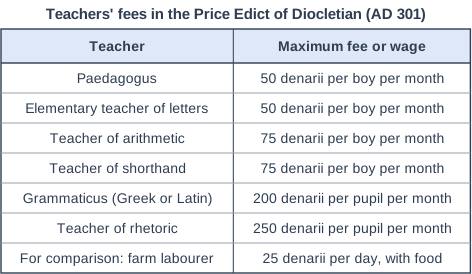
Source A is a table of the maximum fees that teachers could charge, from the Price Edict issued by the emperor Diocletian in AD 301 (much later than the 1st century AD, at a time of high inflation).

To what extent were teachers well rewarded and respected in Roman society? Use Source A as a starting point and your own knowledge.

Teachers' fees in the Price Edict of Diocletian (AD 301). Table with columns "Teacher", "Maximum fee or wage". Teacher: Paedagogus; Maximum fee or wage: 50 denarii per boy per month | Teacher: Elementary teacher of letters; Maximum fee or wage: 50 denarii per boy per month | Teacher: Teacher of arithmetic; Maximum fee or wage: 75 denarii per boy per month | Teacher: Teacher of shorthand; Maximum fee or wage: 75 denarii per boy per month | Teacher: Grammaticus (Greek or Latin); Maximum fee or wage: 200 denarii per pupil per month | Teacher: Teacher of rhetoric; Maximum fee or wage: 250 denarii per pupil per month | Teacher: For comparison: farm labourer; Maximum fee or wage: 25 denarii per day, with food.

Model answer

Source A suggests that teachers were rewarded according to the level they taught. An elementary teacher could charge only 50 denarii a month for each boy, the same as a paedagogus, a slave attendant, whereas a grammaticus could charge 200 and a teacher of rhetoric 250. This suggests that higher education was valued much more. On the other hand, since fees were per pupil, an elementary teacher with twenty or thirty pupils could earn more than a farm labourer on 25 denarii a day. However, these were maximum prices in a period of inflation, centuries after our period, so the table shows relative status better than real incomes.

Earlier evidence supports the idea that ordinary teachers were poorly rewarded and little respected. The litterator often taught in a shop or the forum for small fees, like the eight bronze coins paid at Flavius' school in Horace's Satires. Juvenal claims the grammaticus works from midnight among smoky lamps, rarely gets paid without a court case and earns in a year what a charioteer wins in one race; the famous Orbilius admitted he ended up poor in an attic. Martial's schoolmaster is 'hated by boys and girls'. Many teachers were freedmen or Greeks, so they had low social status.

At the top, however, teachers could be rich and honoured. Vespasian paid rhetors such as Quintilian a salary of 100,000 sesterces a year, and Verrius Flaccus taught Augustus' grandsons on the Palatine for the same sum. Overall, teachers were well rewarded and respected only at the highest level; most litteratores and grammatici were badly paid and treated as hired help, even though parents valued the education they gave.

Explanation

The table supports a comparison between levels, but strong answers question it (late date, maximum prices, inflation) and combine it with literary evidence for both poor teachers (Juvenal, Orbilius, Martial) and rich ones (Quintilian, Verrius Flaccus) to reach a differentiated judgement.

Mark scheme
  1. 8 marks

    Levels of response (8 marks). AO1 (4) and AO2 (4) are equally weighted.
    Level 4 (7-8 marks): consistently accurate and detailed knowledge of the pay and status of teachers at different levels, using both Source A and own wider knowledge; shows very good understanding of the cultural context (social class of teachers, attitudes of parents and writers) and of the limitations of the evidence; a well-argued response with a clear judgement on how far teachers were well rewarded and respected, supported by a range of well-selected evidence, including critical analysis of the table.
    Level 3 (5-6 marks): accurate knowledge, using both the source and own knowledge; a focused response with relevant analysis and a judgement.
    Level 2 (3-4 marks): sound, mostly accurate knowledge; engages with the general topic of teachers, with a limited range of evidence and some analysis.
    Level 1 (1-2 marks): limited knowledge, may only use the source given; isolated analysis.
    0 marks: no response or no response worthy of credit.
    A mainly descriptive or narrative answer with little analysis or judgement cannot go above Level 2.

    Indicative content (not a checklist; credit other valid points): AO1: Source A - fees rise with the stage: elementary teacher 50 denarii per pupil a month, grammaticus 200, rhetor 250; the paedagogus listed with the elementary teacher; fees are per pupil, so a teacher with many pupils could earn more than a farm labourer (25 denarii a day); but these are maximum prices, and from AD 301. Own knowledge: the litterator taught in shops or the forum for small fees (the eight bronze coins paid at Flavius' school, Horace, Satires 1.6); Juvenal 7 - the grammaticus works from midnight, is rarely paid without a lawsuit and earns in a year what a charioteer wins in one race; Orbilius admitted he lived in poverty in an attic and complained of parents; teachers were often freedmen or Greeks of low status; Martial's schoolmaster is 'hated by boys and girls'. At the top: Vespasian paid Latin and Greek rhetors a salary of 100,000 sesterces a year from the treasury, and Quintilian was the first; Verrius Flaccus moved his school to the Palatine to teach Augustus' grandsons and was paid 100,000 sesterces a year; Pliny helped fund teachers at Comum and took care in recommending a rhetor. AO2: rewards and respect rose with the level - the rhetor could be rich and honoured, the litterator was poor and looked down on; parents valued education but not always its teachers; teaching was seen as a job for hire, often done by freedmen; the table is late, gives maximum not actual fees and reflects an inflation crisis, so it shows relative status better than real incomes; satirists exaggerate; judgement - teachers at the top were well rewarded and respected, most ordinary teachers were not.

Ready to try the rest? Every answer you write is marked against the mark scheme, so you can see exactly where the marks are.

AI Tutor Hints first, answers after you try

Hi! Stuck? Ask me for a hint and I’ll help you work it out. Once you’ve checked your answer I can explain exactly where the marks are.