Level:
Correct: 0
Incorrect: 0
Marks: 0/0
Exam Practice
Subject:
Topics:
Avg
score:
–
Topics
done:
0/17

The dinner party (cena)

Practise 27 exam-style questions on The dinner party (cena) for OCR GCSE Classical Civilisation (Roman City Life). Write your answer as you would in the exam and get it marked in seconds against the mark scheme, point by point, with an AI tutor on hand if you get stuck.

  • 27 questions
  • 1–15 marks each
  • Instant marking
  • No sign-up needed
20 questions, marked as you go

Sample questions with model answers

Here are 4 of the questions in this topic, each with a model answer, an explanation of why it earns the marks and the mark scheme an examiner would use.

Question 1

1 mark

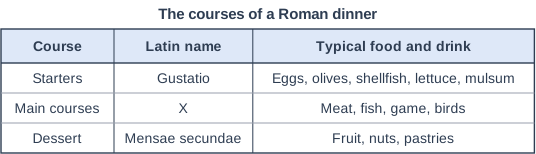
Figure 1 is a table of the courses of a Roman dinner.

What Latin name should replace X?

The courses of a Roman dinner. Table with columns "Course", "Latin name", "Typical food and drink". Course: Starters; Latin name: Gustatio; Typical food and drink: Eggs, olives, shellfish, lettuce, mulsum | Course: Main courses; Latin name: X; Typical food and drink: Meat, fish, game, birds | Course: Dessert; Latin name: Mensae secundae; Typical food and drink: Fruit, nuts, pastries.

Model answer

Mensae primae.

Explanation

The main courses (mensae primae, 'first tables') could include several dishes (fercula) of meat, fish, game and birds; the most elaborate was the centrepiece. The meal ran 'from the egg to the apples', from the starters (gustatio) to the dessert (mensae secundae).

Mark scheme
  1. 1 mark

    Mensae primae

    Accept prima mensa or mensa prima; accept caput cenae for the main dish. Do not accept gustatio, mensae secundae or cena on its own.

Question 2

2 marks

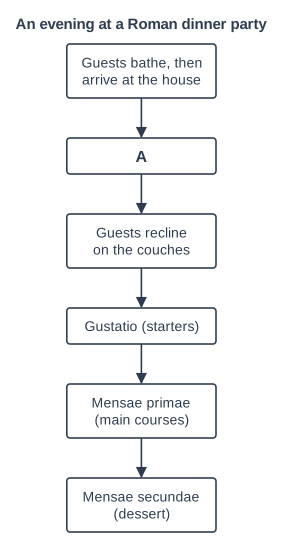
Figure 1 shows the stages of an evening at a Roman dinner party.

Describe two things that slaves did for the guests at stage A.

An evening at a Roman dinner party. Flow chart of 6 boxes joined by arrows, read from top to bottom. The first box is "Guests bathe, then arrive at the house", which leads to box A, which leads to "Guests recline on the couches", which leads to "Gustatio (starters)", which leads to "Mensae primae (main courses)", which leads to "Mensae secundae (dessert)".

Model answer

Slaves took off the guests' sandals and poured water over their hands and feet to wash them before they reclined.

Explanation

Guests reclined barefoot on the couches, so their sandals were removed and their feet washed; hands were washed because Romans ate with their fingers. At Trimalchio's dinner slave boys from Alexandria pour snow-cooled water over the guests' hands and pare their nails, singing as they work.

Mark scheme
  1. 1 mark

    One task done by slaves for arriving guests.

    Two from: took off their sandals / shoes (1); kept the sandals until the guest left (1); poured water over their hands to wash them (sometimes cooled with snow) (1); washed their feet (1); dried their hands or feet with towels (1); trimmed their nails (as at Trimalchio's dinner) (1); showed them to their places on the couches (1). Washing hands and washing feet may be credited separately. Max 2.

  2. 1 mark

    A second, different task.

    As above.

Question 3

4 marks

Source A: Petronius, Satyricon 31 (the narrator arrives at the dinner of Trimalchio, a very rich freedman)

'At last we reclined. Slave boys from Alexandria poured snow-cooled water over our hands, and others followed them to our feet and pared our hangnails with great skill. Not even during this unpleasant task were they silent: they sang as they worked. ... The starters brought in were very elegant. Everyone had now reclined except Trimalchio himself, for whom, in a new fashion, the top place was being kept. On the tray stood a donkey of Corinthian bronze with saddlebags holding olives, pale green on one side and black on the other. Two dishes covered the donkey, with Trimalchio's name and the weight of the silver engraved on their rims. Little bridges soldered onto them held dormice dipped in honey and sprinkled with poppy-seed. There were also sausages sizzling on a silver grill, and under the grill Syrian plums with pomegranate seeds.'

What impressions do you gain of Trimalchio's dinner party from Source A? Make two points, supporting each with evidence from the source.

Model answer

First, the dinner is extremely luxurious: the guests' hands are washed in snow-cooled water, and the starters are served on a donkey made of expensive Corinthian bronze with silver dishes and a silver grill. Second, it is vulgar and boastful: Trimalchio has his own name and the weight of the silver engraved on the rims of the dishes, as if the guests need to be told how much they cost, and he even keeps the top place for himself 'in a new fashion' instead of offering it to a guest.

Explanation

Petronius' Trimalchio is a parody of a rich freedman trying to copy upper-class dining, but every detail goes too far. The passage is a useful (if exaggerated) source for the cena: washing hands and feet, slaves serving, the gustatio of olives, dormice and sausages, and the importance of the places of honour.

Mark scheme
  1. 2 marks

    First point with supporting evidence from Source A: 1 mark for a valid impression of the dinner party, 1 mark for a relevant reference or quotation from the passage that supports it. The two marks are independent: award 1 for a valid point even if no evidence is given, and 1 for a relevant quotation from, reference to or close paraphrase of the source even if the point is missing, weak or wrong.

    Two pairs from, e.g.: it is luxurious / extravagant (1) - snow-cooled water, a donkey of Corinthian bronze, silver dishes and grill (1); it is vulgar / boastful (1) - Trimalchio's name and the weight of the silver engraved on the dishes (1); the food is elaborately presented / theatrical (1) - olives in the donkey's saddlebags, sausages on a grill over plums and pomegranate seeds like coals (1); the service is over-the-top (1) - slave boys from Alexandria wash hands and pare nails, singing as they work (1); exotic delicacies are served (1) - dormice in honey and poppy-seed (1); the host breaks the rules of etiquette / is self-important (1) - he keeps the top place for himself 'in a new fashion' and arrives after the food is served (1). The second pair must make a different point from the first. Points must come from the passage.

  2. 2 marks

    Second, different point with supporting evidence from Source A: 1 mark for a valid impression, 1 mark for a relevant reference or quotation. The two marks are independent: award 1 for a valid point even if no evidence is given, and 1 for a relevant quotation from, reference to or close paraphrase of the source even if the point is missing, weak or wrong.

    As above; must be a different impression from the first.

Question 4

8 marks

Source A: Horace, Satires 2.6 (Horace describes dinners with his neighbours at his farm in the Sabine hills)

'O nights and dinners of the gods, when my friends and I eat before my own household god, and I feed my cheeky home-born slaves with the food we have offered! Each guest, free from mad rules, drains cups of different sizes just as he pleases, whether he is strong and takes his drink strong, or prefers to mellow on moderate cups. Then conversation begins - not about other people's villas and houses, or whether Lepos dances well or badly; we discuss what matters more to us and is bad not to know: whether people are made happy by wealth or by virtue, what draws us into friendship - self-interest or goodness - and what is the nature of the good and what is its highest form.'

To what extent was conversation the most important entertainment at a Roman dinner party? Use Source A as a starting point and your own knowledge.

Model answer

Source A presents conversation as the heart of a good dinner. Horace calls his dinners with neighbours 'dinners of the gods' because the talk is serious and shared: not gossip about other people's villas or about whether a dancer performs well, but questions such as whether people are made happy by wealth or by virtue, and what friendship is based on. The drinking is free from 'mad rules', so the guests can relax and talk.

Other evidence supports the importance of conversation among the educated. The triclinium was designed for about nine diners so that all could join in one discussion, and Pliny's ideal dinner in Letters 1.15 promises a cheerful, simple and free evening, with cultured entertainment - comic actors, a reader or a lyre-player - that supported conversation rather than replacing it.

However, many dinner parties relied on other entertainment. Pliny's friend preferred a dinner with dancing girls from Gades, and wealthy hosts hired musicians, dancers and acrobats. Trimalchio is carried in to music, plays a board game at the table and sings to his guests, and much of the talk at his dinner is gossip. Drinking games and dice were common, and a 'master of the drinking' might set rules for how much everyone drank. Recitations could even be a burden: Martial jokes that he will not recite his poems to his guest.

Horace and Pliny are presenting themselves as men of good taste, so they idealise their own dinners and look down on others. My judgement is that conversation was always part of a dinner party and was the most important entertainment for cultured hosts and their friends, but for many wealthy Romans performers, spectacle and drinking were at least as important, because they impressed guests and displayed the host's wealth.

Explanation

A strong answer uses Horace's ideal as a starting point but balances it against evidence for performers, games and spectacle, and notices that the writers who praise conversation are presenting themselves favourably. The judgement should explain for whom conversation mattered most.

Mark scheme
  1. 8 marks

    Levels of response (8 marks). AO1 (4) and AO2 (4) are equally weighted.
    Level 4 (7-8 marks): consistently accurate and detailed knowledge of the entertainment at dinner parties (conversation, readings, music, dancers, acrobats, games, drinking), using both Source A and own wider knowledge; shows very good understanding of the cultural context and of possible interpretations of the sources; a well-argued response with a clear judgement on how far conversation was the most important entertainment, supported by a range of well-selected evidence, including critical analysis.
    Level 3 (5-6 marks): accurate knowledge, using both the source and own knowledge; a focused response with relevant analysis and a judgement.
    Level 2 (3-4 marks): sound, mostly accurate knowledge; engages with the general topic of entertainment, with a limited range of evidence and some analysis.
    Level 1 (1-2 marks): limited knowledge, may only use the source given; isolated analysis.
    0 marks: no response or no response worthy of credit.
    A mainly descriptive or narrative answer with little analysis or judgement cannot go above Level 2.

    Indicative content (not a checklist; credit other valid points): AO1: Source A - conversation on serious questions (wealth or virtue, friendship, the good), not gossip about villas or dancers; drinking freely without rules; a neighbour then tells the fable of the town mouse and the country mouse. Pliny 1.15 - comic actors, a reader or a lyre-player, contrasted with dancing girls from Gades; Pliny's other letters on readings at dinner; Martial 11.52 - he promises not to recite his own poems, so recitations could be a burden; music and singing; dancers and acrobats; Trimalchio's entertainments - he is carried in to music, plays a board game at the table, and sings; the freedmen's gossip at his table; Nasidienus lectures his guests on his food (Horace 2.8); drinking games, dice and a 'master of the drinking' chosen by dice; the drinking party (comissatio) after dinner. AO2: for educated hosts like Horace and Pliny conversation and literary entertainment were the ideal, and nine diners on three couches were arranged so that all could talk; but many hosts relied on hired performers and spectacle to impress; Horace and Pliny present an idealised picture of themselves, contrasting it with the vulgar entertainment of others; conversation was always present, but whether it was the 'most important' depended on the host and guests; judgement.

Ready to try the rest? Every answer you write is marked against the mark scheme, so you can see exactly where the marks are.

AI Tutor Hints first, answers after you try

Hi! Stuck? Ask me for a hint and I’ll help you work it out. Once you’ve checked your answer I can explain exactly where the marks are.