
Level:
Correct: 0
Incorrect: 0
Marks: 0/0
Exam Practice
Course:
Topics:
Avg
score:
–
Topics
done:
0/16

The growth in support for the Nazis, 1929-32

Practise 18 exam-style questions on The growth in support for the Nazis, 1929-32 for Edexcel GCSE History (Weimar and Nazi Germany 1918-39). Write your answer as you would in the exam and get it marked in seconds against the mark scheme, point by point, with the Study Helper on hand if you get stuck.

  • 18 questions
  • 4–20 marks each
  • Instant marking
  • No sign-up needed
18 questions, marked as you go

Sample questions with model answers

Here are 4 of the questions in this topic, each with a model answer, an explanation of why it earns the marks and the mark scheme an examiner would use.

Question 1

4 marks

Source A: From a statement of the Communist Party's programme, issued by the Central Committee of the Communist Party (KPD) and published in its newspaper, Die Rote Fahne, on 24 August 1930, three weeks before a Reichstag election (translated for this course).

We will tear up the robber 'peace treaty' of Versailles and the Young Plan, which enslave Germany, and we will cancel all the international debts and reparation payments that the capitalists have imposed on the working people of Germany. ...

Today the wholesalers, the magnates of commercial capital, are driving the small shopkeepers to ruin, throwing thousands of office workers onto the street, destroying the livelihoods of hundreds of thousands of the middle classes, fleecing the farmers and pushing up the prices of everyday goods. ...

By introducing the seven-hour day and the four-day working week, through a firm economic alliance with the Soviet Union and by raising the spending power of the masses, we will do away with unemployment. We will give everyone the chance to work. ...

We therefore call on all working people who are still under the spell of the cunning fascist deceivers of the people to break firmly and for ever with National Socialism and to join the army of the proletarian class struggle. We Communists therefore call on all workers who still follow the treacherous Social Democrats to break with this party ... Long live Soviet Germany!

Give two things you can infer from Source A about the aims and tactics of the Communist Party (KPD) in 1930.

Set out your answer under these headings, once for each inference:
What I can infer:
Details in the source that tell me this:

Model answer

What I can infer: The KPD was competing with the Nazis for the votes of Germans who hated the peace settlement, not just appealing to class interests.
Details in the source that tell me this: It promises to 'tear up the robber "peace treaty" of Versailles and the Young Plan, which enslave Germany'.

What I can infer: The KPD tried to win support beyond the industrial working class, among the middle classes and farmers hit by the Depression.
Details in the source that tell me this: It says the wholesalers are 'driving the small shopkeepers to ruin' and 'fleecing the farmers'.

Explanation

Top answers work out what the programme reveals about the KPD's tactics, such as its attempt to compete with the Nazis on nationalist issues, and support each inference with a short quotation. A common mistake is to copy out a promise ('they would give everyone work') without saying what it suggests about the party's aims or tactics. Own knowledge about the KPD's election results is not an inference.

Mark scheme
  1. 1 mark

    A valid inference about the aims and tactics of the KPD in 1930, e.g. it tried to win nationalist voters by attacking Versailles and the Young Plan / it tried to win the unemployed by promising work for all / it tried to appeal beyond industrial workers to shopkeepers, office workers, the middle classes and farmers / it saw the Nazis as rivals for the same voters and tried to win their supporters away / it tried to win Social Democrat voters by presenting the SPD as traitors / it used the Soviet Union as a model of what it could achieve / it blamed the capitalists for Germany's problems.

    Award 1 mark for each valid inference up to a maximum of two inferences. The second mark for each example should be awarded for supporting detail selected from the source. e.g. The KPD tried to compete with the nationalists and Nazis for voters who hated the peace settlement (1). It promises to 'tear up the robber "peace treaty" of Versailles and the Young Plan, which enslave Germany' (1). It tried to win the votes of the unemployed by promising jobs (1). It says it 'will do away with unemployment' and 'give everyone the chance to work' (1). It tried to appeal to groups beyond the industrial working class, such as the middle classes and farmers (1). It says the wholesalers are 'driving the small shopkeepers to ruin' and 'fleecing the farmers' (1). The KPD saw the Nazis as rivals for the support of discontented working people (1). It calls on working people 'under the spell of the cunning fascist deceivers' to 'break ... with National Socialism' (1). It tried to win over Social Democrat supporters by attacking the SPD (1). It calls on workers who 'follow the treacherous Social Democrats to break with this party' (1). It used the Soviet Union as an example of the better life it offered (1). It promises 'a firm economic alliance with the Soviet Union' and ends 'Long live Soviet Germany!' (1). It blamed big business and capitalists for Germany's hardship (1). Reparations were 'imposed ... by the capitalists'; 'magnates of commercial capital' ruin shopkeepers (1). An inference must go beyond what the source says: 'the KPD wanted a seven-hour day' or 'it wanted to tear up Versailles' is comprehension, not inference, unless it says what this reveals about the party's aims or tactics. Own knowledge (e.g. that the KPD won 77 seats in September 1930) is not an inference from the source. Accept other appropriate alternatives.

  2. 1 mark

    Supporting detail selected from Source A that supports the first inference, e.g. 'tear up the robber "peace treaty" of Versailles and the Young Plan' / 'we will do away with unemployment' / 'give everyone the chance to work' / 'driving the small shopkeepers to ruin' / 'fleecing the farmers' / 'break ... with National Socialism' / 'the treacherous Social Democrats' / 'Long live Soviet Germany!'

    Award only if the first inference has been credited and the detail genuinely supports it. A detail that does not support the inference given, or information from own knowledge, earns no mark.

  3. 1 mark

    A second valid inference about the aims and tactics of the KPD in 1930, different from the first (see the examples under the first inference).

    The second inference must be a different point, not the first one reworded. Apply the same rules: no credit for paraphrase or own knowledge.

  4. 1 mark

    Supporting detail selected from Source A that supports the second inference.

    Award only if the second inference has been credited and the detail from Source A supports it.
Question 2

4 marks

Interpretation 1: From Blood and Soil Comes to the Village by Brian Okehurst (fictional), published in 1987.

The Nazis won the countryside through clever organisation and propaganda. In March 1930 the party published a programme for agriculture that praised the farmer as the backbone of the nation and promised him protection from foreign competition and from the money-lenders. Later that year Walther Darré set up a network of Nazi agricultural advisers that reached into almost every rural district. Nazi speakers learned to talk about the price of milk and the burden of debt rather than about Berlin politics, and Nazi supporters won leading positions in the farmers' own organisations. No other party worked so hard for the rural vote, and by 1932 the reward was overwhelming support in many farming areas.

Interpretation 2: From The Price of Grain: Farmers and the Weimar Republic by Janet Selsdon (fictional), published in 2012.

Farmers did not need Nazi propaganda to make them angry. Farming had been in crisis since the late 1920s, before the Wall Street Crash. Prices for grain, pigs and dairy produce fell steeply while farmers' debts and taxes stayed high, and thousands of farms were sold off at auction when their owners could not pay. In 1928 and 1929 farmers in Schleswig-Holstein were already holding mass protests and refusing to pay their taxes. When the Depression made things even worse, desperate farmers turned to the party that seemed the most radical enemy of the Republic. In July 1932 the Nazis won just over half the votes in Schleswig-Holstein, but this was a farmers' revolt that the Nazis inherited rather than created.

Study Interpretations 1 and 2. They give different views about why many farmers supported the Nazis in the years 1930-32. What is the main difference between these views? Explain your answer, using details from both interpretations.

Model answer

The main difference is that Interpretation 1 argues that the Nazis created farmers' support through their own organisation and propaganda, while Interpretation 2 argues that farmers were already angry because of an economic crisis and the Nazis simply benefited. Interpretation 1 says the Nazis 'won the countryside through clever organisation and propaganda', pointing to the agricultural programme of 1930, Darré's 'network of Nazi agricultural advisers' and speakers who talked about 'the price of milk and the burden of debt'. Interpretation 2 says that 'Farmers did not need Nazi propaganda to make them angry', because prices had been falling and farms were being sold off 'before the Wall Street Crash'. It concludes that the Nazi vote was 'a farmers' revolt that the Nazis inherited rather than created'.

Explanation

Top answers state the overall difference of view (the Nazis winning farmers through their own efforts compared with exploiting a crisis that already existed) and support it with short quotations from both interpretations. Weaker answers list details such as Darré or Schleswig-Holstein without explaining the difference in view. Both historians agree that farmers supported the Nazis, so that is not the difference.

Mark scheme
  1. 4 marks

    Levels of response (4 marks). AO4: 4 marks.
    Level 2 (3-4 marks): The interpretations are analysed and a key difference of view is identified and supported from them.
    Level 1 (1-2 marks): Limited analysis of the interpretations is shown by the extraction or paraphrase of some content, but differences of surface detail only are given, or a difference of view is asserted without direct support.
    0 marks: No rewardable material.

    Indicative content (not a checklist; credit other valid points): A main difference is that Interpretation 1 argues that the Nazis won farmers' support through their own organisation and propaganda, while Interpretation 2 argues that farmers turned to the Nazis because of an economic crisis and anger that already existed, so the Nazis simply benefited from it. Interpretation 1 says the Nazis 'won the countryside through clever organisation and propaganda', citing the agricultural programme of March 1930, Darré's 'network of Nazi agricultural advisers', speakers who talked about 'the price of milk and the burden of debt' and the claim that 'No other party worked so hard for the rural vote'. Interpretation 2 says 'Farmers did not need Nazi propaganda to make them angry', citing falling prices, debts and forced sales, and protests in 1928-29 'before the Wall Street Crash', and concludes that it was 'a farmers' revolt that the Nazis inherited rather than created'. Also credit the difference expressed as the Nazis creating support compared with exploiting existing anger, or as the role of the party compared with the role of economic conditions. Level 2 needs the difference of view stated and supported from both interpretations. Differences of surface detail only (e.g. 'Interpretation 1 mentions Darré and Interpretation 2 mentions Schleswig-Holstein') stay in Level 1, as does a difference asserted without support. Do not credit answers that explain why the views differ (a different question). Both interpretations agree that the Nazis won strong rural support, so this is not the difference.

Question 3

12 marks

Explain why unemployment rose so rapidly in Germany in the years 1929-32.

You may use the following in your answer:
- the withdrawal of American loans
- the fall in world trade

You must also use information of your own.

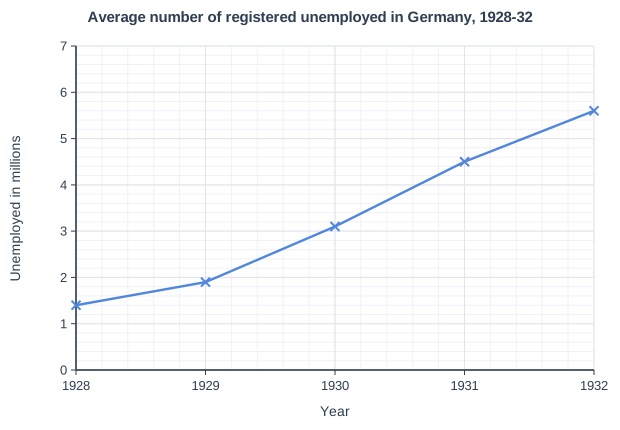
The graph shows the average number of people registered as unemployed in Germany in each year from 1928 to 1932.

Average number of registered unemployed in Germany, 1928-32. Line graph of unemployed in millions (y-axis, 0 to 7) against year (x-axis, 1928 to 1932). The line joins the points (1928, 1.4), (1929, 1.9), (1930, 3.1), (1931, 4.5), (1932, 5.6).

Model answer

Unemployment in Germany rose from an average of about 1.9 million in 1929 to 5.6 million in 1932, and in early 1932 over 6 million people were registered as unemployed. The main reason was that Germany's recovery had depended on foreign money and foreign trade, and both collapsed after 1929.

The first reason was the withdrawal of American loans. Since the Dawes Plan of 1924, German businesses, banks and town councils had borrowed heavily from the USA, and much of this money was in short-term loans that could be called back quickly. After the Wall Street Crash in October 1929, American banks needed their money and stopped lending. German firms that relied on credit to pay wages and buy materials cut production, closed factories or went bankrupt, so their workers were dismissed. Councils that had borrowed to build housing and roads also had to cut projects and jobs.

Secondly, the fall in world trade hit Germany's export industries. The Depression spread to every industrial country, demand collapsed and many countries, including the USA, raised tariffs to protect their own industries. The value of Germany's exports fell by more than half between 1929 and 1932. Coal mines, steelworks and chemical and engineering firms lost orders, and ports such as Hamburg handled far less trade, so miners, factory workers and dockers lost their jobs. Overall, industrial production fell by about 40 per cent.

Thirdly, the banking crisis of 1931 made things much worse. When Austria's largest bank, the Creditanstalt, collapsed in May 1931, foreign investors rushed to take their money out of Germany. In July the Danat Bank failed and the government closed all the banks for two days. After this, firms found it even harder to borrow, more businesses collapsed and unemployment passed 6 million by the start of 1932.

Unemployment also fed on itself. As millions lost their jobs or had their wages and hours cut, they had less money to spend. Shops, small businesses and the industries that made clothing and household goods lost customers and laid off more workers.

Finally, parts of the economy were already weak before the Crash. Farming had been struggling since the late 1920s because of falling food prices and heavy debts, so farmers could not afford to employ labourers, and the industrial boom was already slowing in 1928-29. These weaknesses meant that when the American loans and foreign markets disappeared, there was nothing to cushion the German economy, and unemployment rose very quickly.

Explanation

Top answers explain how each cause led to job losses, for example how the recall of short-term American loans forced firms to cut production and dismiss workers, and they go beyond the two stimulus points to at least three aspects of content, such as the banking crisis of 1931. A common mistake is to describe the Wall Street Crash in detail without linking it to unemployment in Germany. Another is to confuse the Depression with the hyperinflation of 1923.

Mark scheme
  1. 12 marks

    Levels of response (12 marks). AO2: 6 marks. AO1: 6 marks.
    Level 4 (10-12 marks): An analytical explanation is given which is directed consistently at the conceptual focus of the question, showing a line of reasoning that is coherent, sustained and logically structured. [AO2] Accurate and relevant information is precisely selected to address the question directly, showing wide-ranging knowledge and understanding of the required features or characteristics of the period studied. [AO1] No access to Level 4 for answers that do not address three or more aspects of content.
    Level 3 (7-9 marks): An explanation is given, showing some analysis, which is mainly directed at the conceptual focus of the question. It shows a line of reasoning that is generally sustained, although some passages may lack coherence and organisation. [AO2] Accurate and relevant information is included, showing good knowledge and understanding of the required features or characteristics of the period studied. [AO1] Maximum 8 marks for answers that do not address three or more aspects of content.
    Level 2 (4-6 marks): An explanation is given, showing limited analysis and with implicit or unsustained links to the conceptual focus of the question. It shows some development and organisation of material, but a line of reasoning is not sustained. [AO2] Accurate and relevant information is included, showing some knowledge and understanding of the period. [AO1]
    Level 1 (1-3 marks): A simple or generalised answer is given, lacking development and organisation. [AO2] Limited knowledge and understanding of the topic is shown. [AO1]
    0 marks: No rewardable material.
    Performance in AO1 and AO2 is interdependent. An answer displaying no qualities of AO2 cannot be awarded more than the top of Level 1, no matter how strong performance is in AO1; markers should note that the expectation for AO1 is that candidates demonstrate both knowledge and understanding.

    Indicative content (not a checklist; credit other valid points): The withdrawal of American loans: since the Dawes Plan (1924) German businesses, banks and local councils had borrowed heavily from the USA, much of it in short-term loans that could be recalled quickly; after the Wall Street Crash (October 1929) American lenders recalled loans and stopped new lending, so firms that depended on credit cut production, closed or went bankrupt and dismissed workers, and councils cut spending. The fall in world trade: the Depression spread to all the industrial countries; demand collapsed and many countries, including the USA, raised tariffs; the value of German exports fell by more than half between 1929 and 1932 (from about 13.5 to 5.7 billion marks), hitting export industries such as coal, steel, chemicals and machinery and ports such as Hamburg. Industrial production fell by about 40 per cent between 1929 and 1932. The banking crisis of 1931: the collapse of Austria's Creditanstalt (May 1931) led foreign investors to pull money out of Germany; the Danat Bank failed in July 1931 and the banks were closed for two days; credit dried up and more firms failed. A downward spiral: people who lost their jobs or had their wages and hours cut spent less, so shops, small businesses and consumer industries lost trade and laid off more workers. Weaknesses before the Crash: farming had been in difficulty since the late 1920s (falling prices, debts), so farmers could not afford labourers; the industrial boom was already slowing in 1928-29, when average unemployment was already about 1.9 million; rationalisation had replaced some workers with machines. Figures: average registered unemployment rose from about 1.9 million (1929) to about 3.1 million (1930), 4.5 million (1931) and 5.6 million (1932), with over 6 million registered in early 1932 (accept figures in this range). The government's spending cuts may be mentioned briefly as a further cause, but the failure of governments to deal with unemployment is no longer in the specification and is not needed for full marks. Answers must explain how each factor caused job losses, not just describe the Depression. Do not credit confusion of the Depression with the hyperinflation of 1923, the claim that the Wall Street Crash happened in Germany, or material on Nazi job schemes after 1933. No judgement on the most important cause is required.

    Pearson's marking instructions: The middle mark in each level may be achieved by stronger performance in either AO1 or AO2.

Question 4

20 marks

Interpretation 1: From Hunger Years: Germany 1929-33 by Raymond Kestle (fictional), published in 1976.

The Depression brought real hunger to Germany. By early 1932 more than six million people were registered as unemployed, and behind each of them stood a family. Unemployment insurance paid benefit for only a limited period, after which families fell back on smaller crisis payments and then on poor relief from the town council. Children went to school without breakfast, families who could not pay the rent were evicted, and long queues formed outside soup kitchens. Doctors reported the return of diseases of poverty. It was the industrial workers of cities such as Berlin, Hamburg and the Ruhr who suffered most, and for them the Depression meant, above all, the daily struggle to find enough to eat.

Interpretation 2: From The Politics of Despair by Frances Ilbury (fictional), published in 2006.

The deepest wounds of mass unemployment were not to the body but to the mind. Young men who had never held a job saw no future and lost their self-respect. Office workers, shopkeepers and farmers who still had something to lose lived in fear of sinking into poverty. Germans who had seen their savings destroyed in 1923 now watched the banks close in 1931 and concluded that the Republic could not protect them. Millions stopped believing that democracy could solve their problems and turned to parties that promised to destroy it. In 1928 the Nazis and Communists together won about an eighth of the vote; by July 1932 they won more than half of it. That was the real impact of unemployment.

How far do you agree with Interpretation 2 about the impact of mass unemployment on Germany in the years 1930-32? Explain your answer, using both interpretations and your knowledge of the historical context.

Spelling, punctuation, grammar and use of specialist terminology will be assessed in this question.

Model answer

Interpretation 2 argues that 'the deepest wounds of mass unemployment were not to the body but to the mind', so that despair led millions to turn against democracy. Interpretation 1 argues that the Depression's main impact was 'real hunger', especially for industrial workers. I largely agree with Interpretation 2, because the despair it describes changed German politics, but it underestimates the physical suffering that caused that despair.

Interpretation 2 is convincing about the political impact. Its figures are accurate: in 1928 the Nazis won only 2.6 per cent of the vote and the Communists about 10.6 per cent, but in July 1932 the Nazis won 37.3 per cent and the KPD about 14 per cent, giving them together more than half of the seats in the Reichstag. This made it almost impossible to form a majority government. It is also right that fear spread beyond the unemployed. Office workers, shopkeepers and farmers who had lost their savings in 1923 watched the banks close in July 1931, and many turned to the Nazis as the party that promised to restore order. Young men with no jobs flooded into the SA and the Communist fighting groups, which grew rapidly in these years.

However, Interpretation 1 is right that the material hardship was severe. By early 1932 over six million were registered as unemployed, and many more were on short time. Insurance benefit lasted only a limited period, after which families had to manage on lower crisis payments and then poor relief from the council. In 1931 the SPD doctor Julius Moses told the Reichstag that lice had returned and that some children took turns to go to school because the family had only one pair of boots. This suffering was concentrated in industrial cities such as Berlin, Hamburg and the Ruhr, as Interpretation 1 says.

The two historians convey their views differently. Interpretation 1 uses concrete images, such as children going 'without breakfast' and 'queues ... outside soup kitchens', while Interpretation 2 uses the language of emotion ('fear', 'self-respect') and relies on election results.

Overall, I mostly agree with Interpretation 2. If we judge impact by how many people were affected, Interpretation 1 has a strong case, because hunger touched millions of families. But if we judge it by long-term consequences, the loss of faith in democracy mattered more, because it brought the Nazis close to power. In fact the two impacts were linked: hunger and fear produced the despair that changed how Germans voted.

Explanation

Top answers test the claims in Interpretation 2, such as the voting figures and the fears of the middle classes, against precise knowledge, use Interpretation 1 to counter it, and reach a judgement with clear criteria, such as the number of people affected or the long-term consequences. Strong answers also comment on how each historian conveys the view, for example through concrete images of hunger or the language of emotion. Weaker answers write a general essay on the Depression and refer to the interpretations only at the start and end.

Mark scheme
  1. 16 marks

    Levels of response (16 marks). AO4: 16 marks.
    Level 4 (13-16 marks): Answer provides an explained evaluation reviewing the alternative views in coming to a substantiated judgement. Precise analysis of the interpretations is shown, indicating how the differences of view are conveyed and deploying this material to support the evaluation. Relevant contextual knowledge is precisely selected to support the evaluation. An overall judgment is justified and the line of reasoning is coherent, sustained and logically structured.
    Level 3 (9-12 marks): Answer provides an explained evaluation, agreeing or disagreeing with the interpretation. Good analysis of the interpretations is shown indicating difference of view and deploying this to support the evaluation. Relevant contextual knowledge is used directly to support the evaluation. An overall judgement is given with some justification and a line of reasoning is generally sustained.
    Level 2 (5-8 marks): Answer offers valid evaluative comment to agree with or counter the interpretation. Some analysis is shown in selecting and including details from both interpretations to support this comment. Some relevant contextual knowledge is included and linked to the evaluation. An overall judgement is given but its justification is insecure or undeveloped and a line of reasoning is not sustained.
    Level 1 (1-4 marks): Answer offers simple valid comment to agree with or counter the interpretation. Limited analysis of one interpretation is shown by selection and inclusion of some detail in the form of simple paraphrase or direct quotation. Generalised contextual knowledge is included and linked to the evaluation.
    0 marks: No rewardable material.

    Indicative content (not a checklist; credit other valid points): Interpretation 2 argues that the most important impact of mass unemployment was psychological and political: loss of self-respect and hope, fear among the middle classes, loss of faith in democracy and a surge of support for the extremist parties. Points from the interpretations and own knowledge that support Interpretation 2: young people were hit hard and many had never worked; white-collar workers, small shopkeepers and farmers feared losing their status, and many remembered losing their savings in the hyperinflation of 1923; the banking crisis of July 1931 deepened distrust of the Republic; the Nazi vote rose from 2.6 per cent (1928) to 18.3 per cent (1930) and 37.3 per cent (July 1932), and the KPD from 10.6 per cent to about 14 per cent (July 1932) and 16.9 per cent (November 1932), so together they won a majority of seats in July 1932 (319 of 608), making parliamentary government almost impossible; Nazi and KPD membership and the SA grew fast; street violence increased. Points that counter it (including Interpretation 1): the material hardship was severe and widespread: over 6 million registered unemployed in early 1932, many more on short time; insurance benefit lasted only a limited time, then lower crisis relief and municipal poor relief; evictions, soup kitchens, hunger and ill-health (doctors such as Julius Moses reported lice and children without shoes); industrial cities and ports were worst hit; much of the political anger came from this physical suffering, and many unemployed workers voted KPD rather than Nazi. How the views are conveyed: Interpretation 1 uses concrete images of hunger ('without breakfast', 'soup kitchens') and focuses on industrial workers; Interpretation 2 uses language of feeling ('wounds ... to the mind', 'fear', 'self-respect') and focuses on young people and the middle classes and on voting figures. A substantiated judgement might argue that the interpretations are linked (hardship caused the despair that changed voting), using criteria such as how many people were affected, how long the effects lasted, or which effect changed the course of German history. Credit any reasoned judgement supported from both interpretations and own knowledge.

    Pearson's marking instructions (part of the mark scheme): No credit may be given for contextual knowledge unless it is linked to evaluation of the interpretations. In all levels, the second sentence relates to analysis and while the rest relate to evaluation. The following rules will apply: In Level 1, answers that meet the requirements only in relation to analysis without evidence of evaluation should be awarded 1 mark. In other levels, answers that meet the requirements only in relation to analysis (but that also fully meet the descriptors for evaluation of the level below) should be awarded no more than the bottom mark in the level.

  2. 4 marks

    SPaG. Spelling, punctuation, grammar and the use of specialist terminology (4 marks).
    High performance (4 marks): Learners spell and punctuate with consistent accuracy. Learners use rules of grammar with effective control of meaning overall. Learners use a wide range of specialist terms as appropriate.
    Intermediate performance (2-3 marks): Learners spell and punctuate with considerable accuracy. Learners use rules of grammar with general control of meaning overall. Learners use a good range of specialist terms as appropriate.
    Threshold performance (1 mark): Learners spell and punctuate with reasonable accuracy. Learners use rules of grammar with some control of meaning and any errors do not significantly hinder meaning overall. Learners use a limited range of specialist terms as appropriate.
    0 marks: The learner writes nothing. The learner's response does not relate to the question. The learner's achievement in SPaG does not reach the threshold performance level, e.g. errors in spelling, punctuation and grammar severely hinder meaning.

    SPaG is marked separately from the 16 marks for the answer, on the whole response.

Ready to try the rest? Every answer you write is marked against the mark scheme, so you can see exactly where the marks are.

Study Helper Hints first, answers after you try

Stuck on this one? Ask for a hint and I’ll point you in the right direction, without giving the answer away. Once you’ve checked your answer, I’ll show you how the marks are awarded.