
Level:
Correct: 0
Incorrect: 0
Marks: 0/0
Exam Practice
Subject:
Topics:
AQA GCSE History (Germany 1890-1945) Smart practice A mixed round aimed at your weak spots
Unit 1
Part one: Germany and the growth of democracy
Unit 2
Part two: Germany and the Depression
Unit 3
Part three: The experiences of Germans under the Nazis
Avg
score:
–
Topics
done:
0/9

Weimar democracy

Practise 45 exam-style questions on Weimar democracy for AQA GCSE History (Germany 1890-1945). Write your answer as you would in the exam and get it marked in seconds against the mark scheme, point by point, with an AI tutor on hand if you get stuck.

  • 45 questions
  • 1–12 marks each
  • Instant marking
  • No sign-up needed
20 questions, marked as you go

Sample questions with model answers

Here are 4 of the questions in this topic, each with a model answer, an explanation of why it earns the marks and the mark scheme an examiner would use.

Question 1

2 marks

Name two artists, architects, writers or film-makers of Weimar Germany, and give one work or achievement of each.

Model answer

Fritz Lang directed the film 'Metropolis' (1927). Bertolt Brecht wrote 'The Threepenny Opera' (1928) with the composer Kurt Weill.

Explanation

Weimar Germany was a centre of modern culture: New Objectivity painters such as Dix and Grosz, Bauhaus design, Expressionist and science-fiction films from the UFA studios, and political theatre such as Brecht's. Each mark needs a named person matched with a real work or achievement.

Mark scheme
  1. 1 mark

    One person correctly matched with a work or achievement, e.g. Otto Dix - paintings of war cripples and Berlin nightlife (e.g. 'Metropolis', 1928); George Grosz - satirical pictures such as 'Pillars of Society' (1926); Walter Gropius - founded the Bauhaus (1919).

    One mark for each correct person-and-work pair, max 2. Other acceptable pairs: Fritz Lang - 'Metropolis' (film, 1927); Robert Wiene - 'The Cabinet of Dr Caligari' (1920); F. W. Murnau - 'Nosferatu' (1922); Marlene Dietrich - 'The Blue Angel' (1930); Bertolt Brecht (with Kurt Weill) - 'The Threepenny Opera' (1928); Erich Maria Remarque - 'All Quiet on the Western Front' (1929); Thomas Mann - 'The Magic Mountain' (1924); Paul Klee or Wassily Kandinsky - taught at the Bauhaus; Ludwig Mies van der Rohe - modern architecture, Bauhaus director.

  2. 1 mark

    A second person correctly matched with a work or achievement.

    A name without a work or achievement does not score.
Question 2

4 marks

Interpretation A: from the memoirs of a former Freikorps officer, published in 1934. (Written for practice.)
In January 1919 Germany stood on the edge of the abyss. The Spartacists, inspired by Lenin's revolution in Russia, had seized the newspaper offices of Berlin and meant to turn Germany into a Soviet state. The government had no army it could trust. It was we, the volunteers of the Freikorps, who answered the call and cleared the streets. The danger from the left did not end there: Red risings in Munich in 1919 and in the Ruhr in 1920 had to be crushed too. Without us, Germany would have gone the way of Russia.

Interpretation B: from a history of the Weimar Republic written by a German historian in 1985. (Written for practice.)
The real danger to Weimar democracy came from the right, not the left. The Spartacist rising was small, badly planned and crushed within a week. The Kapp Putsch of 1920 was far more serious: the army refused to defend the government, which had to flee Berlin, and the republic was saved only by a general strike of the workers. Right-wing terrorists murdered hundreds of opponents, including the ministers Erzberger and Rathenau, and judges let most of them off lightly. In 1923 Hitler tried to seize power in Munich. The right never accepted the republic.

How does Interpretation B differ from Interpretation A about the threats to the Weimar Republic between 1919 and 1923? Explain your answer based on what it says in Interpretations A and B.

Model answer

Interpretation A argues that the greatest threat to Germany came from the communist left. It says the Spartacists, inspired by Lenin, had seized the newspaper offices in Berlin and meant to create a Soviet state, and that further 'Red risings' in Munich and the Ruhr had to be crushed. In A's view, the Freikorps saved Germany from going 'the way of Russia'. Interpretation B argues the opposite. It says 'the real danger' came from the right: the Spartacist rising was 'small, badly planned and crushed within a week', whereas in the Kapp Putsch the army refused to defend the government, which had to flee Berlin and was saved only by the workers' general strike. B also points to right-wing murders of politicians such as Erzberger and Rathenau, lenient judges and Hitler's attempt to seize power in 1923. So A sees the left as the main threat and the Freikorps as saviours, while B sees the right as the main and lasting threat.

Explanation

Level 2 needs the difference in view explained and supported from both: A's communist danger and Freikorps rescue against B's argument that the Kapp Putsch, political murders and Hitler's putsch made the right the real threat.

Mark scheme
  1. 4 marks

    Levels of response (4 marks).
    Level 2 (3-4 marks): Developed analysis of the interpretations: explains how they differ about the threats to the republic, supported by content from both, e.g. A argues that the great danger came from the communist left - the Spartacists of 1919 and later 'Red risings' in Munich and the Ruhr - and that the Freikorps saved Germany, whereas B argues that 'the real danger' came from the right: the Spartacist rising was small and quickly crushed, while the Kapp Putsch, right-wing murders of politicians, lenient judges and Hitler's putsch showed that the right never accepted the republic.
    Level 1 (1-2 marks): Simple analysis: identifies a difference, e.g. A says the left was the main threat and B says the right was, with little or no support from the content.
    0 marks: nothing worthy of credit.

    Indicative content (not a checklist; credit other valid points): A says Germany stood 'on the edge of the abyss' in January 1919; A says the Spartacists, inspired by Lenin, meant to create a Soviet state; A says the government had no army it could trust and the Freikorps saved it; A points to further left-wing risings in Munich (1919) and the Ruhr (1920); A claims that without the Freikorps Germany would have 'gone the way of Russia'; B says the real danger came from the right; B says the Spartacist rising was 'small, badly planned and crushed within a week'; B says the Kapp Putsch was more serious because the army refused to defend the government; B says the republic was saved by a general strike of workers, not by soldiers; B points to right-wing murders of Erzberger and Rathenau and lenient judges, and to Hitler's attempt in 1923; so A sees the Freikorps as Germany's saviours, while B sees the right, including such forces, as the main threat.

Question 3

8 marks

Interpretation A: from a book by a German Nationalist (DNVP) politician, published in 1930. (Written for practice.)
Stresemann's so-called successes were a policy of surrender. At Locarno he gave up Alsace-Lorraine for ever and accepted that the Rhineland must stay without German troops. In joining the League of Nations, Germany joined the club of the victors who had written the Versailles Diktat. The Young Plan has now chained our children and grandchildren to reparations until 1988. Germany gained a few kind words from foreign ministers; it gave away its honour. A true German statesman would have torn up the treaty, not signed new ones.

Interpretation B: from a history of Germany between the wars, written by a British historian in 2001. (Written for practice.)
Stresemann achieved more for Germany than anyone thought possible in 1923. By accepting the western frontier at Locarno he won France's trust and made a repeat of the Ruhr occupation unlikely. In 1926 Germany joined the League of Nations with a permanent seat on its Council, returning as a great power. The Dawes and Young Plans eased the burden of reparations, and Allied troops left the Rhineland five years early. All this was gained by negotiation at a time when Germany was too weak to do anything else.

Which interpretation gives the more convincing opinion about the impact of Stresemann's foreign policy on Germany? Explain your answer based on your contextual knowledge and what it says in Interpretations A and B.

Model answer

Interpretation A has some truth. At Locarno in 1925 Germany did accept its western borders, including the loss of Alsace-Lorraine, and agreed that the Rhineland would remain demilitarised. Most of the Versailles terms remained in force - the 100,000-man army, the war guilt clause and the losses in the east - and the Young Plan of 1929 still required Germany to pay reparations until 1988. Many nationalists agreed with A: the DNVP and the Nazis campaigned together against the Young Plan. However, A's claim that Germany gained only 'a few kind words' is not convincing, and its call to 'tear up the treaty' ignores the fact that Germany was disarmed and could not enforce such a policy.

Interpretation B is more convincing because the evidence shows real gains. The Dawes Plan of 1924 reduced annual reparations payments and led to the French and Belgians leaving the Ruhr by 1925. Locarno removed the threat of another French invasion and meant Germany was treated as an equal again. In 1926 Germany joined the League of Nations with a permanent seat on the Council, and in 1928 it signed the Kellogg-Briand Pact. The Young Plan reduced the total amount owed, ended Allied control of German finances and was followed by Allied troops leaving the Rhineland in 1930, five years early. Stresemann never accepted the eastern borders and hoped to change them peacefully later.

Overall, B gives the more convincing opinion. Stresemann did not overturn Versailles, as A points out, but in 1923 Germany had been occupied, bankrupt and isolated, and by 1929 it was respected, free of foreign troops in the Ruhr and paying less. The referendum against the Young Plan in December 1929 won only about 14% of the vote, which suggests that most Germans did not share A's nationalist view.

Explanation

Level 4 needs both interpretations tested against specific knowledge of Locarno, the League, Kellogg-Briand and the Dawes and Young Plans, with a sustained judgement. A strong answer weighs what Stresemann gained against what remained of Versailles, and considers what was realistically possible for a weak Germany.

Mark scheme
  1. 8 marks

    Levels of response (8 marks).
    Level 4 (7-8 marks): Complex evaluation of both interpretations, using accurate contextual knowledge to test their arguments (e.g. Locarno's acceptance of the western borders and the demilitarised Rhineland, the continuing Versailles terms and the Young Plan's payments until 1988, against the end of the Ruhr occupation, League membership with a permanent Council seat, the Kellogg-Briand Pact, lower reparations and the early evacuation of the Rhineland), leading to a sustained judgement about which is more convincing.
    Level 3 (5-6 marks): Developed evaluation of both interpretations, supported by relevant contextual knowledge, but the judgement is not sustained or one interpretation is evaluated in less depth.
    Level 2 (3-4 marks): Simple evaluation of one interpretation (or of both, based mainly on their content) supported by some relevant knowledge.
    Level 1 (1-2 marks): Basic analysis: describes or paraphrases one or both interpretations, or asserts which is more convincing with little or no contextual knowledge.
    0 marks: nothing worthy of credit.

    Indicative content (not a checklist; credit other valid points): Supporting A: at Locarno (1925) Germany accepted its western borders, including the loss of Alsace-Lorraine, and agreed the Rhineland would stay demilitarised; most Versailles terms remained - the 100,000-man army, the loss of land in the east, the war guilt clause; the Young Plan (1929) still required payments until 1988; joining the League meant working with the countries that had imposed the treaty; many nationalists agreed with A, and the DNVP and Nazis campaigned against the Young Plan. Supporting B: the Dawes Plan (1924) cut annual payments and led to the French and Belgians leaving the Ruhr by 1925; Locarno ended the threat of French invasion and Germany was treated as an equal; Germany joined the League in 1926 with a permanent seat on the Council; the Treaty of Berlin (1926) kept good relations with the USSR; Germany signed the Kellogg-Briand Pact (1928) with over 60 other countries eventually; the Young Plan reduced the total owed and ended Allied supervision of German finances; Allied troops left the Rhineland in 1930, five years early; Stresemann did not accept the eastern borders and hoped to revise them peacefully; he shared the Nobel Peace Prize (1926); the referendum against the Young Plan (December 1929) won only about 14% of the vote, suggesting most Germans did not share A's view. Possible judgements: B is more convincing because Germany gained a great deal by negotiation when it was too weak to use force; A is right that Versailles was not overturned, but tearing up the treaty was impossible in the 1920s.

Question 4

12 marks

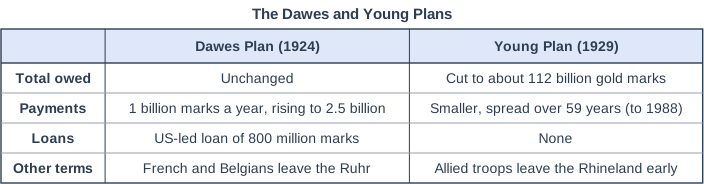
Figure 1 compares the Dawes Plan and the Young Plan.

Which of the following was more important for the German economy between 1924 and 1930:
• the Dawes Plan (1924)
• the Young Plan (1929)?
Explain your answer with reference to both bullet points.

The Dawes and Young Plans. Table with columns (row headings), "Dawes Plan (1924)", "Young Plan (1929)". Total owed; Dawes Plan (1924): Unchanged; Young Plan (1929): Cut to about 112 billion gold marks | Payments; Dawes Plan (1924): 1 billion marks a year, rising to 2.5 billion; Young Plan (1929): Smaller, spread over 59 years (to 1988) | Loans; Dawes Plan (1924): US-led loan of 800 million marks; Young Plan (1929): None | Other terms; Dawes Plan (1924): French and Belgians leave the Ruhr; Young Plan (1929): Allied troops leave the Rhineland early.

Model answer

The Dawes Plan of 1924 was very important for the German economy. As Figure 1 shows, it did not reduce the total Germany owed, but it cut annual payments to 1 billion marks a year at first, rising to 2.5 billion. It also led to the French and Belgians leaving the Ruhr by 1925, so Germany's main industrial region could work normally again. Most importantly, it brought in American money: a first loan of 800 million marks, and then huge loans from American banks, by many estimates about 25 billion marks between 1924 and 1930. This money paid for new factories, machinery, housing and public works, and by 1928 industrial production had returned to its pre-war level. However, it made Germany dependent on short-term loans that could be called back at any time.

The Young Plan of 1929 also helped the economy, at least on paper. Figure 1 shows that it cut the total owed to about 112 billion gold marks and spread the payments over 59 years, until 1988, so annual payments were lower. It also ended Allied supervision of German finances and was followed by Allied troops leaving the Rhineland in 1930. But its timing was disastrous. It was agreed just as the Wall Street Crash of October 1929 began the Depression, and reparations were suspended in 1931 and effectively ended in 1932, so it had little time to make a difference. It also backfired politically: Hugenberg and Hitler campaigned against it, and although their referendum in December 1929 failed, the campaign gave the Nazis national publicity.

Overall, the Dawes Plan was more important for the German economy. It ended the Ruhr crisis, supported the new currency and provided the loans that paid for five years of recovery. The Young Plan reduced the burden more in theory, but it came too late: by the time it took effect, the Depression and the recall of American loans - a weakness created by the Dawes Plan itself - had overwhelmed the economy. So the Dawes Plan was more important both for the recovery of 1924-29 and, through Germany's dependence on American loans, for the collapse that followed.

Explanation

Use Figure 1 for the terms, but Level 4 needs your own knowledge of the effects and a sustained judgement. A strong answer uses timing: the Dawes Plan financed the whole 1924-29 recovery, while the Young Plan was agreed as the Depression began and had little time to help the economy.

Mark scheme
  1. 12 marks

    Levels of response (12 marks).
    Level 4 (10-12 marks): Complex explanation of both bullet points, supported by specific knowledge and evidence from Figure 1 (e.g. the Dawes Plan's reduced annual payments, the end of the Ruhr occupation, American loans and the recovery of 1924-29; the Young Plan's lower total, longer timescale, end of Allied supervision and the Rhineland evacuation, its timing at the start of the Depression and the nationalist campaign against it), leading to a sustained judgement about which was more important for the economy.
    Level 3 (7-9 marks): Developed explanation of both bullet points, supported by relevant, accurate knowledge; any judgement is not sustained or is only asserted at the end.
    Level 2 (4-6 marks): Simple explanation of one or both bullet points, with some relevant knowledge; or a developed explanation of only one bullet point.
    Level 1 (1-3 marks): Basic explanation of one or both bullet points, e.g. 'the Dawes Plan gave loans' or 'the Young Plan cut reparations', with limited knowledge, or only repeating Figure 1.
    0 marks: nothing worthy of credit.

    Indicative content (not a checklist; credit other valid points): Dawes Plan (1924): annual payments cut to 1 billion marks, rising to 2.5 billion after five years; the total was unchanged; French and Belgian troops left the Ruhr by 1925, so production restarted; an initial loan of 800 million gold marks and then large American loans (about 25 billion marks between 1924 and 1930 by many estimates); the Reichsbank was reorganised under Allied supervision, supporting the new Reichsmark; the loans paid for new factories, rationalisation, housing and public works; industrial production regained its pre-war level by 1928; but it made Germany dependent on short-term American loans, which were recalled after the Wall Street Crash (October 1929). Young Plan (1929): reduced the total owed to about 112 billion gold marks (often given in textbooks as about £2,000 million), spread over 59 years until 1988; annual payments were lower; Allied supervision of German finances ended; Allied troops left the Rhineland in 1930, five years early; it was agreed just as the Depression began, so it had little chance to help - reparations were suspended in 1931 (Hoover Moratorium) and effectively ended in 1932; politically it backfired: Hugenberg and Hitler campaigned against it and forced a referendum (December 1929), which failed but gave the Nazis national publicity. Possible judgements: the Dawes Plan was more important because it ended the crisis of 1923 and financed five years of recovery; the Young Plan was more important in principle because it reduced the total, but its timing meant its economic effect was small; credit a judgement that considers political as well as economic effects if it is linked to the economy.

Ready to try the rest? Every answer you write is marked against the mark scheme, so you can see exactly where the marks are.

AI Tutor Hints first, answers after you try

Hi! Stuck? Ask me for a hint and I’ll help you work it out. Once you’ve checked your answer I can explain exactly where the marks are.