Level:
Correct: 0
Incorrect: 0
Marks: 0/0
Exam Practice
Subject:
Topics:
AQA GCSE History (Germany 1890-1945) Smart practice A mixed round aimed at your weak spots
Unit 1
Part one: Germany and the growth of democracy
Unit 2
Part two: Germany and the Depression
Unit 3
Part three: The experiences of Germans under the Nazis
Avg
score:
–
Topics
done:
0/9

Control

Practise 44 exam-style questions on Control for AQA GCSE History (Germany 1890-1945). Write your answer as you would in the exam and get it marked in seconds against the mark scheme, point by point, with an AI tutor on hand if you get stuck.

  • 44 questions
  • 1–12 marks each
  • Instant marking
  • No sign-up needed
20 questions, marked as you go

Sample questions with model answers

Here are 4 of the questions in this topic, each with a model answer, an explanation of why it earns the marks and the mark scheme an examiner would use.

Question 1

2 marks

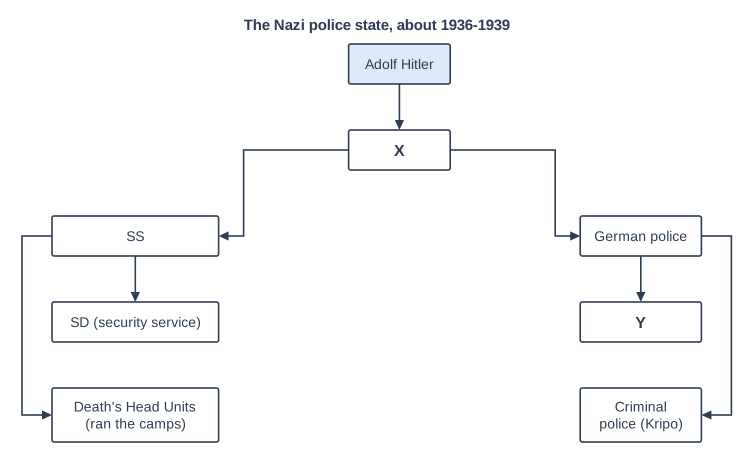
The diagram shows how the Nazi police state was organised in the late 1930s.

X was the head of the SS who also became head of all the German police in 1936. Y was the secret state police, which could arrest people and hold them without trial.

What should replace X and Y?

The Nazi police state, about 1936-1939. Block diagram with eight parts in five rows. Top row: a box "Adolf Hitler" (shaded). Second row: a box labelled X. Third row, left to right: a box "SS" and a box "German police". Fourth row, left to right: a box "SD (security service)" and a box labelled Y. Bottom row, left to right: a box "Death's Head Units (ran the camps)" and a box "Criminal police (Kripo)". Connections: an arrow from "Adolf Hitler" to box X; an arrow from box X to "SS"; an arrow from box X to "German police"; an arrow from "SS" to "SD (security service)"; an arrow from "SS" to "Death's Head Units (ran the camps)", going round on the left; an arrow from "German police" to box Y; an arrow from "German police" to "Criminal police (Kripo)", going round on the right.

Model answer

X is Heinrich Himmler and Y is the Gestapo.

Explanation

Himmler led the SS from 1929 and became Chief of the German Police in 1936, so he controlled both the SS (including the SD and the Death's Head Units that ran the concentration camps) and the police, including the Gestapo. His deputy Reinhard Heydrich ran the SD and the Gestapo, which were combined in the Reich Main Security Office in 1939.

Mark scheme
  1. 1 mark

    X: Heinrich Himmler.

    Accept: Himmler. Do not accept Heydrich, Göring or Goebbels.

  2. 1 mark

    Y: the Gestapo.

    Accept: Geheime Staatspolizei / secret police. Do not accept SS or SD (the SD appears separately in the diagram).

Question 2

4 marks

Interpretation A: from the memoirs of a German writer who left Germany in 1933, written in 1960. (Written for practice.)
Within a few years the Nazis destroyed what had made German culture great. They burned books in the squares, closed the Bauhaus, banned modern painting as 'degenerate' and drove out Jewish musicians, actors and scientists. Writers like me had to choose between silence and exile. What remained was cheap propaganda: heroic peasants, marching soldiers and endless films about German greatness. Germany became a cultural desert.

Interpretation B: from an interview with a woman who worked in a textile factory in the 1930s, recorded in 1987. (Written for practice.)
People talk about books being burned, but nobody I knew read those books. For us, the 1930s brought culture we had never had before. Strength Through Joy organised cheap tickets for the theatre and concerts, and the works choir sang every week. We had a radio at home for the first time and went to the cinema every Saturday. The films were exciting and the music was cheerful. I never felt that anything had been taken away from me.

How does Interpretation B differ from Interpretation A about the effects of Nazi policies on culture?

Explain your answer based on what it says in Interpretations A and B.

Model answer

Interpretation A argues that the Nazis destroyed German culture, while Interpretation B argues that Nazi policies gave ordinary people more access to culture. A says the Nazis burned books, closed the Bauhaus, banned modern painting and drove out Jewish musicians, actors and scientists, leaving only 'cheap propaganda' and turning Germany into 'a cultural desert'. B says that the book burnings meant nothing to the people she knew, and that the 1930s brought them culture they had never had before: cheap theatre and concert tickets through Strength Through Joy, a works choir, a first radio and weekly visits to the cinema. Where A sees loss and propaganda, B sees new opportunities and enjoyment, and she 'never felt that anything had been taken away'.

Explanation

Level 2 needs a developed difference supported from both interpretations - destruction, exile and propaganda in A against access, enjoyment and entertainment in B. Noticing that they are talking about different kinds of culture (high culture against popular entertainment) can strengthen the analysis.

Mark scheme
  1. 4 marks

    Levels of response (4 marks).
    Level 2 (3-4 marks): Developed analysis of both interpretations: explains how they differ about the effects of Nazi policies on culture (e.g. A says the Nazis destroyed German culture and left a 'cultural desert', while B says ordinary workers gained access to culture they had never had before), supported by detail from each interpretation.
    Level 1 (1-2 marks): Simple analysis: identifies a difference (e.g. A says culture got worse, B says it got better) with little or no support from the interpretations.
    0 marks: nothing worthy of credit.

    Indicative content (not a checklist; credit other valid points): A says the Nazis 'destroyed what had made German culture great', while B says the 1930s brought her 'culture we had never had before'; A stresses losses - book burnings, the closure of the Bauhaus, the ban on modern art, the expulsion of Jewish artists and the exile of writers - while B stresses gains - cheap theatre and concert tickets from Strength Through Joy, a works choir, a first radio, weekly cinema; A dismisses Nazi culture as 'cheap propaganda', while B found the films 'exciting' and the music 'cheerful'; B dismisses the book burnings as irrelevant ('nobody I knew read those books'), while A sees them as central; A ends with 'a cultural desert', B with 'I never felt that anything had been taken away from me'.

Question 3

8 marks

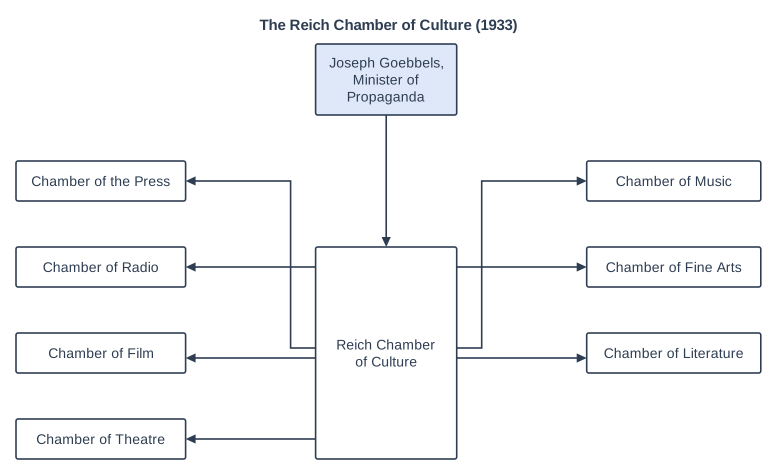
Figure 1 shows how the Reich Chamber of Culture, set up in 1933, was organised. Every writer, artist, musician, actor, film-maker and journalist had to belong to the right chamber in order to work.

In what ways were the lives of artists, writers and musicians in Germany affected by Nazi control of culture?

Explain your answer.

The Reich Chamber of Culture (1933). Block diagram with nine parts in five rows. Top row: a box "Joseph Goebbels, Minister of Propaganda" (shaded). Second row, left to right: a box "Chamber of the Press" and a box "Chamber of Music". Third row, left to right: a box "Chamber of Radio", a box "Reich Chamber of Culture" (tall, across three rows) and a box "Chamber of Fine Arts". Fourth row, left to right: a box "Chamber of Film" and a box "Chamber of Literature". Bottom row: a box "Chamber of Theatre". Connections: an arrow from "Joseph Goebbels, Minister of Propaganda" to "Reich Chamber of Culture"; an arrow from "Reich Chamber of Culture" to "Chamber of the Press"; an arrow from "Reich Chamber of Culture" to "Chamber of Radio"; an arrow from "Reich Chamber of Culture" to "Chamber of Film"; an arrow from "Reich Chamber of Culture" to "Chamber of Theatre"; an arrow from "Reich Chamber of Culture" to "Chamber of Music"; an arrow from "Reich Chamber of Culture" to "Chamber of Fine Arts"; an arrow from "Reich Chamber of Culture" to "Chamber of Literature".

Model answer

Nazi control of culture decided who could work. As Figure 1 shows, the Reich Chamber of Culture, under Goebbels, had separate chambers for the press, radio, film, theatre, music, fine arts and literature, and every artist, writer and musician had to belong to the right one. Jews, political opponents and those whose work the Nazis disliked were refused membership, which meant that they could no longer earn a living from their art.

It also decided what could be produced. Books by Jewish, communist and pacifist writers, such as Erich Maria Remarque, were burned in May 1933 and banned. Modern art was removed from galleries, the Bauhaus closed in 1933, and in 1937 modern paintings were mocked in the Degenerate Art exhibition. Jazz was banned from the radio and music by Jewish composers such as Mendelssohn was no longer performed.

For those who conformed, there were opportunities. The Nazis promoted realistic art showing heroic workers, peasants, soldiers and mothers, displayed at the Great German Art Exhibition of 1937, and favoured composers such as Wagner and Beethoven. Architects like Albert Speer received huge commissions, and film-makers such as Leni Riefenstahl were rewarded for propaganda films.

Many others chose or were forced into exile. Writers such as Thomas Mann and Bertolt Brecht, and scientists such as Albert Einstein, left Germany, while some who stayed chose silence. So Nazi control brought success to a few loyal artists, but censorship, unemployment or exile to many of Germany's most creative people.

Explanation

Level 4 explains several ways, linked - for example contrasting artists who conformed and were rewarded with those who were banned or exiled, using the Reich Chamber of Culture as the means of control. A list of banned things without explaining how artists' lives were affected is Level 2.

Mark scheme
  1. 8 marks

    Levels of response (8 marks).
    Level 4 (7-8 marks): Complex explanation of changes: several developed explanations of ways artists, writers and musicians were affected (e.g. compulsory membership of the Reich Chamber of Culture, bans and censorship, the promotion of approved styles, exile and persecution), linked together - for example showing how effects differed for those who conformed and those who did not - supported by specific, accurate knowledge.
    Level 3 (5-6 marks): Developed explanation of two or more ways, supported by relevant knowledge.
    Level 2 (3-4 marks): Simple explanation of one way.
    Level 1 (1-2 marks): Basic explanation: general statements with little specific knowledge.
    0 marks: nothing worthy of credit.

    Indicative content (not a checklist; credit other valid points): the Reich Chamber of Culture (1933), under Goebbels, had separate chambers for the press, radio, film, theatre, music, fine arts and literature; anyone not accepted as a member - Jews, political opponents, 'degenerate' artists - could not work; censorship: books by Jewish, communist and pacifist writers (e.g. Erich Maria Remarque) burned in May 1933 and banned; modern art (Expressionism, abstract art) removed from galleries, with thousands of works confiscated, and mocked in the Degenerate Art exhibition (1937); the Bauhaus closed in 1933; jazz banned from the radio (1935); music by Jewish composers such as Mendelssohn and Mahler banned; approved culture: realistic art of heroic workers, peasants, soldiers and mothers ('blood and soil'), shown at the Great German Art Exhibition (1937); German composers such as Wagner and Beethoven promoted; monumental architecture by Albert Speer; film-makers such as Leni Riefenstahl were rewarded; exile: many writers, artists, musicians and scientists left Germany, e.g. Thomas Mann, Bertolt Brecht, Albert Einstein; conformity: those who stayed had to avoid criticism, and some chose 'inner emigration' (silence).

Question 4

12 marks

Which of the following was the more important aim of Nazi policies towards culture:
- removing Jewish, modern and 'un-German' influences
- glorifying Nazi values and the Nazi regime?

Explain your answer with reference to both bullet points.

Model answer

Removing Jewish, modern and 'un-German' influences was a key aim of Nazi cultural policy. The Nazis blamed Weimar culture for Germany's 'decadence', linking modern art, jazz and experimental theatre with Jews and communists. On 10 May 1933 books by Jewish, communist and pacifist authors were burned in public. The Reich Chamber of Culture, set up in 1933, excluded Jews and opponents from working in the arts, and the Bauhaus was closed the same year. Thousands of modern paintings were removed from galleries, and in 1937 the Degenerate Art exhibition in Munich mocked them. Jazz was banned from the radio in 1935 and music by Jewish composers such as Mendelssohn and Mahler was banned. Many of Germany's leading writers, artists and scientists went into exile.

Glorifying Nazi values and the regime was also an important aim. The Nazis promoted realistic art showing heroic workers, peasants, soldiers and mothers, celebrating race, family and the land, which was shown at the Great German Art Exhibition in the new House of German Art. Wagner and Beethoven were promoted as great German composers. Albert Speer's monumental architecture, such as the Nuremberg rally grounds and the new Reich Chancellery of 1939, was designed to show the power and permanence of the regime, and films such as Triumph of the Will glorified Hitler. Through Strength Through Joy, millions of workers were given cheap access to approved theatre and concerts.

Overall, glorifying Nazi values and the regime was the more important aim. Removing 'un-German' influences was the first thing the Nazis did, in 1933, and it was the more dramatic, but it was a means to an end. Goebbels wanted culture to serve the regime by spreading its values and building loyalty to Hitler, and the influences were removed so that nothing could compete with that message. This explains why the Nazis did not simply ban things but put so much effort and money into approved art, architecture, film and Strength Through Joy, and why the Degenerate Art exhibition was paired with the Great German Art Exhibition of approved art: the aim was to show Germans what their culture should be, not only what it should not be.

Explanation

Level 4 explains both aims with specific detail - book burnings, the Reich Chamber of Culture, the Degenerate Art exhibition; approved art, Speer, Riefenstahl and Strength Through Joy - and reaches a sustained judgement, for example that removal was a means to the end of glorification. Either judgement can reach Level 4 if well supported.

Mark scheme
  1. 12 marks

    Levels of response (12 marks).
    Level 4 (10-12 marks): Complex explanation of both bullet points: explains how Nazi cultural policy removed Jewish, modern and 'un-German' influences (e.g. book burnings, the Reich Chamber of Culture, the Degenerate Art exhibition, bans on jazz and Jewish composers) and glorified Nazi values and the regime (e.g. approved art, Speer's architecture, Riefenstahl's films, Strength Through Joy), supported by specific, accurate knowledge, leading to a sustained judgement about which aim was more important.
    Level 3 (7-9 marks): Developed explanation of both bullet points, supported by relevant knowledge.
    Level 2 (4-6 marks): Simple explanation of one or both bullet points.
    Level 1 (1-3 marks): Basic explanation of one or both bullet points: general statements with little specific knowledge.
    0 marks: nothing worthy of credit.

    Indicative content (not a checklist; credit other valid points): Removing influences: the Nazis blamed Weimar culture for 'decadence' and linked modern art, jazz and experimental theatre to Jews and communists; book burnings (10 May 1933) of Jewish, communist and pacifist authors; Jews and opponents excluded through the Reich Chamber of Culture (1933); the Bauhaus closed (1933); thousands of modern artworks removed from galleries, and the Degenerate Art exhibition (1937) mocked them; jazz banned from the radio (1935) as 'Negro' music; Jewish composers (Mendelssohn, Mahler) banned; many artists and scientists went into exile. Glorifying values and the regime: realistic art of heroic workers, peasants, soldiers and mothers ('blood and soil'); the Great German Art Exhibition and the House of German Art (1937); classical German composers (Wagner, Beethoven) promoted; Speer's monumental architecture (Nuremberg rally grounds, the new Reich Chancellery of 1939, plans for 'Germania'); films such as Triumph of the Will and Hitler Youth Quex; Strength Through Joy brought approved culture to workers; culture celebrated the Volksgemeinschaft, race, family and the leader. Possible judgements: removing influences was more important because the Nazis acted on it at once in 1933 and most popular culture was entertainment rather than glorification; or glorification was more important because the purpose of removing influences was to make room for culture that served the regime; the two aims were linked parts of Goebbels's policy of coordination.

Ready to try the rest? Every answer you write is marked against the mark scheme, so you can see exactly where the marks are.

AI Tutor Hints first, answers after you try

Hi! Stuck? Ask me for a hint and I’ll help you work it out. Once you’ve checked your answer I can explain exactly where the marks are.