
Level:
Correct: 0
Incorrect: 0
Marks: 0/0
Exam Practice
Subject:
Topics:
AQA GCSE History (Germany 1890-1945) Smart practice A mixed round aimed at your weak spots
Unit 1
Part one: Germany and the growth of democracy
Unit 2
Part two: Germany and the Depression
Unit 3
Part three: The experiences of Germans under the Nazis
Avg
score:
–
Topics
done:
0/9

Kaiser Wilhelm and the difficulties of ruling Germany

Practise 46 exam-style questions on Kaiser Wilhelm and the difficulties of ruling Germany for AQA GCSE History (Germany 1890-1945). Write your answer as you would in the exam and get it marked in seconds against the mark scheme, point by point, with an AI tutor on hand if you get stuck.

  • 46 questions
  • 2–12 marks each
  • Instant marking
  • No sign-up needed
20 questions, marked as you go

Sample questions with model answers

Here are 4 of the questions in this topic, each with a model answer, an explanation of why it earns the marks and the mark scheme an examiner would use.

Question 1

2 marks

Figure 1 summarises the Navy Laws passed by the Reichstag between 1898 and 1912.

State what should replace X, and give one reason why the Kaiser and Tirpitz wanted this law.
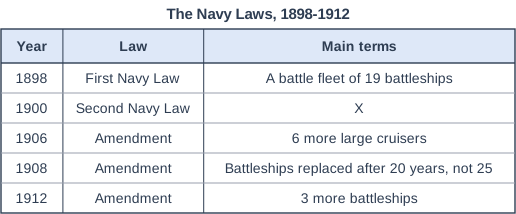
The Navy Laws, 1898-1912. Table with columns "Year", "Law", "Main terms". Year: 1898; Law: First Navy Law; Main terms: A battle fleet of 19 battleships | Year: 1900; Law: Second Navy Law; Main terms: X | Year: 1906; Law: Amendment; Main terms: 6 more large cruisers | Year: 1908; Law: Amendment; Main terms: Battleships replaced after 20 years, not 25 | Year: 1912; Law: Amendment; Main terms: 3 more battleships.

Model answer

X should be that the battle fleet was doubled to 38 battleships. The Kaiser and Tirpitz wanted this because they hoped a large fleet in the North Sea would be such a threat to Britain's Royal Navy that Britain would not dare to risk a war with Germany, so Germany could become a world power.

Explanation

The Second Navy Law of 1900 turned the navy into a long-term challenge to Britain and led to the naval race. Because the size of the fleet was fixed by law, Tirpitz also hoped to stop the Reichstag cutting naval spending from year to year.

Mark scheme
  1. 1 mark

    X: the planned battle fleet was doubled, to 38 battleships (to be built over about 20 years).

    Accept: doubled the size of the fleet; 38 battleships.

  2. 1 mark

    A reason, e.g. to build a fleet strong enough to challenge Britain's Royal Navy in the North Sea, so that Britain would not risk a war with Germany (Tirpitz's 'risk theory'); to make Germany a world power with an empire and navy to match (Weltpolitik, a 'place in the sun'); the Kaiser's personal wish for a navy to rival Britain's; to rally national pride and support for the government at home.

    Accept: to protect German trade and colonies. Max 1.

Question 2

4 marks

Interpretation A: from a booklet about German social policy published by the German government for foreign visitors in 1913. (Written for practice.)
No country in the world has done more for its workers than Germany. Since the 1880s our insurance schemes have protected millions of working people against sickness, accidents, disability and old age. Since 1891 the law has banned Sunday work in factories and protected women and children from long hours. The Insurance Code of 1911 brought these schemes together and extended them to still more workers. These measures show the care of the Kaiser and his government for the welfare of every German.

Interpretation B: from a history of the German labour movement written by a British historian in 1990. (Written for practice.)
The social reforms of the Kaiser's reign were designed as much to weaken socialism as to help workers. Benefits were small: the old-age pension began only at seventy, an age many manual workers never reached, and workers paid much of the cost of their insurance out of their own wages. At the same time the government tried to pass a law to imprison anyone who pressured others to strike. The reforms failed in their political aim: the Social Democrats' vote rose at almost every election, and by 1912 they were the largest party in the Reichstag.

How does Interpretation B differ from Interpretation A about the social reforms of the years 1890-1914? Explain your answer based on what it says in Interpretations A and B.

Model answer

The interpretations differ about both the motives and the value of the social reforms. Interpretation A presents them as generous and sincere: 'no country in the world has done more for its workers', with insurance protecting millions against sickness, accidents and old age, a ban on Sunday work from 1891 and the Insurance Code of 1911. A says these show 'the care of the Kaiser and his government' for every German.

Interpretation B argues that the reforms were 'designed as much to weaken socialism as to help workers'. Instead of A's generous protection, B says benefits were small, the pension began only at seventy and workers paid much of the cost themselves. B also points out that the government tried at the same time to imprison people who pressured others to strike, which suggests repression rather than care. Finally, B judges the reforms a failure, because the Social Democrats' vote kept rising until they became the largest party in 1912.

Explanation

A sees the reforms as proof of the government's care for workers; B sees them as a limited tactic to weaken socialism that failed. Level 2 explains the difference using specific points from both, such as A's 'care of the Kaiser' against B's small pensions paid for by workers.

Mark scheme
  1. 4 marks

    Levels of response (4 marks).
    Level 2 (3-4 marks): Developed analysis of the content of both interpretations: explains how they differ about the social reforms, supported from both, e.g. A presents the reforms as generous, wide-ranging protection that showed the Kaiser's genuine care for workers, whereas B argues that they were mainly a political tactic against socialism, gave small benefits that workers largely paid for themselves, went alongside attempts to repress strikers, and failed to stop the SPD.
    Level 1 (1-2 marks): Simple analysis: identifies a difference in content, e.g. 'A says the reforms helped workers but B says they were to stop socialism'.
    0 marks: nothing worthy of credit.

    Indicative content (not a checklist; credit other valid points): A says 'no country in the world has done more for its workers'; B says benefits were small; A says the reforms show the Kaiser's 'care' for every German; B says they were designed 'as much to weaken socialism as to help workers'; A stresses that millions were protected against sickness, accidents, disability and old age; B says the pension began only at seventy and workers paid much of the cost from their wages; A mentions the 1891 ban on Sunday work and limits on women's and children's hours and the 1911 Insurance Code; B points to the government's attempt to imprison those who pressured others to strike (the 1899 bill), which A ignores; B judges the reforms a political failure because the SPD vote kept rising and it became the largest party in 1912; A does not judge them by their political results.

Question 3

8 marks

In what ways were German workers affected by the social reforms of the years 1890-1914? Explain your answer.

Model answer

The social reforms improved working conditions. The Workers' Protection Act of 1891, part of Caprivi's 'New Course', banned work on Sundays, stopped children under 13 working in factories and limited women's working day to 11 hours. Industrial courts, set up in 1890, gave workers a way to settle disputes with employers over pay and conditions without striking.

The reforms also gave workers more security against hardship. They already had insurance for sickness, accidents and old age from Bismarck's laws of the 1880s, and these were extended: accident insurance covered more workers from 1900, sickness benefit was paid for up to 26 weeks from 1903, and the Imperial Insurance Code of 1911 extended sickness insurance to farm workers and servants and added pensions for widows and orphans. A family whose breadwinner was injured or ill was less likely to fall into complete poverty.

However, the effects were limited. Benefits were small, workers paid a large share of the cost out of their wages, and the old-age pension did not begin until 70. At the same time the government tried to repress the labour movement, for example with the Penitentiary Bill of 1899, which would have imprisoned people who pressured others to strike, although the Reichstag threw it out.

Politically, the reforms did not change how most workers voted. The government hoped they would win workers away from socialism, but workers continued to join trade unions and vote for the SPD, which won about a third of all votes in 1912. So the reforms made workers' lives somewhat safer and more secure, but they did not satisfy their demands for higher wages, better housing and political equality.

Explanation

The reforms of 1890-1914 extended Bismarck's insurance schemes and protected workers at work, but benefits were limited and they failed to stop the growth of the SPD. Level 4 links several developed explanations, for example connecting the limits of the reforms to the continued rise of socialism.

Mark scheme
  1. 8 marks

    Levels of response (8 marks).
    Level 4 (7-8 marks): Complex explanation of the ways workers were affected: several developed explanations, linked, supported by a range of accurate, specific knowledge, e.g. explains how the Workers' Protection Act of 1891 improved working conditions, how industrial courts gave a way to settle disputes, and how the extension of insurance in 1900, 1903 and 1911 gave more security - while explaining the limits (small benefits, contributions from wages, pensions only at 70, continued repression) and linking these to the continued growth of the SPD.
    Level 3 (5-6 marks): Developed explanation of two or more ways, each supported with relevant knowledge.
    Level 2 (3-4 marks): Simple explanation of one way, or description of several ways with little explanation.
    Level 1 (1-2 marks): Basic explanation: general statements with limited knowledge, e.g. 'they got insurance'.
    0 marks: nothing worthy of credit.

    Indicative content (not a checklist; credit other valid points): the Workers' Protection Act (1891) banned Sunday work, stopped children under 13 working in factories and limited women's working day to 11 hours; industrial courts (1890) gave workers and employers a way to settle disputes over pay and conditions; workers continued to benefit from the insurance schemes begun under Bismarck - sickness (1883), accident (1884), and old age and disability pensions (1889); accident insurance was extended to more workers in 1900; sickness insurance was extended in 1903, with benefit paid for longer (up to 26 weeks); the Imperial Insurance Code (1911) brought the schemes together, extended sickness insurance to farm workers and domestic servants and added pensions for widows and orphans; a separate insurance law (1911) covered white-collar employees; limits: benefits were small, workers paid a large share of the contributions from their wages, the old-age pension began only at 70 until 1916, and many workers were not covered at first; reforms went alongside repression, e.g. the Subversion Bill (1894-95) and Penitentiary Bill (1899), both rejected by the Reichstag; the reforms did not win workers away from socialism: the SPD vote rose to about a third of all votes by 1912; Germany's system was among the most advanced in the world and was studied by other countries, e.g. Britain's National Insurance Act of 1911.

Question 4

12 marks

Which of the following was the more important reason why the Kaiser's governments introduced social reforms in the years 1890-1914:
- to weaken support for socialism
- to deal with the problems caused by industrialisation?
Explain your answer with reference to both bullet points.

Model answer

One reason for the social reforms was to weaken support for socialism. Bismarck had introduced insurance for sickness, accidents and old age in the 1880s partly to draw workers away from the socialists, and the young Kaiser continued this approach. In 1890, as the Anti-Socialist Law came to an end, he issued the February Decrees on workers' protection and hosted an international conference on the subject in Berlin, hoping to be seen as a 'social emperor'. Caprivi's 'New Course' followed, including the Workers' Protection Act of 1891. The political motive is shown by what happened next: when the SPD kept growing, the Kaiser turned to repression instead, backing the Subversion Bill of 1894-95 and the Penitentiary Bill of 1899.

The other reason was to deal with the problems caused by industrialisation. Millions of Germans now worked in factories and mines, where long hours, child labour and accidents were common. A huge Ruhr miners' strike in 1889 had shown how serious workers' grievances were. The Workers' Protection Act of 1891 tackled these problems directly by banning Sunday work, stopping children under 13 working in factories and limiting women's working day to 11 hours, and industrial courts were set up in 1890 to settle disputes. Later reforms extended accident insurance in 1900 and sickness benefit in 1903, and the Imperial Insurance Code of 1911 covered farm workers and servants and added pensions for widows and orphans. A growing industrial and military power also needed healthy workers and recruits, and the Catholic Centre Party and some officials genuinely believed in social reform.

Weakening socialism was the more important reason. The timing of the reforms - at the moment the Anti-Socialist Law ended - and the Kaiser's rapid switch to repression when workers kept voting SPD show that the government's main concern was political: it wanted loyal subjects rather than socialists. The problems of industrialisation were real, and they explain what the reforms dealt with, but the government acted on them mainly because those problems were feeding the SPD. In that sense the two reasons overlapped: industrial conditions created the grievances, and the fear that socialism would exploit them was what drove the Kaiser's governments to act. The reforms failed in this aim, since the SPD reached about 35% of the vote in 1912.

Explanation

The reforms dealt with genuine problems of industrial life, but their timing and the switch to repression suggest the main aim was to undermine the SPD. Level 4 explains both reasons with specific knowledge and sustains a judgement, ideally showing how the two overlapped.

Mark scheme
  1. 12 marks

    Levels of response (12 marks).
    Level 4 (10-12 marks): Complex explanation of both bullet points leading to a sustained judgement about which was the more important reason for the social reforms, supported by a range of accurate, specific knowledge, e.g. explains how the 'New Course' and later reforms aimed to win workers from the SPD (shown by the switch to repression when this failed), and how dangerous factories, child labour, long hours and sickness among a growing urban workforce made reform necessary, then weighs them.
    Level 3 (7-9 marks): Developed explanation of both bullet points, supported by relevant knowledge, but without a sustained judgement.
    Level 2 (4-6 marks): Simple explanation of one or both bullet points.
    Level 1 (1-3 marks): Basic explanation of one or both bullet points: general statements with limited knowledge.
    0 marks: nothing worthy of credit.

    Indicative content (not a checklist; credit other valid points): Weakening socialism: Bismarck's insurance schemes of the 1880s were partly meant to draw workers from socialism, and the same thinking continued; in 1890 the young Kaiser wanted to be seen as a friend of the workers - the February Decrees and an international conference on workers' protection in Berlin (1890); Caprivi's 'New Course' followed the end of the Anti-Socialist Law; when the SPD kept growing, the Kaiser turned to repression (Subversion Bill 1894-95, Penitentiary Bill 1899), suggesting that reform had been a political tactic; reforms continued as the SPD grew (1900, 1903, 1911 Insurance Code); the SPD's vote rose to about 35% by 1912, so the aim failed. Problems of industrialisation: millions in factories and mines with long hours, accidents and child labour; the Workers' Protection Act (1891) banned Sunday work, stopped children under 13 working in factories and limited women's hours; industrial courts (1890) to settle disputes; accident insurance extended (1900), sickness benefit extended (1903), the 1911 Code extended insurance to farm workers and servants and added widows' and orphans' pensions; a healthy workforce and healthy army recruits mattered to a growing industrial and military power; the Catholic Centre Party and some officials genuinely supported social reform; a major Ruhr miners' strike in 1889 had shown the scale of workers' grievances. Possible judgements: weakening socialism more important because the timing and the switch to repression show a political motive; or industrial problems more important because the reforms dealt directly with real conditions; links: the problems of industrialisation were what fuelled socialism, so the two motives overlapped.

Ready to try the rest? Every answer you write is marked against the mark scheme, so you can see exactly where the marks are.

AI Tutor Hints first, answers after you try

Hi! Stuck? Ask me for a hint and I’ll help you work it out. Once you’ve checked your answer I can explain exactly where the marks are.