
Level:
Correct: 0
Incorrect: 0
Marks: 0/0
Exam Practice
Subject:
Topics:
AQA GCSE History (Germany 1890-1945) Smart practice A mixed round aimed at your weak spots
Unit 1
Part one: Germany and the growth of democracy
Unit 2
Part two: Germany and the Depression
Unit 3
Part three: The experiences of Germans under the Nazis
Avg
score:
–
Topics
done:
0/9

The failure of Weimar democracy

Practise 46 exam-style questions on The failure of Weimar democracy for AQA GCSE History (Germany 1890-1945). Write your answer as you would in the exam and get it marked in seconds against the mark scheme, point by point, with an AI tutor on hand if you get stuck.

  • 46 questions
  • 1–12 marks each
  • Instant marking
  • No sign-up needed
20 questions, marked as you go

Sample questions with model answers

Here are 4 of the questions in this topic, each with a model answer, an explanation of why it earns the marks and the mark scheme an examiner would use.

Question 1

2 marks

Give two features of the government Franz von Papen led in 1932, known as the 'cabinet of barons'.

Model answer

Most of its ministers were aristocrats, which is why it was called the 'cabinet of barons'. It had almost no support in the Reichstag, so it relied on Hindenburg's emergency decrees, and in September 1932 it lost a vote of no confidence by 512 votes to 42.

Explanation

Papen's 'cabinet of barons' (June-November 1932) was a presidential government of upper-class conservatives with almost no backing in the Reichstag. It survived only because Hindenburg supported it with emergency decrees and dissolved the Reichstag when it turned against Papen.

Mark scheme
  1. 1 mark

    Most of its ministers were aristocrats / nobles / wealthy landowners (hence the nickname)

  2. 1 mark

    It had almost no support in the Reichstag (only the DNVP and DVP backed it) / it lost a vote of no confidence by 512 votes to 42 in September 1932

  3. 1 mark

    It was appointed by Hindenburg and depended on him, ruling by presidential emergency decree (Article 48) rather than through the Reichstag

  4. 1 mark

    It lifted the ban on the SA (June 1932) / took over the government of Prussia (July 1932) / dissolved the Reichstag and called elections (July and November 1932)

    Max 2. One mark for each different accurate feature; credit other valid features (e.g. it was unpopular with ordinary Germans, it represented the old elite, it lasted only from June to November 1932).
Question 2

4 marks

Interpretation A: from a history book for German schools, published in Nazi Germany in 1937. (Written for practice.)
The National Socialist movement came to power by the will of the German people. At election after election, millions more Germans turned to Adolf Hitler, until in July 1932 his movement became by far the largest party in the Reichstag. The old 'November parties' clung to office through deals and emergency decrees, but they could not hold back the awakening nation. When the Führer was called to lead the government on 30 January 1933, it was the victory of a people's movement over a rotten system, won not by force but by the trust of the nation.

Interpretation B: from a book for general readers by a German historian, published in 1985. (Written for practice.)
The Nazis never won a majority in a free election. Their best result, in July 1932, was just over a third of the vote, and in November 1932 they lost two million votes. Many observers believed the movement had passed its peak. Hitler did not become Chancellor because the people demanded him, but because a handful of men around President Hindenburg, who despised democracy, decided to use him. The elections made Hitler impossible to ignore; they did not make him Chancellor.

How does Interpretation B differ from Interpretation A about how Hitler became Chancellor in January 1933? Explain your answer based on what it says in Interpretations A and B.

Model answer

Interpretation A claims that Hitler came to power 'by the will of the German people'. It says that millions more Germans turned to Hitler at election after election, until the Nazis were by far the largest party in July 1932, and that 30 January 1933 was the victory of 'a people's movement' won by 'the trust of the nation'. In A, it is the old parties who used deals and decrees to cling to power.

Interpretation B argues that the people did not make Hitler Chancellor. It points out that the Nazis 'never won a majority', that their best result was just over a third of the vote and that they lost two million votes in November 1932, so the movement seemed past its peak. Instead, B says Hitler was put in power by 'a handful of men around President Hindenburg' who despised democracy and decided to use him. So A sees Hitler's appointment as the result of unstoppable popular support, while B sees it as the result of a deal by a small elite, with the elections only making Hitler 'impossible to ignore'.

Explanation

The difference is in the content: A says Hitler came to power through the will of the people and rising electoral support; B says the Nazis never had a majority, were declining, and were brought in by Hindenburg's circle. Level 2 explains the difference using details from both.

Mark scheme
  1. 4 marks

    Levels of response (4 marks).
    Level 2 (3-4 marks): Developed analysis of the interpretations: explains how they differ about how Hitler became Chancellor, supported by what each says, e.g. A claims Hitler came to power 'by the will of the German people', as millions turned to him at election after election, whereas B argues that the Nazis never won a majority, were losing votes by November 1932, and that Hitler was made Chancellor by a small group around Hindenburg, so the elections made him 'impossible to ignore' but did not make him Chancellor.
    Level 1 (1-2 marks): Simple analysis: identifies a difference, e.g. 'A says the people chose Hitler but B says Hindenburg's friends did', with little reference to the content.
    0 marks: nothing worthy of credit.

    Indicative content (not a checklist; credit other valid points): A - power came 'by the will of the German people'; millions more turned to Hitler 'at election after election'; by July 1932 the largest party; the old 'November parties' clung on through deals and decrees; 30 January 1933 was 'the victory of a people's movement over a rotten system', won by 'the trust of the nation'. B - the Nazis 'never won a majority'; their best was just over a third (July 1932); they lost two million votes in November 1932 and seemed past their peak; Hitler was made Chancellor by 'a handful of men around President Hindenburg' who despised democracy and decided to use him; the elections made him impossible to ignore but 'did not make him Chancellor'. Differences: the people (A) v. a small elite (B) brought Hitler to power; A presents rising, unstoppable support, B stresses the limits and decline of that support; A presents the deals and decrees as the old parties' methods, B presents a deal by Hindenburg's circle as the way Hitler got in.

Question 3

8 marks

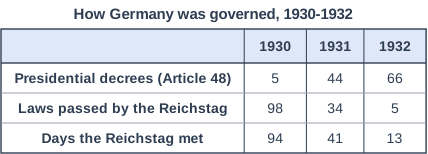
Figure 1 is a table showing the number of presidential decrees, the number of laws passed by the Reichstag and the number of days the Reichstag met in the years 1930-1932.

In what ways did President Hindenburg's use of his powers weaken democracy in the years 1930-1932? Explain your answer.

How Germany was governed, 1930-1932. Table with columns (row headings), "1930", "1931", "1932". Presidential decrees (Article 48); 1930: 5; 1931: 44; 1932: 66 | Laws passed by the Reichstag; 1930: 98; 1931: 34; 1932: 5 | Days the Reichstag met; 1930: 94; 1931: 41; 1932: 13.

Model answer

One way Hindenburg weakened democracy was by ruling through emergency decrees instead of through the Reichstag. Figure 1 shows that presidential decrees under Article 48 rose from 5 in 1930 to 44 in 1931 and 66 in 1932, while the number of laws passed by the Reichstag fell from 98 to just 5, and the number of days it met fell from 94 to 13. By 1932 the elected parliament hardly mattered: Germany was being governed by the President.

A second way was by appointing chancellors who had no majority in the Reichstag. Brüning in 1930, Papen in 1932 and Schleicher in December 1932 were all 'presidential chancellors' who depended on Hindenburg's support rather than on the voters. This meant that the President could also remove them: in May 1932 Hindenburg dismissed Brüning, not because the Reichstag had voted against him, but because Schleicher and the landowners had turned the President against him.

Linked to this, Hindenburg dissolved the Reichstag whenever it opposed his chancellors, in July 1930, June 1932 and September 1932. Each new election was fought in a deepening crisis and helped the Nazis grow, from 12 seats in 1928 to 107 in 1930 and 230 in July 1932. Hindenburg also signed the decree that allowed Papen to remove the elected government of Prussia in July 1932.

Finally, decisions were increasingly made by a small, unelected circle around the President, including his son Oskar, his State Secretary Otto Meissner, Schleicher and Papen. So Hindenburg's use of his powers turned Weimar into a presidential dictatorship in all but name, and democracy was already hollow before Hitler was appointed.

Explanation

Figure 1 shows decrees replacing laws and the Reichstag meeting less and less. Key knowledge: presidential chancellors without majorities, the dismissal of Brüning, repeated dissolutions, the Prussian coup and the influence of Hindenburg's circle. Level 4 needs several developed, linked ways, not just a description of the table.

Mark scheme
  1. 8 marks

    Levels of response (8 marks).
    Level 4 (7-8 marks): Complex explanation: several developed explanations of different ways Hindenburg weakened democracy (e.g. ruling by decree instead of through the Reichstag, appointing chancellors without a majority, dismissing Brüning, repeated dissolutions, the Prussian coup), supported by precise knowledge (which may include the figures in Figure 1) and linked, e.g. showing how decree government made the Reichstag irrelevant and chancellors dependent on the President and his advisers.
    Level 3 (5-6 marks): Developed explanation of two or more ways, each supported by relevant knowledge.
    Level 2 (3-4 marks): Simple explanation of one way, or several ways described with little explanation (or only a description of the table).
    Level 1 (1-2 marks): Basic explanation: general statements (e.g. 'he used Article 48') with little specific knowledge.
    0 marks: nothing worthy of credit.

    Indicative content (not a checklist; credit other valid points): Figure 1 - presidential decrees rose from 5 (1930) to 44 (1931) and 66 (1932), while laws passed by the Reichstag fell from 98 to 34 to 5 and the days it met fell from 94 to 41 to 13; government by Article 48 decree replaced parliamentary government; Hindenburg appointed 'presidential' chancellors who did not have a Reichstag majority - Brüning (March 1930), Papen (June 1932), Schleicher (December 1932) - so chancellors depended on the President, not the voters; he dissolved the Reichstag when it opposed his chancellors (July 1930, June 1932, September 1932), causing elections that helped the Nazis grow (107 seats in 1930, 230 in July 1932); he dismissed Brüning in May 1932 on the advice of Schleicher and the landowners, not because of a Reichstag vote; he signed the decree for the 'Prussian coup' (20 July 1932), removing an elected state government; he relied on a small, unelected circle (his son Oskar, State Secretary Otto Meissner, Schleicher, Papen); by 1932 the Reichstag hardly mattered, so democracy was already hollow before Hitler was appointed.

Question 4

12 marks

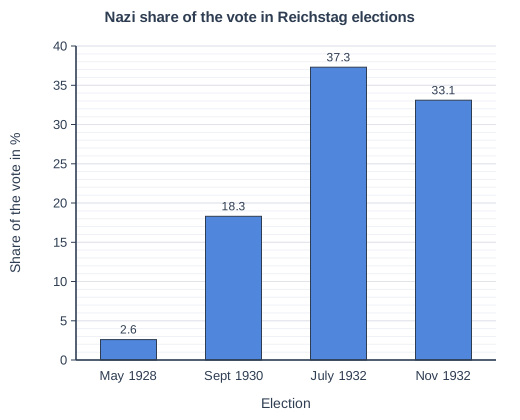
Figure 1 shows the Nazi Party's share of the vote in Reichstag elections from 1928 to November 1932.

Which of the following was the more important reason why Hitler became Chancellor in January 1933:
- the Nazis' success in elections
- the actions of Papen and Hindenburg?
Explain your answer with reference to both bullet points.

Nazi share of the vote in Reichstag elections. Bar chart of share of the vote in % for each election: May 1928 2.6, Sept 1930 18.3, July 1932 37.3, Nov 1932 33.1.

Model answer

Both factors explain Hitler's appointment, but I think the actions of Papen and Hindenburg were more important, because Hitler became Chancellor at a time when the Nazis' electoral support was falling.

The Nazis' success in elections was the essential starting point. Figure 1 shows the Nazi share of the vote rising from just 2.6% in May 1928 to 18.3% in September 1930 and 37.3% in July 1932, when they won 230 seats and became by far the largest party in the Reichstag. Hitler also won 36.8% of the vote in the presidential run-off in April 1932. With the Communists, the Nazis held a majority of seats, so no democratic government was possible. This mass support made Hitler the only right-wing leader who could offer a popular base for a government, which is why conservatives eventually turned to him. However, Figure 1 also shows the limits of Nazi success: they never won a majority, and in November 1932 their share fell to 33.1% as they lost about 2 million votes. By December the party was in debt and Gregor Strasser had resigned.

The actions of Papen and Hindenburg turned a weakening Hitler into the Chancellor. Hindenburg had twice refused to appoint Hitler, in August and November 1932. But Papen, resentful after Schleicher replaced him, met Hitler secretly in Cologne on 4 January 1933 and agreed to form a government together. On 22 January Hindenburg's son Oskar and State Secretary Meissner met Hitler and were won over. When Schleicher asked for emergency powers to rule without the Reichstag, Hindenburg refused, so Schleicher resigned on 28 January. Papen persuaded the President that Hitler could be controlled, with only three Nazis in the cabinet and Papen as Vice-Chancellor, and on 30 January 1933 Hindenburg appointed Hitler.

The election results made Hitler a contender, but they did not make him Chancellor: Hindenburg could have refused again, as he had done twice in 1932. It was the decisions of Papen and Hindenburg, at the very moment when Nazi support was declining, that put Hitler in power. That is why their actions were the more important reason.

Explanation

Figure 1 shows the Nazis' rise to 37.3% and fall to 33.1%. Election success made Hitler a contender; Papen's Cologne deal and Hindenburg's decisions in January 1933 made him Chancellor. Level 4 needs both bullets explained with precise knowledge and a sustained judgement.

Mark scheme
  1. 12 marks

    Levels of response (12 marks).
    Level 4 (10-12 marks): Complex explanation of both bullet points leading to a sustained judgement, e.g. weighing the Nazis' rise to become the largest party (using the trend in Figure 1, including the fall in November 1932) against the decisions of Papen and Hindenburg in January 1933 (the Cologne meeting, the refusal of emergency powers to Schleicher, the belief that Hitler could be controlled), and judging which was decisive. Answers show a range of accurate, detailed knowledge and the judgement is supported throughout.
    Level 3 (7-9 marks): Developed explanation of both bullet points, each supported with relevant knowledge; there may be a judgement but it is not sustained.
    Level 2 (4-6 marks): Simple explanation of one or both bullet points, with some relevant knowledge (or description of Figure 1 with limited explanation).
    Level 1 (1-3 marks): Basic explanation of one or both bullet points; general statements with little specific knowledge.
    0 marks: nothing worthy of credit.

    Indicative content (not a checklist; credit other valid points): Figure 1 - Nazi share of the vote 2.6% (May 1928), 18.3% (September 1930), 37.3% (July 1932), 33.1% (November 1932). Election success - from a fringe party to the largest party in the Reichstag (230 seats in July 1932, 196 in November); Hitler won 36.8% in the April 1932 presidential run-off; together with the KPD, the Nazis held a majority of seats, so no democratic government was possible; the Nazis' mass support made Hitler the only right-wing leader who could offer a popular base, which is why the elite turned to him; but the Nazis never won a majority and lost about 2 million votes in November 1932, and the party was in crisis (debts, Strasser's resignation in December 1932). Actions of Papen and Hindenburg - Hindenburg appointed presidential chancellors and ruled by decree from 1930; Papen lifted the SA ban (June 1932) and called the July election; Hindenburg refused Hitler the chancellorship in August and November 1932; Papen, resentful at being replaced by Schleicher, met Hitler secretly in Cologne on 4 January 1933 and agreed to form a government together; Oskar von Hindenburg and Meissner met Hitler on 22 January; Hindenburg refused Schleicher's request for emergency powers, so Schleicher resigned on 28 January; Papen convinced Hindenburg that Hitler could be controlled with only three Nazis in the cabinet and Papen as Vice-Chancellor; Hindenburg appointed Hitler on 30 January 1933. Judgement - credit either if sustained, e.g. elections made Hitler a contender but Papen and Hindenburg made him Chancellor, at a moment when the Nazi vote was falling.

Ready to try the rest? Every answer you write is marked against the mark scheme, so you can see exactly where the marks are.

AI Tutor Hints first, answers after you try

Hi! Stuck? Ask me for a hint and I’ll help you work it out. Once you’ve checked your answer I can explain exactly where the marks are.