'First Past the Post should be replaced by a proportional voting system for UK general elections.'
Considering a range of views, to what extent do you agree with this statement?
In your answer you should consider:
- the strengths and weaknesses of First Past the Post
- the experience of proportional systems used elsewhere in the UK.
Model answer
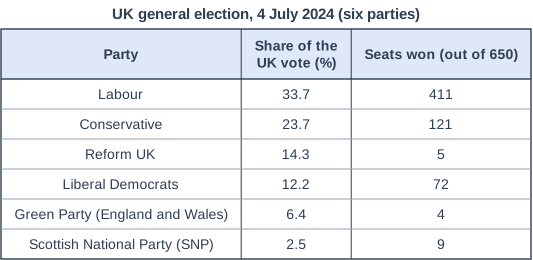
Supporters of change argue that First Past the Post (FPTP) produces results that do not reflect how people voted. In the 2024 general election Labour won about 63% of the seats with 33.7% of the vote, while Reform UK won 14.3% of the vote but only 5 seats. Because only the winner in each constituency is elected, millions of votes for losing candidates elect nobody, and voters in safe seats may feel their vote makes no difference, which may discourage turnout. Many people vote tactically for a party that is not their first choice. A proportional system such as the party list or STV would give parties seats in line with their votes, so Parliament would better reflect the range of views in the country.
Proportional systems already work elsewhere in the UK. The Scottish Parliament has used the Additional Member System since 1999, the Northern Ireland Assembly uses STV, and from 2026 the Senedd uses a closed list system. Supporters argue that these have produced more representative bodies, and governments that must seek agreement, such as the Labour and Liberal Democrat coalition in Scotland from 1999 to 2007.
However, defenders of FPTP argue that it has important strengths. It is simple to understand and quick to count, so the result is usually known the next morning. It usually produces a single-party majority government that can carry out its manifesto and that voters can clearly hold responsible and remove at the next election. Each MP represents one local constituency, giving a strong link between citizens and their representative, whereas list systems give party leaders more say over who is elected. Proportional systems often lead to coalitions whose policies are agreed in private after the election, and a small party can become a 'kingmaker'. Experience elsewhere is mixed: in Northern Ireland, power-sharing broke down for long periods between 2017 and 2024, although this was caused mainly by the power-sharing rules and political disputes rather than by STV itself. Voters also rejected a change to the Alternative Vote in the 2011 referendum by about 68% to 32%, although AV is not a proportional system.
Overall, I largely agree with the statement. In 2024 Labour and the Conservatives together won only about 57% of the vote but over 80% of the seats, which weakens the claim that FPTP is fair or gives governments a strong mandate. The UK's own devolved bodies show that proportional systems can produce workable government. A system such as AMS, which keeps constituency MPs but adds top-up seats, would answer the strongest objection, the loss of the local link, while making Parliament far more representative. The main cost would be more coalition government, but that may be a price worth paying for a Parliament that reflects how people actually voted.
Explanation
Top-level answers weigh evidence on both sides, such as real votes-and-seats figures and the experience of AMS, STV and list systems in Scotland, Northern Ireland and Wales, and reach a reasoned judgement. A judgement either way can reach Level 4 if it is justified by the evidence. Common weaknesses are describing the systems without evaluating them, or mixing up the Alternative Vote (not proportional) with proportional systems.