Level:
Correct: 0
Incorrect: 0
Marks: 0/0
Exam Practice
Course:
Topics:
AQA GCSE Citizenship Studies (Paper 1) Smart practice A mixed round aimed at your weak spots
Unit 1
Active citizenship
Unit 2
Politics and participation
Where does political power reside in the UK and how is it controlled?
Political power and the British constitution
What are the powers of local and devolved government and how can citizens participate?
Local and devolved government
Voting, elections and public spending
Where does political power reside: with the citizen, parliament or government?
Voting systems and political parties
How Parliament and government work
How do others govern themselves?
How other countries govern themselves
How can citizens try to bring about political change?
Bringing about political change
Avg
score:
–
Topics
done:
0/9

How other countries govern themselves

Practise 14 exam-style questions on How other countries govern themselves for AQA GCSE Citizenship Studies (Paper 1). Write your answer as you would in the exam and get it marked in seconds against the mark scheme, point by point, with the Study Helper on hand if you get stuck.

  • 14 questions
  • 1–8 marks each
  • Instant marking
  • No sign-up needed
14 questions, marked as you go

Sample questions with model answers

Here are 4 of the questions in this topic, each with a model answer, an explanation of why it earns the marks and the mark scheme an examiner would use.

Question 1

1 mark

Which one of the following best describes a one-party state?

Choose your answer.

  • A A country where the same party has won several free elections in a row
  • B A country where only one party is allowed to hold power
  • C A country where two parties share power in a coalition
  • D A country where the head of state inherits the position

Model answer

B A country where only one party is allowed to hold power

Explanation

In a one-party state, such as the People's Republic of China, one party controls the state and other parties cannot compete for power, so citizens cannot vote the ruling party out. A party that keeps winning free and fair elections is different, because voters could choose another party. Do not confuse this with a hereditary monarchy, which is about how the head of state is chosen.

Mark scheme
  1. 1 mark

    B / A country where only one party is allowed to hold power

    Accept the letter or the option text. If more than one option is given, 0 marks. A describes a dominant party in a democracy: the other parties could still win. C describes a coalition government. D describes a monarchy.

Question 2

2 marks

Which two of the following are features of the political system of the People's Republic of China?

Choose two answers.

A The Communist Party leads the state and decides who holds power
B Voters choose between rival parties to form the national government
C The national parliament is elected indirectly, by lower-level congresses
D The head of state is elected by all adult citizens in a national vote
E Newspapers and websites are free to criticise the government without restriction
F The head of state is a hereditary monarch

Model answer

A The Communist Party leads the state and decides who holds power
C The national parliament is elected indirectly, by lower-level congresses

Explanation

China is a one-party state: its constitution describes the leadership of the Communist Party as the defining feature of its system. The National People's Congress, the national parliament, is elected indirectly by provincial congresses; citizens vote directly only for the lowest levels of people's congresses (county and township). The press and internet are tightly controlled, so citizens have few ways to challenge those in power.

Mark scheme
  1. 2 marks

    A and C (The Communist Party leads the state and decides who holds power; The national parliament is elected indirectly, by lower-level congresses)

    1 mark for each correct option, max 2. Accept the letters or the option texts, in either order. If more than two options are given, each extra option cancels one correct one. Count every option the student gives: with exactly two, 1 mark for each correct one; with three, the number of correct ones among them minus 1; with four or more, 0 marks. B is wrong: other parties cannot compete for power. D is wrong: the President is elected by the National People's Congress. E is wrong: the media and the internet are censored. F is wrong: China is a republic.

Question 3

2 marks

Source A

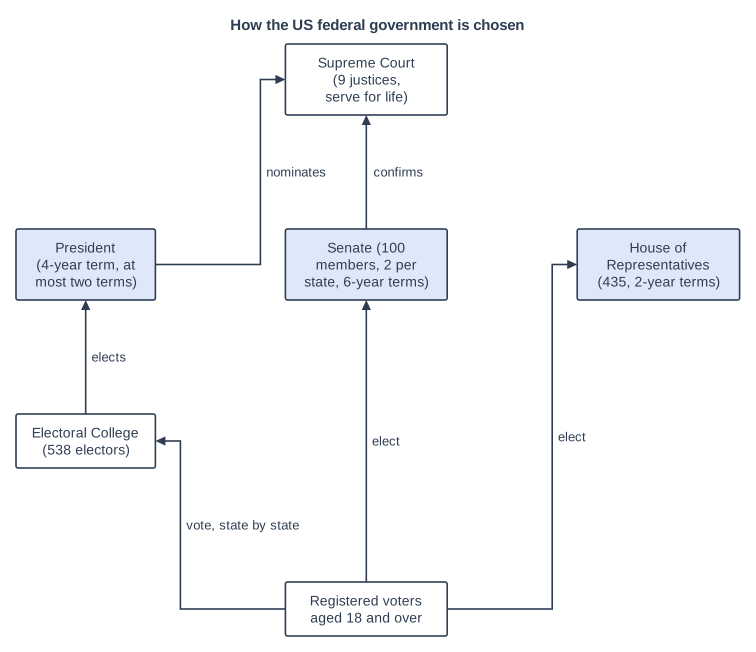
Electing the US federal government

Source A is a diagram showing how the people who make up the federal (national) government of the United States of America are chosen.

Using Source A and your own knowledge, identify two differences between the ways citizens in the USA and citizens in the UK choose the people who govern them.

How the US federal government is chosen. Block diagram with six parts in seven rows. Top row: a box "Supreme Court (9 justices, serve for life)". Third row, left to right: a box "President (4-year term, at most two terms)" (shaded), a box "Senate (100 members, 2 per state, 6-year terms)" (shaded) and a box "House of Representatives (435, 2-year terms)" (shaded). Fifth row: a box "Electoral College (538 electors)". Bottom row: a box "Registered voters aged 18 and over". Connections: an arrow from "Registered voters aged 18 and over" to "Electoral College (538 electors)", labelled "vote, state by state"; an arrow from "Electoral College (538 electors)" to "President (4-year term, at most two terms)", labelled "elects"; an arrow from "Registered voters aged 18 and over" to "Senate (100 members, 2 per state, 6-year terms)", labelled "elect"; an arrow from "Registered voters aged 18 and over" to "House of Representatives (435, 2-year terms)", labelled "elect"; an arrow from "President (4-year term, at most two terms)" to "Supreme Court (9 justices, serve for life)", labelled "nominates"; an arrow from "Senate (100 members, 2 per state, 6-year terms)" to "Supreme Court (9 justices, serve for life)", labelled "confirms".

Model answer

1. US citizens elect their head of government, the President, in a separate election through the Electoral College, but UK citizens do not vote for the Prime Minister, who is the leader of the party that can command a majority in the House of Commons.
2. US citizens elect both houses of Congress, the Senate and the House of Representatives, but UK citizens elect only the House of Commons, because members of the House of Lords are appointed.

Explanation

Each correct, different difference scores a mark. The clearest are that Americans vote (indirectly) for their head of government and for both houses of their legislature, while UK voters elect only MPs. A common error is to say that UK voters elect the Prime Minister: they vote for an MP in their constituency.

Mark scheme
  1. 2 marks

    Any two different differences, 1 mark each, e.g. US citizens elect the head of government (the President) in a separate election, through the Electoral College, while UK citizens do not vote for the Prime Minister, who is the leader of the party that can command a majority in the Commons / US citizens elect both houses of Congress, while UK citizens elect only the House of Commons (the House of Lords is appointed) / US elections are more frequent and on fixed dates (the House every 2 years, the President every 4), while a UK general election must be held at least every five years, usually on a date chosen by the Prime Minister / the US President can serve at most two terms, while the Prime Minister has no term limit / US citizens can elect a President from a different party from the majority in Congress, while the UK Prime Minister must command the confidence of the Commons, so normally leads the largest party there (or a coalition) / US voters choose party candidates in primary elections, while UK candidates and party leaders are chosen by party members / in many US states citizens elect judges, while UK judges are appointed

    1 mark for each correct, different difference, max 2. The difference may be stated for one country if the contrast is clear. Two statements that are the same difference reworded score 1. Do not credit 'US citizens elect Supreme Court judges' (Source A shows they are nominated and confirmed), or 'UK citizens elect the Prime Minister'. Award marks for any other relevant answer.

Question 4

8 marks

'Citizens in the USA have more ways to influence their government than citizens in the UK.'

Considering a range of views, to what extent do you agree with this statement?

In your answer you should consider:
- how citizens choose those who govern them
- other ways in which citizens can take part in politics.

Model answer

There are strong reasons to agree. US citizens can vote for many more of the people who govern them. They elect the President, through the Electoral College, as well as both houses of Congress, while UK citizens elect only their MP: the Prime Minister is not directly elected and the House of Lords is appointed. Elections in the USA are also more frequent: the whole House of Representatives is elected every two years, so voters can quickly reward or punish their representatives. Because the USA is a federal system, citizens also elect state governors and state legislators and, in many places, local officials such as sheriffs, prosecutors, school boards and judges. In about half the states citizens can propose and vote on laws directly through ballot initiatives, and some states allow recall elections. US citizens also choose their parties' candidates in primary elections, while in the UK candidates are usually chosen by party members. Their rights to free speech, a free press, peaceful assembly and to petition the government are written into the First Amendment and protected by the Supreme Court.

However, having more elections does not always mean more influence. Voter registration is the individual's responsibility and the rules differ from state to state, including different voter ID rules and limits on voting for people with criminal convictions, and election day is usually a normal working day. Because of the Electoral College, votes in a few swing states matter far more than votes in 'safe' states, and candidates have won the presidency while losing the national popular vote, as in 2000 and 2016. In many states the boundaries of House districts are drawn by state politicians, which can lead to gerrymandering, whereas UK boundaries are drawn by independent Boundary Commissions. The cost of US campaigns, and spending by groups such as Super PACs since a 2010 Supreme Court ruling, may give wealthy donors more influence than ordinary citizens. UK citizens also have important opportunities of their own: they elect local councillors, mayors and, in Scotland, Wales and Northern Ireland, devolved parliaments and assemblies; they can raise problems with their MP at constituency surgeries; e-petitions with 100,000 signatures are considered for debate in Parliament; and they have voted in national referendums, such as the 2016 vote on EU membership, which have never been held at national level in the USA.

Overall, I agree that US citizens have more ways to influence their government, because they elect far more of those who govern them and, in many states, can make laws directly. But more ways do not necessarily mean more influence: the Electoral College, unequal voting rules and the power of money mean that some American citizens' voices count for far more than others. So US citizens have more opportunities on paper, but how much influence they actually have depends on who they are and where they live.

Explanation

Level 4 answers compare the two systems on both sides, using accurate detail (elections for the President and both houses, state initiatives and primaries against registration rules, the Electoral College, money in politics and the UK's own opportunities), and reach a judgement that distinguishes the number of ways from how effective they are. A common error is to claim that UK voters elect the Prime Minister. One-sided answers are capped at 4 marks.

Mark scheme
  1. 8 marks

    Levels of response (8 marks).
    Level 4 (7-8 marks): Developed and sustained analysis of a wide range of evidence and views related to the citizenship issue. Developed and reasoned justifications are given which relate to the evidence provided. The justifications put forward form a coherent argument.
    Level 3 (5-6 marks): Analysis of a range of evidence and views related to the citizenship issue. The evidence is used to support arguments but these arguments are not always completely developed, justified or evaluated. Conclusions drawn from the arguments may not be completely coherent.
    Level 2 (3-4 marks): Basic analysis of a limited range of evidence and views related to the citizenship issue. Weak arguments are made which are not necessarily related to the evidence selected. The arguments represent only a limited range of viewpoints. Some attempt is made to integrate the arguments into concluding remarks.
    Level 1 (1-2 marks): Limited evidence presented and/or evidence presented is not directly related to the citizenship issue. Insufficient range of differing viewpoints considered. Little or no attempt is made to analyse or evaluate the evidence presented. Little or no attempt is made to integrate the points made.
    0 marks: Nothing to credit.

    Max 4 if the answer considers only one side of the statement. Max 6 if the answer reaches no judgement. Points which may be included to agree with this statement are: US citizens elect the President (through the Electoral College) and both houses of Congress, while UK citizens elect only MPs (the Prime Minister is not directly elected and the House of Lords is appointed); more frequent elections (the House every two years); a federal system with elected governors, state legislators and, in many places, sheriffs, prosecutors, school boards and judges; ballot initiatives and referendums in about half the states, and recall elections in some; primary elections let ordinary voters choose party candidates; First Amendment rights to free speech, a free press, peaceful assembly and to petition the government, protected by a codified constitution and the Supreme Court; many access points for lobbying. Points which may be included to disagree with this statement are: voter registration is the individual's responsibility and rules differ between states (ID rules, limits on voting by people with criminal convictions), and election day is usually a working day; residents of Washington DC have no voting member of Congress; the Electoral College means votes in a few swing states matter most, and candidates have won the presidency while losing the national popular vote (2000, 2016); House districts in many states are drawn by state politicians, allowing gerrymandering, while UK boundaries are drawn by independent Boundary Commissions; the cost of campaigns and spending by groups such as Super PACs (after a 2010 Supreme Court ruling) may give wealthy donors more influence; UK citizens elect councillors, mayors, police and crime commissioners (in England and Wales) and devolved parliaments and assemblies; they can meet their MP at surgeries; UK Parliament e-petitions with 100,000 signatures are considered for debate; UK citizens have voted in national referendums (e.g. 1975, 2011, 2016), which the USA has never held. A judgement might weigh: the number of opportunities against how equal and effective they are; whether influence depends on money, state and background. Award marks for any other relevant points.

Ready to try the rest? Every answer you write is marked against the mark scheme, so you can see exactly where the marks are.

Study Helper Hints first, answers after you try

Stuck on this one? Ask for a hint and I’ll point you in the right direction, without giving the answer away. Once you’ve checked your answer, I’ll show you how the marks are awarded.