Level:
Correct: 0
Incorrect: 0
Marks: 0/0
Exam Practice
Subject:
Topics:
AQA GCSE History (Edward I) Smart practice A mixed round aimed at your weak spots
Unit 1
Part one: Government, the rights of King and people
Unit 2
Part two: Life in Medieval England
Unit 3
Part three: Edward I’s military campaigns in Wales and Scotland
Unit 4
Part four: The historic environment of Medieval England
Avg
score:
–
Topics
done:
0/10

The relations with Scotland

Practise 40 exam-style questions on The relations with Scotland for AQA GCSE History (Edward I). Write your answer as you would in the exam and get it marked in seconds against the mark scheme, point by point, with an AI tutor on hand if you get stuck.

  • 40 questions
  • 1–16 marks each
  • Instant marking
  • No sign-up needed
20 questions, marked as you go

Sample questions with model answers

Here are 4 of the questions in this topic, each with a model answer, an explanation of why it earns the marks and the mark scheme an examiner would use.

Question 1

2 marks

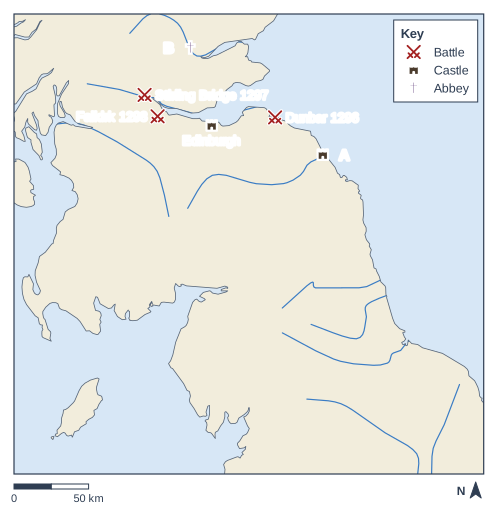
Figure 1 is a map of south-east Scotland and the border. The town labelled A was stormed by Edward I's army in March 1296. The place labelled B was where the Stone of Destiny was kept until Edward I removed it in 1296.

Name the places labelled A and B on Figure 1.

Map of northern England and southern Scotland, drawn with real coastlines (land pale buff, sea pale blue) and no modern borders; a north arrow shows north at the top; the scale bar is 50 km long. 6 symbols: a castle symbol labelled A on the coast, towards the top of the map (about 65% of the way across and 30% of the way down), about 40 km south-east of the symbol labelled "Dunbar 1296"; a crossed-swords symbol (battle) labelled "Dunbar 1296" (on the coast); a crossed-swords symbol (battle) labelled "Stirling Bridge 1297" (inland); a crossed-swords symbol (battle) labelled "Falkirk 1298" (inland); a castle symbol labelled "Edinburgh" (inland); a cross symbol (abbey or church) labelled B inland, towards the top of the map (about 40% of the way across and 5% of the way down), about 45 km north-east of the symbol labelled "Stirling Bridge 1297". Blue lines show rivers. The key (in a box on the map) shows: "Battle", "Castle" and "Abbey".

Model answer

A is Berwick and B is Scone.

Explanation

Berwick, Scotland's richest trading town at the mouth of the Tweed, was stormed and sacked on 30 March 1296. Scone Abbey near Perth was where Scottish kings were inaugurated on the Stone of Destiny, which Edward took to Westminster Abbey as a sign that the Scottish kingdom had ended.

Mark scheme
  1. 1 mark

    A: Berwick (Berwick-upon-Tweed).

    Accept Berwick. Do not accept Carlisle or Dunbar.

  2. 1 mark

    B: Scone (Scone Abbey, near Perth).

    Accept Scone. Do not accept Perth on its own, Edinburgh or Westminster.

Question 2

8 marks

Explain what was important about the alliance made between Scotland and France in 1295 for Edward I's relations with Scotland.

Model answer

The alliance with France was important first because it caused the war of 1296. It was made in Paris in October 1295 by the council of twelve who now governed Scotland, and ratified in February 1296. Each kingdom promised to help the other against England, and Balliol's son was to marry a niece of King Philip IV. Edward had been at war with France since 1294 over Gascony, so to him this was treason by a vassal who had sworn homage. He invaded in March 1296, stormed Berwick and defeated the Scots at Dunbar, and by July Balliol had been deposed. The alliance therefore turned a quarrel over overlordship into open war.

Secondly, it shaped the long war that followed. Edward now faced enemies on two fronts. In 1297 he was campaigning in Flanders against France when the Scots won at Stirling Bridge. The Scots looked to France for help: Wallace went to France in 1299 to seek support, French pressure helped secure Balliol's release into papal custody in 1299, and France helped arrange truces such as that of 1302. This encouraged the Scots to keep fighting in the hope that Balliol might be restored.

However, the alliance was also important because of its limits. After the French were defeated by the Flemings at Courtrai in 1302, Philip IV made the Peace of Paris with Edward in May 1303, leaving the Scots out. Without French help, the Scots were isolated, and in February 1304 John Comyn and most of the Scottish leaders submitted to Edward. So the alliance both started the war and, when France abandoned it, helped to bring about the Scottish surrender of 1304 - although it began the 'Auld Alliance' that lasted for centuries.

Explanation

The treaty of October 1295 was treason in Edward's eyes and led to his invasion in 1296; it gave the Scots hope of French help during the war, but France's desertion in the Peace of Paris (1303) left them isolated before the submission of 1304. Level 4 explains several linked consequences; saying it caused the war, with one detail, is Level 2.

Mark scheme
  1. 8 marks

    Levels of response (8 marks).
    Level 4 (7-8 marks): Complex explanation of the importance of the alliance, e.g. explains how it turned Scottish defiance into an alliance with Edward's enemy and gave him the reason to invade in 1296, how it shaped the long war (French diplomatic help, Wallace's hopes) and how France's abandonment of the Scots in 1303 weakened them, with specific knowledge and some sense of how these consequences were linked.
    Level 3 (5-6 marks): Developed explanation of two or more consequences of the alliance, with specific knowledge.
    Level 2 (3-4 marks): Simple explanation of one consequence, e.g. that it led to war in 1296.
    Level 1 (1-2 marks): Basic explanation with little specific knowledge.
    0 marks: nothing worthy of credit.

    Indicative content (not a checklist; credit other valid points): Made in Paris in October 1295 by the council of twelve, ratified by the Scots in February 1296; each kingdom promised to help the other against England, and Balliol's son Edward was to marry a niece of Philip IV; England and France had been at war since 1294 over Gascony, so Edward saw it as treason by his vassal; it was the immediate cause of war - Edward invaded in March 1296, stormed Berwick and defeated the Scots at Dunbar (April 1296), and Balliol was deposed; it meant Edward had to fight on two fronts - he was in Flanders against France when the Scots won at Stirling Bridge (1297); French diplomacy helped the Scots - Wallace went to France (1299) to seek support, the French helped arrange truces (e.g. 1302) and Balliol was released into papal custody (1299); but France's help was limited: after the French defeat at Courtrai (1302), Philip IV made the Peace of Paris with Edward (May 1303), which left the Scots out, and within months most Scottish leaders, including John Comyn, submitted (February 1304); in the long run it began the 'Auld Alliance', which lasted for centuries.

Question 3

8 marks

Interpretation A: from a history of England written for schools in 1925. (Written for practice.)
By 1305 Edward's long labours in Scotland were complete. The Scottish nobles, led by John Comyn, had submitted; Stirling Castle had fallen after a famous siege; and the outlaw Wallace had paid the penalty for his crimes. Edward now gave Scotland a wise new government, with Scots and English sitting together on its council. Had the rash young Robert Bruce not murdered Comyn in a church in 1306, the two kingdoms might have lived in peace under one crown.

How convincing is Interpretation A about Edward I's position in Scotland by 1305? Explain your answer based on your contextual knowledge and what it says in Interpretation A.

Model answer

Interpretation A is convincing that Edward was at the height of his power in Scotland in 1305. In February 1304 John Comyn and most of the Scottish nobles submitted at Strathord, on fairly lenient terms that restored their lands in return for fines or short periods of exile. In July 1304 Stirling Castle, the last major stronghold, surrendered after a siege in which Edward used the giant Warwolf trebuchet. Wallace was captured in August 1305 and executed at Smithfield. In September 1305 the Ordinance for the Government of Scotland, drawn up with ten Scottish representatives at Westminster, created a council that included Scots such as Robert Bruce and Bishops Wishart and Lamberton, and some Scots were appointed sheriffs.

However, A is much less convincing when it claims the conquest was complete and the settlement wise. Scotland was now called a 'land', not a kingdom; its king had been deposed and the Stone of Destiny was in Westminster Abbey. The top officials, including the lieutenant, Edward's nephew John of Brittany, were Edward's men, and the peace depended on English garrisons. The nobles had submitted only because France had abandoned them in 1303. Resentment remained: Wallace's harsh execution created bitterness, and Bruce and Bishop Lamberton had already made a secret bond of mutual support in 1304. When Bruce killed Comyn in February 1306 and was crowned in March, bishops and many Scots supported him, which shows the settlement had not been accepted. It was not just one 'rash' act that destroyed it.

Overall, A is convincing about Edward's achievements in 1304-05, but as an English school history of 1925 it admires Edward, calls Wallace an 'outlaw' and blames Bruce alone. Edward's position looked strong in 1305 but rested on force and forced submissions, which is why it collapsed so quickly.

Explanation

By 1305 the nobles had submitted, Stirling had fallen, Wallace was dead and the Ordinance set up a council with Scots, but Scotland was reduced to a 'land' run by Edward's men, resentment and secret plotting continued, and Bruce's rising found support at once. Level 4 evaluates A's claims and its provenance with a sustained judgement; agreeing with one fact is Level 2.

Mark scheme
  1. 8 marks

    Levels of response (8 marks).
    Level 4 (7-8 marks): Complex evaluation of Interpretation A with a sustained judgement based on contextual knowledge, e.g. confirms with specific detail the submissions of 1304, the fall of Stirling, Wallace's execution and the Ordinance of 1305, but challenges the claim that the conquest was complete and the settlement wise, using evidence of continuing resentment, secret plotting, the abolition of Scotland as a kingdom and the speed of Bruce's rising, and comments on the provenance, reaching a sustained judgement.
    Level 3 (5-6 marks): Developed evaluation of Interpretation A based on contextual knowledge: explains, with specific knowledge, how far its claims are supported and/or challenged.
    Level 2 (3-4 marks): Simple evaluation of Interpretation A based on contextual knowledge, e.g. agrees that Stirling Castle fell, with one supporting fact.
    Level 1 (1-2 marks): Basic analysis of Interpretation A: identifies or paraphrases what it says, with little or no contextual knowledge.
    0 marks: nothing worthy of credit.

    Indicative content (not a checklist; credit other valid points): Convincing: John Comyn and most Scottish nobles submitted at Strathord (February 1304) on fairly lenient terms - lands restored in return for fines or short exiles; Stirling Castle surrendered after a siege (April-20 July 1304) in which Edward used the Warwolf trebuchet; Wallace was captured (August 1305) and executed at Smithfield (23 August 1305); the Ordinance for the Government of Scotland (September 1305), drawn up with ten Scottish representatives at Westminster, set up a council with Scottish members (including Robert Bruce and Bishops Wishart and Lamberton), with Edward's nephew John of Brittany as his lieutenant and some Scots as sheriffs. Less convincing: Scotland was treated as a 'land', not a kingdom, with its king deposed and the Stone of Destiny at Westminster; the top officials - lieutenant, chancellor, chamberlain - were English or Edward's men; some Scottish customs were abolished; peace depended on English garrisons; the nobles' submission was forced, after France abandoned them in 1303; Wallace's execution caused bitterness; Bruce and Bishop Lamberton had made a secret bond of mutual support in 1304; when Bruce rose in 1306, bishops and many Scots supported him, showing the settlement had not been accepted; the killing of Comyn may have been unplanned, but Bruce's rising was not simply rash. Provenance: an English school history of 1925, admiring Edward and calling Wallace an 'outlaw', from an imperial point of view. Possible judgement: convincing that Edward was at the height of his power in 1305, but wrong that the conquest was complete or accepted.

Question 4

16 marks

'William Wallace was the most important leader of Scottish resistance to Edward I between 1297 and 1307.'

How far do you agree with this statement? Explain your answer.

Model answer

William Wallace was the most famous leader of Scottish resistance, and in 1297-98 he was the most important. However, across the whole period from 1297 to 1307 I think Robert Bruce was more important, because his rising of 1306 began the struggle that finally won independence, while John Comyn kept resistance alive in the years between.

Wallace's importance is clear. In May 1297, when most nobles had submitted to Edward, he began his rising by killing William Heselrig, the English sheriff of Lanark. With Andrew Moray he won the great victory at Stirling Bridge in September 1297, which destroyed English rule. As Guardian of Scotland in the name of King John he raided northern England and organised the kingdom. He never submitted to Edward, was excluded from the terms of 1304 and, after his capture and execution in 1305, became a lasting symbol of resistance. However, he was defeated at Falkirk in 1298 and resigned as Guardian, and after that his role was smaller - in 1299 he went to France to seek help.

Other leaders were also vital. Andrew Moray led the rising in the north in 1297 and shared command at Stirling Bridge - his name comes first on the letter to the merchants of Lubeck - but he died of his wounds in 1297. John Comyn of Badenoch, head of the most powerful noble family, was Guardian from 1298 and kept up resistance for six years after Falkirk; he defeated an English force at Roslin in 1303 and only submitted in 1304 after France abandoned the Scots. Churchmen such as Bishop Wishart of Glasgow and Bishop Lamberton of St Andrews encouraged resistance, won the support of the Pope, who claimed Scotland for the papacy in 1299, and later backed Bruce.

Robert Bruce's role was mixed. He was a Guardian from 1298 to 1300 but submitted to Edward in 1302. In February 1306, however, he killed Comyn and was crowned King of Scots. Although he was defeated at Methven in 1306 and lost his brothers and much of his family, he fought on, winning at Glen Trool and Loudoun Hill in 1307. When Edward died in July 1307, Bruce was still fighting, and he went on to win independence at Bannockburn in 1314.

Overall, Wallace was the most important leader in 1297-98 and the greatest inspiration of the war. But measured over the whole period, Bruce was more important: he gave the Scots a king to fight for, and his persistence in 1306-07 laid the foundation for victory. Wallace's importance lies more in what he symbolised than in what he achieved after 1298.

Explanation

Wallace won Stirling Bridge, led as Guardian and became a martyr, but Moray shared his early success, Comyn sustained resistance from 1298 to 1304, churchmen kept the cause alive, and Bruce's rising of 1306 led to independence. Level 4 weighs Wallace against other leaders with specific detail and sustains a judgement; a narrative of Wallace's life is Level 2.

Mark scheme
  1. 16 marks

    Levels of response (16 marks).
    Level 4 (13-16 marks): Complex explanation of Wallace's importance (the rising of 1297, Stirling Bridge, his time as Guardian, his refusal to submit and his martyrdom) and of other leaders (Andrew Moray, John Comyn and the other Guardians, Robert Bruce, churchmen such as Bishops Wishart and Lamberton), with a sustained judgement about who was most important, and in what way, supported throughout by specific, accurate knowledge.
    Level 3 (9-12 marks): Developed explanation of Wallace and at least one other leader, with specific knowledge; a judgement is reached but not fully sustained.
    Level 2 (5-8 marks): Simple explanation of Wallace or of other leader(s).
    Level 1 (1-4 marks): Basic explanation with little specific knowledge.
    0 marks: nothing worthy of credit.

    Indicative content (not a checklist; credit other valid points): Wallace: began his rising by killing Heselrig, sheriff of Lanark (May 1297); with Moray won Stirling Bridge (11 September 1297); Guardian in the name of King John (1298); raided northern England; sought help in France (1299); never submitted and was excluded from the terms of 1304; executed in 1305 - became a lasting symbol; but defeated at Falkirk (1298) and resigned, playing a smaller role after 1298. Andrew Moray: led the rising in the north in 1297, recovered castles, shared command at Stirling Bridge and is named first in the Lubeck letter, but died of wounds in 1297. John Comyn of Badenoch: Guardian from 1298, leader of the most powerful noble family, kept up resistance for six years after Falkirk, won at Roslin (February 1303), negotiated the submission of 1304; killed by Bruce in 1306. Robert Bruce: joint Guardian (1298-1300), but submitted to Edward in 1302; killed Comyn and was crowned in 1306; defeated at Methven (1306) but fought on, winning at Glen Trool and Loudoun Hill (1307) - the leader who eventually won independence (Bannockburn, 1314; recognition in 1328). Churchmen: Bishop Robert Wishart of Glasgow encouraged the rising of 1297 and supported Bruce in 1306; Bishop William Lamberton of St Andrews was a Guardian, worked for papal and French support (the Pope's letter of 1299 claiming Scotland) and made a secret bond with Bruce (1304). Possible judgements: Wallace was most important as an inspiration and in 1297-98; or Comyn was more important in sustaining the war; or Bruce was most important because his rising of 1306 led to independence.

Ready to try the rest? Every answer you write is marked against the mark scheme, so you can see exactly where the marks are.

AI Tutor Hints first, answers after you try

Hi! Stuck? Ask me for a hint and I’ll help you work it out. Once you’ve checked your answer I can explain exactly where the marks are.