Level:
Correct: 0
Incorrect: 0
Marks: 0/0
Exam Practice
Subject:
Topics:
AQA GCSE History (Edward I) Smart practice A mixed round aimed at your weak spots
Unit 1
Part one: Government, the rights of King and people
Unit 2
Part two: Life in Medieval England
Unit 3
Part three: Edward I’s military campaigns in Wales and Scotland
Unit 4
Part four: The historic environment of Medieval England
Avg
score:
–
Topics
done:
0/10

The invasion and colonisation of Wales

Practise 41 exam-style questions on The invasion and colonisation of Wales for AQA GCSE History (Edward I). Write your answer as you would in the exam and get it marked in seconds against the mark scheme, point by point, with an AI tutor on hand if you get stuck.

  • 41 questions
  • 1–16 marks each
  • Instant marking
  • No sign-up needed
20 questions, marked as you go

Sample questions with model answers

Here are 4 of the questions in this topic, each with a model answer, an explanation of why it earns the marks and the mark scheme an examiner would use.

Question 1

2 marks

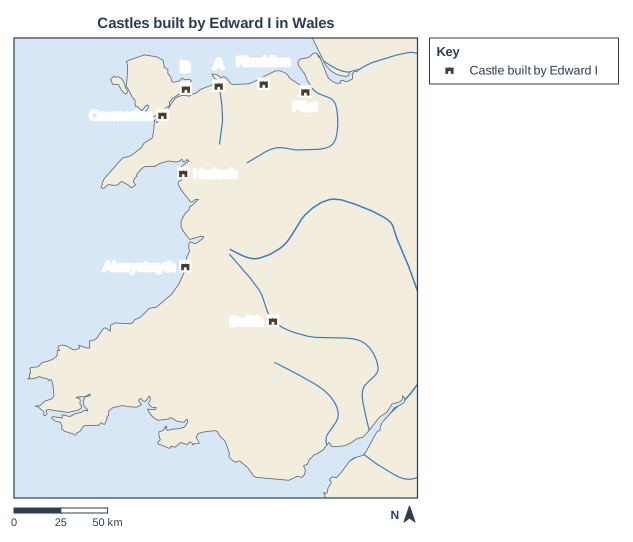
Figure 1 is a map of the castles built by Edward I in Wales.

Name the castles labelled A and B on Figure 1.

Map of Wales and the Welsh border, titled "Castles built by Edward I in Wales", drawn with real coastlines (land pale buff, sea pale blue) and no modern borders; a north arrow shows north at the top; the scale bar is 50 km long. 8 symbols: a castle symbol labelled "Flint" (on the coast); a castle symbol labelled "Rhuddlan" (inland); a castle symbol labelled "Builth" (inland); a castle symbol labelled "Aberystwyth" (on the coast); a castle symbol labelled A on the coast, towards the top of the map (about 50% of the way across and 10% of the way down), about 25 km west of the symbol labelled "Rhuddlan"; a castle symbol labelled "Caernarfon" (on the coast); a castle symbol labelled "Harlech" (on the coast); a castle symbol labelled B on the coast of an island, towards the top of the map (about 45% of the way across and 10% of the way down), about 20 km north-east of the symbol labelled "Caernarfon". Blue lines show rivers. The key (to the right of the map) shows: "Castle built by Edward I".

Model answer

A is Conwy Castle and B is Beaumaris Castle.

Explanation

Conwy, at the mouth of the River Conwy, was begun in 1283 with its walled town; Beaumaris, on Anglesey at the north-east end of the Menai Strait, was begun in 1295 after Madog ap Llywelyn's revolt and was never finished. Like most of Edward's castles they stand on the coast, where they could be supplied by sea.

Mark scheme
  1. 1 mark

    A: Conwy Castle.

    Accept Conway. Do not accept Deganwy.

  2. 1 mark

    B: Beaumaris Castle.

    Accept Beaumaris. Do not accept 'Anglesey' on its own.

Question 2

8 marks

Write an account of the ways in which tension grew between the Welsh and the English between 1277 and 1282.

Model answer

After the Treaty of Aberconwy in November 1277, Edward took over the Four Cantrefs, the land between the River Conwy and the Dee. Much of it was run by royal officials under the Justice of Chester, and they began to replace Welsh customs with English ones. The Welsh were summoned to English-style courts, fined and made to pay new dues, which they saw as an attack on their own laws. When Reginald de Grey became Justice of Chester in 1281 his harsh rule made matters worse. So the settlement itself created resentment among ordinary Welsh people.

At first relations between Edward and Llywelyn seemed good: in October 1278 Edward attended Llywelyn's wedding to Eleanor de Montfort at Worcester. However, Llywelyn then began a lawsuit to win back Arwystli from his rival Gruffudd ap Gwenwynwyn. The case dragged on in the royal courts for years, with arguments about whether Welsh or English law should be used. Llywelyn came to believe that Edward would never give him justice, which turned his resentment against the king himself.

Dafydd ap Gruffudd was also angry. He had fought for Edward in 1277 but felt he had been poorly rewarded with only two cantrefs, and he quarrelled with de Grey over his rights. Welsh lords in Ceredigion and the south complained that royal officials were taking their lands. These grievances among very different groups were later collected by Archbishop Pecham, showing how widespread they were.

Finally, on Palm Sunday in March 1282, Dafydd attacked Hawarden Castle. Attacks followed on Flint and Rhuddlan, and in the south Aberystwyth was captured. Llywelyn joined the rising, and the tensions of five years turned into a full war.

Explanation

After 1277 English officials and English law in the Four Cantrefs, the long Arwystli lawsuit and Dafydd's disappointment created grievances that exploded in Dafydd's attack on Hawarden on Palm Sunday 1282. Level 4 needs a well-ordered account that explains how these causes built up and led to war; a list of events is Level 2.

Mark scheme
  1. 8 marks

    Levels of response (8 marks).
    Level 4 (7-8 marks): Complex analysis of causation in a coherent, well-ordered account, e.g. explains how the settlement of 1277 put English officials and English law into the Four Cantrefs, how their demands, the Arwystli lawsuit and Dafydd's disappointment built up grievances among different Welsh groups, and how these came together in the attack on Hawarden in March 1282, supported by specific, accurate knowledge.
    Level 3 (5-6 marks): Developed analysis of causation: an account that explains two or more causes of growing tension, with specific knowledge.
    Level 2 (3-4 marks): Simple analysis: an account that explains one cause of tension, or a narrative with little explanation.
    Level 1 (1-2 marks): Basic, general account with little specific knowledge.
    0 marks: nothing worthy of credit.

    Indicative content (not a checklist; credit other valid points): The Treaty of Aberconwy (November 1277) gave Edward the Four Cantrefs between the Conwy and the Dee; royal officials ran much of it under the Justice of Chester, and from 1281 Reginald de Grey, Justice of Chester, was accused of harsh, high-handed rule; English legal procedures and customs were imposed in place of Welsh law, and the Welsh were summoned to English courts, fined and made to pay new dues; Welsh lords in Ceredigion and Ystrad Tywi complained of losing lands and rights to royal officials; relations were calm at first - Edward attended Llywelyn's wedding to Eleanor de Montfort at Worcester (October 1278) - but Llywelyn's claim to Arwystli against Gruffudd ap Gwenwynwyn dragged on in the royal courts from 1278 with arguments over whether Welsh or English law should apply, and Llywelyn came to believe Edward would never give him justice; Dafydd ap Gruffudd, who had fought for Edward in 1277, felt poorly rewarded with only two cantrefs and clashed with de Grey; Welsh communities' complaints (gravamina) were later collected by Archbishop Pecham in 1282, showing grievances were widespread; on Palm Sunday, March 1282, Dafydd attacked Hawarden Castle, and attacks followed on Flint, Rhuddlan and in the south (Aberystwyth captured); Llywelyn joined the rising.

Question 3

8 marks

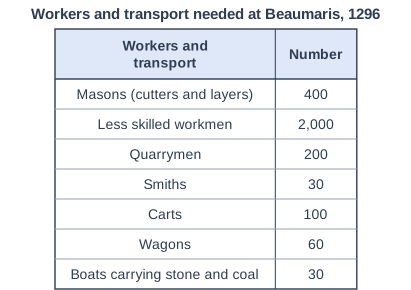
Figure 1 is a table based on a letter written in February 1296 by the officials in charge of building Beaumaris Castle to the king's Exchequer. It lists the workers and transport they said the building work needed.

Write an account of the ways in which Edward I's castles in Wales were built.

Workers and transport needed at Beaumaris, 1296. Table with columns "Workers and transport", "Number". Workers and transport: Masons (cutters and layers); Number: 400 | Workers and transport: Less skilled workmen; Number: 2,000 | Workers and transport: Quarrymen; Number: 200 | Workers and transport: Smiths; Number: 30 | Workers and transport: Carts; Number: 100 | Workers and transport: Wagons; Number: 60 | Workers and transport: Boats carrying stone and coal; Number: 30.

Model answer

Edward's castles were built in stages that followed his wars. In 1277 work began at Flint, Rhuddlan, Builth and Aberystwyth; after the conquest of Gwynedd, Conwy, Caernarfon and Harlech were begun in 1283; and Beaumaris was started in 1295 after Madog ap Llywelyn's revolt. Each new castle was a response to a new military need.

The building was organised by Master James of St George, a master mason from Savoy who was in charge of the king's works in Wales from about 1278. He designed or directed most of the castles, using up-to-date ideas such as the concentric design at Harlech and Beaumaris, where a lower outer wall surrounded a higher inner one. Because one expert controlled the whole programme, the castles were built quickly and to a high standard: Conwy castle and its town walls were largely finished in about four or five years.

Edward could only build on this scale because he could command huge numbers of workers. Sheriffs across England were ordered to send masons, carpenters, diggers and other craftsmen. The table shows that in 1296 Beaumaris alone needed 400 masons, 2,000 less skilled workmen, 200 quarrymen and 30 smiths. Materials such as stone, timber, lead and coal were moved by 100 carts, 60 wagons and 30 boats. Most castles were built on the coast or on rivers so that materials and supplies could come by sea; at Rhuddlan the River Clwyd was even straightened into a new channel about 3 km long so that ships could reach the castle.

The cost was enormous, perhaps about £80,000-100,000 for all the castles. Money often ran short: the letter of 1296 complained that the workers' pay was badly in arrears. As a result, Beaumaris and Caernarfon were never finished, and work on them stopped around 1330.

Explanation

The castles were built in phases (1277, 1283, 1295) by Master James of St George, using thousands of workers summoned from across England and materials brought by sea, at enormous cost that left Beaumaris and Caernarfon unfinished. Level 4 needs an account that explains how these methods made the building possible and what problems followed; listing castles is Level 2.

Mark scheme
  1. 8 marks

    Levels of response (8 marks).
    Level 4 (7-8 marks): Complex analysis in a coherent account, e.g. explains how Edward's resources (money, the power to summon workers from across England, ships) and Master James of St George's organisation and designs allowed huge castles to be built quickly on coastal sites, and how the scale and cost created problems such as unpaid workers and unfinished castles, supported by specific, accurate knowledge.
    Level 3 (5-6 marks): Developed analysis: an account that explains two or more ways in which the castles were built, with specific knowledge.
    Level 2 (3-4 marks): Simple analysis: an account that explains one way, or a description with little explanation.
    Level 1 (1-2 marks): Basic, general account with little specific knowledge.
    0 marks: nothing worthy of credit.

    Indicative content (not a checklist; credit other valid points): Two main phases - Flint, Rhuddlan, Builth and Aberystwyth begun in 1277; Conwy, Caernarfon and Harlech begun in 1283; Beaumaris begun in 1295 after Madog's revolt; Master James of St George, a master mason from Savoy, was in charge of the king's works in Wales from about 1278 and designed or directed most of them, with other masons such as Walter of Hereford at Caernarfon; workers were summoned through the sheriffs from across England - masons, carpenters, diggers, quarrymen, smiths; huge numbers - the table shows 400 masons, 2,000 less skilled workmen and 200 quarrymen at Beaumaris; materials (local stone, timber, lead, iron, sea coal) were carried by carts, wagons and boats - most castles were on the coast or rivers so supplies could come by sea; at Rhuddlan the River Clwyd was straightened into a new channel about 3 km long so ships could reach the castle; building was fast - Conwy castle and its town walls were largely built in about four or five years (1283-87), Harlech by about 1289; walled towns were built alongside; designs included concentric castles (Harlech, Beaumaris, Rhuddlan) and long castles fitted to rocky sites (Conwy, Caernarfon); the cost was enormous - perhaps about £80,000-100,000 for all the castles (estimates vary); money ran short - the 1296 letter complained that the workers' pay was badly in arrears, and Beaumaris and Caernarfon were never finished (work stopped about 1330).

Question 4

16 marks

'Edward I's settlement of Wales after 1283 was harsh on the Welsh people.'

How far do you agree with this statement? Explain your answer.

Model answer

Edward's settlement was harsh in many ways, especially for the ruling family of Gwynedd and for Welsh people who lived near the new castles and towns. However, for many ordinary Welsh people in the countryside it brought more continuity than change, so I agree only in part.

The settlement was undoubtedly harsh on the princes and on Welsh independence. Dafydd was executed at Shrewsbury in October 1283, Llywelyn's baby daughter Gwenllian was confined in Sempringham Priory for life, and the relic of the princes, the Croes Naid, was taken to England. The Statute of Rhuddlan of 1284 annexed the principality to the English Crown and set up English-style counties under English officials such as the Justice of North Wales at Caernarfon. English criminal law replaced Welsh law for serious crimes. The Welsh had lost their own rulers.

The settlement was also harsh because it was a colonial one. Huge castles were begun at Conwy, Caernarfon and Harlech in 1283, each with a walled borough for English settlers who were given trading privileges, while the Welsh were excluded from living in them. Whole Welsh communities were moved: the monks of Aberconwy Abbey, burial place of Llywelyn the Great, were moved to Maenan to make way for Conwy, and later the people of Llanfaes were moved to Newborough when Beaumaris was built. In north-east Wales new Marcher lordships were given to English lords - Henry de Lacy at Denbigh, Reginald de Grey at Ruthin - and at Denbigh English settlers took the best land while Welsh tenants were moved to poorer land. Heavy taxation in the early 1290s and the call-up of Welshmen to fight in Gascony led to Madog ap Llywelyn's revolt in 1294.

On the other hand, Edward did not try to destroy Welsh society. The Statute of Rhuddlan kept Welsh law and custom for most civil cases, such as disputes over land and debts, and Welsh inheritance customs largely survived. Welshmen continued to serve as local officials in the commotes. Welsh lords who had supported Edward, such as Gruffudd ap Gwenwynwyn of Powys, kept their lands. Many of the dues ordinary people paid were the same as those they had paid to the princes, whose own rule had been heavy - Llywelyn's taxes had made him unpopular. For most Welsh farmers, daily life went on much as before.

Overall, the settlement was harsh on the Welsh as a people with their own rulers and on the communities pushed aside for castles, towns and English settlers, and it made the Welsh feel like second-class subjects in their own land, as the revolt of 1294-95 shows. But it was not harsh in every way: by keeping Welsh civil law and local customs, Edward created a settlement that most Welsh people could live with, which is why it lasted until 1536. It was harsh in its aims and symbols, but more moderate in everyday government.

Explanation

The settlement destroyed the house of Gwynedd, annexed the principality, imposed English officials, castles, boroughs and Marcher lords and moved Welsh communities, but it kept Welsh civil law, local officials and the lands of loyal Welsh lords. Level 4 weighs both sides with specific detail and sustains a judgement about how harsh it was and for whom; a one-sided list is Level 2.

Mark scheme
  1. 16 marks

    Levels of response (16 marks).
    Level 4 (13-16 marks): Complex explanation of the ways the settlement was harsh (annexation, the destruction of the royal house, English officials and criminal law, castles, English boroughs and the exclusion of the Welsh, Marcher lordships and the moving of Welsh communities, taxation) and the ways it was moderate or brought continuity (Welsh civil law, local Welsh officials, lords who submitted keeping lands, everyday life for most people), with a sustained judgement about how harsh it was and for whom, supported throughout by specific, accurate knowledge.
    Level 3 (9-12 marks): Developed explanation of harsh features and at least one feature that was not harsh, with specific knowledge; a judgement is reached but not fully sustained.
    Level 2 (5-8 marks): Simple explanation of harsh features or of moderate ones.
    Level 1 (1-4 marks): Basic explanation with little specific knowledge.
    0 marks: nothing worthy of credit.

    Indicative content (not a checklist; credit other valid points): Harsh: the Statute of Rhuddlan (1284) annexed the principality to the English Crown; Dafydd executed at Shrewsbury (October 1283), Gwenllian sent to Sempringham, Dafydd's sons imprisoned, the Croes Naid taken; English officials (Justice of North Wales, sheriffs) and English criminal law; castles at Conwy, Caernarfon and Harlech (1283) and Beaumaris (1295) dominated the land; English boroughs given trading privileges, with the Welsh excluded from living in them; Aberconwy Abbey, burial place of Llywelyn the Great, moved to Maenan to make way for Conwy; the people of Llanfaes moved to Newborough for Beaumaris; new Marcher lordships for English lords - Denbigh (Henry de Lacy), Ruthin/Dyffryn Clwyd (Reginald de Grey), Bromfield and Yale (John de Warenne), Chirk (Roger Mortimer) - where English settlers replaced Welsh tenants, who were moved to poorer land; a tax of a fifteenth collected in Wales in the early 1290s and the call-up of Welsh soldiers for Gascony (1294) helped cause Madog's revolt (1294-95). Not so harsh: Welsh law and custom continued in most civil cases and inheritance customs largely survived; Welsh lords who had supported Edward or submitted kept their lands (e.g. Gruffudd ap Gwenwynwyn in Powys); Welshmen served as local officials in the commotes; many of the dues collected were the same as those owed to the princes, whose rule had also been heavy (Llywelyn's taxes); the Marcher lordships of the south were not changed; most Welsh people in the countryside carried on farming as before; the settlement brought a long period without major war after 1295 and lasted until 1536. Possible judgements: harsh for the princes, the leading families and the communities moved for castles and towns, but less harsh for most ordinary people; or harsh because it made the Welsh second-class subjects in their own land.

Ready to try the rest? Every answer you write is marked against the mark scheme, so you can see exactly where the marks are.

AI Tutor Hints first, answers after you try

Hi! Stuck? Ask me for a hint and I’ll help you work it out. Once you’ve checked your answer I can explain exactly where the marks are.