Level:
Correct: 0
Incorrect: 0
Marks: 0/0
Exam Practice
Subject:
Topics:
AQA GCSE History (Edward I) Smart practice A mixed round aimed at your weak spots
Unit 1
Part one: Government, the rights of King and people
Unit 2
Part two: Life in Medieval England
Unit 3
Part three: Edward I’s military campaigns in Wales and Scotland
Unit 4
Part four: The historic environment of Medieval England
Avg
score:
–
Topics
done:
0/10

Education and learning

Practise 43 exam-style questions on Education and learning for AQA GCSE History (Edward I). Write your answer as you would in the exam and get it marked in seconds against the mark scheme, point by point, with an AI tutor on hand if you get stuck.

  • 43 questions
  • 1–16 marks each
  • Instant marking
  • No sign-up needed
20 questions, marked as you go

Sample questions with model answers

Here are 4 of the questions in this topic, each with a model answer, an explanation of why it earns the marks and the mark scheme an examiner would use.

Question 1

1 mark

What nickname was the Franciscan scholar John Duns Scotus given because of the complicated, precise reasoning in his work?

Model answer

He was called the Subtle Doctor (Doctor Subtilis).

Explanation

Scotus was known for fine distinctions and careful arguments. In the 16th century humanist and Protestant critics mocked his followers ('Duns men') as hair-splitting and old-fashioned, which is where the word 'dunce' comes from - an insult the opposite of his reputation.

Mark scheme
  1. 1 mark

    The Subtle Doctor (Doctor Subtilis).

    Accept Subtle Doctor / Doctor Subtilis. Do not accept 'Doctor Mirabilis' (Roger Bacon) or 'dunce' (a later insult, not his nickname).

Question 2

8 marks

Interpretation A: from a history of the friars in England, written by a Franciscan historian in 1999. (Written for practice.)

'The coming of the friars transformed English learning. Within a few years of arriving in the 1220s, the Dominicans and Franciscans had set up schools at Oxford, and they soon produced the most brilliant scholars in the country. Without the friars there would have been no Roger Bacon, no John Peckham and no Duns Scotus. The friars also took learning out of the schools and into the market place, preaching to ordinary people in their own language.'

How convincing is Interpretation A about the importance of the friars for learning in England?

Explain your answer based on your contextual knowledge and what it says in Interpretation A.

Model answer

Interpretation A is convincing about the friars' contribution. The Dominicans reached Oxford in 1221 and the Franciscans arrived in England in 1224 and soon settled in Oxford, where Robert Grosseteste lectured to them from about 1229. Both orders set up schools of theology and sent their ablest members to study. Many of the most brilliant scholars of the 13th century were friars: the Franciscans Adam Marsh, Roger Bacon, John Peckham, who became Archbishop of Canterbury and wrote a standard textbook on optics, and Duns Scotus, as well as the Dominican Robert Kilwardby, another Archbishop of Canterbury. It is also right that friars took religious teaching to ordinary people, preaching in English in towns and markets and helping priests to teach the basics of the faith ordered by the Council of Lambeth in 1281.

However, the claim that the friars 'transformed' English learning is exaggerated. Oxford had been a centre of learning since the 12th century, and Cambridge since 1209, before the friars arrived. Most masters and students were secular clergy, not friars, and the greatest early figure, Grosseteste, was a secular scholar and bishop. Monks played a part too, with Gloucester College founded for Benedictines in 1283, and colleges such as Merton were for secular scholars. There were also bitter quarrels between the friars and the university, for example over friars studying theology without first taking an arts degree. The claim that there would have been 'no Roger Bacon' without the friars is weak: Bacon had already lectured on Aristotle in Paris before he joined the Franciscans, and his order then restricted what he could publish.

Overall, Interpretation A is convincing that the friars produced many of the greatest scholars and spread religious teaching widely, but it exaggerates in claiming that they transformed English learning on their own. As the work of a Franciscan historian, it may give the friars more credit than other groups.

Explanation

The friars set up schools at Oxford and produced scholars such as Bacon, Peckham, Kilwardby and Scotus, and preached in English, but Oxford and Cambridge pre-dated them, secular scholars like Grosseteste were central and the Franciscans restrained Bacon. Level 4 needs a sustained judgement weighing these.

Mark scheme
  1. 8 marks

    Levels of response (8 marks).
    Level 4 (7-8 marks): Complex evaluation of Interpretation A with a sustained judgement about how convincing it is, based on precise contextual knowledge of the friars' arrival and schools at Oxford, their great scholars (Bacon, Peckham, Kilwardby, Scotus) and their preaching, weighed against knowledge that qualifies 'transformed' (the universities existed before the friars; secular masters such as Grosseteste were central; monks also founded colleges; quarrels between friars and the university; the Franciscans restrained Bacon), e.g. convincing about the friars' outstanding contribution but exaggerated in crediting them with transforming English learning alone.
    Level 3 (5-6 marks): Developed evaluation of Interpretation A, using relevant contextual knowledge to explain why one or more of its claims are or are not convincing, e.g. explains the Franciscan scholars at Oxford, or explains that Oxford and Cambridge existed before the friars arrived.
    Level 2 (3-4 marks): Simple evaluation of Interpretation A supported by some factual knowledge, e.g. it is convincing because Bacon and Scotus were friars.
    Level 1 (1-2 marks): Basic analysis of Interpretation A: describes or paraphrases what it says, with little or no contextual knowledge.
    0 marks: nothing worthy of credit.

    Indicative content (not a checklist; credit other valid points): Supports: the Dominicans reached Oxford in 1221 and the Franciscans arrived in England in 1224 and quickly settled in Oxford; Robert Grosseteste lectured to the Oxford Franciscans from about 1229; the friars set up schools of theology in Oxford and Cambridge and sent their best students to study; Franciscan scholars included Adam Marsh, Roger Bacon, John Peckham (Archbishop of Canterbury 1279-92, author of a standard work on optics) and Duns Scotus; the Dominican Robert Kilwardby became Archbishop of Canterbury (1273-78); the friars preached in English in towns and markets, using stories and examples, and helped carry out the teaching ordered by the Council of Lambeth (1281). Challenges: Oxford had been a centre of learning since the 12th century and Cambridge since 1209 - before the friars arrived; most masters and students were secular clergy, not friars, and the greatest early figure, Grosseteste, was a secular scholar and bishop; monks also played a part (Gloucester College, 1283) and colleges such as Merton (1264) were for secular scholars; there were bitter quarrels between friars and the university, for example over friars studying theology without first taking an arts degree; Bacon did much of his early work, lecturing on Aristotle in Paris, before he joined the Franciscans, and his order restricted his writing; preaching spread basic religious teaching rather than learning in general. Provenance: a Franciscan historian may emphasise the achievements of their own order. Judgement: e.g. convincing that the friars produced many of the greatest scholars and spread religious teaching, but exaggerated in claiming they transformed English learning on their own.

Question 3

8 marks

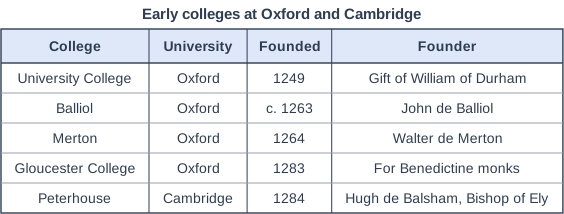
Figure 1 is a table of some early colleges at Oxford and Cambridge.

Explain what was important about the founding of colleges at Oxford and Cambridge in the 13th century.

Early colleges at Oxford and Cambridge. Table with columns "College", "University", "Founded", "Founder". College: University College; University: Oxford; Founded: 1249; Founder: Gift of William of Durham | College: Balliol; University: Oxford; Founded: c. 1263; Founder: John de Balliol | College: Merton; University: Oxford; Founded: 1264; Founder: Walter de Merton | College: Gloucester College; University: Oxford; Founded: 1283; Founder: For Benedictine monks | College: Peterhouse; University: Cambridge; Founded: 1284; Founder: Hugh de Balsham, Bishop of Ely.

Model answer

The founding of colleges was important first because it gave scholars security. Early students lived in rented rooms or halls, were often poor and frequently clashed with townspeople, as in 1209 when townsmen hanged some students. As Figure 1 shows, a series of colleges was founded from the middle of the 13th century. A college was an endowed community: its lands gave it a permanent income, it had its own buildings, and its statutes set out rules for an ordered life of study. This meant that scholars could afford the long years needed for higher degrees, especially theology.

The colleges were also important because of who founded them and why. Walter de Merton, who founded Merton in 1264, was Chancellor of England at the start of Edward I's reign, and Peterhouse was founded in 1284 by Hugh de Balsham, Bishop of Ely. Balliol was founded in about 1263 by John de Balliol, whose son became King of Scots in 1292. Such founders wanted to train educated clergy and servants for the Church and the crown, so the colleges show how closely the universities were tied to both.

Merton was especially important because it became a model. Its statutes, revised in 1270 and 1274, created a self-governing body of scholars under a warden, and when Peterhouse was founded its scholars were to follow the rule of Merton. Later colleges at both universities followed the same pattern, and colleges still shape Oxford and Cambridge today.

The colleges also drew the monks into university life. Gloucester College was founded in 1283 for Benedictine monks, and the Cistercians founded Rewley Abbey in Oxford in 1281, showing that by Edward's reign the universities, not the monasteries, were the leading centres of learning. However, the early colleges were small and mainly for graduates, so most students still lived in halls; their full importance came later.

Explanation

Colleges such as Merton (1264) and Peterhouse (1284) gave scholars endowments, housing and rules, were founded by churchmen and royal servants to train men for Church and state, set a lasting model and drew monks into the universities, though they were small and mainly for graduates at first. Level 4 needs these aspects explained and linked.

Mark scheme
  1. 8 marks

    Levels of response (8 marks).
    Level 4 (7-8 marks): Complex explanation of the importance of the early colleges, analysing several aspects and how they were linked, e.g. they gave scholars endowments, housing and rules, which supported long study for higher degrees; they show the role of churchmen and royal servants as patrons and the training of men for Church and state; Merton became a model; monks used colleges to join university life; but they were small and mainly for graduates, supported by precise, accurate knowledge (and may use Figure 1).
    Level 3 (5-6 marks): Developed explanation of two or more aspects of the importance of the colleges, supported by accurate knowledge.
    Level 2 (3-4 marks): Simple explanation of one aspect, e.g. they gave students somewhere to live.
    Level 1 (1-2 marks): Basic explanation: general statements about colleges with little specific knowledge.
    0 marks: nothing worthy of credit.

    Indicative content (not a checklist; credit other valid points): early students lived in rented rooms or halls and were often poor; conflict with townspeople (the hangings of 1209); colleges were endowed communities with lands giving a permanent income, buildings and statutes; University College (William of Durham's bequest, 1249; statutes 1280); Balliol (about 1263, John de Balliol, as a penance; statutes from his widow Dervorguilla, 1282 - their son John Balliol became King of Scots in 1292); Merton (1264, Walter de Merton, Chancellor of England 1261-63 and 1272-74, later Bishop of Rochester; statutes 1264, 1270, 1274) - a self-governing body of scholars under a warden, the model for later colleges; Peterhouse (1284, Hugh de Balsham, Bishop of Ely; its scholars were to follow the rule of Merton) - the first Cambridge college; Gloucester College (1283, for Benedictine monks) and Rewley Abbey (1281, Cistercians) - monks joining university life; colleges supported graduates through the long years of higher study, especially theology, producing educated clergy and royal servants; founders were churchmen and royal administrators, showing the links between the universities, the Church and the crown; colleges helped give the universities stability and permanent property; limits - they were small and mostly for graduates, so most students still lived in halls; their importance grew later, and colleges still shape Oxford and Cambridge today.

Question 4

16 marks

'Duns Scotus was more important than Roger Bacon for medieval learning.'

How far do you agree with this statement?

Explain your answer.

Model answer

I largely agree that Duns Scotus was more important than Roger Bacon for medieval learning, because medieval learning centred on theology and the universities, where Scotus's influence was far greater. However, Bacon was important in different ways, especially for the later history of science.

Scotus's importance for medieval learning was very great. Born in about 1266, he became a Franciscan, was ordained at Northampton in 1291, lectured at Oxford around 1300 and became a master of theology at Paris, the leading theology faculty in Europe, in 1305, before dying at Cologne in 1308. He worked at the very heart of the medieval university system. His ideas were original and deep: he argued that each individual has its own 'thisness' (haecceity), that the word 'being' means the same when applied to God and to creatures, that the will and love matter more than the intellect, and that God acts freely. He developed a rigorous proof of God's existence. His defence of the Immaculate Conception helped to change Catholic belief, and it became official teaching in 1854. Above all, his followers created Scotism, one of the main schools of thought in medieval universities, taught in Franciscan houses across Europe for centuries, and later thinkers such as William of Ockham developed their ideas by arguing with him.

However, Scotus's influence had limits. His writing was so difficult that he was called the Subtle Doctor, his ideas reached only educated scholars, and he had little to say about the natural world. In the 16th century his followers were mocked as 'dunces'.

Bacon's importance lies in his programme for reforming learning. In the Opus Majus, Opus Minus and Opus Tertium, written for Pope Clement IV in 1267-68, he argued for experimental science, for mathematics as the key to the sciences and for the study of Greek, Hebrew and Arabic. He wrote on optics, explaining reflection, refraction and magnifying lenses, described gunpowder and showed that the calendar needed reform. In this sense he looked further beyond the medieval curriculum than Scotus did.

But Bacon's importance for medieval learning at the time was limited. Clement IV died in 1268, so his proposals were never taken up; the Franciscans restricted what he could publish; and he did not found a school of followers as Scotus did. His work built on Robert Grosseteste and Arab scholars such as Ibn al-Haytham. Much of his fame came later, when Tudor writers made him a legendary magician and 19th-century admirers hailed him as a forerunner of modern science.

The answer depends on the criteria used. If importance means influence on medieval learning, which centred on theology in the universities, Scotus was clearly more important. If it means originality about the natural world or later reputation, Bacon has a stronger claim.

Overall, I largely agree. Scotus was more important for medieval learning because his ideas were taught and debated in universities across Europe for centuries and shaped Catholic belief. Bacon was a more unusual thinker whose importance lies more in his vision of what learning could become and in the later history of science than in his influence on the learning of his own time.

Explanation

Scotus shaped university theology through his ideas, the Immaculate Conception and the school of Scotism, while Bacon's programme of experimental science, optics and languages had little effect at the time but mattered more for the later history of science. Level 4 needs clear criteria and a sustained judgement.

Mark scheme
  1. 16 marks

    Levels of response (16 marks).
    Level 4 (13-16 marks): Complex explanation of the importance of Scotus (his ideas in theology and philosophy, the Immaculate Conception, his place in the universities and the school of Scotism) and of Bacon (his programme for learning, optics, mathematics, languages, experimental science, calendar reform, later reputation), using clear criteria (influence at the time, long-term influence, originality, importance to the Church or to science), with a sustained judgement, supported by precise, accurate knowledge.
    Level 3 (9-12 marks): Developed explanation of both scholars' importance, supported by accurate knowledge, with a judgement that may not be fully sustained.
    Level 2 (5-8 marks): Simple explanation of the importance of one or both, with some accurate knowledge.
    Level 1 (1-4 marks): Basic explanation, with little specific knowledge.
    0 marks: nothing worthy of credit.

    Indicative content (not a checklist; credit other valid points): Scotus (for): about 1266-1308; Franciscan, ordained at Northampton (1291), lectured at Oxford around 1300, master of theology at Paris (1305), died at Cologne (1308); ideas - haecceity, univocity of being, the primacy of the will and love, God's freedom, a rigorous proof of God's existence; defence of the Immaculate Conception, which became official Catholic teaching in 1854; called the Subtle Doctor; worked at the heart of the universities as a regent master at Paris, the leading theology faculty; Scotism became a major school taught across Europe for centuries, shaping later theology and philosophy, including William of Ockham's criticisms; beatified 1993. Scotus (against): very difficult - influence limited to scholars; little impact on science; later mocked ('dunce'). Bacon (for): about 1214/20-1292; Opus Majus, Opus Minus and Opus Tertium (1267-68) for Clement IV - a whole programme for reforming learning; experimental science, mathematics, optics (reflection, refraction, lenses), languages, calendar reform, gunpowder; criticism of the causes of error; later seen as a forerunner of modern science and a legendary figure; influence on later optics and on writers such as the 15th-century and later scholars who read him. Bacon (against): his proposals had little effect at the time - Clement IV died in 1268, and the Franciscans restricted him; he did not found a school; he built on Grosseteste and Arab scholars; his modern reputation was partly created later. Criteria: medieval learning was centred on theology and the universities, where Scotus was far more influential; Bacon matters more for the later history of science. Judgement: e.g. Scotus was more important for medieval learning because of his lasting influence on university theology, while Bacon's importance lies more in later reputation and in the history of science.

Ready to try the rest? Every answer you write is marked against the mark scheme, so you can see exactly where the marks are.

AI Tutor Hints first, answers after you try

Hi! Stuck? Ask me for a hint and I’ll help you work it out. Once you’ve checked your answer I can explain exactly where the marks are.