Level:
Correct: 0
Incorrect: 0
Marks: 0/0
Exam Practice
Subject:
Topics:
AQA GCSE History (Edward I) Smart practice A mixed round aimed at your weak spots
Unit 1
Part one: Government, the rights of King and people
Unit 2
Part two: Life in Medieval England
Unit 3
Part three: Edward I’s military campaigns in Wales and Scotland
Unit 4
Part four: The historic environment of Medieval England
Avg
score:
–
Topics
done:
0/10

Development of government, rights and justice

Practise 41 exam-style questions on Development of government, rights and justice for AQA GCSE History (Edward I). Write your answer as you would in the exam and get it marked in seconds against the mark scheme, point by point, with an AI tutor on hand if you get stuck.

  • 41 questions
  • 1–16 marks each
  • Instant marking
  • No sign-up needed
20 questions, marked as you go

Sample questions with model answers

Here are 4 of the questions in this topic, each with a model answer, an explanation of why it earns the marks and the mark scheme an examiner would use.

Question 1

1 mark

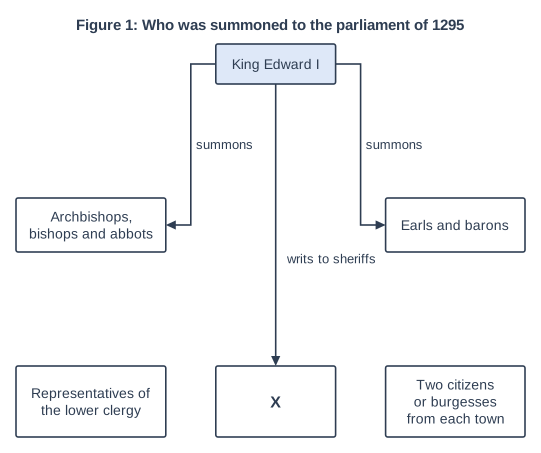
Study Figure 1, a diagram showing who was summoned to Edward I's parliament of 1295 (the 'Model Parliament').

What should replace X on the diagram?

Figure 1: Who was summoned to the parliament of 1295. Block diagram with six parts in five rows. Top row: a box "King Edward I" (shaded). Third row, left to right: a box "Archbishops, bishops and abbots" and a box "Earls and barons". Bottom row, left to right: a box "Representatives of the lower clergy", a box labelled X and a box "Two citizens or burgesses from each town". Connections: an arrow from "King Edward I" to "Archbishops, bishops and abbots", labelled "summons"; an arrow from "King Edward I" to "Earls and barons", labelled "summons"; an arrow from "King Edward I" to box X, labelled "writs to sheriffs".

Model answer

Two knights from each shire.

Explanation

In 1295 the sheriffs were ordered to have two knights elected from each shire, and two citizens or burgesses from each city and borough, to come with full power to act for their communities, alongside the lords and representatives of the lower clergy. The knights and burgesses later became the House of Commons.

Mark scheme
  1. 1 mark

    Two knights from each shire (county).

    Accept 'knights of the shire' / 'two knights from every county' / 'knights'. Do not accept 'barons', 'burgesses' or 'the people'.

Question 2

8 marks

Interpretation A: from a history of the English Church in the Middle Ages written by a clergyman in 1910. (Written for practice.)
Robert Burnell was a churchman in name only. He served the king, not God: he piled up manors and money, built himself a castle fit for a great lord, lived like a baron and found good positions for his relatives. Twice the king tried to make him Archbishop of Canterbury, and the Church was right to refuse him. Burnell's only loyalties were to Edward and to himself.

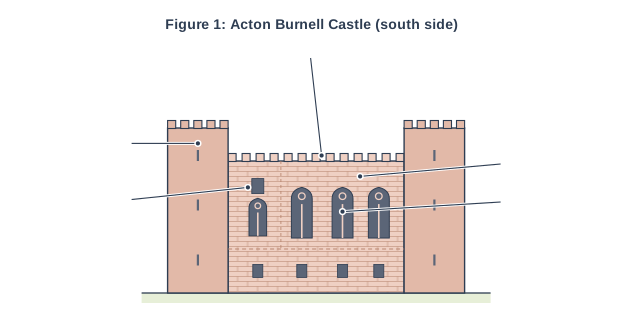
Figure 1 shows the south side of the fortified manor house that Burnell built at Acton Burnell in Shropshire after he received a licence to fortify it in 1284.

How convincing is Interpretation A about Robert Burnell? Explain your answer based on your contextual knowledge and what it says in Interpretation A.

Elevation of one side of a fortified stone house. Its heading is "Figure 1: Acton Burnell Castle (south side)". Drawing of one side of a fortified stone house (not to scale; about 27 m long). It is a rectangular block of reddish stone with a taller square block at each end, rising above the notched parapet of the main block. The lowest storey has only small openings. Above, the wider right-hand part has three tall pointed openings divided into two lights; the narrower left-hand part is three storeys high, with a smaller pointed opening and a small opening above it. The label "Corner tower" points to the taller square block at the left-hand end; the label "Battlements" points to the notched parapet along the top; the label "Large first-floor window" points to one of the tall pointed openings on the first floor; the label "Burnell's chamber" points to the narrower left-hand part of the main block, three storeys high; the label "Great hall (first floor)" points to the first floor of the wider right-hand part, behind the three tall pointed openings.

Model answer

Interpretation A is convincing in describing Burnell as a worldly man who grew rich in the king's service. He bought many manors and built up a great estate for his family. Figure 1 supports this: Acton Burnell Castle, built after he received a licence to fortify it in 1284, is a red sandstone manor house with corner towers, battlements and large first-floor windows for its great hall - the home of a wealthy lord, built as much for show and comfort as for defence. He also built a great hall at the bishop's palace at Wells. His career was spent as a royal clerk and minister rather than as a pastor, and when Edward tried to have him made Archbishop of Canterbury in 1278, the pope refused, partly because of his worldly life; he was said to have had children of his own.

However, A is unconvincing when it claims that Burnell's only loyalties were to Edward and himself. Serving Edward meant serving the kingdom. Burnell was one of the council that kept England peaceful in 1272-74, and as chancellor from 1274 to 1292 he ran the chancery efficiently while the great statutes were made: Westminster I (1275), Gloucester (1278), Mortmain (1279), Westminster II and Winchester (1285) and Quia Emptores (1290). Some of these protected ordinary people against corrupt officials and helped keep order. He was also a hard-working diplomat and took part in the Great Cause, dying at Berwick in 1292. Moreover, it was normal for royal clerks to be rewarded with bishoprics - Burnell became Bishop of Bath and Wells in 1275 - so judging him only as a churchman is unfair. The author, a clergyman writing in 1910, judges him by a later ideal of what a bishop should be.

Overall, A is convincing that Burnell was a wealthy, worldly royal servant, but unconvincing in its harsh conclusion, because his service brought good government to the kingdom as well as rewards to himself.

Explanation

Burnell's wealth, his castle and the pope's refusal in 1278 support A, but his long, effective service as chancellor, the statutes made under him and the normality of royal clerks becoming bishops challenge its conclusion. Level 4 uses specific knowledge (and may use the figure) to test A's claims and sustains a judgement.

Mark scheme
  1. 8 marks

    Levels of response (8 marks).
    Level 4 (7-8 marks): Complex evaluation of Interpretation A with a sustained judgement based on contextual knowledge, e.g. accepts that Burnell was a wealthy, worldly royal servant (estates, Acton Burnell Castle, the papal refusal of 1278) but challenges 'only loyalties to Edward and himself' with his long and effective service to the kingdom as chancellor, the statutes made under him, his work as Bishop of Bath and Wells and the normality of royal clerks becoming bishops, with a judgement sustained throughout.
    Level 3 (5-6 marks): Developed evaluation of Interpretation A based on contextual knowledge: explains, with specific knowledge, how far its view is supported and/or challenged.
    Level 2 (3-4 marks): Simple evaluation of Interpretation A based on contextual knowledge, e.g. agrees he built a castle and was rich, with one supporting detail.
    Level 1 (1-2 marks): Basic analysis of Interpretation A: paraphrases its view with little or no contextual knowledge.
    0 marks: nothing worthy of credit.

    Indicative content (not a checklist; credit other valid points): Convincing: Burnell built up a great estate for his family, buying many manors; Acton Burnell Castle - a red sandstone fortified manor house with corner towers, battlements and large first-floor windows, built more for show and comfort than defence (licence to crenellate 1284) - is the home of a wealthy lord; he also built a great hall at the bishop's palace at Wells; his career was as a royal clerk and minister - chancellor 1274-92 - rather than as a pastor; Edward tried to have him made Archbishop of Canterbury in 1270 and 1278, and in 1278 the pope refused, partly because of his worldly life; he was said to have had children; his family benefited from the estates he built up. Unconvincing: his service to Edward was service to the realm - he governed with Giffard and Mortimer in 1272-74, ran the chancery efficiently for 18 years and the great statutes (Westminster I 1275, Gloucester 1278, Mortmain 1279, Acton Burnell 1283, Westminster II and Winchester 1285, Quia Emptores 1290) were made under him, some protecting ordinary people from corrupt officials; he was Bishop of Bath and Wells from 1275 and many bishops of the time were royal servants - this was normal, not unusual; diplomacy and the Great Cause (died at Berwick, 1292); provenance - a clergyman writing a history of the Church in 1910 judges Burnell by the standards of a later, more spiritual idea of a bishop. Possible judgement: convincing that Burnell was a worldly, wealthy royal servant, but unconvincing that he served only Edward and himself, since his work benefited the kingdom.

Question 3

8 marks

Write an account of the ways in which Edward I tried to improve law and order in England.

Model answer

When Edward became king, the disorder left by the civil war and the corruption of local officials were serious problems. The Hundred Rolls inquiry of 1274-75 revealed sheriffs and bailiffs taking bribes and imprisoning people unjustly, so Edward's first step was the Statute of Westminster I in 1275. It curbed the abuses of officials, set out rules on who could be released on bail, and ordered harsh imprisonment for notorious felons who refused to accept trial by jury. Royal justices continued to visit the counties on the general eyre to hear criminal cases.

The most important measure came in 1285 with the Statute of Winchester, which made local communities responsible for keeping order. When a crime was discovered the hue and cry was to be raised and everyone had to join the chase; if robbers were not caught, the whole hundred was held responsible for the losses. Towns were to keep watch and ward, shutting their gates from sunset to sunrise and questioning strangers. Roads between market towns were to be cleared of trees and undergrowth for 200 feet on each side so that robbers could not lie in ambush, and every man between fifteen and sixty had to keep weapons according to his wealth. In the same year Westminster II allowed cases to be tried by royal justices when they visited the counties (nisi prius), making justice quicker. Keepers of the peace were later appointed in some counties to enforce the Statute of Winchester.

Edward also acted against those who abused the law. On his return from Gascony in 1289 he found many complaints against his officials, and in 1289-90 most of his judges were dismissed. In 1305 he sent special trailbaston commissions to deal with violent gangs. However, war limited his success: from 1294 large numbers of criminals were pardoned in return for serving in his armies, and the general eyres stopped. Edward created a lasting framework for keeping order, but disorder remained a problem at the end of his reign.

Explanation

Edward's measures ran from Westminster I (1275) through the Statute of Winchester and nisi prius (1285) to the dismissal of judges (1289-90) and trailbaston (1305), but pardons for military service undermined them. Level 4 explains why each measure was needed and how they fitted together, not just what they said.

Mark scheme
  1. 8 marks

    Levels of response (8 marks).
    Level 4 (7-8 marks): Complex analysis of Edward's measures and why they were needed in a coherent, well-structured narrative, e.g. explains how the problems revealed in 1274-75 led to Westminster I, how the Statute of Winchester (1285) and nisi prius organised local policing and justice, how keepers of the peace and trailbaston commissions followed, and how war and pardons limited the results, with specific knowledge and links between the measures.
    Level 3 (5-6 marks): Developed analysis in a structured narrative supported by specific knowledge.
    Level 2 (3-4 marks): Simple analysis: a narrative of one or two measures with some explanation, e.g. the Statute of Winchester made towns shut their gates at night.
    Level 1 (1-2 marks): Basic analysis: general narrative with little specific knowledge.
    0 marks: nothing worthy of credit.

    Indicative content (not a checklist; credit other valid points): Problems: disorder after the civil war; corrupt sheriffs and bailiffs (Hundred Rolls, 1274-75); Westminster I (1275): curbs on officials, rules on bail, harsh imprisonment (prison forte et dure) for notorious felons who refused trial by jury; the general eyre - royal justices visiting each county; Statute of Winchester (1285): the hue and cry - everyone to chase criminals; the hundred held responsible for robberies if the robbers were not caught; watch and ward - town gates shut from sunset to sunrise and strangers questioned; roads between market towns cleared of trees and undergrowth for 200 feet on each side so robbers could not hide; every man aged 15-60 to keep arms according to his wealth; constables to inspect; Westminster II (1285): nisi prius - cases tried in the counties by justices of assize; keepers of the peace appointed in some counties to enforce the Statute of Winchester; 1289-90: corrupt judges and officials dismissed after Edward's return from Gascony; 1305: trailbaston commissions against violent gangs and hired thugs; limits: from 1294 large numbers of criminals were pardoned in return for military service, and the general eyres stopped with war.

Question 4

16 marks

'Edward I's statutes mainly benefited the great landowners.'

How far do you agree with this statement? Explain your answer.

Model answer

Great landowners certainly benefited from several of Edward I's statutes, especially those about land. However, I do not agree that they were the main beneficiaries overall. The statutes also served the crown, which gained most from restoring its authority, and some of the most important protected ordinary free men from the abuses of officials and lords.

The case for the great landowners is strong. De Donis, the first chapter of the Statute of Westminster II in 1285, allowed land granted to a man and the heirs of his body to be kept in the family rather than sold away, protecting great estates for generations. Quia Emptores, passed in 1290 at the request of the magnates, ended subinfeudation: when land was sold, the buyer held it directly from the seller's lord, so lords no longer lost the valuable dues - wardships, marriages, reliefs and escheats - that came with land. The Statute of Mortmain of 1279 had a similar purpose, preventing land from passing to the Church, which never died or married and so never paid these dues. Westminster II also helped lords recover services and rents owed by tenants, and the Statute of Quo Warranto of 1290 allowed lords to keep franchises their families had held since 1189. Since the great landowners dominated parliament, it is not surprising that statutes served their interests.

However, the crown benefited at least as much. Many statutes restored royal rights after the weakness of Henry III's reign. The Quo Warranto inquiries established that franchises came from the king, even if the 1290 compromise let lords keep long-held rights. Mortmain gave the crown control over gifts of land to the Church, and licences to make such gifts brought in money. In the long run Quia Emptores brought more land under the king as the ultimate overlord.

Ordinary free men also benefited. The Statute of Westminster I of 1275 was a response to the complaints of the Hundred Rolls juries, many of whom were ordinary freeholders. It forbade sheriffs, bailiffs and the officials of lords to take bribes or excessive fees, limited wrongful imprisonment and the abuse of distraint, protected free elections and repeated Magna Carta's promise of reasonable amercements. Westminster II allowed cases to be heard in the counties instead of only at Westminster, which made justice easier to obtain. The Statute of Winchester of 1285 aimed to make the roads and towns safer for everyone through the hue and cry, watch and ward, and the clearing of undergrowth 200 feet on each side of highways, although it also placed burdens on local communities. Merchants gained from the Statute of Acton Burnell of 1283 and the Statute of Merchants of 1285, which helped them recover debts. Not everyone benefited: the Church lost out through Mortmain.

Overall, great landowners were among the main beneficiaries of the land law statutes, but the statutes as a whole were designed to strengthen royal authority and good order, and the crown gained most. Westminster I and the Statute of Winchester show that ordinary free men and communities gained real protection too, so the statement is only partly true.

Explanation

De Donis, Quia Emptores, Mortmain and the Quo Warranto compromise helped great landowners, but the crown gained most, and Westminster I, nisi prius, the Statute of Winchester and the Statutes of Merchants benefited free men, communities and merchants. Level 4 explains several groups with precise knowledge and sustains a judgement about who benefited most.

Mark scheme
  1. 16 marks

    Levels of response (16 marks).
    Level 4 (13-16 marks): Complex explanation of how the statutes benefited great landowners (e.g. De Donis, Quia Emptores, Mortmain, the Quo Warranto compromise, rules on distraint) and how they benefited others (e.g. the crown through royal rights and licences, ordinary free men through Westminster I and curbs on officials and lords, merchants through the Statutes of Merchants, the community through the Statute of Winchester) or burdened groups such as the Church, with a sustained judgement about who benefited most, supported throughout by specific, accurate knowledge.
    Level 3 (9-12 marks): Developed explanation of benefits to great landowners and at least one other group, with specific knowledge; a judgement is reached but not fully sustained.
    Level 2 (5-8 marks): Simple explanation of benefits to great landowners or to other group(s).
    Level 1 (1-4 marks): Basic explanation with little specific knowledge.
    0 marks: nothing worthy of credit.

    Indicative content (not a checklist; credit other valid points): Great landowners: De Donis (Westminster II, 1285, chapter 1) - land granted to a man and the heirs of his body could not be sold away from the family (entails); Quia Emptores (1290), made at the request of the magnates - stopped subinfeudation, so lords did not lose wardships, marriages, reliefs and escheats; Statute of Mortmain (1279) - stopped land passing to the Church, where lords lost their feudal dues; Westminster II helped lords recover services and rents; the Statute of Quo Warranto (1290) let lords keep franchises held since 1189. The crown: Quo Warranto established that franchises came from the king; Mortmain licences brought income and control; Quia Emptores in the long run brought more land under the king as overlord; statutes restored royal authority after the civil war. Ordinary free men and communities: Westminster I (1275) curbed abuses by sheriffs, bailiffs and lords' officials (bribes, excessive fees, wrongful imprisonment, distraint), protected free elections and reasonable amercements, rules on bail; nisi prius (1285) let cases be heard in the counties; the Statute of Winchester (1285) - hue and cry, watch and ward, roads cleared 200 feet each side - aimed at safety for all, though it also placed duties and liability for robberies on local communities. Merchants: Statute of Acton Burnell (1283) and Statute of Merchants (1285) - recovery of debts. Losers: the Church (Mortmain); the Jews (Statute of the Jewry 1275, expulsion 1290 - not a statute of Westminster but part of policy). Possible judgements: landowners gained most from the land law statutes, but the statutes as a whole served the crown's authority and the wider community; or the great landowners were the main beneficiaries because they dominated parliament.

Ready to try the rest? Every answer you write is marked against the mark scheme, so you can see exactly where the marks are.

AI Tutor Hints first, answers after you try

Hi! Stuck? Ask me for a hint and I’ll help you work it out. Once you’ve checked your answer I can explain exactly where the marks are.