Level:
Correct: 0
Incorrect: 0
Marks: 0/0
Exam Practice
Subject:
Topics:
AQA GCSE History (Norman England) Smart practice A mixed round aimed at your weak spots
Unit 1
Part one: The Normans: conquest and control
Unit 2
Part two: Life under the Normans
Unit 3
Part three: The Norman Church and monasticism
The Norman Church and monasticism
The Church
0%
Monasticism
0%
Unit 4
Part four: The historic environment of Norman England
Avg
score:
–
Topics
done:
0/9

The Church

Practise 42 exam-style questions on The Church for AQA GCSE History (Norman England). Write your answer as you would in the exam and get it marked in seconds against the mark scheme, point by point, with an AI tutor on hand if you get stuck.

  • 42 questions
  • 1–16 marks each
  • Instant marking
  • No sign-up needed
20 questions, marked as you go

Sample questions with model answers

Here are 4 of the questions in this topic, each with a model answer, an explanation of why it earns the marks and the mark scheme an examiner would use.

Question 1

2 marks

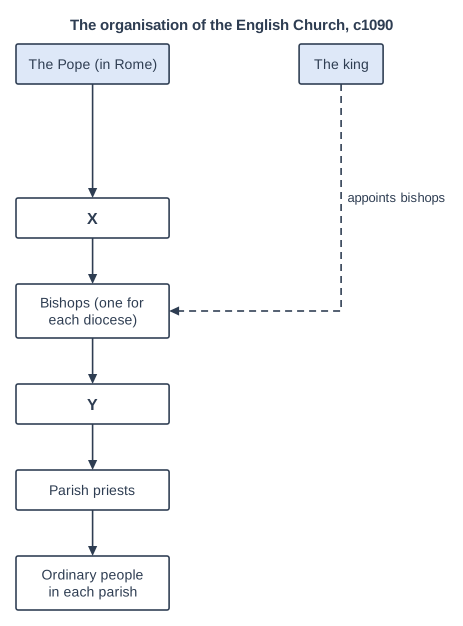
Figure 1 shows the organisation of the English Church in about 1090.

What should replace the letters X and Y?

The organisation of the English Church, c1090. Block diagram with seven parts in seven rows. Top row, left to right: a box "The Pope (in Rome)" (shaded) and a box "The king" (shaded). Third row: a box labelled X. Fourth row: a box "Bishops (one for each diocese)". Fifth row: a box labelled Y. Sixth row: a box "Parish priests". Bottom row: a box "Ordinary people in each parish". Connections: an arrow from "The Pope (in Rome)" to box X; an arrow from box X to "Bishops (one for each diocese)"; an arrow from "Bishops (one for each diocese)" to box Y; an arrow from box Y to "Parish priests"; an arrow from "Parish priests" to "Ordinary people in each parish"; a dashed arrow from "The king" to "Bishops (one for each diocese)", labelled "appoints bishops".

Model answer

X is the archbishops (of Canterbury and York) and Y is the archdeacons.

Explanation

The English Church had two provinces, Canterbury and York, each under an archbishop; the Accord of Winchester (1072) made Canterbury the senior. Each diocese had a bishop, and under Lanfranc archdeacons were appointed to supervise the parish clergy and enforce discipline. The king appointed the bishops, which gave him great power over the Church.

Mark scheme
  1. 1 mark

    X: archbishops (the Archbishops of Canterbury and York).

    Accept 'archbishop', 'Archbishop of Canterbury', 'Archbishops of Canterbury and York', 'Lanfranc'. Do not accept 'cardinals' or 'the king'.

  2. 1 mark

    Y: archdeacons.

    Accept 'archdeacon(s)'. Do not accept 'deacons', 'abbots' or 'monks'.

Question 2

8 marks

Explain what was important about the Accord of Winchester of 1072 for the English Church.

Model answer

The Accord of Winchester was important because it gave the English Church a single leader. When Thomas of Bayeux became Archbishop of York in 1070 he refused to swear obedience to Lanfranc. Both men went to Rome in 1071, and Pope Alexander II sent the dispute back to be settled in England. At Winchester at Easter 1072, confirmed at Windsor at Whitsun, it was agreed that Canterbury was superior to York, and Thomas made his profession of obedience. The disputed sees of Worcester, Lichfield and Dorchester stayed in Canterbury's province, leaving York with the north.

First, this unity made reform possible. As the undisputed head of the Church, Lanfranc could call councils for the whole English Church, such as London in 1075 and Winchester in 1076, which moved sees to towns, condemned simony and restricted clerical marriage. Without the Accord, York could have ignored these decisions.

Second, the Accord helped William's political security. Lanfranc argued that if the Archbishop of York were independent he might crown a rival king of the north with the help of the Danes or the Scots. This was a real danger: the north had rebelled in 1069 with Danish help, and William had answered with the Harrying of the North. By binding York to Canterbury, the Accord tied the northern Church to the king and his closest ally.

Third, it increased royal control of the Church as a whole. Lanfranc worked hand in hand with William, so a powerful Canterbury meant a Church that followed the king's wishes. Lanfranc even claimed authority over 'the whole of Britain' and consecrated a bishop for Dublin in 1074. The Accord's weakness was that it rested on Thomas's personal submission, and the rivalry revived after Lanfranc's death in 1089, but in the 1070s and 1080s it was the foundation of both reform and Norman control of the Church.

Explanation

The Accord (1072) made York accept Canterbury's primacy, which allowed Lanfranc to hold national reforming councils and reduced the danger of a rival northern king crowned at York. Level 4 links its importance for reform, unity and royal security with precise knowledge; simply saying York had to obey Canterbury is Level 2.

Mark scheme
  1. 8 marks

    Levels of response (8 marks).
    Level 4 (7-8 marks): Complex explanation of the importance of the Accord of Winchester, e.g. links Canterbury's primacy over York to the unity of the Church, Lanfranc's ability to hold national councils and carry through reform, and William's political security in the north, supported by a range of accurate knowledge.
    Level 3 (5-6 marks): Developed explanation of two or more consequences of the Accord, with specific knowledge.
    Level 2 (3-4 marks): Simple explanation of one consequence, e.g. that it made the Archbishop of York obey Lanfranc.
    Level 1 (1-2 marks): Basic explanation or description of the Accord, with little specific knowledge.
    0 marks: nothing worthy of credit.

    Indicative content (not a checklist; credit other valid points): The dispute: Thomas of Bayeux, Archbishop of York from 1070, refused to make a profession of obedience to Lanfranc; both went to Rome in 1071 and Pope Alexander II sent the question back to be settled in England. The Accord, agreed at Winchester at Easter 1072 and confirmed at Windsor at Whitsun, declared Canterbury's primacy over York and 'the whole of Britain'; Thomas made his profession of obedience; the disputed sees of Worcester, Lichfield and Dorchester stayed in Canterbury's province, leaving York with the north (Durham). Unity: one leader for the English Church, so Lanfranc could call councils for the whole Church (London 1075, Winchester 1076) and enforce reform. Security: Lanfranc argued that an independent Archbishop of York might crown a rival king in the north with Danish or Scottish support - a real fear after the northern rebellions of 1069-70 and the Danish invasion; the Accord bound the northern Church to the king's Canterbury. Royal control: Lanfranc was William's closest ally, so Canterbury's primacy helped William control the whole Church. Wider claims: Lanfranc consecrated bishops for Dublin (Patrick, 1074). Limits: the agreement depended on Thomas's personal submission and the quarrel revived after Lanfranc's death in 1089. Possible judgement: its main importance was to make reform and royal control possible across the whole kingdom.

Question 3

8 marks

Interpretation A: from a popular history of the kings and queens of England written in 1965. (Written for practice.)
William Rufus was the most irreligious king ever to sit on the English throne. He mocked the saints, robbed the Church of its wealth and left bishoprics and abbeys without shepherds so that he could pocket their revenues. When Archbishop Lanfranc died, Rufus kept Canterbury empty for four years, and he drove the saintly Anselm into exile. Little wonder that when he was killed in the New Forest in 1100, few churchmen mourned him.

How convincing is Interpretation A about William II's relationship with the Church? Explain your answer based on your contextual knowledge and what it says in Interpretation A.

Model answer

Interpretation A is convincing about the way William Rufus treated the Church's wealth. After Lanfranc died in May 1089 Rufus kept Canterbury vacant until March 1093, almost four years, and took its revenues. Ranulf Flambard managed vacant bishoprics and abbeys to raise money for the king, and according to the Anglo-Saxon Chronicle, when Rufus died he held the archbishopric of Canterbury, the bishoprics of Winchester and Salisbury and eleven abbeys. He sold Church offices: Herbert de Losinga bought the bishopric of Thetford, and Flambard became Bishop of Durham in 1099. A is also right that Rufus quarrelled with Anselm. He refused Anselm's gift of 500 pounds as too small, clashed with him at Rockingham in 1095 and, after Anselm went into exile in 1097, seized Canterbury's lands. Rufus was killed in the New Forest in 1100 and buried at Winchester with little ceremony, and some writers saw his death as God's judgement.

However, A is less convincing in calling Rufus 'the most irreligious king ever'. Our evidence comes from monks such as Eadmer, Anselm's friend and biographer, and William of Malmesbury, who had every reason to present him badly. Taking the revenues of vacant churches was seen as a royal right, and William I had also made the Church pay, through knight service. Rufus did appoint Anselm, a famous and holy scholar, and he recognised Urban II as pope in 1095. He attended the consecration of Battle Abbey in 1094 and supported the new abbey of St Mary's, York. His quarrel with Anselm was mainly about royal rights and authority rather than about religion itself.

Overall, A is convincing about Rufus's exploitation of the Church and his poor relations with churchmen, but its picture of extreme irreligion comes from hostile monastic writers, and as a popular history it exaggerates for effect.

Explanation

The vacancies, Flambard's exploitation, simony and Anselm's exile support A, but the sources were hostile monks, vacancies were a recognised royal right, and Rufus appointed Anselm and recognised Urban II. Level 4 tests A's claims against precise knowledge and considers the reliability of the evidence behind it, with a sustained judgement; agreeing that Canterbury was left vacant is Level 2.

Mark scheme
  1. 8 marks

    Levels of response (8 marks).
    Level 4 (7-8 marks): Complex evaluation of Interpretation A with a sustained judgement based on contextual knowledge, e.g. confirms the vacancies, the exploitation of Church revenues and Anselm's exile with precise knowledge, but questions the claim that Rufus was 'the most irreligious king ever' by considering the bias of monastic chroniclers, the rights kings claimed over Church lands, his appointment of Anselm and his recognition of Urban II; the judgement is sustained.
    Level 3 (5-6 marks): Developed evaluation of Interpretation A based on contextual knowledge, explaining how far two or more of its claims are supported and/or challenged.
    Level 2 (3-4 marks): Simple evaluation, e.g. agrees that Canterbury was left vacant, with one supporting fact.
    Level 1 (1-2 marks): Basic analysis of Interpretation A, identifying or paraphrasing what it says.
    0 marks: nothing worthy of credit.

    Indicative content (not a checklist; credit other valid points): Convincing: Canterbury vacant from Lanfranc's death (May 1089) until Anselm's appointment (March 1093) - almost four years; Ranulf Flambard ran vacant sees and abbeys for profit; at his death (Anglo-Saxon Chronicle) he held Canterbury, Winchester, Salisbury and eleven abbeys; simony - Herbert de Losinga bought Thetford, Flambard became Bishop of Durham (1099); he refused Anselm's 500 pounds as too small; churches stripped treasures to pay for the 1096 mortgage of Normandy; quarrel with Anselm - Rockingham (1095), exile (1097) and seizure of Canterbury's lands; chroniclers (Eadmer, William of Malmesbury, Orderic) describe blasphemy and mockery; killed in the New Forest on 2 August 1100 and buried at Winchester with little ceremony - some saw his death as God's judgement. Less convincing: the chroniclers were monks with reasons to hate him (Eadmer was Anselm's friend and biographer); taking the revenues of vacant churches was seen as a royal right and William I had also taxed the Church and demanded knight service; Rufus appointed Anselm (1093) and bishops who were capable administrators (Robert Bloet at Lincoln); he recognised Urban II in 1095; he attended the consecration of Battle Abbey (1094) and supported St Mary's, York; the quarrel with Anselm was largely about royal rights and authority, not religion; 'the most irreligious king ever' is an exaggeration typical of popular history. Possible judgement: convincing about his exploitation of the Church, but the portrait of irreligion relies on hostile sources.

Question 4

16 marks

'The main consequence of the Norman Conquest for the English Church was the building of new cathedrals and churches.'

How far do you agree with this statement? Explain your answer.

Model answer

The building of new cathedrals and churches was the most visible consequence of the Conquest for the English Church, but I do not think it was the main one. The building was itself the result of a deeper change: the replacement of the English leaders of the Church by Normans, who reorganised and reformed the Church under the king's control.

The building programme was certainly enormous. Lanfranc began a new Canterbury Cathedral in 1070, modelled on St Stephen's at Caen. Within thirty years almost every English cathedral had been rebuilt or begun again: Lincoln in about 1072, Winchester in 1079, Rochester and York in about 1080, Worcester in 1084, St Paul's in 1087, Durham in 1093 and Norwich in 1096. Great abbeys such as St Albans and Gloucester were rebuilt too, and Norman lords put up stone parish churches on their manors. The massive Romanesque style, with round arches, thick walls and, at Durham, stone rib vaults, transformed the look of England, and many old English churches were demolished, which upset Bishop Wulfstan of Worcester. Because cathedrals often stood beside castles, at Lincoln, Old Sarum and Durham, they became symbols of Norman rule.

However, this building happened because of the change of leadership. After the rebellions were crushed, the councils of 1070 deposed Stigand and other English bishops, and as others died Normans replaced them, until by 1087 Wulfstan was the only English bishop left. Abbots were replaced too, such as Turold at Peterborough and Paul of Caen at St Albans. These new leaders were the ones who ordered the rebuilding, brought Norman customs and Latin learning, and owed their positions and their loyalty to William. Without this change there would have been no building programme.

The new leadership also reorganised the Church in ways that went deeper than its buildings. Lanfranc secured Canterbury's primacy over York in 1072 and held councils that moved sees to towns (1075), condemned simony and restricted clerical marriage (1076). Archdeacons were appointed to supervise the clergy, and in the 1070s William separated Church courts from lay courts. These changes affected how the Church was run and how the clergy behaved, not just how churches looked.

Another major consequence was royal control. William chose every bishop and abbot, required knight service from Church lands from about 1070, and laid down that no pope could be recognised, no papal letter received and no baron excommunicated without his permission. In 1080 he refused fealty to Gregory VII. Under William II this control turned into exploitation: Canterbury was left vacant from 1089 to 1093 and Ranulf Flambard collected the revenues of empty bishoprics and abbeys. The Church also lost wealth: the monasteries were plundered in 1070 and English estates were given to Norman abbeys.

Overall, the building of cathedrals and churches was the most visible and lasting consequence, and it is what most people would have noticed. But the main consequence was the takeover of the Church's leadership by Normans loyal to the king. That takeover caused the building programme, made reform possible and placed the Church firmly under royal control.

Explanation

The building programme (Canterbury 1070 to Norwich 1096, abbey and parish churches, the Romanesque style) was the most visible change, but it flowed from the replacement of English bishops and abbots, Lanfranc's reorganisation and the king's tight control of the Church. Level 4 compares building with other consequences in depth and sustains a judgement; describing the cathedrals alone is Level 2.

Mark scheme
  1. 16 marks

    Levels of response (16 marks).
    Level 4 (13-16 marks): Complex explanation of the building programme as a consequence and of other consequences (new Norman leadership, Lanfranc's reforms and reorganisation, royal control and Church-state relations, closer but controlled links with the papacy, the use of Church wealth, monastic change, language), with a sustained judgement about which was the main consequence, supported throughout by specific, accurate knowledge.
    Level 3 (9-12 marks): Developed explanation of building and at least one other consequence; a judgement is reached but not fully sustained.
    Level 2 (5-8 marks): Simple explanation of building or of other consequences.
    Level 1 (1-4 marks): Basic explanation, with little specific knowledge.
    0 marks: nothing worthy of credit.

    Indicative content (not a checklist; credit other valid points): Building: Canterbury (1070), Lincoln (about 1072), Winchester (1079), Rochester and York (about 1080), Worcester (1084), St Paul's (1087), Durham (1093, rib vaults), Norwich (1096); abbey churches (St Albans, Bury, Ely, Gloucester); stone parish churches; Romanesque style; demolition of English churches (Wulfstan's lament); cathedrals beside castles - the most visible change. Leadership: Stigand deposed (1070); English bishops and abbots replaced by Normans - by 1087 only Wulfstan was English. Reform and organisation: Accord of Winchester (1072); councils of London (1075: sees moved to towns) and Winchester (1076: celibacy); archdeacons; separate Church courts (1070s). Royal control: William chose bishops, controlled papal letters, councils and excommunications; knight service from Church lands (about 1070); bishops as royal servants. Papacy: banner (1066), legates (1070); William refused fealty (1080); schism; William II recognised Urban II only in 1095. Wealth: monasteries plundered (1070); English estates given to Norman abbeys; William II's vacancies (Canterbury 1089-93) and Ranulf Flambard. Monasticism and culture: Norman abbots, Lanfranc's Constitutions, new foundations (Battle, Selby, Lewes), Latin replacing English in documents. Possible judgements: building was the most visible but the change of leadership was the root consequence that caused the others; or reform and royal control changed the Church more deeply; building was itself a result of new leadership and reform.

Ready to try the rest? Every answer you write is marked against the mark scheme, so you can see exactly where the marks are.

AI Tutor Hints first, answers after you try

Hi! Stuck? Ask me for a hint and I’ll help you work it out. Once you’ve checked your answer I can explain exactly where the marks are.