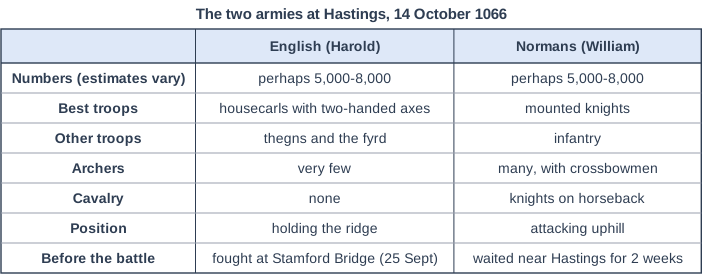
Figure 1 is a table comparing the two armies at the Battle of Hastings.
'The Normans won the Battle of Hastings because their army was better equipped and organised than the English army.'
How far does a study of the Battle of Hastings support this statement? Explain your answer. You should refer to the Battle of Hastings and your contextual knowledge.
Model answer
A study of the Battle of Hastings supports the statement to some extent. The Norman army's mix of troops gave William options the English did not have. But the English army was also well equipped and organised, and for most of the day the Normans' advantages did not bring success; leadership, English weaknesses and Harold's death were needed as well.
The Norman army was varied and well organised. As Figure 1 shows, William had mounted knights, infantry and many archers and crossbowmen, while the English had no cavalry and very few archers. William organised his army in three divisions - Bretons on the left, Normans in the centre, French and Flemish on the right - each with archers in front, then infantry, then knights. The knights wore mail and conical helmets, carried kite-shaped shields, lances and swords, and fought in small trained units that could charge, wheel and pursue. This allowed William to keep attacking all day in different ways: arrows, then infantry, then cavalry. His knights cut down the English who chased the Bretons on to a hillock around midday, and later made the feigned retreats that William of Poitiers describes. In the late afternoon the archers shot high so their arrows fell behind the shield wall. The Normans had also rested near Hastings for about two weeks.
However, the English army was not poorly equipped. The housecarls were professional soldiers in mail with deadly two-handed axes, supported by thegns and the select fyrd, and the numbers on each side were roughly equal, perhaps 5,000-8,000. Their disciplined shield wall on the ridge, with marshy ground protecting both flanks, held from about 9 a.m. into the late afternoon. For most of the day the Norman advantages failed: arrows shot uphill hit shields, cavalry could not break the line, the Bretons fled and William was thought dead. This shows that equipment and organisation alone did not win the battle.
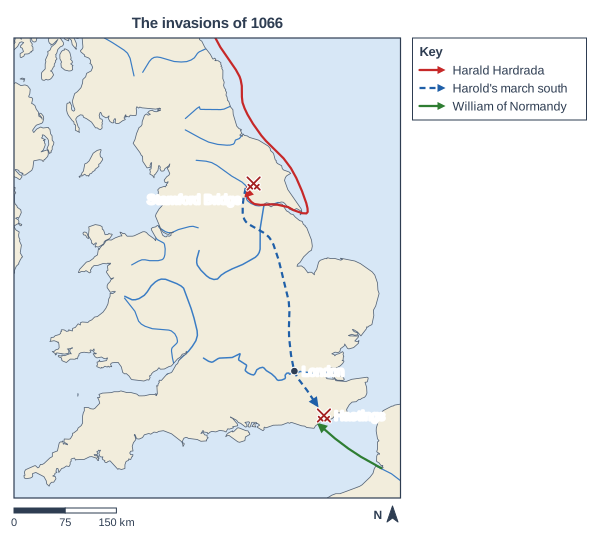
Other factors were needed. William's leadership was vital, especially when he raised his helmet to stop his army breaking. The English were tired after Stamford Bridge and the march south, and Harold fought 'before all his army had come', without Earls Edwin and Morcar. English discipline failed when men left the shield wall to pursue. Luck had allowed William to land unopposed, because the fyrd had been sent home on 8 September and Harold was in the north. Finally, the battle was decided by Harold's death near his standards late in the afternoon, after which the English line collapsed.
Overall, the statement is partly convincing. The Norman army's combination of archers, infantry and cavalry was a real advantage that let William keep up the pressure all day while the English could only defend. But the English were well armed and organised too, and the battle was very close. The Norman army's strengths only became decisive because of William's leadership, the tiredness and indiscipline of the English, and the death of Harold.
Explanation
The Normans' combination of archers, infantry and cavalry let William keep attacking, but the English housecarls and shield wall were also formidable and held for most of the day; leadership, English tiredness and indiscipline, luck and Harold's death turned the Norman advantages into victory. Level 4 weighs the armies against each other and against other factors with a sustained judgement.