Level:
Correct: 0
Incorrect: 0
Marks: 0/0
Exam Practice
Subject:
Topics:
AQA GCSE History (Norman England) Smart practice A mixed round aimed at your weak spots
Unit 1
Part one: The Normans: conquest and control
Unit 2
Part two: Life under the Normans
Unit 3
Part three: The Norman Church and monasticism
The Norman Church and monasticism
The Church
0%
Monasticism
0%
Unit 4
Part four: The historic environment of Norman England
Avg
score:
–
Topics
done:
0/9

Establishing and maintaining control

Practise 43 exam-style questions on Establishing and maintaining control for AQA GCSE History (Norman England). Write your answer as you would in the exam and get it marked in seconds against the mark scheme, point by point, with an AI tutor on hand if you get stuck.

  • 43 questions
  • 1–16 marks each
  • Instant marking
  • No sign-up needed
20 questions, marked as you go

Sample questions with model answers

Here are 4 of the questions in this topic, each with a model answer, an explanation of why it earns the marks and the mark scheme an examiner would use.

Question 1

2 marks

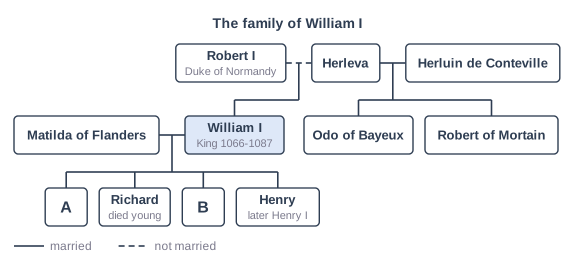
Figure 1 shows the family of William I.

Name the sons labelled A and B. A became Duke of Normandy when William I died in 1087; B became King of England.

Family tree titled "The family of William I": names in boxes joined by lines, with 3 generations in rows from the oldest at the top to the youngest at the bottom. A line between two boxes in a row joins a couple (solid: married; dashed: not married), and a line coming down from a couple, or from one person on their own, leads to their children. Top row, left to right: Robert I (Duke of Normandy), Herleva and Herluin de Conteville. Second row, left to right: Matilda of Flanders, William I (King 1066-1087), Odo of Bayeux and Robert of Mortain. Third row, left to right: box A, Richard (died young), box B and Henry (later Henry I). Robert I and Herleva are joined by a dashed line (not married); their child is William I. Herleva and Herluin de Conteville are married; their children are Odo of Bayeux and Robert of Mortain. Matilda of Flanders and William I are married; their children are box A, Richard, box B and Henry. The box of William I is shaded. Boxes A and B show letters instead of names.

Model answer

A is Robert Curthose, William's eldest son, who inherited Normandy. B is William Rufus, who became King William II of England.

Explanation

William I left Normandy, the family's inherited land, to his eldest son Robert, who had rebelled against him, and England to his loyal second surviving son, William Rufus (Richard had died young); the youngest, Henry, received a large sum of silver. The division caused problems because many barons held land in both England and Normandy.

Mark scheme
  1. 1 mark

    A: Robert Curthose (Robert, Duke of Normandy).

    Accept 'Robert' / 'Robert Curthose' / 'Robert II of Normandy'. Do not accept Robert of Mortain or Robert I.

  2. 1 mark

    B: William Rufus (William II).

    Accept 'William II', 'William Rufus', 'Rufus'.

Question 2

8 marks

Interpretation A: from an article in a history magazine, written in 2010. (Written for practice.)
The Revolt of the Earls in 1075 was a turning point. For the first time the danger to William came not from the defeated English but from his own great men: two of the three rebel earls were Norman and Breton lords who owed everything to him. Worse, they had invited a Danish fleet. The revolt failed only because William's other followers stayed loyal and the Danes arrived too late. From now on, the greatest threat to the Norman kings would come from within the Norman nobility.

How convincing is Interpretation A about the Revolt of the Earls? Explain your answer based on your contextual knowledge and what it says in Interpretation A.

Model answer

Interpretation A is convincing in several ways. Two of the three rebel earls were indeed William's own men. Roger de Breteuil, Earl of Hereford, was the son of William's close friend William FitzOsbern, and Ralph de Gael, Earl of East Anglia, was half-Breton, with lands in Brittany; only Waltheof came from an old English noble family. They plotted at Ralph's wedding feast at Exning while William was in Normandy, and they invited a Danish fleet. A is right that loyal followers saved William: Archbishop Lanfranc excommunicated Roger, Bishop Wulfstan and the sheriff Urse d'Abetot stopped Roger's army at the Severn, and Odo of Bayeux and Geoffrey of Coutances defeated Ralph near Cambridge. The Danish fleet of about 200 ships arrived too late, raided York and sailed home. A is also right about the future: after 1075 the main threats to the Norman kings came from Normans - Robert Curthose's rebellion against his father, Odo's arrest in 1082, the rebellion of 1088 against William II and Robert de Mowbray's revolt in 1095.

However, A is less convincing in other ways. It was not 'the first time' danger came from outside the English: Eustace of Boulogne had attacked Dover in 1067, and the Danes had invaded in 1069. The revolt was also far less dangerous than A suggests. It was small, badly coordinated and quickly crushed, nothing like the northern risings and Danish invasion of 1069. It failed not 'only' because of loyalty and the Danes' lateness, but also because Waltheof lost his nerve and confessed to Lanfranc, and because the English did not join it; English bishops and soldiers supported the king.

Overall, Interpretation A is convincing that 1075 marked a turning point, as the threat to Norman rule moved from the English to the Norman elite, but it exaggerates how dangerous the revolt was and simplifies why it failed.

Explanation

The Revolt of the Earls was led by a Norman and a Breton with the English Waltheof, backed by a Danish fleet that came too late, and it was crushed by Lanfranc, Odo, Wulfstan and others; later threats did come mainly from Norman barons. Level 4 tests each claim against specific knowledge and sustains a judgement about its significance.

Mark scheme
  1. 8 marks

    Levels of response (8 marks).
    Level 4 (7-8 marks): Complex evaluation of Interpretation A with a sustained judgement based on contextual knowledge, e.g. supports its claims about the rebel earls, the Danish fleet, the loyalty of Lanfranc, Odo, Wulfstan and others, and the later threats from Norman barons (Robert Curthose, Odo, 1088, 1095), and challenges its claims that this was the first such danger, that it was very dangerous and that it failed 'only' because of loyalty and the Danes' lateness, with a sustained judgement.
    Level 3 (5-6 marks): Developed evaluation of Interpretation A based on contextual knowledge: explains, with specific knowledge, how far its claims are supported and/or challenged.
    Level 2 (3-4 marks): Simple evaluation of Interpretation A based on contextual knowledge, e.g. agrees that the Danish fleet arrived too late.
    Level 1 (1-2 marks): Basic analysis of Interpretation A: identifies or paraphrases what it says, with little or no contextual knowledge.
    0 marks: nothing worthy of credit.

    Indicative content (not a checklist; credit other valid points): Convincing: the rebels were Roger de Breteuil, Earl of Hereford (son of William FitzOsbern, William's close friend), and Ralph de Gael, Earl of East Anglia (half-Breton, with lands in Brittany), joined by the English earl Waltheof; they plotted at the wedding feast at Exning; they invited a Danish fleet, which arrived (about 200 ships) after the revolt had collapsed, raided York and left; William was in Normandy; loyal followers crushed the revolt - Lanfranc excommunicated Roger, Bishop Wulfstan, Urse d'Abetot and others blocked Roger at the Severn, and Odo of Bayeux and Geoffrey of Coutances defeated Ralph near Cambridge; Ralph fled and his wife Emma held Norwich Castle for about three months; after 1075 the main threats did come from Normans: Robert Curthose's rebellion (1078-80), Odo's arrest (1082), the 1088 rebellion against William II and Robert de Mowbray's revolt (1095). Less convincing: it was not 'the first time' a non-English threat appeared - Eustace of Boulogne attacked Dover in 1067, and the Danes had invaded in 1069-70; the revolt was small and quickly crushed - far less dangerous than the northern risings and Danish invasion of 1069; it failed also because it was badly organised, Waltheof confessed to Lanfranc, and the English did not join it - the English fyrd and English bishops supported the king; the Danish threat remained (Cnut IV planned an invasion in 1085). Possible judgement: convincing that 1075 marked a shift towards threats from within the Norman elite, but it exaggerates the danger and simplifies why it failed.

Question 3

8 marks

Explain what was important about the rebellion of 1088 for William II's reign.

Model answer

The rebellion of 1088 was important first because it showed the danger created by William I's division of his lands. In 1087 Normandy went to Robert Curthose and England to William Rufus, crowned by Lanfranc on 26 September. But many barons held land in both countries and wanted a single ruler, and Robert was thought to be easier to manage. In spring 1088 Odo of Bayeux, Robert of Mortain, the Bishop of Durham, William of St Calais, and others rebelled to make Robert King of England, with risings in Kent, Sussex, the west and East Anglia.

Secondly, the rebellion showed how Rufus would rule. Facing many of his father's greatest barons, he turned to the English. He promised them good laws, lower taxes and fairer forest laws, and the English fyrd fought for him. He besieged Tonbridge, then Pevensey, where Odo and Robert of Mortain surrendered after about six weeks, and then Rochester, which also surrendered. Robert Curthose never came to help his supporters. This showed Rufus to be a decisive military leader, but he soon broke his promises to the English.

Thirdly, the defeat of the rebellion secured Rufus's position. Within a year of becoming king he had defeated his most dangerous opponents. Odo was exiled to Normandy and never returned to English politics, and William of St Calais was put on trial and exiled, while some rebels were pardoned to divide the opposition. This allowed Rufus to go on the attack: from 1089 he campaigned in Normandy against Robert, leading to the Treaty of Rouen in 1091.

So the rebellion of 1088 was important because it tested Rufus at the start of his reign, revealed the problems caused by the division of 1087 and, through its defeat, established him as a strong king, although further rebellion came in 1095.

Explanation

The 1088 rebellion, led by Odo and other cross-Channel barons for Robert Curthose, showed the danger of the 1087 division; Rufus's appeal to the English, his sieges of Tonbridge, Pevensey and Rochester and Robert's failure to come secured his throne. Level 4 explains several linked consequences; a narrative of the sieges is Level 1-2.

Mark scheme
  1. 8 marks

    Levels of response (8 marks).
    Level 4 (7-8 marks): Complex explanation of the importance of the 1088 rebellion: explains two or more consequences or aspects (e.g. the problem of barons with lands on both sides of the Channel, Rufus's appeal to the English and use of the fyrd, the defeat and exile of Odo and others, the security it gave Rufus's position, the broken promises, the continuing rivalry with Robert) and how they were linked, supported by a range of accurate knowledge.
    Level 3 (5-6 marks): Developed explanation of two or more aspects of the rebellion's importance, supported by accurate knowledge.
    Level 2 (3-4 marks): Simple explanation of one aspect, e.g. Rufus defeated Odo at Rochester.
    Level 1 (1-2 marks): Basic explanation: general statements with little specific knowledge.
    0 marks: nothing worthy of credit.

    Indicative content (not a checklist; credit other valid points): William I divided his lands in 1087 - Normandy to Robert Curthose, England to William Rufus (crowned 26 September 1087 by Lanfranc); many barons held land on both sides of the Channel and wanted a single ruler; Robert was thought to be easier to control; in spring 1088 Odo of Bayeux, Robert of Mortain, Geoffrey of Coutances, William of St Calais (Bishop of Durham) and others rebelled to make Robert king, with risings in Kent, Sussex, the west and East Anglia; Rufus appealed to the English, promising good laws, lower taxes and fairer forest laws, and the English fyrd fought for him; he besieged Tonbridge, then Pevensey (about six weeks, where Odo and Robert of Mortain surrendered), then Rochester, which surrendered; Robert Curthose never came - the help he sent was defeated; Odo was exiled to Normandy and William of St Calais was tried and exiled (he was later restored); some rebels were pardoned to divide the opposition; consequences: Rufus's position as king was secured within a year of his accession; it showed the danger created by the division of 1087 and led to his campaigns in Normandy from 1089 and the Treaty of Rouen (1091); it showed the importance of English support and of Lanfranc; Rufus soon broke his promises to the English; it removed Odo from English politics; further rebellion came in 1095 (Robert de Mowbray). Possible judgement: the rebellion was a serious early test, and its defeat established Rufus as a strong king.

Question 4

16 marks

'William's leadership was the main reason the Normans kept control of England between 1066 and 1087.'

How far do you agree with this statement? Explain your answer.

Model answer

William's leadership was the most important reason the Normans kept control of England, but it worked through other factors, such as castles, the land settlement and the use of English government, which made Norman control permanent.

William's leadership was decisive in the crises of 1067-71. He moved fast: to Exeter in 1068, to York in 1068 and twice in 1069, and across the Pennines to Chester in the winter of 1070. He was flexible, accepting Exeter's surrender on fairly lenient terms, pardoning Edwin, Morcar and Waltheof, and paying the Danes to leave in 1070. When he judged it necessary he was utterly ruthless: the Harrying of the North destroyed the north's ability to rebel, and later Morcar was imprisoned for life and Waltheof executed in 1076. He forced Malcolm III to submit at Abernethy in 1072. Later he dealt with new threats firmly, arresting his own half-brother Odo in 1082, hiring a huge mercenary army against the Danish threat in 1085, ordering the Domesday survey and making the major landholders swear loyalty at Salisbury in 1086.

However, other factors were essential. Castles let small Norman garrisons dominate towns, roads and rivers; they were built in every rebellious town and perhaps around 500 existed by 1100. The land settlement was even more important in the long run. The lands of English nobles who had fought or rebelled passed to Normans, so that by 1086 only about 5% was held by the English. These Norman lords owed William knight service and had every reason to defend the conquest, because their own lands depended on it.

William also kept the efficient Anglo-Saxon system of government. Shires, sheriffs, courts, writs and the geld continued, now run mainly by Normans, which allowed him to govern England even while he spent long periods in Normandy. The Church was another pillar of Norman control: Lanfranc, Archbishop of Canterbury from 1070, and the Norman bishops supported the king, and in 1075 Lanfranc and the loyal bishop Wulfstan helped crush the Revolt of the Earls while William was away. Finally, the English were weak and divided: after Harold's death there was no strong leader, their revolts were mostly local, and their Danish and Scottish allies proved unreliable.

These factors were closely linked to William's leadership. He chose to build the castles, to transfer land to his followers, to keep the English system of government and to appoint loyal men such as Lanfranc and Odo. English weaknesses gave him opportunities, but it was his speed and ruthlessness that exploited them.

Overall, William's leadership was the main reason for Norman control, because it lay behind the castles, the land settlement and the use of English government and the Church. Those factors made control permanent, so that by 1075 the system could defend itself even in his absence, but they were the results of his decisions.

Explanation

William's speed, flexibility and ruthlessness, his choice of deputies and his later measures (Domesday, the Oath of Salisbury) were crucial, but castles, the land settlement, Anglo-Saxon government, the Church and English weaknesses also kept the Normans in control. Level 4 explains several factors, shows how they were linked to William's decisions and sustains a judgement.

Mark scheme
  1. 16 marks

    Levels of response (16 marks).
    Level 4 (13-16 marks): Complex explanation of William's leadership and other factors (e.g. castles, the transfer of land to Normans and knight service, the use of Anglo-Saxon government, the Church, loyal deputies, English weaknesses), showing how they were linked, with a sustained judgement about the main reason, supported by a range of specific, accurate knowledge from across the reign.
    Level 3 (9-12 marks): Developed explanation of William's leadership and at least one other factor, supported by accurate knowledge, with a judgement that may not be fully sustained.
    Level 2 (5-8 marks): Simple explanation of William's leadership or of other factors, e.g. William acted quickly to crush revolts.
    Level 1 (1-4 marks): Basic explanation: general statements with limited knowledge.
    0 marks: nothing worthy of credit.

    Indicative content (not a checklist; credit other valid points): For (leadership): decisive and fast - Exeter (1068), York (1068 and twice in 1069), the winter march to Chester (1070); ruthless - the Harrying of the North (1069-70), the execution of Waltheof (1076), imprisonment of Morcar; flexible - pardons for Edwin, Morcar and Waltheof, buying off the Danes (1070), lenient terms at Exeter; diplomatic and military pressure on Scotland - Abernethy (1072); choice of deputies - Odo, FitzOsbern, Lanfranc - and willingness to remove Odo (1082); dealt with the 1085 Danish threat by hiring mercenaries; ordered the Domesday survey (1085-86) and the Oath of Salisbury (1086); ruled both England and Normandy. Against (other factors): castles - perhaps around 500 by 1100, letting small garrisons control towns and routes; the land settlement - English land passed to Normans (only about 5% English-held by 1086), who owed knight service and had every reason to defend the conquest; the Anglo-Saxon system of government - shires, sheriffs, writs, the geld, courts - allowed William to rule while in Normandy; the Church - Lanfranc (from 1070) and Norman bishops supported the king and helped crush the 1075 revolt; Norman military superiority - knights and castles; English weaknesses - no strong leader after 1066, revolts local and uncoordinated, unreliable Danish and Scottish allies; loyal followers in his absence (1075). Links: castles, the land settlement and the choice of deputies were themselves William's decisions. Possible judgements: leadership was the main reason because it shaped the other factors; or the land settlement and castles were more important because they made control permanent and did not depend on William's presence.

Ready to try the rest? Every answer you write is marked against the mark scheme, so you can see exactly where the marks are.

AI Tutor Hints first, answers after you try

Hi! Stuck? Ask me for a hint and I’ll help you work it out. Once you’ve checked your answer I can explain exactly where the marks are.