Level:
Correct: 0
Incorrect: 0
Marks: 0/0
Exam Practice
Subject:
Topics:
AQA GCSE History (Norman England) Smart practice A mixed round aimed at your weak spots
Unit 1
Part one: The Normans: conquest and control
Unit 2
Part two: Life under the Normans
Unit 3
Part three: The Norman Church and monasticism
The Norman Church and monasticism
The Church
0%
Monasticism
0%
Unit 4
Part four: The historic environment of Norman England
Avg
score:
–
Topics
done:
0/9

Monasticism

Practise 42 exam-style questions on Monasticism for AQA GCSE History (Norman England). Write your answer as you would in the exam and get it marked in seconds against the mark scheme, point by point, with an AI tutor on hand if you get stuck.

  • 42 questions
  • 1–16 marks each
  • Instant marking
  • No sign-up needed
20 questions, marked as you go

Sample questions with model answers

Here are 4 of the questions in this topic, each with a model answer, an explanation of why it earns the marks and the mark scheme an examiner would use.

Question 1

2 marks

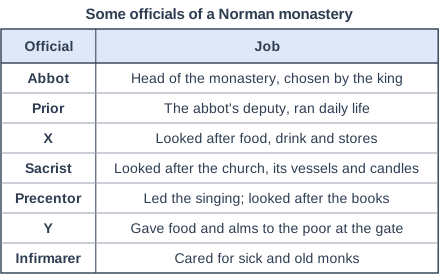
Figure 1 is a table of some of the officials of a Norman monastery and their jobs.

What should replace X and Y?

Some officials of a Norman monastery. Table with columns "Official", "Job". Official: Abbot; Job: Head of the monastery, chosen by the king | Official: Prior; Job: The abbot's deputy, ran daily life | Official: X; Job: Looked after food, drink and stores | Official: Sacrist; Job: Looked after the church, its vessels and candles | Official: Precentor; Job: Led the singing; looked after the books | Official: Y; Job: Gave food and alms to the poor at the gate | Official: Infirmarer; Job: Cared for sick and old monks.

Model answer

X is the cellarer and Y is the almoner.

Explanation

Large monasteries were run by officials (obedientiaries) under the abbot and prior: the cellarer looked after food, drink and the estates that supplied them, the almoner gave food, clothing and money to the poor, the sacrist cared for the church, the precentor led the singing and kept the books, and the infirmarer cared for the sick. Lanfranc's Monastic Constitutions set out these duties in detail.

Mark scheme
  1. 1 mark

    X: the cellarer.

    Accept 'cellarer'. Do not accept 'cook' or 'kitchener' alone.

  2. 1 mark

    Y: the almoner.

    Accept 'almoner'. Do not accept 'infirmarer' or 'guest master'.

Question 2

8 marks

Explain what was important about the appointment of Norman abbots to English monasteries after 1066.

Model answer

The appointment of Norman abbots was important because the abbot controlled every part of a monastery's life, so changing the abbot changed the monastery. After 1066 English abbots were replaced as they died or were removed: Turold went to Peterborough in 1070, Serlo to Gloucester in 1072, Paul of Caen to St Albans and Walter to Evesham in 1077, and Thurstan to Glastonbury. By the late 1080s most great abbeys had Norman or French abbots.

First, it strengthened Norman control. Abbeys were great landowners, and some had supported resistance: the monks of Ely backed Hereward in 1070-71. Norman abbots were loyal to William, and as tenants-in-chief they owed him knight service. Turold settled knights on the lands of Peterborough to meet this duty. The monasteries became supports of Norman rule rather than possible centres of English resistance.

Second, Norman abbots reformed and rebuilt their houses. They brought stricter discipline and continental customs, and Paul of Caen introduced Lanfranc's Constitutions at St Albans. Many rebuilt their churches on a grand scale - St Albans from 1077, using Roman bricks from nearby Verulamium, and Gloucester from 1089 - and communities grew, as at Gloucester under Serlo. Paul also set up a scriptorium to copy books, which spread Latin learning.

Third, the change caused conflict and cultural loss. A later St Albans chronicler said that Paul called his English predecessors uneducated and destroyed their tombs. At Glastonbury in 1083 Thurstan tried to impose a new style of chant, and when the monks resisted he brought in armed men, who killed three monks and wounded eighteen in the church. In time, however, Norman abbots came to honour English saints, for example when St Edmund's body was moved into the new church at Bury in 1095. So Norman abbots made the monasteries both pillars of Norman power and centres of reform, but at a real cost to English monks.

Explanation

Norman abbots (Turold, Serlo, Paul of Caen, Thurstan) made the abbeys loyal and provided knight service, brought discipline, building and learning, and caused conflicts such as Glastonbury in 1083. Level 4 explains and links several consequences with specific examples; one consequence explained simply is Level 2.

Mark scheme
  1. 8 marks

    Levels of response (8 marks).
    Level 4 (7-8 marks): Complex explanation of the importance of Norman abbots, e.g. links their role in securing Norman control (loyalty, knight service, ending resistance) to the changes they made (discipline, building, books, Latin and Norman customs) and to the conflict and cultural loss they caused, supported by a range of accurate knowledge.
    Level 3 (5-6 marks): Developed explanation of two or more consequences of appointing Norman abbots, with specific knowledge.
    Level 2 (3-4 marks): Simple explanation of one consequence, e.g. that they were loyal to William.
    Level 1 (1-2 marks): Basic explanation or description, with little specific knowledge.
    0 marks: nothing worthy of credit.

    Indicative content (not a checklist; credit other valid points): Examples: Turold at Peterborough (1070), Scotland at St Augustine's, Canterbury, Serlo at Gloucester (1072), Paul of Caen at St Albans (1077), Walter at Evesham (1077, after the English abbot Aethelwig), Thurstan at Glastonbury, Simeon at Ely (1082); by the late 1080s most great abbeys had Norman or French abbots. Control: abbeys were great landholders and some had backed resistance (Ely with Hereward, 1070-71); Norman abbots were loyal, and as tenants-in-chief owed knight service - Turold settled knights on Peterborough's lands. Reform: stricter discipline and Norman customs, often Lanfranc's Constitutions (St Albans); communities grew (Gloucester under Serlo); new buildings - St Albans rebuilt from 1077 with Roman bricks, Gloucester from 1089, St Augustine's Canterbury; libraries and copying (Paul of Caen's scriptorium); Latin learning. Conflict and loss: Paul of Caen is said (by a later St Albans chronicler) to have called his English predecessors uneducated and destroyed their tombs; Glastonbury (1083) - Thurstan's new chant led to armed men attacking the monks in their church, three killed and eighteen wounded (Anglo-Saxon Chronicle); St Augustine's monks refused Lanfranc's choice of abbot (1087-89); doubts about English saints. Later accommodation: Norman abbots came to honour English saints - St Edmund translated at Bury (1095), St Augustine at Canterbury (1091). Possible judgement: important because abbots shaped every aspect of monastic life, making monasteries both pillars of Norman rule and centres of reform.

Question 3

8 marks

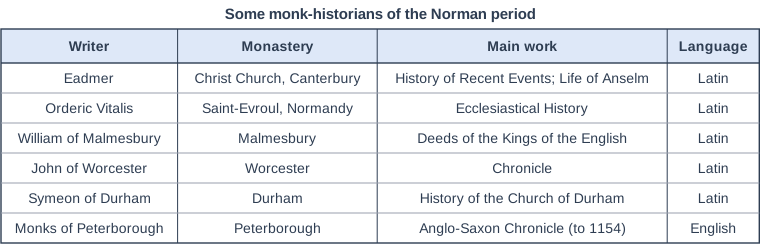
Figure 1 lists some monk-historians of the Norman period and their main works.

Explain what was important about monasteries for learning in Norman England.

Some monk-historians of the Norman period. Table with columns "Writer", "Monastery", "Main work", "Language". Writer: Eadmer; Monastery: Christ Church, Canterbury; Main work: History of Recent Events; Life of Anselm; Language: Latin | Writer: Orderic Vitalis; Monastery: Saint-Evroul, Normandy; Main work: Ecclesiastical History; Language: Latin | Writer: William of Malmesbury; Monastery: Malmesbury; Main work: Deeds of the Kings of the English; Language: Latin | Writer: John of Worcester; Monastery: Worcester; Main work: Chronicle; Language: Latin | Writer: Symeon of Durham; Monastery: Durham; Main work: History of the Church of Durham; Language: Latin | Writer: Monks of Peterborough; Monastery: Peterborough; Main work: Anglo-Saxon Chronicle (to 1154); Language: English.

Model answer

Monasteries were important for learning because they were where most books were made, kept and read. Monks copied the Bible, the writings of the Church Fathers such as Augustine and Gregory, and works such as Bede's history. After 1066 the copying of books grew rapidly, especially at Christ Church in Canterbury. Norman abbots and bishops built up libraries: Paul of Caen set up a scriptorium at St Albans, and Bishop William of St Calais gave many books to Durham. This spread knowledge and linked England more closely to the Latin learning of Europe.

Monasteries also educated the next generation. Boys given to monasteries as oblates, and novices, were taught Latin, the psalms and chant, and Lanfranc's Constitutions laid down how the children should be supervised and taught. The greatest scholars of the age were monks: Lanfranc and Anselm had made the abbey of Bec famous across Europe, and Anselm, as Archbishop of Canterbury, wrote important works of theology such as Why God Became Man (1098).

Above all, monasteries preserved the memory of the past. As Figure 1 shows, the leading historians of the Norman period were monks. Eadmer of Canterbury wrote the History of Recent Events and the Life of Anselm, Orderic Vitalis, born in Shropshire, wrote his Ecclesiastical History at Saint-Evroul in Normandy, and William of Malmesbury and John of Worcester wrote histories of England. Several had English mothers and Norman fathers, and they preserved English history and the stories of English saints in Latin, joining the two traditions. At Peterborough the monks even kept the Anglo-Saxon Chronicle in English until 1154. Most of what we know about Norman England comes from these monastic writers.

Learning was limited to a small, mostly clerical elite, and cathedral schools such as York also mattered. But monasteries were the main centres of learning and memory in Norman England.

Explanation

Monasteries copied and kept books (Christ Church, St Albans, Durham), educated oblates and novices, produced great scholars (Lanfranc, Anselm) and the historians (Eadmer, Orderic, William of Malmesbury) on whom our knowledge of the period depends. Level 4 explains and links several of these points and notes limits; one point explained simply is Level 2.

Mark scheme
  1. 8 marks

    Levels of response (8 marks).
    Level 4 (7-8 marks): Complex explanation of the importance of monasteries for learning, e.g. links their libraries and scriptoria (the copying and spread of books), their schools for oblates and novices, their scholars (Lanfranc, Anselm) and their historians (Eadmer, Orderic, William of Malmesbury, the Peterborough Chronicle) to the transmission of knowledge, the joining of English and Norman traditions and our knowledge of the period, while recognising that learning was limited to a small elite, supported by a range of accurate knowledge.
    Level 3 (5-6 marks): Developed explanation of two or more ways in which monasteries mattered for learning, with specific knowledge.
    Level 2 (3-4 marks): Simple explanation of one way, e.g. that monks copied books.
    Level 1 (1-2 marks): Basic explanation or description, with little specific knowledge.
    0 marks: nothing worthy of credit.

    Indicative content (not a checklist; credit other valid points): Libraries and scriptoria: monks copied the Bible, the Church Fathers (Augustine, Gregory, Jerome) and Bede; book production grew sharply after 1066, notably at Christ Church, Canterbury; Paul of Caen set up a scriptorium at St Albans; Norman abbots and bishops brought books from Normandy (William of St Calais gave many books to Durham). Schools: oblates and novices learned Latin, the psalms and chant inside the monastery (Lanfranc's Constitutions set rules for the children). Scholars: Lanfranc and Anselm had made Bec famous; Anselm wrote major theology (Proslogion, about 1077-78; Why God Became Man, 1098). History: a generation of monk-historians - Eadmer (Christ Church; History of Recent Events, Life of Anselm), Orderic Vitalis (born in Shropshire, a monk of Saint-Evroul; Ecclesiastical History), William of Malmesbury, John of Worcester, Symeon of Durham - mostly writing in Latin after 1100 but educated in the Norman period; several had English mothers and preserved English history and saints; the Peterborough monks kept the Anglo-Saxon Chronicle in English until 1154. Importance: preserved and spread knowledge; linked England to European Latin learning; trained churchmen; joined English and Norman traditions (lives of English saints by Osbern and Goscelin); most of our evidence for the period comes from monastic writers. Limits: learning was for a small, mostly male, clerical elite; cathedral schools (York, Canterbury) also mattered; English-language learning declined. Possible judgement: monasteries were the main centres of learning and memory in Norman England.

Question 4

16 marks

'The main reason why the Normans built so many abbeys and monasteries in England was to show their power.'

How far do you agree with this statement? Explain your answer.

Model answer

Showing their power was certainly one reason why the Normans built so many abbeys and monasteries, and in some cases, such as Battle Abbey, it was very important. But I do not think it was the main reason. The main reason was religious belief: the Normans genuinely believed that monks' prayers could save their souls, and they came from a duchy where founding monasteries was a deeply rooted tradition.

There is clear evidence that monasteries displayed Norman power. William founded Battle Abbey in about 1070 on the battlefield of Hastings, with its high altar where Harold had fallen, and brought stone from Caen to build it - a permanent monument to his victory. Norman barons often built priories beside their castles: William de Warenne at Lewes in about 1077, Roger of Montgomery at Shrewsbury in 1083 and Hugh of Avranches at Chester in 1092. In the rebellious north, the monastery at Durham, founded in 1083, stood beside the castle. Norman abbots rebuilt English abbey churches on a vast scale, such as St Albans from 1077 and Gloucester from 1089, and these huge Romanesque buildings dominated their towns, while the old English buildings were demolished. Many new houses were filled with monks from Normandy, from Marmoutier at Battle or Sées at Shrewsbury.

However, religious motives were stronger. Normans believed that the prayers of monks could help the souls of the dead, and founders' charters stress salvation for themselves and their families. Cluny, whose monks came to Lewes, was famous for its prayers for the dead. The violence of the Conquest also needed penance: in 1070 the papal legate Ermenfrid set penances for everyone who had fought at Hastings, which could be paid by building or endowing churches. Roger of Montgomery became a monk at Shrewsbury shortly before he died in 1094, which suggests his foundation was a matter of faith, not just display.

The Normans also brought a strong monastic tradition with them. Eleventh-century Normandy had seen a great revival of monasteries, such as Bec, where Lanfranc and Anselm had been monks, and the two abbeys at Caen, founded by William and Matilda as penance for their marriage. Reformers like Lanfranc wanted monasteries to be well run and well housed, and bigger communities and grander services needed bigger buildings. The relics of saints, such as St Edmund at Bury and St Cuthbert at Durham, drew pilgrims and needed fitting shrines. In the north, the revival was driven by an English monk, Aldwin, inspired by Bede's history.

There were practical reasons too. Monks were literate and could keep records, manage estates and offer hospitality and care for the poor and sick, which made monasteries useful to lords and communities.

Overall, showing power was an important reason, especially for the king at Battle and for barons who placed priories beside their castles in newly conquered lands. But it was not the main reason. For the Normans, piety and power went together, and the deepest motive was the belief that monasteries would save their souls, a belief they had brought from Normandy and that explains why they kept founding them long after their power was secure.

Explanation

Battle Abbey, priories beside castles, vast rebuilt abbey churches and Norman monks show the display of power, but piety, prayer for souls, penance after Hastings, the Norman monastic tradition, relics and practical uses were also important. Level 4 explains several reasons in depth and sustains a judgement about the main one; describing abbeys as symbols of power without weighing other reasons is Level 2.

Mark scheme
  1. 16 marks

    Levels of response (16 marks).
    Level 4 (13-16 marks): Complex explanation of the display of power as a reason (abbeys beside castles, Battle Abbey, rebuilding on a vast scale, Norman abbots and patrons, the north) and of other reasons (piety and prayer for souls, penance, the reform movement and Norman monastic traditions, larger communities, relics and pilgrims, practical uses, family prestige), with a sustained judgement about the main reason, supported throughout by specific, accurate knowledge.
    Level 3 (9-12 marks): Developed explanation of power and at least one other reason; a judgement is reached but not fully sustained.
    Level 2 (5-8 marks): Simple explanation of power or of other reasons.
    Level 1 (1-4 marks): Basic explanation, with little specific knowledge.
    0 marks: nothing worthy of credit.

    Indicative content (not a checklist; credit other valid points): Power: Battle Abbey (about 1070) on the battlefield, high altar where Harold fell, stone from Caen; priories beside castles - Lewes (about 1077), Castle Acre, Shrewsbury (1083), Chester (1092); St Mary's York and Durham (1083) in the rebellious north, Durham beside the castle; huge Romanesque abbey churches (St Albans from 1077, Gloucester from 1089, Bury, Ely) dominating towns; English buildings demolished; Norman abbots (Paul of Caen, Serlo) and Norman monks (Marmoutier at Battle, Sees at Shrewsbury, Cluny at Lewes); English estates given to Norman abbeys. Other reasons: piety - prayer for the souls of founders and families, belief in purgatory-like punishment after death, Cluny's prayers for the dead; penance - Ermenfrid's Penitential (1070); the reform movement - Lanfranc, Bec and Caen, Norman tradition of founding monasteries in eleventh-century Normandy (Bec, the two abbeys at Caen founded by William and Matilda as penance for their marriage); needs of reformed and growing communities; relics and pilgrims (St Edmund at Bury, St Albans, St Cuthbert at Durham); northern revival inspired by Bede (Aldwin); practical value - literate monks, estate management, hospitality, care of the poor; family burial and prestige. Possible judgements: power was important but piety was the main motive, as contemporaries saw no conflict; or power was the main reason in the first decades after 1066; or reasons differed between the king, barons and monks.

Ready to try the rest? Every answer you write is marked against the mark scheme, so you can see exactly where the marks are.

AI Tutor Hints first, answers after you try

Hi! Stuck? Ask me for a hint and I’ll help you work it out. Once you’ve checked your answer I can explain exactly where the marks are.