Level:
Correct: 0
Incorrect: 0
Marks: 0/0
Exam Practice
Subject:
Topics:
AQA GCSE History (Norman England) Smart practice A mixed round aimed at your weak spots
Unit 1
Part one: The Normans: conquest and control
Unit 2
Part two: Life under the Normans
Unit 3
Part three: The Norman Church and monasticism
The Norman Church and monasticism
The Church
0%
Monasticism
0%
Unit 4
Part four: The historic environment of Norman England
Avg
score:
–
Topics
done:
0/9

Feudalism and government

Practise 42 exam-style questions on Feudalism and government for AQA GCSE History (Norman England). Write your answer as you would in the exam and get it marked in seconds against the mark scheme, point by point, with an AI tutor on hand if you get stuck.

  • 42 questions
  • 1–16 marks each
  • Instant marking
  • No sign-up needed
20 questions, marked as you go

Sample questions with model answers

Here are 4 of the questions in this topic, each with a model answer, an explanation of why it earns the marks and the mark scheme an examiner would use.

Question 1

2 marks

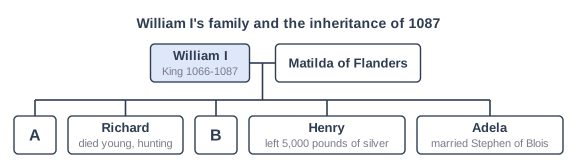
Figure 1 is a family tree of William I. When he died in 1087, William left Normandy to one son and England to another.

Name the son labelled A, who inherited Normandy, and the son labelled B, who inherited England.

Family tree titled "William I's family and the inheritance of 1087": names in boxes joined by lines, with 2 generations in rows from the oldest at the top to the youngest at the bottom. A line between two boxes in a row joins a couple, and a line coming down from a couple, or from one person on their own, leads to their children. Top row, left to right: William I (King 1066-1087) and Matilda of Flanders. Second row, left to right: box A, Richard (died young, hunting), box B, Henry (left 5,000 pounds of silver) and Adela (married Stephen of Blois). William I and Matilda of Flanders are married; their children are box A, Richard, box B, Henry and Adela. The box of William I is shaded. Boxes A and B show letters instead of names.

Model answer

A is Robert Curthose, William's eldest son, who inherited Normandy. B is William Rufus, who became King William II of England.

Explanation

William followed Norman custom by leaving the family lands (Normandy) to his eldest son Robert and the lands he had won (England) to William Rufus; Henry received money. The division caused conflict, because barons who held land on both sides of the Channel now had two lords, which helps explain the rebellion of 1088.

Mark scheme
  1. 1 mark

    A: Robert Curthose.

    Accept Robert / Robert, Duke of Normandy.

  2. 1 mark

    B: William Rufus.

    Accept William II / William. Do not accept Henry for either letter.

Question 2

8 marks

Interpretation A: from a book about medieval kings and their followers, written in 2005. (Written for practice.)

'William's great gift was generosity to the men who had risked everything with him in 1066. He rewarded them with English land on a scale never seen before, and in doing so he created a new ruling class that owed everything to him. Because their wealth depended on his success, the Norman barons had every reason to stay loyal and to defend his kingdom. Patronage, more than anything else, held Norman England together.'

How convincing is Interpretation A about the importance of patronage in Norman England?

Explain your answer based on your contextual knowledge and what it says in Interpretation A.

Model answer

Interpretation A is convincing that patronage gave the Norman barons strong reasons to support William, but it is less convincing that patronage, more than anything else, held Norman England together.

William certainly rewarded his followers on an enormous scale. His half-brothers Odo of Bayeux and Robert of Mortain received vast estates, Odo becoming Earl of Kent and Robert holding Cornwall and the rape of Pevensey. William FitzOsbern became Earl of Hereford, Roger of Montgomery Earl of Shrewsbury and Hugh d'Avranches Earl of Chester. William also gave out sheriffdoms, castles, bishoprics and the marriages of heiresses. By 1086 Norman barons held about half the land, so their wealth depended on William defending it against English rebels and foreign invaders; they fought with him in 1069-70. Because what the king gave he could take away, patronage also discouraged disloyalty.

However, the barons did not always stay loyal. In 1075 the Revolt of the Earls was led by Roger, Earl of Hereford, the son of FitzOsbern, and Ralph, Earl of East Anglia, men who had done well out of William's patronage. William had to arrest his own half-brother Odo in 1082. In 1088 Odo and Robert of Mortain led a rebellion against William II in favour of Robert Curthose, partly because barons with lands in both England and Normandy wanted a single lord. Patronage could therefore create powerful men who threatened the king.

Norman England was also held together by other things: castles and their garrisons, force such as the Harrying of the North, the Church under Lanfranc, the Anglo-Saxon system of government and oaths such as the Oath of Salisbury in 1086.

Overall, the interpretation is partly convincing. Patronage was essential in binding the barons to William, but the rebellions show it was not enough on its own, so 'more than anything else' overstates its importance.

Explanation

Huge grants to men such as Odo, Robert of Mortain and FitzOsbern support the interpretation, but the rebellions of 1075 and 1088 and the role of castles, force and the Church challenge 'more than anything else'. Level 4 needs a sustained judgement weighing patronage against these.

Mark scheme
  1. 8 marks

    Levels of response (8 marks).
    Level 4 (7-8 marks): Complex evaluation of Interpretation A with a sustained judgement, based on precise knowledge of William's patronage and why it encouraged loyalty (great estates for Odo, Robert of Mortain, FitzOsbern, Roger of Montgomery and others; offices; the threat of losing land) weighed against evidence of disloyalty (1075, Odo in 1082, 1088, 1095) and other factors that held England together (castles, force, the Church, government, oaths), reaching a judgement about 'more than anything else'.
    Level 3 (5-6 marks): Developed evaluation, using relevant knowledge to explain why one or more claims is or is not convincing, e.g. explains the grants to William's half-brothers, or explains the Revolt of the Earls.
    Level 2 (3-4 marks): Simple evaluation supported by some factual knowledge, e.g. it is convincing because William gave his followers land.
    Level 1 (1-2 marks): Basic analysis of Interpretation A: describes or paraphrases what it says.
    0 marks: nothing worthy of credit.

    Indicative content (not a checklist; credit other valid points): Convincing: William used patronage on a huge scale - his half-brothers Odo of Bayeux (Earl of Kent) and Robert of Mortain (Cornwall, the rape of Pevensey) received vast estates; William FitzOsbern became Earl of Hereford, Roger of Montgomery Earl of Shrewsbury, Hugh d'Avranches Earl of Chester; the rapes of Sussex went to trusted men; he also granted sheriffdoms, castles, bishoprics and abbeys, and the marriages of heiresses; by 1086 Norman barons held about half the land by value, so they depended on William defending it against English rebels and Danish invaders - they fought for him in 1069-70 and served in 1075; patronage could be withdrawn, which deterred disloyalty (Roger de Breteuil lost Hereford in 1075). Not convincing: barons were not always loyal - the Revolt of the Earls (1075) was led by Normans and Bretons whom William had rewarded (Roger, Earl of Hereford, and Ralph, Earl of East Anglia); William arrested Odo in 1082; in 1088 Odo and Robert of Mortain led a rebellion against William II in favour of Robert Curthose, partly because barons with land on both sides of the Channel wanted one lord; Robert de Mowbray rebelled in 1095; generosity created over-mighty subjects. Other factors: castles and garrisons; force such as the Harrying of the North; the Church under Lanfranc; the continued Anglo-Saxon government and the geld; oaths such as the Oath of Salisbury; William's own reputation and military skill. Provenance: a book about kings and followers naturally emphasises their relationship. Judgement: e.g. convincing that patronage created a loyal-by-interest ruling class, but 'more than anything else' is too strong given repeated baronial rebellions and the role of force.

Question 3

8 marks

Write an account of the ways in which land in England passed from English to Norman hands between 1066 and 1086.

Model answer

Land passed from English to Norman hands in stages between 1066 and 1086, with rebellion turning a partial settlement into an almost complete takeover.

After his victory at Hastings, William claimed all the land of England as Edward the Confessor's rightful heir and as conqueror. The lands of Harold, his brothers Gyrth and Leofwine and the many thegns who had fought against William were forfeited. William used them to reward his closest followers: his half-brother Odo of Bayeux received Kent, and William FitzOsbern became Earl of Hereford. At this stage, however, many English landholders kept their land. Some paid William to keep it, and the earls Edwin, Morcar and Waltheof kept their earldoms.

This changed because of rebellion. Between 1068 and 1071 there were risings at Exeter, in Mercia under Edwin and Morcar, in the north around York, and at Ely under Hereward. Each failure led to more confiscations. After the Harrying of the North in 1069-70, northern estates were given to Normans such as Alan the Red at Richmond and Ilbert de Lacy at Pontefract. Edwin was killed in 1071 and Morcar imprisoned.

The way land was granted also mattered. Most barons received the lands of particular English predecessors, which made the transfer look lawful but left their estates scattered across many shires. On the frontiers, however, William created compact lordships, such as the earldoms of Chester, Shrewsbury and Hereford on the Welsh border and the rapes of Sussex. Normans also seized land illegally; Odo took lands belonging to Canterbury, which Archbishop Lanfranc won back at the trial on Penenden Heath.

The Revolt of the Earls in 1075 led to more forfeitures, and in 1076 Waltheof, the last English earl, was executed. Meanwhile Norman bishops and abbots took control of church lands.

By 1086 Domesday Book showed the result: English landholders held only about 5 per cent of the land, and many thegns had become sub-tenants of Normans on their old estates. The Normans now formed a ruling class that held its land in return for service to the king.

Explanation

Land passed to the Normans through forfeiture after Hastings, confiscation after each rebellion of 1068-75, grants based on English predecessors and frontier lordships, and illegal seizures, leaving the English with about 5 per cent by 1086. Level 4 needs a clear sequence with analysis of why the takeover grew, such as the role of rebellion.

Mark scheme
  1. 8 marks

    Levels of response (8 marks).
    Level 4 (7-8 marks): A coherent, well-organised account of the stages and methods by which land passed to the Normans (forfeiture after Hastings, early grants and English survivors, confiscations after the rebellions of 1068-75, the antecessor principle and compact frontier lordships, illegal seizures and disputes, church lands, the position recorded in Domesday), with complex analysis of causes and consequences, e.g. how rebellion turned a partial settlement into a near-complete takeover.
    Level 3 (5-6 marks): A developed account of two or more ways in which land passed to the Normans, with some analysis of causes or consequences.
    Level 2 (3-4 marks): A simple account of one way, e.g. William gave his followers the lands of the English who died at Hastings.
    Level 1 (1-2 marks): A general, basic account, e.g. the Normans took the land.
    0 marks: nothing worthy of credit.

    Indicative content (not a checklist; credit other valid points): 1066-67: William claimed all land as Edward's rightful heir and conqueror; the lands of Harold, his brothers Gyrth and Leofwine, the Godwin family and thegns who fought at Hastings were forfeited; some English landholders paid to keep their land; Edwin, Morcar and Waltheof kept their earldoms at first; early grants to William's closest followers - Odo of Bayeux (Kent) and William FitzOsbern (Hereford and the Isle of Wight). 1068-71: rebellions (Exeter 1068, Edwin and Morcar 1068, the north and York 1069, Hereward at Ely 1070-71) led to more confiscations; the Harrying of the North (1069-70) was followed by grants of northern lands to Normans such as Alan the Red (Richmond) and Ilbert de Lacy (Pontefract); Edwin was killed (1071) and Morcar imprisoned. Methods: most barons received the lands of particular English predecessors (antecessors), which gave the transfer a look of legality and left estates scattered; compact frontier lordships at Chester, Shrewsbury and Hereford and the rapes of Sussex were given to trusted men for defence. Seizures: Norman barons and sheriffs often grabbed land illegally (e.g. Odo of Bayeux took Canterbury lands, recovered by Lanfranc at Penenden Heath in the 1070s). 1075-76: the Revolt of the Earls led to the forfeiture of the earls of Hereford and East Anglia and the execution of Waltheof, the last English earl (1076). Church: Norman bishops and abbots replaced English ones, so church land came under Norman control. 1086: Domesday Book recorded the result - English landholders held only about 5 per cent of the land, many thegns had become sub-tenants, and the Oath of Salisbury bound the new landholders to the king. Consequences: a Norman ruling class owing knight service; English resentment and exile.

Question 4

16 marks

'The Norman legal system was much harsher than the Anglo-Saxon legal system.'

How far do you agree with this statement?

Explain your answer.

Model answer

In some areas Norman justice was clearly harsher, especially where it protected the conquerors and the king's hunting. However, Anglo-Saxon justice was itself severe, and most of it continued after 1066. I therefore disagree that the Norman legal system was much harsher overall.

There are strong arguments for the statement. The murdrum fine meant that if a Norman was found murdered and the killer was not handed over, the whole hundred paid a heavy fine, so innocent communities were punished. The Normans introduced trial by combat. Above all, forest law was harsh: according to the Anglo-Saxon Chronicle, William ruled that anyone who killed a hart or a hind should be blinded, and villagers living in royal forests lost rights to hunt, graze animals and gather wood freely. The courts were now run by Norman sheriffs, some of whom, such as Urse d'Abetot in Worcestershire and Picot in Cambridgeshire, were accused of seizing land. Under William II justice could be arbitrary: Eadmer reported that when about fifty men accused of forest offences passed the ordeal of hot iron, the king mocked the result.

However, Anglo-Saxon law had already been harsh. Thieves and other serious criminals could be executed, and the laws of King Cnut laid down mutilation for repeat offenders. Trial by ordeal, with hot iron, hot water or cold water, was an Anglo-Saxon practice that the Normans inherited. Collective responsibility was also English: men were grouped in tithings that were responsible for each other's behaviour, and everyone had to join the hue and cry. Outlawry existed before and after 1066.

There was also much continuity. William claimed to be Edward the Confessor's heir and promised to keep the laws of King Edward. Shire and hundred courts carried on, with local men acting as suitors and witnesses. Compensation payments such as wergild survived for a time.

In some ways Norman justice was even less harsh. William's laws replaced execution with mutilation, such as blinding, which was brutal but meant fewer deaths. The Anglo-Saxon Chronicle, though critical of William, praised the good peace he kept, saying that a man could travel the kingdom unharmed with a bosom full of gold. The Normans also opposed the slave trade, and slavery was declining: slaves made up only about a tenth of the people recorded in Domesday Book.

The key difference, therefore, was not that punishments became much more severe, but that new laws such as murdrum and forest law protected the conquerors and the king's rights, and so felt foreign and unfair to the English.

In conclusion, the Norman legal system was harsher in specific ways that targeted the English, especially murdrum and forest law, but it was not much harsher overall. Anglo-Saxon justice was already severe, and the courts, ordeals and customs that most English people experienced continued largely unchanged.

Explanation

Murdrum, trial by combat, forest law and Norman sheriffs made justice harsher in some ways, but Anglo-Saxon law already used execution, mutilation, ordeals and collective responsibility, and William replaced execution with mutilation. Level 4 needs both sides explained with precise knowledge and a sustained judgement on 'much harsher'.

Mark scheme
  1. 16 marks

    Levels of response (16 marks).
    Level 4 (13-16 marks): Complex explanation of ways in which Norman justice was harsher (murdrum, trial by combat, forest law, Norman sheriffs and lords' courts, arbitrary justice under William II) and of ways in which it was not (Anglo-Saxon law was already harsh, with execution, mutilation, ordeals and collective responsibility; the Normans kept English courts and customs and replaced execution with mutilation), leading to a sustained judgement about how far it was 'much harsher', supported by a wide range of accurate and specific knowledge.
    Level 3 (9-12 marks): Developed explanation of harsher and less harsh features, supported by accurate knowledge, with a judgement that may not be fully sustained.
    Level 2 (5-8 marks): Simple explanation of harsher or less harsh features, with some accurate knowledge.
    Level 1 (1-4 marks): Basic explanation: general statements about Norman or Anglo-Saxon justice, with limited knowledge.
    0 marks: nothing worthy of credit.

    Indicative content (not a checklist; credit other valid points): Harsher (for): murdrum - the hundred paid a heavy fine if a Norman was murdered and the killer was not handed over, punishing whole communities; trial by combat introduced; forest law - the Anglo-Saxon Chronicle (1087) says William ruled that anyone who killed a hart or hind should be blinded, and villagers in forests lost rights to hunt, graze and gather wood; Norman sheriffs ran the courts and some seized land (Urse d'Abetot, Picot); the law favoured Normans and was administered in French and Latin; William II's justice was arbitrary - Eadmer reported he mocked the result when about fifty men accused of forest offences passed the ordeal. Not harsher (against): Anglo-Saxon law already used execution for serious crimes such as theft, and Cnut's laws laid down mutilation for repeat offenders; ordeals by hot iron and water were Anglo-Saxon; collective responsibility through tithings and the hue and cry already existed; outlawry existed in both. Continuity: William promised to keep the laws of King Edward; shire and hundred courts continued with local suitors; wergild and compensation survived for a time. Less harsh in some ways: William's laws replaced execution with mutilation such as blinding; the Anglo-Saxon Chronicle praised the good peace William kept; the Normans opposed the slave trade and slavery declined; separate church courts dealt with clergy. Linking: the main difference was not the severity of punishments but that new laws protected the conquerors and royal rights (forest law, murdrum). Judgement: e.g. harsher in specific areas that targeted the English and protected royal hunting, but not much harsher overall, because Anglo-Saxon justice was itself severe and largely continued.

Ready to try the rest? Every answer you write is marked against the mark scheme, so you can see exactly where the marks are.

AI Tutor Hints first, answers after you try

Hi! Stuck? Ask me for a hint and I’ll help you work it out. Once you’ve checked your answer I can explain exactly where the marks are.