
Level:
Correct: 0
Incorrect: 0
Marks: 0/0
Exam Practice
Subject:
Topics:
Avg
score:
–
Topics
done:
0/32

Verification checks

Practise 22 exam-style questions on Verification checks for Cambridge IGCSE Computer Science (Paper 2). Write your answer as you would in the exam and get it marked in seconds against the mark scheme, point by point, with an AI tutor on hand if you get stuck.

  • 22 questions
  • 1–6 marks each
  • Instant marking
  • No sign-up needed
20 questions, marked as you go

Sample questions with model answers

Here are 4 of the questions in this topic, each with a model answer, an explanation of why it earns the marks and the mark scheme an examiner would use.

Question 1

1 mark

Identify which one of the following is a verification check.

presence check
double entry check
length check
check digit

Model answer

Double entry check

Explanation

Presence checks, length checks and check digits are all validation checks: the computer automatically tests whether the data follows a rule. A double entry check is verification because it checks whether the data has been entered accurately by comparing two entries of the same data.

Mark scheme
  1. 1 mark

    Double entry check

    Do not accept more than one answer.
Question 2

2 marks

A company is deciding whether to use a visual check or a double entry check when staff type customer account numbers into its system.

Give one advantage and one disadvantage of using a double entry check rather than a visual check.

Model answer

Advantage: the computer compares the two entries, so any difference is always detected, whereas a person doing a visual check could miss a small error in a long account number.
Disadvantage: every account number must be typed twice, which takes longer and costs more staff time.

Explanation

A visual check depends on a person noticing differences, which is easy to get wrong with long strings of digits. A double entry check makes the computer do the comparison, but at the cost of entering everything twice. Neither check can detect an error in the source document itself.

Mark scheme
  1. 1 mark

    Advantage: the computer compares the two entries, so a difference cannot be overlooked / it does not rely on a person spotting the error / more reliable for long numbers

  2. 1 mark

    Disadvantage: the data has to be typed twice, so it takes longer / needs more staff time / costs more

    Accept: the same mistake may be typed both times (e.g. misreading the source) so it is not detected.

Question 3

3 marks

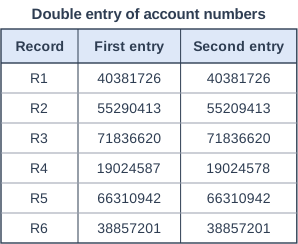
Two clerks each typed the account numbers from six paper forms. The table shows the two entries for each record. A double entry check compares the two entries for each record.

Identify the records that would be flagged by the double entry check and state what should happen to these records.

Double entry of account numbers. Table with columns "Record", "First entry", "Second entry". Record: R1; First entry: 40381726; Second entry: 40381726 | Record: R2; First entry: 55290413; Second entry: 55209413 | Record: R3; First entry: 71836620; Second entry: 71836620 | Record: R4; First entry: 19024587; Second entry: 19024578 | Record: R5; First entry: 66310942; Second entry: 66310942 | Record: R6; First entry: 38857201; Second entry: 38857201.

Model answer

R2 and R4 would be flagged because their two entries are different (55290413 / 55209413 and 19024587 / 19024578). The account numbers for these records should be checked against the original forms and entered again.

Explanation

The double entry check accepts a record only when both entries are identical. In R2 and R4 two digits have been swapped in one entry, a very common typing error. Note that the check cannot tell which entry is right, so the original form must be consulted.

Mark scheme
  1. 1 mark

    R2

    Deduct 1 mark for each extra record given (minimum 0 for these two marks).

  2. 1 mark

    R4

  3. 1 mark

    They are rejected/flagged and the account number is checked against the original form and re-entered

Question 4

5 marks

A gas company's app asks customers to enter their meter reading, a whole number. The app then performs a visual check: it displays the reading that was entered and asks the customer to type Y if it matches the number on their meter or N if it does not. Any reply other than Y or y means the reading must be entered again.

Write pseudocode for this process. When the reading has been confirmed, output the message Reading saved: followed by the reading.

Model answer

REPEAT
    OUTPUT "Enter your meter reading"
    INPUT Reading
    OUTPUT "You entered ", Reading, ". Is this correct? Type Y or N"
    INPUT Reply
UNTIL UCASE(Reply) = 'Y'
OUTPUT "Reading saved: ", Reading

Explanation

Showing the data back to the user and asking them to confirm it is a visual check written as an algorithm. The reading and the reply must both be inside the loop so that a wrong reading can be re-entered. UCASE lets the program accept y as well as Y in a single comparison.

Mark scheme
  1. 1 mark

    MP1 prompts for and inputs the reading inside a loop

    max 5

  2. 1 mark

    MP2 outputs the reading that was entered with a message asking the customer to confirm it

  3. 1 mark

    MP3 inputs the customer's reply

  4. 1 mark

    MP4 the loop repeats until the reply is Y or y

    e.g. UNTIL UCASE(Reply) = 'Y' or UNTIL Reply = 'Y' OR Reply = 'y'. Accept a WHILE loop with equivalent logic.

  5. 1 mark

    MP5 outputs Reading saved: followed by the reading after the loop

    Do not accept the output inside the loop.

Ready to try the rest? Every answer you write is marked against the mark scheme, so you can see exactly where the marks are.

AI Tutor Hints first, answers after you try

Hi! Stuck? Ask me for a hint and I’ll help you work it out. Once you’ve checked your answer I can explain exactly where the marks are.