
Level:
Correct: 0
Incorrect: 0
Marks: 0/0
Exam Practice
Course:
Topics:
Avg
score:
–
Topics
done:
0/22

Variation and classification

Practise 14 exam-style questions on Variation and classification for OCR GCSE Combined Science (Biology Paper 2). Write your answer as you would in the exam and get it marked in seconds against the mark scheme, point by point, with the Study Helper on hand if you get stuck.

  • 14 questions
  • 1–6 marks each
  • Instant marking
  • No sign-up needed
14 questions, marked as you go

Sample questions with model answers

Here are 4 of the questions in this topic, each with a model answer, an explanation of why it earns the marks and the mark scheme an examiner would use.

Question 1

1 mark

Scientists can classify animals in different ways.

Which of these is an artificial classification?

Choose your answer.

  • A grouping bats with whales, because both feed their young on milk
  • B grouping crabs with woodlice, because DNA shows that they share a recent common ancestor
  • C grouping dolphins with sharks, because both have fins and live in the sea
  • D grouping eagles with penguins, because both have feathers and lay eggs with hard shells

Model answer

C

Explanation

A natural classification groups organisms by how closely they are related, using evidence such as DNA and features inherited from common ancestors. An artificial classification groups organisms by a few convenient features, such as having fins or living in water, so it can put unrelated animals together. Dolphins breathe air and feed their young on milk, so they are mammals, not fish.

Mark scheme
  1. 1 mark

    C / grouping dolphins with sharks, because both have fins and live in the sea

    The only correct answer is C: an artificial classification groups animals by a few features that are easy to see, which can put unrelated animals together; dolphins are mammals and sharks are fish, and they look alike only because both swim in the sea. A is not correct because bats and whales are both mammals, so this grouping shows that they are related (a natural classification); B is not correct because grouping by DNA evidence of a common ancestor is a natural classification; D is not correct because eagles and penguins are both birds, so this grouping also shows that they are related. ALLOW the letter or the option. If more than one option is given, do not award the mark.
Question 2

2 marks

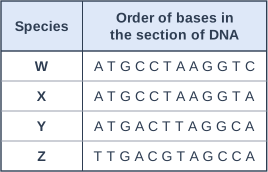
Scientists compared the same short section of a gene in four species of buttercup, W, X, Y and Z. The table shows the order of the bases in this section of DNA for each species. The data are simplified.

Which species, X, Y or Z, is most closely related to species W? Explain your answer using the data.

Table with columns "Species", "Order of bases in the section of DNA". Species: W; Order of bases in the section of DNA: A T G C C T A A G G T C | Species: X; Order of bases in the section of DNA: A T G C C T A A G G T A | Species: Y; Order of bases in the section of DNA: A T G A C T T A G G C A | Species: Z; Order of bases in the section of DNA: T T G A C G T A G C C A.

Model answer

Species X. Its sequence is different from W's at only one base (the last one), but Y differs at 4 bases and Z at 7 bases. X's DNA is the most similar to W's, so X shares the most recent common ancestor with W.

Explanation

In molecular phylogenetics, scientists compare the base sequences of the same gene in different species. Differences build up over time after two species separate, so the fewer differences there are, the more closely related the species are. Compare each species with W one base at a time and count the differences.

Mark scheme
  1. 1 mark

    X

    DO NOT ALLOW more than one species.

  2. 1 mark

    X's base sequence has the fewest differences from W's (1 difference, compared with 4 for Y and 7 for Z), so its DNA is the most similar / it shares the most recent common ancestor with W

    ALLOW X differs from W at only one base. ALLOW X has the most bases the same as W (11 out of 12). A comparison or a number from the table is needed: DO NOT ALLOW 'X's DNA is similar to W's' with no comparison. This point cannot be awarded for an explanation that supports Y or Z.

Question 3

2 marks

A student looks at a large patch of bluebells in a wood. The student says: 'All of these bluebell plants look the same, so they must be genetically identical.'

Explain why the student is probably wrong.

Model answer

Most populations of a species have extensive genetic variation, so the bluebells are likely to have different alleles. Plants can look the same but have different genotypes: a recessive allele does not show in a heterozygous plant, and many genes affect features you cannot see, such as resistance to a disease.

Explanation

Looking the same is not evidence of being genetically identical. The phenotype does not show every allele, because heterozygous and homozygous dominant individuals look alike and many genes control internal features. Only clones, such as plants grown from pieces of one parent, are genetically identical.

Mark scheme
  1. 1 mark

    there is usually extensive genetic variation within a population of a species

    ALLOW the plants are likely to have different alleles. ALLOW wild plants produced by sexual reproduction are not genetically identical.

  2. 1 mark

    plants that look the same can still have different alleles, because many alleles do not show in their appearance (such as recessive alleles in heterozygous plants, or genes for features that cannot be seen, like disease resistance)

    ALLOW looking the same does not mean having the same genotype / the same phenotype can come from different genotypes (for example AA and Aa). IGNORE they could be different because of the environment.

Question 4

4 marks

In the past, mushrooms and other fungi were classified as plants. Like plants, fungi grow in the ground and do not move, and their cells have a cell wall. But fungal cells have no chloroplasts.

Explain how having no chloroplasts affects the way fungi get their food.

DNA sequencing has shown that fungi are more closely related to animals than to plants. What does this show about the ancestors of fungi?

Model answer

Chloroplasts contain chlorophyll, which absorbs light for photosynthesis. Fungal cells have no chloroplasts, so fungi cannot photosynthesise to make their own glucose. They have to get their food from other organisms, living or dead.

Fungi and animals share a more recent common ancestor than fungi and plants.

Explanation

Plants are producers: their chloroplasts contain chlorophyll, which absorbs the light needed to make glucose by photosynthesis. Without chloroplasts, fungi cannot be producers and must feed on other organisms, often dead material. Being more closely related means sharing a more recent common ancestor, not that fungi evolved from animals.

Mark scheme
  1. 1 mark

    chloroplasts contain chlorophyll, which absorbs light (for photosynthesis)

    ALLOW chloroplasts absorb light / chlorophyll traps or captures light (energy). IGNORE chloroplasts make food, with no reference to chlorophyll or light.

  2. 1 mark

    so fungi cannot photosynthesise / cannot make their own glucose (food)

    ALLOW fungi are not producers. DO NOT ALLOW fungi cannot respire.

  3. 1 mark

    so fungi must get their food (glucose) from other organisms, living or dead

    ALLOW fungi feed on / absorb food from dead material (plants and animals) or living things. DO NOT ALLOW fungi get food from the soil without the idea of other organisms or dead material.

  4. 1 mark

    fungi and animals share a more recent common ancestor than fungi and plants

    ALLOW fungi and animals evolved from the same ancestor more recently. DO NOT ALLOW fungi evolved from animals.

Ready to try the rest? Every answer you write is marked against the mark scheme, so you can see exactly where the marks are.

Study Helper Hints first, answers after you try

Stuck on this one? Ask for a hint and I’ll point you in the right direction, without giving the answer away. Once you’ve checked your answer, I’ll show you how the marks are awarded.