
Level:
Correct: 0
Incorrect: 0
Marks: 0/0
Exam Practice
Course:
Topics:
Avg
score:
–
Topics
done:
0/22

Haploid and diploid cells and meiosis

Practise 14 exam-style questions on Haploid and diploid cells and meiosis for OCR GCSE Combined Science (Biology Paper 2). Write your answer as you would in the exam and get it marked in seconds against the mark scheme, point by point, with the Study Helper on hand if you get stuck.

  • 14 questions
  • 1–6 marks each
  • Instant marking
  • No sign-up needed
14 questions, marked as you go

Sample questions with model answers

Here are 4 of the questions in this topic, each with a model answer, an explanation of why it earns the marks and the mark scheme an examiner would use.

Question 1

1 mark

Apple trees have 34 chromosomes in each leaf cell. The nucleus of a pollen grain from an apple tree is haploid.

Which statement describes the chromosomes in the nucleus of a pollen grain from an apple tree?

Choose your answer.

  • A It contains one chromosome from each pair.
  • B It contains pairs of chromosomes.
  • C It contains twice as many chromosomes as a leaf cell.
  • D Its chromosomes are each half the length of those in a leaf cell.

Model answer

A - It contains one chromosome from each pair.

Explanation

A diploid cell has its chromosomes in pairs (two sets); a haploid cell has one chromosome from each pair (one set), so it has half the number. An apple leaf cell has 34 chromosomes in 17 pairs; a pollen grain nucleus has 17. A common misconception is that each chromosome is cut in half: whole chromosomes are shared out.

Mark scheme
  1. 1 mark

    A / it contains one chromosome from each pair

    The only correct answer is A: haploid means having one set of chromosomes - one chromosome from each pair - so an apple pollen grain nucleus has 17 chromosomes. B is not correct because chromosomes in pairs (two sets) is diploid, as in a leaf cell; C is not correct because a haploid cell has half as many chromosomes as a body cell, not twice as many; D is not correct because each whole chromosome goes into the gamete - the number of chromosomes is halved, not the length of each one. ALLOW the letter or the option. If more than one option is given, do not award the mark.
Question 2

2 marks

Here are four events in living organisms.

1 A cut on a person's arm heals.
2 Sperm cells are made in the testes of a bull.
3 A bean seedling grows taller.
4 Pollen grains are made in the anthers of a flower.

Which events need cells to divide by mitosis, and which need cells to divide by meiosis?

Write the numbers of the events under each heading: mitosis and meiosis.

Model answer

Mitosis: 1 and 3.
Meiosis: 2 and 4.

Explanation

Mitosis makes genetically identical cells for growth and repair, so it is needed when a cut heals and when a seedling grows. Meiosis halves the chromosome number to make gametes, so it is needed to make sperm cells and pollen grains.

Mark scheme
  1. 1 mark

    mitosis: 1 and 3

    Both numbers are needed, and no other number may be given under mitosis. ALLOW the events written in words instead of their numbers. A number written under both headings is not credited under either heading.

  2. 1 mark

    meiosis: 2 and 4

    Both numbers are needed, and no other number may be given under meiosis. ALLOW the events written in words instead of their numbers.

Question 3

2 marks

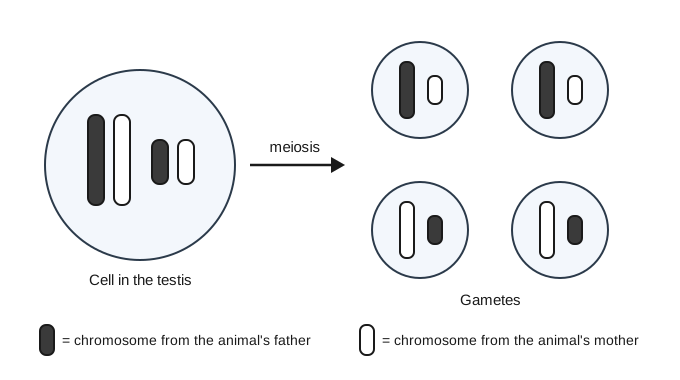
The diagram shows a cell from the testis of an animal and the four gametes produced from it by meiosis. The key shows which chromosomes came from the animal's father and which came from its mother.

Use the diagram to explain why the cell in the testis is described as diploid and the gametes are described as haploid.

On the left, a large circle labelled 'Cell in the testis' contains four chromosomes: two long ones, one dark and one light, and two short ones, one dark and one light. An arrow labelled 'meiosis' points to four small circles labelled 'Gametes'. Two of the gametes each contain a dark long chromosome and a light short chromosome. The other two gametes each contain a light long chromosome and a dark short chromosome. A key shows that dark chromosomes came from the animal's father and light chromosomes came from its mother.

Model answer

The cell in the testis is diploid because its chromosomes are in pairs: it has two long chromosomes and two short chromosomes, one of each pair from the animal's father and one from its mother. Each gamete is haploid because it has only one chromosome from each pair - one long and one short - which is one set, half the number of the cell in the testis.

Explanation

Diploid cells have two sets of chromosomes, so every chromosome has a partner; haploid cells have one set, one chromosome from each pair. The diagram shows meiosis separating the pairs. Saying only that a gamete has 'half the chromosomes' misses the important idea that it gets one of each type.

Mark scheme
  1. 1 mark

    diploid: the cell in the testis has its chromosomes in pairs / two of each type of chromosome (one long pair and one short pair), one from each parent

    ALLOW the cell has two sets of chromosomes. ALLOW it has two long and two short chromosomes. A reference to pairs, two sets or two of each chromosome is needed: 'it has 4 chromosomes' on its own does not score.

  2. 1 mark

    haploid: each gamete has only one chromosome from each pair / one long and one short chromosome / one set of chromosomes

    ALLOW each gamete has half the number of chromosomes of the cell in the testis, only if linked to one of each type. DO NOT ALLOW each gamete has half of each chromosome.

Question 4

4 marks

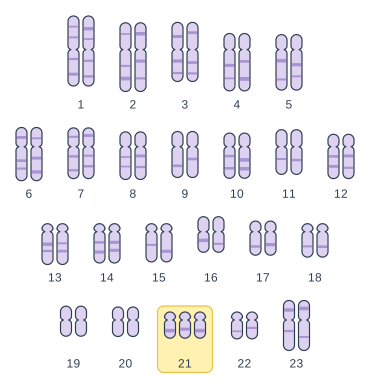
Down syndrome is caused by an extra copy of chromosome 21. The diagram shows the chromosomes from a body cell of a person with Down syndrome, arranged in pairs and numbered.

In most cases, Down syndrome happens when meiosis does not work correctly as an egg cell is made.

Explain how this leads to every body cell of the person having an extra chromosome 21. Use your knowledge of meiosis, fertilisation and mitosis.

Diagram of a karyotype: the chromosomes from one body cell, arranged in 23 pairs in four rows, from the largest pair at the top left to the smallest; the pairs are numbered 1 to 23. Each chromosome is drawn as a banded rod pinched at one point. In pairs 1 to 22 the two chromosomes of each pair look the same, except that pair 21 has three chromosomes instead of two. In pair 23 the two chromosomes are the same medium size. Pair 21 is highlighted.

Model answer

Meiosis should halve the number of chromosomes, so that each egg cell gets one chromosome from each pair - 23 chromosomes. Here the two chromosomes 21 did not separate, so the egg cell got both of them and had 24 chromosomes. At fertilisation a normal sperm cell with 23 chromosomes, including one chromosome 21, joined the egg, so the zygote had 47 chromosomes, with three copies of chromosome 21. The zygote then divided by mitosis to make all the cells of the body; mitosis copies every chromosome, so every body cell has three copies of chromosome 21.

Explanation

Follow the chromosomes through the life cycle: meiosis should give each gamete one of each chromosome, fertilisation joins two gametes, and mitosis copies the zygote's chromosomes into every body cell. An error in meiosis that gives an egg two copies of chromosome 21 therefore gives a zygote, and every cell made from it, three copies.

Mark scheme
  1. 1 mark

    meiosis should halve the number of chromosomes, so that each egg cell gets one chromosome from each pair / 23 chromosomes

    1 mark for each of points 1 to 4. ALLOW meiosis should make haploid egg cells with 23 chromosomes.

  2. 1 mark

    the two chromosomes 21 did not separate, so the egg cell got two copies of chromosome 21 / 24 chromosomes

    ALLOW the egg cell got both chromosomes of pair 21 / an extra chromosome 21.

  3. 1 mark

    at fertilisation a (normal) sperm cell with 23 chromosomes / one chromosome 21 joined it, so the zygote had 47 chromosomes / three copies of chromosome 21

    ALLOW 24 + 23 = 47. ALLOW ECF from a wrong number of chromosomes in the egg cell, if added correctly to 23.

  4. 1 mark

    the zygote divides by mitosis, which copies every chromosome, so every body cell has the same chromosomes as the zygote / three copies of chromosome 21

    ALLOW all body cells come from the zygote by mitosis, which makes genetically identical cells. DO NOT ALLOW the body cells are made by meiosis.

Ready to try the rest? Every answer you write is marked against the mark scheme, so you can see exactly where the marks are.

Study Helper Hints first, answers after you try

Stuck on this one? Ask for a hint and I’ll point you in the right direction, without giving the answer away. Once you’ve checked your answer, I’ll show you how the marks are awarded.