
Level:
Correct: 0
Incorrect: 0
Marks: 0/0
Exam Practice
Course:
Topics:
Avg
score:
–
Topics
done:
0/22

Single gene inheritance and genetic crosses

Practise 18 exam-style questions on Single gene inheritance and genetic crosses for OCR GCSE Combined Science (Biology Paper 2). Write your answer as you would in the exam and get it marked in seconds against the mark scheme, point by point, with the Study Helper on hand if you get stuck.

  • 18 questions
  • 1–6 marks each
  • Instant marking
  • No sign-up needed
18 questions, marked as you go

Sample questions with model answers

Here are 4 of the questions in this topic, each with a model answer, an explanation of why it earns the marks and the mark scheme an examiner would use.

Question 1

1 mark

In pepper plants, the allele for red fruit (R) is dominant to the allele for yellow fruit (r).

A grower crosses two pepper plants that are both heterozygous (Rr). She grows 200 plants from the seeds.

How many of the 200 plants are expected to have yellow fruit?

Choose your answer.

  • A 150
  • B 100
  • C 67
  • D 50

Model answer

D

Explanation

A cross between two heterozygous plants gives a 3 : 1 ratio of the dominant to the recessive phenotype, so 1 in 4 plants are expected to be rr with yellow fruit: 200 ÷ 4 = 50. A common slip is to divide by 3, because the ratio contains a 3, but a 3 : 1 ratio means 1 out of every 4 plants. 150 is the number expected to have red fruit.

Mark scheme
  1. 1 mark

    D / 50

    The only correct answer is D: Rr × Rr gives the offspring RR, Rr, Rr and rr, so 1 in 4 (25%) are expected to be rr with yellow fruit, and 200 ÷ 4 = 50. A is not correct because 150 is the number expected to have red fruit (3 in 4); B is not correct because 100 would be half of the plants, as expected from Rr × rr; C is not correct because 67 comes from 200 ÷ 3, which wrongly treats the 3 : 1 ratio as 1 in 3. ALLOW the letter or the option. If more than one option is given, do not award the mark.
Question 2

1 mark

In Dalmatian dogs, the allele for black spots (B) is dominant to the allele for liver (brown) spots (b).

A black-spotted Dalmatian and a liver-spotted Dalmatian have a litter of eight puppies. All eight puppies have black spots.

Give the most likely genotype of the black-spotted parent.

Model answer

BB

Explanation

The liver-spotted parent is bb, so it passes b to every puppy. If the black-spotted parent were Bb, about half of the puppies would be bb with liver spots. All eight puppies have black spots, so the black-spotted parent is most likely BB: every puppy is Bb and has black spots.

Mark scheme
  1. 1 mark

    BB

    ALLOW homozygous dominant. DO NOT ALLOW Bb (a Bb parent crossed with a bb parent would be expected to give about half liver-spotted puppies). IGNORE the genotype of the liver-spotted parent (bb) if it is also given.

Question 3

2 marks

Human earwax can be wet or dry. Earwax type is controlled by a single gene: the allele for dry earwax (w) is recessive to the allele for wet earwax (W).

A student says: 'Dry earwax is caused by a recessive allele, so dry earwax must be rare in every population.'

In 2006, scientists reported that in many populations in East Asia, 80% to 95% of people have dry earwax.

Explain why the student is wrong.

Model answer

Recessive only means that the w allele does not show in the phenotype when W is present, so dry earwax is only seen in people who are ww. It does not mean the allele is passed on less often: a Ww parent passes w to half of their children. If most people in a population carry w, as in parts of East Asia, dry earwax can be very common.

Explanation

Many people think a dominant allele 'beats' a recessive one and so becomes more common, but dominance only describes which allele shows in the phenotype. Both alleles of a heterozygous parent have an equal chance of being passed on. How common an allele is in a population depends on that population's history, not on whether it is dominant or recessive.

Mark scheme
  1. 1 mark

    recessive only means that the allele (w) does not affect the phenotype when a dominant allele (W) is present / dry earwax only shows in people who are ww

    ALLOW being recessive is about whether the allele shows in the phenotype, not about how common it is. IGNORE repeats of the data with no explanation.

  2. 1 mark

    a recessive allele is passed on as often as a dominant allele: a Ww parent passes w to half of their gametes / children

    ALLOW how common an allele is depends on how many people in the population carry it, not on whether it is dominant or recessive. ALLOW in these populations most people are ww, so they can only pass on w. DO NOT ALLOW the dominant allele is passed on more often.

Question 4

3 marks

In Syrian hamsters, the allele for short hair (L) is dominant to the allele for long hair (l).

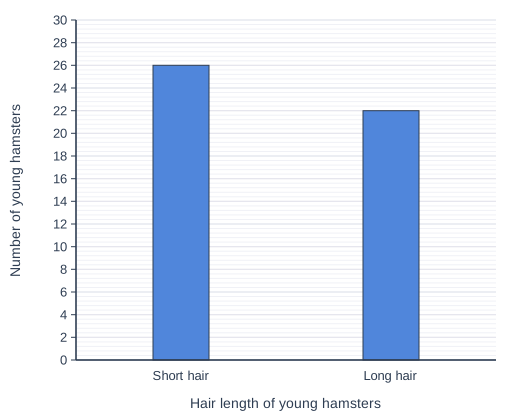
A breeder crossed short-haired hamsters that were heterozygous (Ll) with long-haired hamsters (ll). The bar chart shows the hair length of all of the young hamsters from these crosses.

Calculate the percentage of the young hamsters that had long hair.

Do these results agree with the outcome expected from this cross? Explain your answer.

Bar chart of number of young hamsters for each hair length of young hamsters: Short hair 26, Long hair 22.

Model answer

Total = 26 + 22 = 48 young hamsters.
Percentage with long hair = 22 ÷ 48 × 100 = 45.8%

Yes, they agree. Ll × ll gives Ll, Ll, ll, ll, so 50% of the young are expected to have long hair. 45.8% is close to 50%; the small difference is due to chance.

Explanation

Divide the number of long-haired young by the total number of young, not by the number of short-haired young. The Punnett square for Ll × ll has two ll boxes out of four, so half of the young are expected to have long hair. Real results are rarely exactly the expected value because fertilisation is random, so a result close to 50% supports the prediction.

Mark scheme
  1. 1 mark

    22 ÷ (26 + 22) × 100 / 22 ÷ 48 × 100; or a correct final answer of 45.8% (or 46%) with no working

    An answer of 45.8% (ALLOW 45.83% or 46%) with no working scores marking points 1 and 2 only. ALLOW ECF from a misread bar for point 1 (for example 21 ÷ 47 × 100). 22 ÷ 26 × 100 = 84.6% (long-haired divided by short-haired, not by the total) scores 0 for points 1 and 2.

  2. 1 mark

    evaluation: 45.8 (%) / 46 (%)

    ALLOW 45.83 / 45.833. IGNORE a missing % sign.

  3. 1 mark

    yes: Ll × ll is expected to give half of the young with long hair (equal numbers of short-haired and long-haired young), and the calculated percentage is close to a half

    The expected outcome (50%, a half or a 1 : 1 ratio) and the judgement are both needed. ALLOW 45.8% is close to 50%. ALLOW the small difference is due to chance. ALLOW ECF: a correct comparison of an incorrect percentage from point 2 with 50%. DO NOT ALLOW 'no, because it is not exactly 50%'.

Ready to try the rest? Every answer you write is marked against the mark scheme, so you can see exactly where the marks are.

Study Helper Hints first, answers after you try

Stuck on this one? Ask for a hint and I’ll point you in the right direction, without giving the answer away. Once you’ve checked your answer, I’ll show you how the marks are awarded.