
Level:
Correct: 0
Incorrect: 0
Marks: 0/0
Exam Practice
Course:
Topics:
Avg
score:
–
Topics
done:
0/22

Practical skills (biology PAGs B1-B5)

Practise 15 exam-style questions on Practical skills (biology PAGs B1-B5) for OCR GCSE Combined Science (Biology Paper 2). Write your answer as you would in the exam and get it marked in seconds against the mark scheme, point by point, with the Study Helper on hand if you get stuck.

  • 15 questions
  • 1–6 marks each
  • Instant marking
  • No sign-up needed
15 questions, marked as you go

Sample questions with model answers

Here are 4 of the questions in this topic, each with a model answer, an explanation of why it earns the marks and the mark scheme an examiner would use.

Question 1

1 mark

A student put a 0.05 cm³ drop of pond water on a microscope slide. She counted 40 cells of a single-celled alga in the drop.

Estimate the number of these algal cells in 1000 cm³ of the pond water.

Choose your answer.

  • A 2000
  • B 40 000
  • C 800 000
  • D 8 000 000

Model answer

C: 800 000 (40 ÷ 0.05 = 800 cells per cm³; 800 × 1000 = 800 000).

Explanation

First scale the sample up to 1 cm³: a 0.05 cm³ drop is one twentieth of 1 cm³, so 1 cm³ contains 40 × 20 = 800 cells. Then multiply by 1000 for 1000 cm³. The answer is only an estimate, because the cells may not be spread evenly through the pond, so several drops should be counted and a mean used.

Mark scheme
  1. 1 mark

    C / 800 000

    The only correct answer is C: 40 ÷ 0.05 = 800 cells in 1 cm³, and 800 × 1000 = 800 000 cells in 1000 cm³. A is not correct because 2000 comes from multiplying by the volume of the drop (40 × 0.05 × 1000) instead of dividing by it; B is not correct because 40 000 comes from ignoring the volume of the drop (40 × 1000), as if the drop were 1 cm³; D is not correct because 8 000 000 is ten times too large (800 cells in 1 cm³ gives 800 000 in 1000 cm³). ALLOW the letter or the option. If more than one option is given, do not award the mark.
Question 2

1 mark

Two students counted the white clover plants in the same 0.5 m × 0.5 m quadrat on a lawn. One student counted 23 plants and the other counted 31 plants.

White clover grows as creeping stems that spread across the ground and grow roots at many points.

Suggest why the two counts were different.

Model answer

The clover plants are joined by creeping stems, so it is hard to tell where one plant ends and the next begins, and the two students decided differently what counted as one plant.

Explanation

When individual plants are hard to tell apart, different people make different judgements, which causes random error in counts. Agreeing clear rules (for example about plants on the edge of the quadrat) reduces this. For plants such as clover and grass, ecologists often estimate percentage cover instead of counting plants.

Mark scheme
  1. 1 mark

    it is hard to tell where one clover plant ends and the next begins / the students decided differently what counts as one plant

    1 mark for any one of points 1 to 3, max 1. If more than one answer is given, a wrong one cancels a right one. ALLOW the creeping stems join the plants together, so it is hard to count separate plants. IGNORE 'human error' on its own.

  2. 1 mark

    the students treated plants at the edge of the quadrat (partly inside it) differently

    ALLOW one student counted plants on the edge and the other did not.

  3. 1 mark

    some plants were hidden by the grass, so they were missed or counted twice

    ALLOW one student missed some plants / counted some plants twice. IGNORE 'one student counted wrong' on its own.

Question 3

2 marks

A class used a model to show how a communicable disease spreads.

• Each student had a test tube of colourless liquid. One tube, chosen secretly, contained a chemical that represented a pathogen.
• Each student swapped some liquid with three other students, one after another.
• An indicator was then added to every tube. The tubes that contained the chemical turned pink.

At the end, 7 of the 20 tubes turned pink.

Suggest one way in which this model is like the spread of a real communicable disease and one way in which it is not like it.

Model answer

Like: one 'infected' person passed the 'pathogen' to others by contact, so the number of infected people grew, as in a real outbreak.
Not like: the chemical only gets more dilute each time it is shared, but real pathogens reproduce inside the body.

Explanation

A model shows some features of the real thing but not others. Here the passing on by contact and the growing number of 'infected' tubes behave like a real outbreak, but a chemical cannot multiply as pathogens do, everyone who receives it counts as infected for good (no immunity and no recovery), and real people meet many more people and catch diseases in several different ways.

Mark scheme
  1. 1 mark

    (like) the 'pathogen' passes from one person to another by contact / by sharing liquids, as some pathogens pass in body fluids

    1 mark for any one of points 1 and 2, max 1 (the way it is like). 1 mark for any one of points 3 to 7, max 1 (the way it is not like). For each part, if more than one answer is given, a wrong one cancels a right one. ALLOW the chemical is passed on when liquid is swapped, as a pathogen is passed on by contact.

  2. 1 mark

    (like) one infected person can lead to many others becoming infected (the number of infected people grows with each contact)

    ALLOW one tube led to 7 pink tubes.

  3. 1 mark

    (not like) the chemical gets more dilute / does not multiply, but pathogens reproduce inside the body

    ALLOW the amount of 'pathogen' does not increase. ALLOW pathogens can multiply, so the amount in each person increases.

  4. 1 mark

    (not like) in real life some people are immune (for example vaccinated) / do not become infected after contact

    ALLOW in the model everyone who receives the chemical is 'infected'.

  5. 1 mark

    (not like) real people can recover / be treated with medicines, but a tube that turns pink stays 'infected'

    ALLOW infected people can be cured / get better.

  6. 1 mark

    (not like) real people meet many more people / the contacts in the model are controlled (each student met only three people)

    ALLOW in real life people do not choose who they meet in a planned order.

  7. 1 mark

    (not like) real pathogens also spread in other ways (in droplets in the air, in food or water, or by vectors), not only by direct contact

    ALLOW a named route, for example coughing and sneezing, or mosquitoes.

Question 4

4 marks

Fresh kiwi fruit contains a protease enzyme that breaks down the protein in jelly.

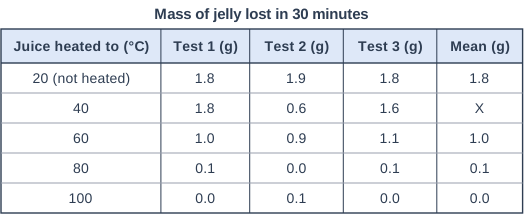
A student heated samples of fresh kiwi fruit juice to different temperatures for 5 minutes, then cooled them all to room temperature. She put a 5.0 g cube of jelly into each sample, and after 30 minutes she found the mass of jelly that had been lost. She did each test three times.

The table shows her results. One result at 40 °C is anomalous.

Identify the anomalous result and calculate the mean mass lost at 40 °C without it.

Explain why the student cooled all the samples to room temperature before adding the jelly.

Suggest how the student could find more precisely the lowest temperature that stops the enzyme working.

Mass of jelly lost in 30 minutes. Table with columns "Juice heated to (°C)", "Test 1 (g)", "Test 2 (g)", "Test 3 (g)", "Mean (g)". Juice heated to (°C): 20 (not heated); Test 1 (g): 1.8; Test 2 (g): 1.9; Test 3 (g): 1.8; Mean (g): 1.8 | Juice heated to (°C): 40; Test 1 (g): 1.8; Test 2 (g): 0.6; Test 3 (g): 1.6; Mean (g): X | Juice heated to (°C): 60; Test 1 (g): 1.0; Test 2 (g): 0.9; Test 3 (g): 1.1; Mean (g): 1.0 | Juice heated to (°C): 80; Test 1 (g): 0.1; Test 2 (g): 0.0; Test 3 (g): 0.1; Mean (g): 0.1 | Juice heated to (°C): 100; Test 1 (g): 0.0; Test 2 (g): 0.1; Test 3 (g): 0.0; Mean (g): 0.0.

Model answer

The anomalous result is 0.6 g (test 2 at 40 °C).
Mean at 40 °C = (1.8 + 1.6) ÷ 2 = 1.7 g
Cooling every sample to room temperature means the jelly was digested at the same temperature each time, so any difference in the mass lost was caused only by how hot the juice had been heated. Warm juice would also melt some of the jelly.
To find the temperature more precisely, she should test temperatures between 60 °C and 80 °C, for example 65 °C, 70 °C and 75 °C.

Explanation

An anomalous result does not fit the pattern of the other repeats, so it is left out when the mean is calculated. The investigation tests the effect of heating the juice, so the temperature while the enzyme acts on the jelly must be kept the same. The results show that heating to 80 °C or more denatures the enzyme, and that this happens somewhere between 60 °C and 80 °C, so testing at smaller intervals in that range narrows it down.

Mark scheme
  1. 1 mark

    anomalous result = 0.6 (g, test 2 at 40 °C) / (1.8 + 1.6) ÷ 2; or a correct final answer of 1.7 g with no working

    An answer of 1.7 g with no working scores marking points 1 and 2 only. An answer of 1.3 g (the anomalous result included: 4.0 ÷ 3 = 1.33) scores 0. 1 mark for any one of points 3 and 4, max 1. For the reason for cooling, if more than one answer is given, a wrong one cancels a right one.

  2. 1 mark

    1.7 (g)

    ALLOW 1.70 (g). IGNORE units.

  3. 1 mark

    (cooling) so the jelly was digested at the same temperature in every sample (temperature was a control variable), so differences in mass lost were caused only by the earlier heating of the juice

    ALLOW so it is a fair test, if linked to the temperature while the jelly is in the juice being the same. ALLOW because the enzyme works at different rates at different temperatures. IGNORE 'to make it a fair test' on its own.

  4. 1 mark

    (cooling) warm juice would melt / dissolve the jelly, so mass would be lost even without the enzyme

    ALLOW so that the mass lost is caused only by the enzyme. IGNORE 'so the jelly is not damaged' on its own.

  5. 1 mark

    test more temperatures between 60 °C and 80 °C / use smaller intervals between 60 °C and 80 °C (for example every 5 °C)

    ALLOW test temperatures such as 65 °C, 70 °C and 75 °C. ALLOW smaller intervals over a range that includes 60 °C to 80 °C (for example every 5 °C from 60 °C to 100 °C). The idea of smaller temperature intervals between 60 °C and 80 °C is needed. IGNORE 'repeat the investigation' or 'do more repeats' on its own (this does not narrow the temperature down).

Ready to try the rest? Every answer you write is marked against the mark scheme, so you can see exactly where the marks are.

Study Helper Hints first, answers after you try

Stuck on this one? Ask for a hint and I’ll point you in the right direction, without giving the answer away. Once you’ve checked your answer, I’ll show you how the marks are awarded.