
Level:
Correct: 0
Incorrect: 0
Marks: 0/0
Exam Practice
Subject:
Topics:
Avg
score:
–
Topics
done:
0/9

The impact of Lenin's dictatorship

Practise 45 exam-style questions on The impact of Lenin's dictatorship for AQA GCSE History (Russia 1894-1945). Write your answer as you would in the exam and get it marked in seconds against the mark scheme, point by point, with an AI tutor on hand if you get stuck.

  • 45 questions
  • 2–12 marks each
  • Instant marking
  • No sign-up needed
20 questions, marked as you go

Sample questions with model answers

Here are 4 of the questions in this topic, each with a model answer, an explanation of why it earns the marks and the mark scheme an examiner would use.

Question 1

2 marks

Figure 1 is a flow chart of events leading to the Russian Civil War.

What happened at the stage marked X? Explain why it helped to start the Civil War.
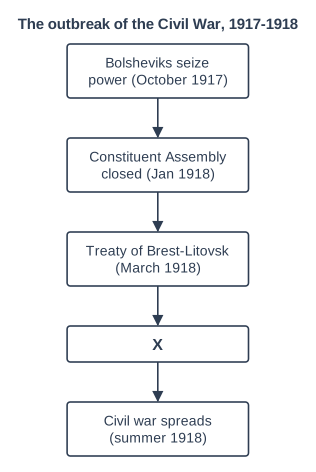
The outbreak of the Civil War, 1917-1918. Flow chart of 5 boxes joined by arrows, read from top to bottom. The first box is "Bolsheviks seize power (October 1917)", which leads to "Constituent Assembly closed (Jan 1918)", which leads to "Treaty of Brest-Litovsk (March 1918)", which leads to box X, which leads to "Civil war spreads (summer 1918)".

Model answer

At X the Czech Legion, about 40,000 former prisoners of war travelling east along the Trans-Siberian Railway, revolted in May 1918 after the Bolsheviks tried to disarm them, and seized towns along the railway. This helped start the Civil War because it gave the Bolsheviks' opponents a strong armed force, allowing anti-Bolshevik governments such as the SR government at Samara to be set up.

Explanation

The Czech Legion's revolt turned scattered opposition into open war in the summer of 1918, and it also gave the Allies a reason to intervene. Opposition had been growing since the closing of the Constituent Assembly and the Treaty of Brest-Litovsk.

Mark scheme
  1. 1 mark

    X: the Czech Legion revolted (May 1918) and seized towns along the Trans-Siberian Railway.

    Accept: the revolt / uprising of the Czech Legion (Czechoslovak Legion); fighting between the Czech Legion and the Bolsheviks.

  2. 1 mark

    It gave the Bolsheviks' opponents a strong armed force and control of the railway, so anti-Bolshevik governments could be set up (e.g. the SR government at Samara) and White armies could form.

    Accept: it encouraged the Allies to intervene (to help the Czechs); it showed the Bolsheviks could be beaten; it brought the Whites close to Ekaterinburg, where the Tsar was held.
Question 2

4 marks

Interpretation A: from a memoir by a political commissar who served in the Red Army, published in Moscow in 1923. (Written for practice.)
Wherever the front was breaking, Trotsky's train arrived. It carried a printing press, a radio station, a band and a squad of picked fighters. Within hours deserters had been turned back, orders printed, cowards punished and tired men given new heart. Trotsky took the army of 1918, a crowd of volunteers who elected their own officers, and made it a disciplined force of millions. Without him the Red Army would not have existed.

Interpretation B: from a history of the Soviet Union for schools, published in Moscow in 1948. (Written for practice.)
The Red Army was created and led by the Communist Party under the guidance of Lenin and Stalin. Comrade Stalin, sent by Lenin to Tsaritsyn in 1918, organised its defence and saved the vital grain supplies of the south. Again and again Stalin was sent to the most dangerous fronts. Trotsky, by contrast, disrupted the work of the army, trusted former Tsarist officers who betrayed it, and made mistakes that cost many lives.

Why might the authors of Interpretations A and B have a different interpretation about Trotsky's role in the Red Army? Explain your answer using Interpretations A and B and your contextual knowledge.

Model answer

The interpretations differ mainly because of when they were written and the political situation in the Soviet Union at the time. The author of Interpretation A was a political commissar who had served in the Red Army, so he had seen Trotsky's armoured train and its effect on the soldiers for himself. He was writing in 1923, when Trotsky was still Commissar for War and celebrated as the organiser of victory in the Civil War, so it was natural - and safe - to praise him in a book published in Moscow.

Interpretation B was a school history book published in Moscow in 1948, at the height of Stalin's dictatorship. By then Trotsky had lost the power struggle, had been expelled from the party and the USSR, and had been murdered in Mexico in 1940 on Stalin's orders. Soviet history was rewritten to glorify Stalin and blame Trotsky, which explains why B exaggerates Stalin's role at Tsaritsyn and claims Trotsky 'disrupted the work of the army'. As a school book, its purpose was to teach children the official version.

Explanation

This pair shows how political change in the USSR changed the way the Civil War was written about. Level 2 needs a developed explanation from provenance and context, e.g. Trotsky's position in 1923 compared with his fall and the cult of Stalin by 1948.

Mark scheme
  1. 4 marks

    Levels of response (4 marks).
    Level 2 (3-4 marks): Developed explanation of why the interpretations differ, based on their provenance and supported by contextual knowledge, e.g. explains that A was written in 1923 by a commissar who had served under Trotsky, when Trotsky was still Commissar for War and a hero of the Civil War, whereas B was a school textbook published in 1948 under Stalin, after Trotsky had been expelled, exiled and murdered and history had been rewritten to glorify Stalin and blacken Trotsky.
    Level 1 (1-2 marks): Simple explanation of a reason from provenance, e.g. 'they were written at different times' or 'B was written under Stalin'.
    0 marks: nothing worthy of credit.

    Indicative content (not a checklist; credit other valid points): A's author served as a commissar in the Red Army, so had first-hand experience of Trotsky's leadership and his armoured train; in 1923 Trotsky was still Commissar for War and one of the best-known Bolshevik leaders, so praise of him could be published in Moscow; B was published in 1948, at the height of Stalin's power and his cult of personality; Trotsky had lost the power struggle, been expelled from the party (1927) and the USSR (1929) and was murdered in Mexico on Stalin's orders in 1940; Soviet history books were rewritten to remove or blame Trotsky and exaggerate Stalin's role (e.g. at Tsaritsyn, later renamed Stalingrad); B was written for schools, so its purpose was to teach the official view to children; Stalin's role at Tsaritsyn was real but much smaller than B claims, and Stalin and Trotsky had quarrelled over the use of former Tsarist officers.

Question 3

8 marks

Interpretation A: from a book about Soviet propaganda by a British historian, published in 1985. (Written for practice.)
In a country where most peasants could not read, the Bolsheviks used pictures, films and travelling speakers better than any government before them. Agit-trains carried their message to the front and the villages, and millions of posters warned that a White victory would bring back the landlords. This message mattered, because the peasants' choice between Reds and Whites decided the war. Propaganda did not win battles by itself, but it helped to give the Reds the soldiers and the support they needed.

Interpretation B: from a history of the Russian Civil War by an American historian, published in 2005. (Written for practice.)
It is easy to exaggerate the power of Bolshevik propaganda. Posters and agit-trains reached only a small part of a vast country, and peasants judged the Reds by what they did, not by what they said. What they saw were armed squads seizing their grain and conscripting their sons, and they deserted from the Red Army in huge numbers. The Bolsheviks won not because peasants believed their propaganda but because peasants feared the Whites even more, and because the Cheka and the army held them down.

Which interpretation gives the more convincing opinion about the importance of propaganda in the Bolshevik victory in the Civil War? Explain your answer based on your contextual knowledge and what it says in Interpretations A and B.

Model answer

Interpretation A argues that propaganda helped give the Reds 'the soldiers and the support they needed'. This is convincing in several ways. Most peasants could not read, so the Bolsheviks used posters with simple images, such as Dmitry Moor's 'Have You Volunteered?' and Viktor Deni's caricatures of capitalists and White generals. Agit-trains and agit-ships carried films, speakers and printing presses to the front and the villages, and commissars spread the message inside the Red Army. Above all, the message that a White victory would bring back the landlords matched peasants' real fears, because many White officers were landowners. By contrast, the Whites made little effort to explain their aims. A is also careful not to overstate its case, saying propaganda 'did not win battles by itself'.

Interpretation B argues that the power of propaganda is easily exaggerated. This is also convincing. Russia was vast, and posters and trains reached only part of it. Under War Communism, armed squads seized grain from the villages and the Red Army conscripted peasants, which led to peasant revolts, such as the Greens, and to very high desertion. The Cheka and the Red Terror kept control through fear. B is right that many peasants supported the Reds only as the lesser evil.

Overall, A is more convincing, although B is a useful warning. Propaganda could not make peasants love the Bolsheviks while their grain was being seized, but the decisive choice for most peasants was between the Reds and a White victory that threatened their land. Propaganda made sure that peasants understood that choice, which is why it mattered more than B allows.

Explanation

Level 4 tests both interpretations against specific knowledge - posters, agit-trains, the land message, requisitioning, desertion and the Cheka - and reaches a sustained judgement. The best answers see that the two views can be partly reconciled while still deciding which is more convincing.

Mark scheme
  1. 8 marks

    Levels of response (8 marks).
    Level 4 (7-8 marks): Complex evaluation of both interpretations with a sustained judgement about which is more convincing about the importance of propaganda, based on accurate contextual knowledge, e.g. tests A's claim that propaganda helped win peasant support against the agit-trains, posters and the land message, and B's claim that propaganda mattered little against grain requisitioning, conscription, desertion and the Cheka, then reaches a substantiated judgement (e.g. propaganda was most effective where it matched peasants' real fear of the landlords, which supports both in part).
    Level 3 (5-6 marks): Developed evaluation of both interpretations based on contextual knowledge, without a sustained judgement.
    Level 2 (3-4 marks): Simple evaluation of one interpretation based on contextual knowledge.
    Level 1 (1-2 marks): Basic analysis of one or both interpretations: assertion or paraphrase with little contextual knowledge.
    0 marks: nothing worthy of credit.

    Indicative content (not a checklist; credit other valid points): Supporting A: most peasants could not read, so the Bolsheviks used images - posters by Dmitry Moor ('Have You Volunteered?'), Viktor Deni, El Lissitzky; agit-trains from 1918 and agit-ships on the Volga with films, speakers and printing presses; ROSTA windows; newspapers (Pravda, Izvestia); commissars spread propaganda in the Red Army; the main message - the Whites would bring back the landlords and were puppets of foreign capitalists - fitted real fears, since many White officers were landowners and foreign troops had landed; the Whites made little use of propaganda. Supporting B: Russia was vast and communications poor; War Communism - armed squads requisitioned grain, causing peasant anger, revolts (Greens, Tambov) and famine; conscription; very high desertion from the Red Army; the Cheka and the Red Terror used fear to control the population; peasants often saw the Reds as the 'lesser evil' rather than supporting them. Challenging A: it does not show how many people propaganda reached or believed; Challenging B: it underestimates the role propaganda played in turning fear of the Whites into support for the Reds, and in motivating party members and workers. Possible judgement: either, if sustained.

Question 4

12 marks

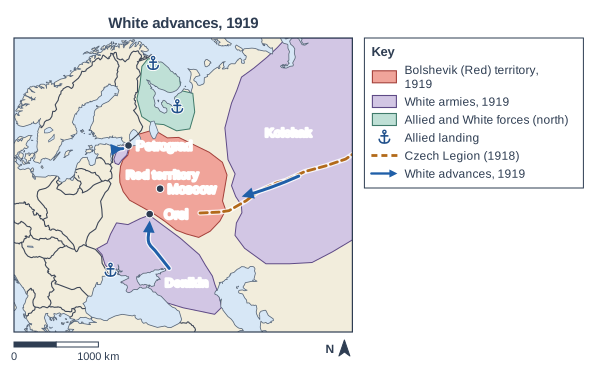
Study Figure 1, a map of the White advances in 1919.

Which of the following was the more important reason why the Reds won the Civil War:
- the Reds' control of central Russia
- the Whites' failure to co-ordinate their attacks?
Explain your answer with reference to both bullet points.

Map of Russia west of the Ural Mountains during the Russian Civil War (1918-20), drawn on the borders of the early 1920s, titled "White advances, 1919". It is drawn with real coastlines (land pale buff, sea pale blue) and the borders of the time as simplified lines; a north arrow shows north at the top; the scale bar is 1000 km long. The map shows the Russian Civil War (1918-20, at the height of the White advances in 1919); the key explains the shading. Red shading ("Bolshevik (Red) territory, 1919") covers one area described below. Lilac shading ("White armies, 1919") covers 3 areas described below. Green shading ("Allied and White forces (north)") covers one area described below. The label "Red territory" is written on an area shaded red near the centre of the map. The label "Kolchak" is written on an area shaded lilac in the top right of the map. The label "Denikin" is written on an area shaded lilac towards the bottom of the map. 2 more shaded areas are not labelled. Dashed lines mark a territory inside a larger state. A thick dashed brown line (key: "Czech Legion (1918)") runs from the centre of the map to the right of the map (about 1950 km from end to end). An anchor symbol is on the coast towards the top of the map. An anchor symbol is on the coast towards the top of the map. An anchor symbol is on the coast in the bottom left of the map. Points: a dot labelled "Moscow" (inland); a dot labelled "Petrograd" (on the coast); a dot labelled "Orel" (inland). Arrows: a blue arrow (key: "White advances, 1919") from the right of the map to the right of the map; a blue arrow from the bottom of the map to the point labelled "Orel"; a blue arrow from the left of the map to the point labelled "Petrograd". The key (beside the map) shows: "Bolshevik (Red) territory, 1919", "White armies, 1919", "Allied and White forces (north)", "Allied landing", "Czech Legion (1918)" and "White advances, 1919".

Model answer

The Reds' control of central Russia, shown by the large area around Moscow and Petrograd in Figure 1, was a major reason for their victory. This was the most densely populated part of the country, so the Reds had far more people to conscript; the Red Army grew to about 5 million by 1920. The centre also contained most of Russia's remaining industry and arms factories, which could supply the army. Most importantly, Moscow was the hub of the railway network. Using these interior lines, the Reds could move troops and supplies quickly from one front to another, and Trotsky's armoured train could reach a crisis within days. The Whites, by contrast, held the thinly populated edges of Russia, with poor communications and little industry.

The Whites' failure to co-ordinate their attacks was also crucial. As Figure 1 shows, the White armies attacked from three directions, but not at the same time. Kolchak advanced from Siberia towards the Volga in the spring of 1919, but he had been driven back before Denikin's army advanced from the south to Orel in October 1919, and Yudenich reached the outskirts of Petrograd in the same month. The White leaders were thousands of kilometres apart, with poor communications, and they were rivals with different aims. This allowed the Reds to concentrate their forces against each White army in turn: Kolchak first, then Denikin and Yudenich, and finally Wrangel in 1920.

Overall, the Reds' control of central Russia was the more important reason, but the two factors were closely linked. Even if the Whites had co-ordinated their attacks, the Reds would still have had more men, more industry and the railways. Control of the centre was a permanent advantage, whereas the Whites' failure to co-ordinate was partly a result of geography: armies on the edges of a vast country, separated by Red territory, found it almost impossible to work together. The Whites' disunity made the Reds' task easier, but it was the Reds' central position that turned that disunity into defeat.

Explanation

Level 4 explains both factors with specific knowledge, using the map as evidence rather than just describing it, and reaches a sustained judgement. The strongest answers see the link between the two: the Reds' central position let them exploit the Whites' failure to attack together.

Mark scheme
  1. 12 marks

    Levels of response (12 marks).
    Level 4 (10-12 marks): Complex explanation of both bullet points leading to a sustained judgement about which was the more important reason for the Red victory, supported by a range of accurate, specific knowledge, e.g. explains how the central heartland around Moscow and Petrograd gave the Reds most of the population, industry and railways and allowed them to move troops between fronts, and how the separate White advances of 1919 (Kolchak in the spring, Denikin and Yudenich in the autumn) allowed the Reds to defeat each in turn, then weighs them (e.g. the two were linked - central control was decisive because the Whites attacked separately).
    Level 3 (7-9 marks): Developed explanation of both bullet points, supported by relevant knowledge, but without a sustained judgement.
    Level 2 (4-6 marks): Simple explanation of one or both bullet points, e.g. describing the map with little explanation.
    Level 1 (1-3 marks): Basic explanation of one or both bullet points: general statements with limited knowledge.
    0 marks: nothing worthy of credit.

    Indicative content (not a checklist; credit other valid points): Control of central Russia (the shaded Red territory in Figure 1): the Reds held Moscow (capital from March 1918) and Petrograd, the most populated area, giving them more men to conscript; most of the remaining industry and the arms factories; the hub of the railway network, so troops and supplies could be moved quickly along interior lines to whichever front was threatened; a single, united government; the Whites held the thinly populated edges with poor communications; Trotsky's armoured train used the railways. Failure to co-ordinate (the separate arrows in Figure 1): Kolchak's advance from Siberia towards the Volga in spring 1919 was driven back before Denikin's advance from the south to Orel (October 1919) and Yudenich's advance from Estonia to the outskirts of Petrograd (October 1919); the White armies were thousands of kilometres apart, with poor communications; their leaders were rivals with different aims; so the Reds could concentrate their forces against each in turn - Kolchak (spring-summer 1919), then Denikin and Yudenich (autumn 1919), then Wrangel (1920). Other factors: Red Army organisation, the Cheka, propaganda, White policies on land and nationalities, limited foreign help. Possible judgements: central control more important - a lasting advantage in men, industry and railways; or failure to co-ordinate more important - the Whites came close in 1919 and a joint attack might have succeeded; or the two are linked; credit any sustained judgement.

Ready to try the rest? Every answer you write is marked against the mark scheme, so you can see exactly where the marks are.

AI Tutor Hints first, answers after you try

Hi! Stuck? Ask me for a hint and I’ll help you work it out. Once you’ve checked your answer I can explain exactly where the marks are.