Interpretation A: from a book about the USSR written in 1944 by a British writer who supported the Soviet Union, Britain's wartime ally. (Written for practice.)
'In little more than ten years Stalin's plans turned a backward peasant country into a land of tractors, steel mills and power stations. The peasant who could not read became a skilled worker or an engineer, and schools, hospitals and libraries reached the remotest villages. Without this transformation the Red Army could never have stopped Hitler: the tanks and guns now driving the Germans back were made in factories that did not exist in 1928. Modernisation was the great achievement of the Soviet people.'
Interpretation B: from a history of Russia written by a Russian historian in 1996, after the collapse of the USSR. (Written for practice.)
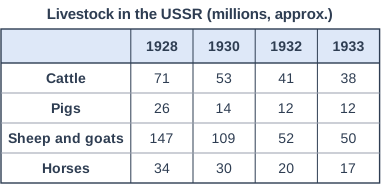
'Stalin's modernisation was lopsided. The USSR could make steel, tractors and tanks, but it could hardly feed itself: grain harvests in the 1930s were on average little better than in 1928, and there were still far fewer cattle than before collectivisation. Most townspeople lived in overcrowded rooms and queued for basic goods. Much of the new industry was built by prisoners. The country gained factories, but its people gained little comfort or freedom. It was the modernisation of a state, not of a society.'
Which interpretation gives the more convincing opinion about the extent of Stalin's modernisation of the USSR by 1941?
Explain your answer based on your contextual knowledge and what it says in Interpretations A and B.
Model answer
Interpretation A is convincing about industry and some social changes. Heavy industry grew enormously between 1928 and 1940: coal output rose from about 35 to about 166 million tonnes and steel from about 4 to about 18 million tonnes. New industrial centres such as Magnitogorsk were built in the Urals and Siberia, out of reach of invaders, and in 1941-45 these factories produced the tanks and guns A mentions. Society changed too: literacy rose from about half the population in 1926 to over 80 percent by 1939, and the number of students in higher education rose more than fourfold. However, A was written in 1944 by a supporter of Britain's wartime ally, so it praises the USSR and says nothing about the famine, the labour camps or the Terror.
Interpretation B is convincing about the limits and costs. Agriculture remained backward: grain harvests in the 1930s were on average little better than in 1928, cattle numbers did not recover to their 1928 level until the 1950s, and collective farmers depended on their tiny private plots. In the towns families lived in overcrowded communal flats and queued for basic goods, and real wages were probably still lower in 1937 than in 1928. Prisoners built the White Sea Canal and worked the mines of Kolyma. However, B goes too far in saying that society was not modernised: the urban population doubled from about 26 million to about 56 million, millions learned to read, and many workers and peasants became engineers and managers.
Overall, B is more convincing about the extent of modernisation. My knowledge supports A's claims about industry and the war, but B gives a more complete picture: modernisation was rapid in heavy industry and defence, but very limited in agriculture and living standards, and it was achieved by force.
Explanation
A good answer weighs the real transformation of industry and education (supporting A) against stagnant farming, poor living standards and forced labour (supporting B), and uses the provenance only to support the judgement. Level 4 needs both evaluated with precise contextual knowledge and a sustained judgement about extent.