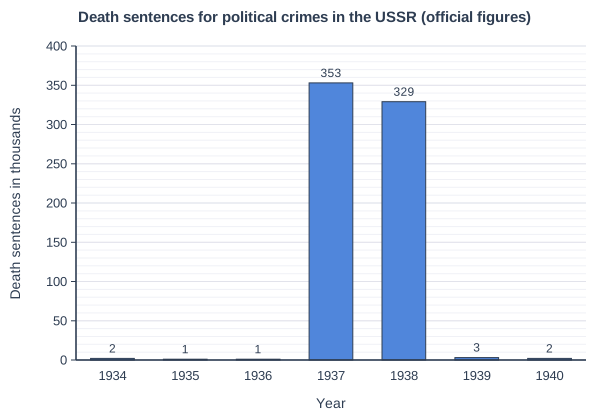
Figure 1 is a bar chart showing the approximate number of death sentences for political crimes in the USSR each year from 1934 to 1940, according to official Soviet figures.
In what ways were the lives of ordinary Soviet people affected by the Terror of 1936-38? Explain your answer.
Model answer
The Terror first affected ordinary people through its sheer scale. Figure 1 shows that death sentences for political crimes rose from only about 1,000 to 2,000 a year in 1934-36 to about 353,000 in 1937 and about 329,000 in 1938, before falling back to about 3,000 in 1939. In total about 1.5 million people were arrested in 1937-38, and those who were not shot were sent to the labour camps of the Gulag. Most victims were not famous leaders but ordinary people: NKVD Order No. 00447 of July 1937 set quotas of arrests and executions for each region, targeting former kulaks, priests, former members of other parties and 'criminals', and other operations targeted Poles, Germans and other national minorities.
Secondly, the Terror filled everyday life with fear. Arrests usually came at night, and anyone could be accused of 'counter-revolutionary' crimes under Article 58. The NKVD relied on informers in factories and blocks of flats, and some people denounced others out of fear, or to take their job or room. People stopped speaking freely, even to friends, and avoided contact with foreigners.
Thirdly, the families of victims suffered. The relatives of an 'enemy of the people' could lose their jobs and homes; wives could be sent to camps and children to orphanages. Many people felt forced to disown arrested relatives in public.
Finally, the Terror changed workplaces. Engineers, managers and specialists were blamed as 'wreckers' when targets were missed, and their arrest disrupted industry. At the same time, younger workers were promoted rapidly into their jobs, so some people benefited. These effects were linked: the fear of denunciation, the punishment of families and the chance of promotion all encouraged people to conform and support Stalin, which is what the Terror was meant to achieve, until Beria replaced Yezhov at the end of 1938 and the mass arrests were scaled down.
Explanation
Figure 1 shows the sudden, enormous peak of 1937-38: about 680,000 death sentences in two years. The Terror reached ordinary people through quotas, denunciations and arrests, punished their families and changed workplaces. Level 4 needs several developed, linked explanations that use the figure and other specific knowledge.