
Level:
Correct: 0
Incorrect: 0
Marks: 0/0
Exam Practice
Subject:
Topics:
Avg
score:
–
Topics
done:
0/9

Nicholas II's autocracy and the court

Practise 44 exam-style questions on Nicholas II's autocracy and the court for AQA GCSE History (Russia 1894-1945). Write your answer as you would in the exam and get it marked in seconds against the mark scheme, point by point, with an AI tutor on hand if you get stuck.

  • 44 questions
  • 2–12 marks each
  • Instant marking
  • No sign-up needed
20 questions, marked as you go

Sample questions with model answers

Here are 4 of the questions in this topic, each with a model answer, an explanation of why it earns the marks and the mark scheme an examiner would use.

Question 1

2 marks

Figure 1 is a table about the four Dumas. One entry has been replaced by X.

Describe what happened to the Second Duma in June 1907 and explain how this affected the Dumas that followed.
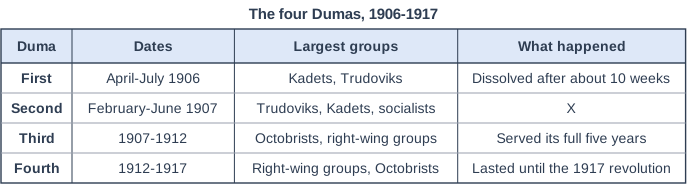
The four Dumas, 1906-1917. Table with columns "Duma", "Dates", "Largest groups", "What happened". Duma: First; Dates: April-July 1906; Largest groups: Kadets, Trudoviks; What happened: Dissolved after about 10 weeks | Duma: Second; Dates: February-June 1907; Largest groups: Trudoviks, Kadets, socialists; What happened: X | Duma: Third; Dates: 1907-1912; Largest groups: Octobrists, right-wing groups; What happened: Served its full five years | Duma: Fourth; Dates: 1912-1917; Largest groups: Right-wing groups, Octobrists; What happened: Lasted until the 1917 revolution.

Model answer

In June 1907 the Second Duma was dissolved after only about three months, after Stolypin accused Social Democrat deputies of plotting against the state. At the same time the electoral law was changed so that landowners' votes counted for far more than those of peasants and workers, so the Third and Fourth Dumas were dominated by conservatives and were much more willing to work with the government.

Explanation

The change to the electoral law in June 1907 broke the Fundamental Laws, because it was made without the Duma's consent, and critics called it a coup. It ended the period of radical Dumas and produced a Duma that would co-operate with Stolypin.

Mark scheme
  1. 1 mark

    It was dissolved (by the Tsar / Stolypin) after only about three months.

    Accept 'it was closed down' or 'sent home'. Accept the reason given at the time - Stolypin accused Social Democrat deputies of plotting against the state.

  2. 1 mark

    The electoral law was changed (3 June 1907) to give much more weight to the votes of landowners and the wealthy and fewer seats to peasants, workers and the national minorities, so the Third and Fourth Dumas were much more conservative and loyal to the Tsar.

    The mark needs the change to the voting system and its effect. Accept 'later Dumas were dominated by the right / the Octobrists'.

Question 2

4 marks

Interpretation A: from the memoirs of a former officer of the Okhrana, the Tsar's secret police, written in exile in 1929. (Written for practice.)
Before the war the revolutionaries were never a serious danger to the throne. They were a few thousand students, intellectuals and workers, and their leaders spent their time in Swiss cafés quarrelling with one another. We had agents inside every party; for years the head of the Socialist Revolutionaries' terrorist section was in our pay. Bombs killed some brave officials, but the people did not follow the terrorists. It was the war, and the mistakes made in Petrograd, that destroyed Russia, not Lenin's little party.

Interpretation B: from a history of the Bolshevik Party published in Moscow in 1946. (Written for practice.)
From the moment Lenin founded the newspaper Iskra, the Bolshevik Party grew into the leader of the Russian working class. Its members organised strikes, spread revolutionary ideas in the factories and taught the workers that the Tsar could only be overthrown by mass struggle, not by the bombs of the Socialist Revolutionaries. The revolution of 1905 was a dress rehearsal. In spite of arrests, hangings and exile, by 1914 the Bolsheviks led the great strike movement and their newspaper Pravda was read by tens of thousands of workers. The overthrow of Tsarism was certain.

Why might the authors of Interpretations A and B have a different interpretation about the threat from the revolutionary parties before 1914? Explain your answer using Interpretations A and B and your contextual knowledge.

Model answer

The author of Interpretation A was an officer in the Okhrana, the Tsar's secret police. He had inside knowledge of how thoroughly the revolutionary parties were infiltrated - Azef, the head of the SRs' Combat Organisation, was a police agent, and so was the Bolshevik Duma deputy Malinovsky. But he also had a motive to argue that the police had the revolutionaries under control, so that the fall of Tsarism could be blamed on the war and on politicians rather than on his own service. Writing in exile in 1929, after the Bolsheviks had won, he may also have wanted to belittle Lenin.

Interpretation B was published in Moscow in 1946, under Stalin, when history was controlled by the Communist Party. Soviet histories had to show the Bolshevik Party as the leader of the working class from the very beginning and the revolution as the inevitable result of its work, following Marxist ideas. So the author stresses Iskra, the strikes and Pravda and ignores the other parties and the role of the war.

Explanation

Level 2 explains how each author's position and purpose shaped the view: a former secret policeman defending his service, against an official Soviet party history glorifying the Bolsheviks. Contextual knowledge such as Azef or Stalin's control of history strengthens the answer.

Mark scheme
  1. 4 marks

    Levels of response (4 marks).
    Level 2 (3-4 marks): Developed explanation of why the interpretations differ, based on their provenance and supported by contextual knowledge, e.g. explains that A's author served in the Okhrana, so he had inside knowledge of how far the parties were infiltrated but also wanted to show that his service had done its job and that others lost Russia; whereas B was published by the Communist Party in the USSR in 1946, when history had to glorify Lenin and the Bolsheviks and present the revolution as the inevitable result of their leadership.
    Level 1 (1-2 marks): Simple explanation: identifies a reason from the provenance, e.g. 'A was a policeman' or 'B was written by communists', without explaining how it shaped the view.
    0 marks: nothing worthy of credit.

    Indicative content (not a checklist; credit other valid points): A's author was an Okhrana officer, with first-hand knowledge of police agents inside the parties (Azef in the SR Combat Organisation until 1908; Malinovsky, a Bolshevik deputy in the Fourth Duma, was also a police agent); he had a reason to show the police had the revolutionaries under control and to blame politicians, the war and the court instead; he was writing in exile in 1929 after the Bolsheviks had won, perhaps bitter and wishing to belittle Lenin; B was a party history published in Moscow in 1946, under Stalin, when all history was controlled; Soviet histories had to show the Bolshevik Party as the leader of the workers from the start and Lenin as a genius; Marxist ideas taught that revolution was historically inevitable; written after the victory of 1945, to boost the prestige of the Party; B ignores the Mensheviks and SRs, who were often larger; B uses real evidence that suits it (Iskra, the 1912-14 strikes, Pravda).

Question 3

8 marks

Interpretation A: from the memoirs of a former general in the Russian army, written in exile in 1923. (Written for practice.)
In 1905 the throne was saved by the army, and by nothing else. While ministers lost their nerve and wrote manifestos, the soldiers stayed loyal to their oath. The Semyonovsky Guards crushed the rebels in Moscow in a few days, and our columns restored order along the Siberian railway and in the Baltic provinces. A few sailors mutinied, but the great mass of peasant soldiers did their duty. Concessions only encouraged the revolutionaries to demand more; firmness ended the disorders.

Interpretation B: from a history of Russia written by a historian at a British university in 1990. (Written for practice.)
The Tsarist regime survived 1905 above all because its opponents were divided. The October Manifesto gave the liberals much of what they wanted, and most of them were ready to stop protesting and prepare for the Duma elections. Workers, peasants, national minorities and liberals had risen at different times for different reasons, and there was no single leadership. Once the opposition had split, the government could isolate the workers of St Petersburg and Moscow and use force against them. Repression worked only because the Manifesto had come first.

Which interpretation gives the more convincing opinion about why Nicholas II survived the 1905 Revolution? Explain your answer based on your contextual knowledge and what it says in Interpretations A and B.

Model answer

Interpretation A is convincing in arguing that the army was essential. In December 1905 the Semyonovsky Guards crushed the armed uprising in Moscow with artillery, killing about 1,000 people, and the St Petersburg Soviet was arrested. Punitive expeditions restored order along the Trans-Siberian Railway and in the Baltic provinces, and most soldiers, who were peasants, did obey their officers. However, A goes too far in saying that the army saved the throne 'by nothing else'. There were serious mutinies, not just 'a few sailors': the Potemkin in June, and the naval bases at Kronstadt and Sevastopol in the autumn. Before October, force had failed to stop the revolution, and the Tsar issued the Manifesto because the general strike had paralysed the country. As a former general, the author would naturally want to praise the army and dismiss the politicians.

Interpretation B is more convincing. The Manifesto did split the opposition: the Octobrists accepted it completely, and the Kadets, though they wanted more, turned to the Duma elections. Many workers ended the general strike. It is also true that the different groups rose at different times - workers in January and October, the Potemkin sailors in June, peasants mainly in the summer and autumn - and that there was no single leadership, as Lenin did not even return to Russia until November. Only after the Manifesto did the government move against the Soviet and Moscow, as B says. B does underplay other factors, such as peace with Japan, which freed troops, and the abolition of redemption payments, which helped calm the peasants.

Overall, B is more convincing because it explains why force succeeded in December when it had not worked earlier in the year. The army was necessary, but it was the October Manifesto, by dividing the opposition, that allowed the army to crush the remaining revolutionaries one group at a time.

Explanation

Level 4 evaluates both interpretations against specific knowledge and sustains a judgement. The best answers see that the two are linked: the army crushed the revolution, but the Manifesto made that possible by dividing the opposition.

Mark scheme
  1. 8 marks

    Levels of response (8 marks).
    Level 4 (7-8 marks): Complex evaluation of both interpretations with a sustained judgement based on contextual knowledge, e.g. tests A's claim that the army alone saved the throne (Moscow, punitive expeditions, mutinies) and B's claim that division of the opposition after the October Manifesto was decisive (Octobrists and Kadets, the isolated Soviet), reaching a substantiated judgement about which is more convincing.
    Level 3 (5-6 marks): Developed evaluation of both interpretations using relevant contextual knowledge to support or challenge each.
    Level 2 (3-4 marks): Simple evaluation of one interpretation, using some contextual knowledge.
    Level 1 (1-2 marks): Basic analysis of one or both interpretations; assertion, or paraphrase with little knowledge.
    0 marks: nothing worthy of credit.

    Indicative content (not a checklist; credit other valid points): Support for A: the Semyonovsky Guards did crush the Moscow uprising in December 1905 (about 1,000 killed); punitive expeditions under generals such as Meller-Zakomelsky and Rennenkampf restored order along the Trans-Siberian Railway and in the Baltic provinces; the St Petersburg Soviet was arrested in December; most peasant soldiers stayed loyal. Challenges to A: there were serious mutinies - the Potemkin (June 1905), Kronstadt and Sevastopol (autumn 1905) and unrest among troops returning from Manchuria; force had not stopped the revolution before October; the general strike forced the Tsar to issue the Manifesto because he had no reliable dictator to use (Grand Duke Nicholas refused); a general writing in exile would want to praise the army. Support for B: the Manifesto split the liberals from the socialists - the Octobrists accepted it and the Kadets prepared for elections; the general strike ended; different groups rose at different times (workers in January and October, peasants mainly in the summer and autumn, the Potemkin in June, national minorities in Poland and the Caucasus); there was no single leader, and Lenin only returned in November; repression came after the Manifesto. Challenges to B: the Soviet and the workers still had to be crushed by force; the peasants were also calmed by the abolition of redemption payments (announced November 1905); peace with Japan and the French loan mattered too. Possible judgements: B more convincing because it explains why force worked when it did; A convincing that force was necessary but not that it was enough.

Question 4

12 marks

Which of the following was the more important reason why Nicholas II survived the 1905 Revolution:
• the October Manifesto
• the loyalty of the army?
Explain your answer with reference to both bullet points.

Model answer

The October Manifesto was very important in saving Nicholas II. By October 1905 a general strike had brought much of Russia to a standstill, and Witte persuaded the Tsar that he had to make concessions. The Manifesto promised freedom of speech, assembly and association and an elected Duma without whose consent no law could be passed. This split the opposition. Many liberals were satisfied: the Octobrists, led by Guchkov, accepted the Manifesto completely, and even the Kadets, who wanted more, turned their energy to the coming elections rather than revolution. Many workers ended the strike. The St Petersburg Soviet and the socialists rejected it as a trick, but they were now isolated, and later concessions to the peasants, such as the abolition of redemption payments, helped calm the countryside.

The loyalty of the army was also vital. Most soldiers were peasants, and although there were mutinies - the battleship Potemkin in June and the naval bases at Kronstadt and Sevastopol in the autumn - the great majority obeyed orders. In December 1905 the police arrested the St Petersburg Soviet, and the Semyonovsky Guards crushed the armed uprising in Moscow with artillery, killing about 1,000 people. Once peace with Japan had been signed at Portsmouth in September 1905, troops could return from Manchuria; punitive expeditions restored order along the Trans-Siberian Railway and in the countryside.

Overall, the October Manifesto was the more important reason. The army was the means by which the revolution was finally crushed, but it could only succeed once the opposition had been divided. Before October, the government faced liberals, workers, peasants and national minorities all at once; after the Manifesto, the liberals withdrew and the army only had to deal with isolated groups of workers and peasants. The Manifesto came first and made the successful use of force possible, which is why many historians see the Tsar's survival as the result of concession followed by repression.

Explanation

Level 4 needs both factors explained with precise evidence and a judgement that is argued throughout, for example that the Manifesto divided the opposition so that the army could crush what remained. Answers that simply describe the army's actions and the Manifesto's terms stay in Level 2 or 3.

Mark scheme
  1. 12 marks

    Levels of response (12 marks).
    Level 4 (10-12 marks): Complex explanation of both bullet points, supported by specific knowledge (e.g. the Manifesto's promises, the split between Octobrists, Kadets and socialists, the end of the general strike; the crushing of the Moscow uprising, punitive expeditions, the arrest of the Soviet, the return of troops after the Treaty of Portsmouth), leading to a sustained judgement about which was more important, for example showing how the Manifesto made it possible to use the army successfully.
    Level 3 (7-9 marks): Developed explanation of both bullet points, supported by relevant knowledge; any judgement is not sustained.
    Level 2 (4-6 marks): Simple explanation of one or both bullet points.
    Level 1 (1-3 marks): Basic explanation of one or both bullet points, with limited knowledge.
    0 marks: nothing worthy of credit.

    Indicative content (not a checklist; credit other valid points): The October Manifesto (17 October 1905), drafted by Witte: promised civil rights, an elected Duma and no law without its consent; the liberals split - the Octobrists (Guchkov) accepted it, the Kadets (Milyukov) wanted more but turned to elections; many workers ended the general strike; the socialists and the St Petersburg Soviet rejected it but were isolated; peasants were later won over by the halving and then abolition of redemption payments (from January 1907); the opposition, which had no single leadership, broke apart. The army: most soldiers were peasants who stayed loyal to their oath, despite mutinies (Potemkin in June, Kronstadt and Sevastopol in the autumn); the Semyonovsky Guards crushed the Moscow uprising (December 1905, about 1,000 killed); the St Petersburg Soviet was arrested (December 1905); punitive expeditions along the Trans-Siberian Railway and in the Baltic provinces; peace with Japan (Treaty of Portsmouth, September 1905) allowed troops to return; a large French loan (April 1906) helped pay the army. Possible judgements: the army was more important because in the end force crushed the revolution; or the Manifesto was more important because it divided the opposition, so the army only had to deal with the workers and peasants; or both were essential - concession first, then repression.

Ready to try the rest? Every answer you write is marked against the mark scheme, so you can see exactly where the marks are.

AI Tutor Hints first, answers after you try

Hi! Stuck? Ask me for a hint and I’ll help you work it out. Once you’ve checked your answer I can explain exactly where the marks are.