
Level:
Correct: 0
Incorrect: 0
Marks: 0/0
Exam Practice
Subject:
Topics:
Avg
score:
–
Topics
done:
0/9

The 'Boom'

Practise 45 exam-style questions on The 'Boom' for AQA GCSE History (America 1920-1973). Write your answer as you would in the exam and get it marked in seconds against the mark scheme, point by point, with an AI tutor on hand if you get stuck.

  • 45 questions
  • 2–12 marks each
  • Instant marking
  • No sign-up needed
20 questions, marked as you go

Sample questions with model answers

Here are 4 of the questions in this topic, each with a model answer, an explanation of why it earns the marks and the mark scheme an examiner would use.

Question 1

2 marks

Figure 1 summarises the economic policies of the Republican governments of the 1920s. The policy marked X was introduced by a law passed in 1922.

Name the policy marked X and give one way in which it helped American businesses.
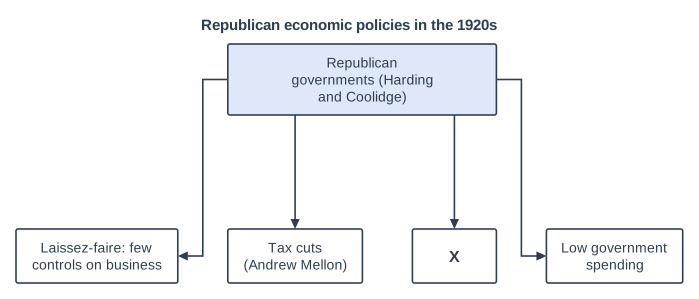
Republican economic policies in the 1920s. Block diagram with five parts in three rows. Top row: a box "Republican governments (Harding and Coolidge)" (wide, shaded). Bottom row, left to right: a box "Laissez-faire: few controls on business", a box "Tax cuts (Andrew Mellon)", a box labelled X and a box "Low government spending". Connections: an arrow from "Republican governments (Harding and Coolidge)" to "Laissez-faire: few controls on business"; an arrow from "Republican governments (Harding and Coolidge)" to "Tax cuts (Andrew Mellon)"; an arrow from "Republican governments (Harding and Coolidge)" to box X; an arrow from "Republican governments (Harding and Coolidge)" to "Low government spending".

Model answer

Policy X was high tariffs on imported goods, introduced by the Fordney-McCumber Tariff of 1922. The tariff made foreign goods more expensive in American shops, so Americans bought American-made goods instead, protecting American companies from foreign competition and helping them to sell more and make bigger profits.

Explanation

Tariffs, tax cuts and laissez-faire were the main Republican economic policies of the 1920s. Tariffs protected American industry, though other countries put up their own tariffs in return, making it harder for American farmers and firms to export.

Mark scheme
  1. 1 mark

    High tariffs (import duties / taxes) on goods imported into the USA - the Fordney-McCumber Tariff (1922).

    Accept: tariffs; protectionism; taxes on imports. Do not accept tax cuts, laissez-faire or low spending (they are shown on the figure).

  2. 1 mark

    Foreign goods became more expensive, so Americans bought American-made goods instead: American industry (and farming) was protected from foreign competition.

    Accept: helped American firms sell more and make bigger profits; encouraged people to buy American goods.

Question 2

4 marks

Describe two features of the stock market boom in the USA in the late 1920s.

Model answer

One feature was the very rapid rise in share prices, especially at the end of the decade. The Dow Jones Industrial Average, which measured share prices on the New York Stock Exchange, rose from about 200 at the end of 1927 to 300 at the end of 1928 and reached a peak of about 381 in September 1929, far faster than companies' profits were growing.

A second feature was speculation using borrowed money. Many people bought shares not to keep them but to sell them quickly at a higher price, and they bought 'on the margin', paying a deposit of perhaps 10% and borrowing the rest from a stockbroker. Banks lent huge sums for this, so the boom was built on debt and would turn into disaster if prices fell, as they did in October 1929.

Explanation

The late 1920s boom was driven by speculation and borrowing (buying on the margin) more than by real growth in profits. Level 2 needs two developed features with specific detail such as index levels, dates or how margin buying worked.

Mark scheme
  1. 4 marks

    Levels of response (4 marks).
    Level 2 (3-4 marks): Demonstrates knowledge and understanding of two features of the stock market boom, each developed with specific detail, e.g. explains that share prices rose very fast (the Dow Jones index went from about 200 at the end of 1927 to a peak of about 381 in September 1929); or that many people bought on the margin, paying perhaps 10% and borrowing the rest from brokers.
    Level 1 (1-2 marks): Demonstrates basic knowledge of one or two features, simply stated, e.g. 'share prices went up' or 'people borrowed money to buy shares'.
    0 marks: nothing worthy of credit.

    Indicative content (not a checklist; credit other valid points): share prices rose rapidly, especially in 1928-29 - the Dow Jones Industrial Average was about 200 at the end of 1927, 300 at the end of 1928 and peaked at about 381 on 3 September 1929; speculation - people bought shares to sell quickly at a profit rather than to receive dividends; buying on the margin - a deposit of as little as 10%, the rest borrowed from a broker; banks lent heavily to brokers and speculators, sometimes using savers' deposits; more ordinary Americans bought shares for the first time, though they were still a minority; share prices rose much faster than company profits, creating a bubble; little regulation - laissez-faire governments did not control the market (the Securities and Exchange Commission was only set up in 1934); widespread optimism, e.g. John J. Raskob's article 'Everybody Ought to Be Rich' (1929) and the economist Irving Fisher's claim in October 1929 that prices had reached 'a permanently high plateau'; the boom ended in the Wall Street Crash of October 1929.

Question 3

8 marks

In what ways were the lives of factory workers affected by mass production in the 1920s? Explain your answer.

Model answer

Mass production brought factory workers both benefits and costs. The most obvious benefit was higher pay in the big modern firms. Ford's five-dollar day, introduced in 1914, roughly doubled the usual factory wage, and wages in many large modern factories rose during the 1920s. This meant that many industrial workers could, for the first time, afford to buy a car or a radio, often on hire purchase, so mass production made workers into consumers as well as producers. Hours were also shorter: Ford introduced an eight-hour day in 1914 and a five-day week in 1926, giving workers more leisure time.

However, the work itself became duller and harder to bear. On the moving assembly line each worker did one simple task over and over again, at a speed set by the line, not by the worker. Skilled craftsmen were no longer needed, so workers could easily be replaced, which made them feel insecure. Many found the work so monotonous and tiring that they quit; high labour turnover was the main reason Ford introduced the five-dollar day.

Workers also lost freedom. Foremen enforced strict discipline, talking on the line was discouraged, and Ford's Sociological Department checked workers' home lives to decide whether they deserved the higher wage. Employers like Ford opposed trade unions, and union membership fell during the 1920s, so workers had little power to improve conditions.

Overall, mass production raised the living standards of many workers, but at the cost of boring, tightly controlled work over which they had little say.

Explanation

Mass production gave many workers higher wages and shorter hours, but made work repetitive, deskilled and closely controlled, with unions kept out. Level 4 needs several developed, linked explanations covering more than one effect.

Mark scheme
  1. 8 marks

    Levels of response (8 marks).
    Level 4 (7-8 marks): Complex explanation of the ways workers' lives were affected: several developed explanations, linked, supported by a range of accurate, specific knowledge, e.g. explains both benefits (higher wages such as Ford's five-dollar day, shorter hours, the chance to buy consumer goods) and costs (boring, repetitive, deskilled work at the pace of the line, strict control, opposition to unions, job insecurity), perhaps reaching a view about the overall effect.
    Level 3 (5-6 marks): Developed explanation of two or more ways, each supported with relevant knowledge.
    Level 2 (3-4 marks): Simple explanation of one way, or description of several ways with little explanation.
    Level 1 (1-2 marks): Basic explanation: general statements with limited knowledge, e.g. 'work was boring'.
    0 marks: nothing worthy of credit.

    Indicative content (not a checklist; credit other valid points): higher wages in the big modern firms - Ford's five-dollar day (1914) roughly doubled pay; workers could buy cars, radios and other consumer goods; shorter hours - Ford's eight-hour day (1914) and five-day week (1926) gave more leisure; work became repetitive and boring - each worker did one simple task on the moving assembly line; deskilling - craftsmen were replaced by unskilled workers who could be trained quickly and easily replaced; the speed of the line set the pace of work, which was exhausting; strict discipline - foremen, rules against talking; Ford's Sociological Department checked whether workers' home lives qualified them for the five-dollar day; employers such as Ford opposed trade unions, and union membership fell in the 1920s; machines replaced some workers, causing insecurity; some firms offered benefits such as company sports clubs or pensions to keep workers loyal and unions out; the lowest-paid jobs often went to immigrants and African Americans, though Ford employed many African Americans at River Rouge; profits rose faster than wages.

Question 4

12 marks

Which of the following was the more important effect of the growth of the motor industry in the USA in the 1920s:
- the growth of other industries
- changes to the way Americans lived?
Explain your answer with reference to both bullet points.

Model answer

The growth of the motor industry had a huge effect on other industries. Car registrations rose from about 8 million in 1920 to about 23 million in 1929, and every car needed steel for its body, rubber for its tyres, glass for its windows and leather or cloth for its seats, so the motor industry became one of the biggest customers of these industries. The oil industry grew rapidly to supply petrol. Road-building expanded, helped by the Federal Highway Act of 1921, and along the new roads appeared petrol stations, garages, motels and roadside restaurants. Car dealers and credit companies, such as the one General Motors set up in 1919, also grew. Hundreds of thousands of people worked in car factories in and around Detroit, and many more depended on the motor industry indirectly. These jobs and wages were spent on more goods, spreading prosperity across the economy.

The motor industry also changed the way Americans lived. Cars allowed people to live in the new suburbs and drive into the cities to work, so towns spread outwards. Families could take weekend trips to the countryside, beaches or national parks, and young people gained a new freedom from their parents' supervision, which worried many conservative Americans. For farmers and rural families, the car reduced isolation, making it easier to reach shops, doctors and entertainment in town. There were negative changes too, such as traffic jams, road accidents and the decline of the railways.

Which effect was more important depends on what is being judged. The changes to everyday life affected millions of families and lasted long after the 1920s, shaping American society for the rest of the century. However, many of these social changes reached only those who could afford a car, while the growth of other industries affected the whole economy.

Overall, I think the growth of other industries was the more important effect in the 1920s. It was the main way in which the motor industry drove the boom: by creating demand for steel, rubber, glass, oil and roads, it generated jobs and wages for millions, which in turn kept the consumer society growing. The changes to how people lived were important, but they were largely a result of that economic expansion.

Explanation

The motor industry boosted steel, rubber, glass, oil, roads and services, driving the boom, and also changed where and how people lived. Level 4 explains both with specific detail and judges them by a clear criterion, such as importance to the economy or the number of people affected.

Mark scheme
  1. 12 marks

    Levels of response (12 marks).
    Level 4 (10-12 marks): Complex explanation of both bullet points leading to a sustained judgement about which was the more important effect of the motor industry, supported by a range of accurate, specific knowledge, e.g. explains how car-making stimulated steel, rubber, glass, oil and road-building and created jobs that fuelled the boom, and how cars changed where and how people lived (suburbs, leisure, freedom for young people, the end of rural isolation), then weighs them by a clear criterion (e.g. importance to the boom, numbers affected, how long-lasting).
    Level 3 (7-9 marks): Developed explanation of both bullet points, supported by relevant knowledge, but without a sustained judgement.
    Level 2 (4-6 marks): Simple explanation of one or both bullet points.
    Level 1 (1-3 marks): Basic explanation of one or both bullet points: general statements with limited knowledge.
    0 marks: nothing worthy of credit.

    Indicative content (not a checklist; credit other valid points): Growth of other industries: car registrations rose from about 8 million (1920) to about 23 million (1929); the motor industry used a large share of the country's steel, rubber, glass and leather; the oil industry grew to supply petrol; road-building expanded (the Federal Highway Act, 1921); new businesses - petrol stations, garages, motels, roadside restaurants, car dealers, credit companies (General Motors' credit company, 1919); construction of suburbs; hundreds of thousands worked directly in car factories in and around Detroit (Ford, General Motors, Chrysler) and many more in related industries; this multiplier effect spread wages and demand across the economy and was central to the boom. Changes to the way Americans lived: suburbs - people could live away from crowded city centres and drive to work; leisure - weekend trips, holidays, national parks; young people gained freedom from parental supervision, worrying conservatives; rural isolation reduced - farmers could reach towns, shops and doctors; shopping and entertainment changed; new problems - traffic, road deaths; decline of railways and horse-related trades. Possible judgements: the growth of other industries more important because it drove the boom and created millions of jobs; or changes to how people lived more important because they affected almost every American and lasted long after the boom; credit either if sustained with a clear criterion.

Ready to try the rest? Every answer you write is marked against the mark scheme, so you can see exactly where the marks are.

AI Tutor Hints first, answers after you try

Hi! Stuck? Ask me for a hint and I’ll help you work it out. Once you’ve checked your answer I can explain exactly where the marks are.