Practise 26 exam-style questions on Representing sound: sampling for AQA GCSE Computer Science (Paper 2). Write your answer as you would in the exam and get it marked in seconds against the mark scheme, point by point, with the Study Helper on hand if you get stuck.
26 questions
1–4 marks each
Instant marking
No sign-up needed
20 questions, marked as you go
Sample questions with model answers
Here are 4 of the questions in this topic, each with a model answer, an explanation of why it earns the marks and the mark scheme an examiner would use.
Question 1
1 mark
A smart doorbell records sound using a sampling rate of 8 kHz.
State how many samples it takes each second.
Model answer
8 kHz = 8 × 1000 Hz = 8000 Hz, and 1 Hz is 1 sample per second, so it takes 8000 samples each second.
Explanation
One hertz means one sample per second, and the prefix kilo means 1000, so 8 kHz is 8000 samples per second. Answering 8 ignores the prefix.
Mark scheme
1 mark
8000
Mark is for AO2 (apply). Correct answer with no working scores the mark. A. 8 thousand. R. 8.
Question 2
2 marks
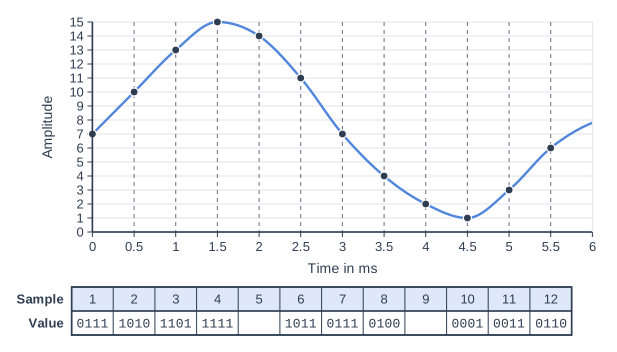
The figure shows a sound wave sampled every 0.5 ms with a sample resolution of 4 bits. The table shows each sample value in binary, but the values for sample 5 and sample 9 are missing.
State the 4-bit binary values for sample 5 and sample 9.
Model answer
Sample 5 (at 2 ms) is at level 14 = 8 + 4 + 2 = 1110. Sample 9 (at 4 ms) is at level 2 = 0010.
Explanation
Read each sample's level from the graph, then convert it to binary using the 4-bit place values 8, 4, 2 and 1. With a 4-bit sample resolution every value must have 4 bits, so level 2 is 0010, not 10. Sample 1 is at time 0, so sample 5 is at 2 ms and sample 9 at 4 ms.
Mark scheme
1 mark
Sample 5: 1110
All marks AO2 (apply). Sample 5 is at level 14. R. 14 (denary).
1 mark
Sample 9: 0010
Sample 9 is at level 2. R. 2 (denary). R. 10 (the value must be written with 4 bits).
Question 3
2 marks
A scientist recording bird song needs each sample to be able to take at least 50 different amplitude levels.
State the minimum sample resolution needed and explain your answer.
Model answer
6 bits. 5 bits would give only 2⁵ = 32 different levels, which is fewer than 50, but 6 bits give 2⁶ = 64 levels, which is enough.
Explanation
Each bit doubles the number of levels, so find the smallest power of 2 that is at least 50: 32 is too small and 64 is enough, so 6 bits are needed. Some of the 64 levels will be unused, which is fine. Answering 50 bits confuses the number of levels with the number of bits.
Mark scheme
1 mark
6 (bits)
All marks AO2 (apply). A correct answer of 6 with no explanation scores 1 mark.
1 mark
5 bits give only 2⁵ = 32 levels, which is too few // 6 bits give 2⁶ = 64 levels, which is at least 50
The explanation must compare a power of 2 (the number of levels) with 50. R. 'because 50 needs 6 digits'. R. 50 bits (number of levels confused with number of bits).
Question 4
3 marks
A recording studio has 1 GB of free storage. It records sound at a sampling rate of 50 000 Hz with a sample resolution of 20 bits.
Calculate how many seconds of sound can be stored in the free space. Ignore any metadata.
Work out how much storage one second of sound uses, put the free space into the same unit and divide. Here one second is 1 000 000 bits and 1 GB is 8 000 000 000 bits, giving 8000 seconds (about 2 hours 13 minutes). Mixing bits and bytes in the division is the error that gives an answer 8 times too big or too small.
Mark scheme
1 mark
50 000 × 20 = 1 000 000 bits per second // 125 000 bytes per second
All marks AO2 (apply). Correct answer with no working scores full marks. Maximum 2 marks if the final answer is not correct.
1 mark
1 GB = 1 000 000 000 bytes // 8 000 000 000 bits
R. if 1024 used in place of 1000 (AQA June 2022 8525/2 Q10), e.g. 1 073 741 824 bytes.
1 mark
8000 (seconds)
R. 8589 / 8590 (1024 used in place of 1000). I. a correct conversion to minutes (133 minutes 20 seconds) given as well as 8000 seconds.
Ready to try the rest? Every answer you write is marked against the mark scheme, so you can see exactly where the marks are.
Ctrl + Enter to check
Study HelperHints first, answers after you try
Stuck on this one? Ask for a hint and I’ll point you in the right direction, without giving the answer away. Once you’ve checked your answer, I’ll show you how the marks are awarded.