Practise 35 exam-style questions on Number bases and converting between them for AQA GCSE Computer Science (Paper 2). Write your answer as you would in the exam and get it marked in seconds against the mark scheme, point by point, with the Study Helper on hand if you get stuck.
35 questions
1–4 marks each
Instant marking
No sign-up needed
20 questions, marked as you go
Sample questions with model answers
Here are 4 of the questions in this topic, each with a model answer, an explanation of why it earns the marks and the mark scheme an examiner would use.
Question 1
1 mark
In a mobile game, the number of gems a player has collected is stored in binary. Freya has collected 89 gems.
Work from the largest place value: 128 does not fit into 89, so write 0; 64 fits, leaving 25; 32 does not fit; 16 fits, leaving 9; 8 fits, leaving 1; 4 and 2 do not fit; 1 fits. That gives 0101 1001. Always check by adding the place values back up: 64 + 16 + 8 + 1 = 89.
Mark scheme
1 mark
01011001
Mark is for AO2 (apply). Correct answer with no working scores full marks. R. 1011001 (the question asks for 8 bits). I. spaces between the bits (e.g. 0101 1001).
Question 2
2 marks
A technician uses a diagnostic tool to check the settings stored in a printer. One setting is stored as the byte 1101 0111. The tool displays every byte in hexadecimal.
Split the byte into two groups of four bits and convert each group into one hexadecimal digit: 1101 is 13, which is D, and 0111 is 7. Writing 137 is a common error - 13 must become the single digit D. Converting to decimal first (215) and then dividing by 16 also works but takes longer.
Mark scheme
1 mark
D (as the left-hand digit)
All marks AO2 (apply). This must be the left-hand digit to gain the mark.
1 mark
7 (as the right-hand digit)
This must be the right-hand digit to gain the mark. Maximum 1 mark if the final answer is not correct. Correct answer with no working scores full marks. A. lower case d7. R. 215 (the decimal value, not hexadecimal). R. 137 (1101 = 13 written as two decimal digits) for the left-hand digit.
Question 3
2 marks
Programmers often write values such as memory contents and colour codes in hexadecimal rather than in binary.
Explain why hexadecimal is often used in computer science.
Model answer
Hexadecimal is much shorter than binary: one hexadecimal digit stands for four bits, so a byte is written as two digits instead of eight. This makes values easier for people to read and remember, and they are less likely to make mistakes when typing or copying them. It is also quick to convert between hexadecimal and binary, so the bit pattern can still be worked out easily. The computer itself still stores the values in binary.
Explanation
Hexadecimal is used for the benefit of people: it is shorter, easier to read and remember, less error-prone to copy, and converts to and from binary very easily because each digit is exactly four bits. It does not save memory or make processing faster - the computer still stores and processes binary, which is the most common wrong answer.
Mark scheme
1 mark
Hexadecimal is easier for people to read / understand than binary
All marks AO1 (understanding). Max 2 from the five mark points.
1 mark
Hexadecimal values are shorter / use fewer digits, so are quicker to write / type
A. one hexadecimal digit replaces four bits // a byte is two hexadecimal digits instead of eight bits.
1 mark
People make fewer mistakes when reading / copying / typing hexadecimal
1 mark
Hexadecimal is easier to remember
1 mark
It is easy to convert between hexadecimal and binary (each hexadecimal digit is exactly four bits)
Max 2. R. hexadecimal takes up less memory / storage space (the values are still stored in binary). R. the computer processes hexadecimal faster. Do not award two marks for the same idea said twice, e.g. 'easier to read' and 'more readable'.
Question 4
3 marks
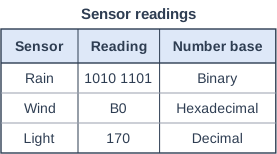
A weather station has three sensors. The table shows each sensor's latest reading, written in a different number base.
List the three sensors in order of their readings, from smallest to largest. You should show your working.
Readings in different bases can only be compared once they are in the same base, so convert them all to decimal (or all to binary or hexadecimal): Rain is 173, Wind is 176 and Light is 170. The values are close together, so a careless conversion easily changes the order. Do not judge by the number of digits or the letters - B0 has only two digits but is the largest.
Mark scheme
1 mark
One reading correctly converted into another base, e.g. Rain 1010 1101 = 173 // Wind B0 = 176 // Light 170 = 1010 1010 // Light 170 = AA
All marks AO2 (apply).
1 mark
A second reading correctly converted, so that all three readings are in the same base (e.g. 173 and 176 in decimal, or 1010 1010 and 1011 0000 in binary)
Any common base is acceptable.
1 mark
Light, Rain, Wind (in that order)
A correct order with no working scores 3 marks. A. the readings listed instead of the sensor names (170, 1010 1101, B0). R. largest first for this mark.
Ready to try the rest? Every answer you write is marked against the mark scheme, so you can see exactly where the marks are.
Ctrl + Enter to check
Study HelperHints first, answers after you try
Stuck on this one? Ask for a hint and I’ll point you in the right direction, without giving the answer away. Once you’ve checked your answer, I’ll show you how the marks are awarded.