Practise 25 exam-style questions on Network protocols and the TCP/IP model for AQA GCSE Computer Science (Paper 2). Write your answer as you would in the exam and get it marked in seconds against the mark scheme, point by point, with the Study Helper on hand if you get stuck.
25 questions
1–6 marks each
Instant marking
No sign-up needed
20 questions, marked as you go
Sample questions with model answers
Here are 4 of the questions in this topic, each with a model answer, an explanation of why it earns the marks and the mark scheme an examiner would use.
Question 1
1 mark
Which statement about HTTP is true?
Choose your answer.
It encrypts data sent to a web server
It is used to request and send web pages
It retrieves emails from a mail server
It adds IP addresses to packets
Model answer
It is used to request and send web pages
Explanation
HTTP is the application layer protocol a browser uses to request web pages from a web server and the server uses to send them back. HTTP does not encrypt data - that is what HTTPS adds. Retrieving emails is done by IMAP, and adding IP addresses to packets is done by IP at the internet layer.
Mark scheme
1 mark
It is used to request and send web pages
Mark is for AO1 (recall). If more than one option is given, 0 marks.
Question 2
2 marks
The internet layer is one of the four layers of the TCP/IP model.
Describe two functions of the internet layer.
Model answer
The internet layer adds the source and destination IP addresses to each packet, so the data is addressed and packaged for transmission. It also routes the packets across the network towards their destination.
Explanation
The internet layer, where IP operates, addresses and packages data for transmission and routes the packets across the network. Its functions are easy to confuse with those of the transport layer: setting up the communication and agreeing packet size belong to the transport layer (TCP), not the internet layer. Naming IP alone does not describe a function.
Mark scheme
1 mark
Adds the (source and destination) IP addresses to the packets // addresses the data (for transmission)
All marks AO1 (understanding). Max 2 from the three points.
1 mark
Packages the data for transmission
A. puts the data into packets ready to be sent across the network.
1 mark
Routes the packets across the network(s) // decides the route the packets take (through routers)
NE. 'IP works here' with no function described. R. functions of other layers, e.g. agreeing the size of packets or checking that packets arrive in order (transport layer), or where the NIC is (link layer).
Question 3
2 marks
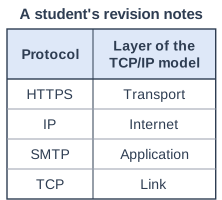
A student has written revision notes showing the layer of the TCP/IP model at which four protocols operate, as shown in the table. Two of the rows in the table are incorrect.
Identify the two incorrect rows and state the correct layer for the protocol in each of these rows.
Model answer
The HTTPS row is wrong: HTTPS operates at the application layer. The TCP row is wrong: TCP operates at the transport layer.
Explanation
HTTPS is used by applications such as web browsers, so it belongs to the application layer, and TCP is the transport layer protocol. The IP (internet layer) and SMTP (application layer) rows are correct. Learning the protocol for each layer from the top down - application: HTTP, HTTPS, SMTP, IMAP; transport: TCP; internet: IP - makes errors like these easy to spot.
Mark scheme
1 mark
HTTPS: (it operates at the) application layer
All marks AO2 (apply). For each mark the protocol and its correct layer are both needed. If more than two rows are given as incorrect, max 1 mark.
1 mark
TCP: (it operates at the) transport layer
R. TCP at the internet layer.
Question 4
3 marks
A student's revision notes say: "IP makes sure that all the packets arrive, and puts them back into the correct order."
Explain what is wrong with the student's notes, and describe what IP actually does.
Model answer
The notes describe TCP, not IP: it is TCP, at the transport layer, that makes sure all the packets arrive and puts them back in the right order. IP works at the internet layer. It adds the source and destination IP addresses to the packets, packaging the data for transmission, and routes the packets across the network to their destination.
Explanation
TCP and IP are often written together as 'TCP/IP', which is why their jobs get mixed up. TCP gives reliable delivery: packets split, numbered, checked and reassembled in order. IP addresses each packet and routes it, but does not check that every packet has arrived.
Mark scheme
1 mark
It is TCP (not IP) that makes sure the packets all arrive and puts them back in the correct order // this is done at the transport layer, not by IP
All marks AO2 (apply). NE. 'it should be a different protocol' without naming TCP or the transport layer.
1 mark
IP adds the (source and destination) IP addresses to the packets // IP addresses and packages the data for transmission
1 mark
IP routes the packets across the network(s) / internet
A. IP decides where each packet is sent next (through routers). R. 'IP splits the data into packets'.
Ready to try the rest? Every answer you write is marked against the mark scheme, so you can see exactly where the marks are.
Ctrl + Enter to check
Study HelperHints first, answers after you try
Stuck on this one? Ask for a hint and I’ll point you in the right direction, without giving the answer away. Once you’ve checked your answer, I’ll show you how the marks are awarded.