Practise 12 exam-style questions on Photo description: popular culture for AQA GCSE German (Foundation Writing). Write your answer as you would in the exam and get it marked in seconds against the mark scheme, point by point, with the Study Helper on hand if you get stuck.
12 questions
10 marks each
Instant marking
No sign-up needed
12 questions, marked as you go
Sample questions with model answers
Here are 4 of the questions in this topic, each with a model answer, an explanation of why it earns the marks and the mark scheme an examiner would use.
Question 1
10 marks
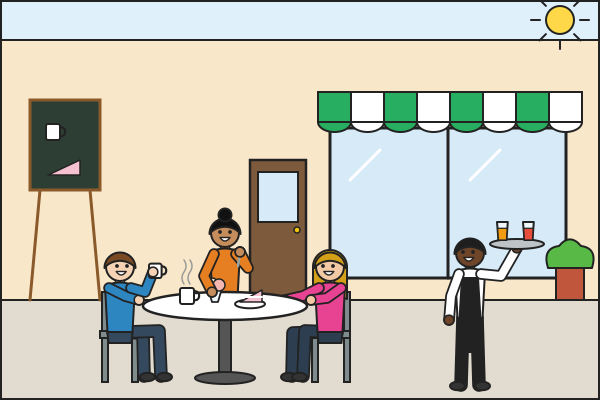
Your aunt lives in Vienna. You send her this picture of you and your friends at a café in your town.
What is in this photo? Write five sentences in German.
Model answer
Wir sitzen draußen an einem runden Tisch, denn das Wetter ist schön. Meine Freundin mit den schwarzen Haaren hat ein Eis in der Hand. Meine andere Freundin möchte den Kuchen essen. Der Mann rechts ist sehr freundlich. Hinten gibt es eine Tür und zwei große Fenster.
Explanation
Full marks come from five clear sentences about the picture, each with a conjugated verb: sitzen, essen, trinken, arbeiten and haben all fit here. Remember the stem change in isst (er/sie isst, not esst), and that möchte sends the second verb to the end (Sie möchte den Kuchen essen). After a word such as Hinten or In der Mitte the verb comes second (Hinten gibt es eine Tür; In der Mitte isst ein Mädchen ein Eis); getting this wrong does not lose the mark if the message is clear. A list of things on the table without a verb earns only 1 mark.
Mark scheme
2 marks
Levels of response: sentence 1 (AO2, 2 marks). Level 2 (2 marks): the relevant message is clearly communicated. Level 1 (1 mark): the message is relevant but has some ambiguity and causes a delay in communication. 0 marks: the message is irrelevant or cannot be understood.
Each of the five sentences is marked separately, as a whole, and must be about the picture. 2 marks: a sentence with an appropriate conjugated verb. - The same structure may be repeated with different nouns (Es gibt ...; Ich sehe ...). - Any person of the verb (ich, wir, du, sie) and any tense are accepted. - There may be errors, as long as the message is unambiguous. - A figure may be written for a number. - Anything that could possibly be true of the picture is accepted. 1 mark: - an infinitive in an otherwise appropriate sentence (Die Frau Kaffee trinken); - a noun phrase with no verb (vier Personen; ein Tisch); - an error that causes ambiguity or delay (Sie essen Kaffee); - a long sentence where one part communicates and another does not. 0 marks: - a single word; - an inappropriate verb (Ich möchte einen Tisch); - something clearly false about the picture; - an opinion about the photo that says nothing about what is in it (Ich mag das Foto = 0; Ich mag das Foto, weil es sonnig ist = 2). Spelling: - Umlauts, ß/ss and noun capitals do not matter unless the message becomes ambiguous. AQA: 'There may be linguistic errors, but the message must be communicated without ambiguity.' - ae/oe/ue for ä/ö/ü are the right letter (site rule, not AQA's). Gender identity (specification 4.7): 'Students should not be disadvantaged on the basis of their gender identity and/or how they refer to the gender identity of others in their exam responses. Students' preferred ways of referring to themselves and others through the use of pronouns, gendered language and grammatical agreements will be credited by examiners, regardless of whether such usage has been adopted by official language bodies in the target language-speaking countries.' Accept forms such as Schüler*innen, Lehrer:innen and LehrerInnen and neopronouns, and never count them as errors. Examples for this picture: 2 marks - Ich sitze mit zwei Freundinnen im Café. / Das Café ist in meiner Stadt. / Der Himmel ist blau. 1 mark - zwei Mädchen und ein Junge. / wir draußen sitzen. 0 marks - Sonne. / Es ist Nacht (clearly false: the sun is shining).
2 marks
Levels of response: sentence 2 (AO2, 2 marks). Level 2 (2 marks): the relevant message is clearly communicated. Level 1 (1 mark): the message is relevant but has some ambiguity and causes a delay in communication. 0 marks: the message is irrelevant or cannot be understood.
As sentence 1 (any sentence may describe any part of the picture). Examples: 2 marks - Der Junge links hat einen Arm oben. / Er trägt eine blaue Hose. / Mein Freund links lacht. 1 mark - mein Freund in Blau. 0 marks - blau. / Der Junge links isst ein Eis (clearly false: the girl in the middle has the ice cream).
2 marks
Levels of response: sentence 3 (AO2, 2 marks). Level 2 (2 marks): the relevant message is clearly communicated. Level 1 (1 mark): the message is relevant but has some ambiguity and causes a delay in communication. 0 marks: the message is irrelevant or cannot be understood.
As sentence 1 (any sentence may describe any part of the picture). Examples: 2 marks - Das Mädchen in der Mitte hat schwarze Haare. / Ihr Eis ist sicher lecker. / Sie ist sehr froh. 1 mark - ein Mädchen mit schwarzen Haaren. 0 marks - froh. / Das Mädchen in der Mitte weint (clearly false: she is smiling).
2 marks
Levels of response: sentence 4 (AO2, 2 marks). Level 2 (2 marks): the relevant message is clearly communicated. Level 1 (1 mark): the message is relevant but has some ambiguity and causes a delay in communication. 0 marks: the message is irrelevant or cannot be understood.
As sentence 1 (any sentence may describe any part of the picture). Examples: 2 marks - Das Mädchen rechts sitzt am Tisch. / Der Kuchen sieht lecker aus. / Der Tisch ist rund. 1 mark - ein Mädchen rechts am Tisch. 0 marks - Kuchen. / Es gibt drei Stück Kuchen (clearly false: there is one).
2 marks
Levels of response: sentence 5 (AO2, 2 marks). Level 2 (2 marks): the relevant message is clearly communicated. Level 1 (1 mark): the message is relevant but has some ambiguity and causes a delay in communication. 0 marks: the message is irrelevant or cannot be understood.
As sentence 1 (any sentence may describe any part of the picture). Examples: 2 marks - Der Mann rechts hat eine schwarze Hose. / Er hat heute viel zu tun. / Das Café hat zwei große Fenster. 1 mark - ein Mann mit zwei Gläsern. 0 marks - Gläser. / Der Mann rechts sitzt am Tisch (clearly false: he is standing).
Question 2
10 marks
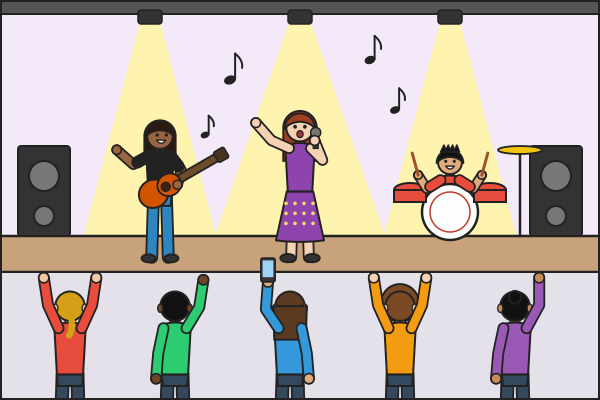
Your cousin plays in a band. You send this picture of the band's concert to your German friend in Hamburg.
What is in this photo? Write five sentences in German.
Model answer
Rechts sitzt mein Cousin und spielt ein Instrument. Die Sängerin mit den roten Haaren hat einen Arm oben. Oben gibt es drei helle Lichter. Fünf Fans stehen unten und hören die Musik. Ich finde die Band toll, weil mein Cousin gut spielt.
Explanation
Say who is on the stage and what they are doing (singen, spielen, tanzen), then add the fans or an opinion with weil. Useful words are das Konzert, die Band, der Sänger or die Sängerin, das Lied, das Instrument and der Fan. Spielen is used for music too (Sie spielt ein Instrument; Die Band spielt Musik). Keep the verb second after Rechts, Oben or In der Mitte (Rechts sitzt mein Cousin), and remember that weil sends the verb to the end (weil mein Cousin gut spielt).
Mark scheme
2 marks
Levels of response: sentence 1 (AO2, 2 marks). Level 2 (2 marks): the relevant message is clearly communicated. Level 1 (1 mark): the message is relevant but has some ambiguity and causes a delay in communication. 0 marks: the message is irrelevant or cannot be understood.
Each of the five sentences is marked separately, as a whole, and must be about the picture. 2 marks: a sentence with an appropriate conjugated verb. - The same structure may be repeated with different nouns (Es gibt ...; Ich sehe ...). - Any person of the verb (ich, wir, du, sie) and any tense are accepted. - There may be errors, as long as the message is unambiguous. - A figure may be written for a number. - Anything that could possibly be true of the picture is accepted. 1 mark: - an infinitive in an otherwise appropriate sentence (Die Frau Kaffee trinken); - a noun phrase with no verb (vier Personen; ein Tisch); - an error that causes ambiguity or delay (Sie essen Kaffee); - a long sentence where one part communicates and another does not. 0 marks: - a single word; - an inappropriate verb (Ich möchte einen Tisch); - something clearly false about the picture; - an opinion about the photo that says nothing about what is in it (Ich mag das Foto = 0; Ich mag das Foto, weil es sonnig ist = 2). Spelling: - Umlauts, ß/ss and noun capitals do not matter unless the message becomes ambiguous. AQA: 'There may be linguistic errors, but the message must be communicated without ambiguity.' - ae/oe/ue for ä/ö/ü are the right letter (site rule, not AQA's). Gender identity (specification 4.7): 'Students should not be disadvantaged on the basis of their gender identity and/or how they refer to the gender identity of others in their exam responses. Students' preferred ways of referring to themselves and others through the use of pronouns, gendered language and grammatical agreements will be credited by examiners, regardless of whether such usage has been adopted by official language bodies in the target language-speaking countries.' Accept forms such as Schüler*innen, Lehrer:innen and LehrerInnen and neopronouns, and never count them as errors. Examples for this picture: 2 marks - Mein Cousin spielt in dieser Band. / Heute spielt die Band ein Konzert. / Die Band ist sehr gut. 1 mark - die Band von meinem Cousin. / ein Konzert am Abend. 0 marks - Band. / Die Band spielt im Park (clearly false: it is on a stage with lights from the ceiling).
2 marks
Levels of response: sentence 2 (AO2, 2 marks). Level 2 (2 marks): the relevant message is clearly communicated. Level 1 (1 mark): the message is relevant but has some ambiguity and causes a delay in communication. 0 marks: the message is irrelevant or cannot be understood.
As sentence 1 (any sentence may describe any part of the picture). Examples: 2 marks - Die Sängerin hat einen Arm oben. / Ihr Mund ist offen. / Sie hat rote Haare. 1 mark - eine Sängerin mit roten Haaren. 0 marks - Sängerin. / Die Sängerin sitzt (clearly false: she is standing).
2 marks
Levels of response: sentence 3 (AO2, 2 marks). Level 2 (2 marks): the relevant message is clearly communicated. Level 1 (1 mark): the message is relevant but has some ambiguity and causes a delay in communication. 0 marks: the message is irrelevant or cannot be understood.
As sentence 1 (any sentence may describe any part of the picture). Examples: 2 marks - Links steht eine Person mit langen braunen Haaren. / Sie hat viel Spaß. / Mein Cousin rechts hat schwarze Haare. 1 mark - mein Cousin rechts mit einem Instrument. 0 marks - Cousin. / Mein Cousin rechts hat lange helle Haare (clearly false: his hair is short, spiky and black).
2 marks
Levels of response: sentence 4 (AO2, 2 marks). Level 2 (2 marks): the relevant message is clearly communicated. Level 1 (1 mark): the message is relevant but has some ambiguity and causes a delay in communication. 0 marks: the message is irrelevant or cannot be understood.
As sentence 1 (any sentence may describe any part of the picture). Examples: 2 marks - Ein Fan in Blau hat lange braune Haare. / Die Fans stehen alle. / Die Fans sind sehr laut. 1 mark - fünf Fans unten. 0 marks - Fans. / Die Fans sitzen auf Stühlen (clearly false: they are standing).
2 marks
Levels of response: sentence 5 (AO2, 2 marks). Level 2 (2 marks): the relevant message is clearly communicated. Level 1 (1 mark): the message is relevant but has some ambiguity and causes a delay in communication. 0 marks: the message is irrelevant or cannot be understood.
As sentence 1 (any sentence may describe any part of the picture). Examples: 2 marks - Die Musik ist sehr laut. / Das Konzert macht viel Spaß. / Ich mag die Band, weil die Sängerin so gut singt. 1 mark - Ich mag die Band, weil laut. 0 marks - laut. / Ich mag Musik (an opinion that says nothing about what is in the picture).
Question 3
10 marks
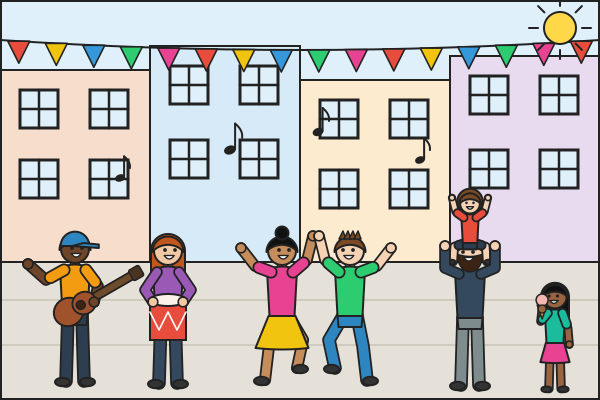
Your exchange partner in Bremen has sent you this picture of a street festival in her part of town.
What is in this photo? Write five sentences in German.
Model answer
Heute feiern die Leute auf der Straße. Links steht eine Frau mit langen roten Haaren. Eine Frau in einem gelben Rock und ein junger Mann haben viel Spaß. Das Kind in Rot hat die Arme oben und lacht. Ganz rechts steht ein kleines Mädchen mit dunklen Haaren.
Explanation
There is a lot to describe, so pick five things and give each its own sentence with a verb: feiern, spielen, tanzen and lachen fit this picture. A plural subject needs a plural verb (die Leute feiern; viele Leute lachen). Words for places in the picture (links, rechts, in der Mitte, ganz rechts) make the sentence clear, and the verb comes straight after them (Ganz rechts steht ein Mädchen). In and auf take the dative here (in einem gelben Rock; auf der Straße).
Mark scheme
2 marks
Levels of response: sentence 1 (AO2, 2 marks). Level 2 (2 marks): the relevant message is clearly communicated. Level 1 (1 mark): the message is relevant but has some ambiguity and causes a delay in communication. 0 marks: the message is irrelevant or cannot be understood.
Each of the five sentences is marked separately, as a whole, and must be about the picture. 2 marks: a sentence with an appropriate conjugated verb. - The same structure may be repeated with different nouns (Es gibt ...; Ich sehe ...). - Any person of the verb (ich, wir, du, sie) and any tense are accepted. - There may be errors, as long as the message is unambiguous. - A figure may be written for a number. - Anything that could possibly be true of the picture is accepted. 1 mark: - an infinitive in an otherwise appropriate sentence (Die Frau Kaffee trinken); - a noun phrase with no verb (vier Personen; ein Tisch); - an error that causes ambiguity or delay (Sie essen Kaffee); - a long sentence where one part communicates and another does not. 0 marks: - a single word; - an inappropriate verb (Ich möchte einen Tisch); - something clearly false about the picture; - an opinion about the photo that says nothing about what is in it (Ich mag das Foto = 0; Ich mag das Foto, weil es sonnig ist = 2). Spelling: - Umlauts, ß/ss and noun capitals do not matter unless the message becomes ambiguous. AQA: 'There may be linguistic errors, but the message must be communicated without ambiguity.' - ae/oe/ue for ä/ö/ü are the right letter (site rule, not AQA's). Gender identity (specification 4.7): 'Students should not be disadvantaged on the basis of their gender identity and/or how they refer to the gender identity of others in their exam responses. Students' preferred ways of referring to themselves and others through the use of pronouns, gendered language and grammatical agreements will be credited by examiners, regardless of whether such usage has been adopted by official language bodies in the target language-speaking countries.' Accept forms such as Schüler*innen, Lehrer:innen and LehrerInnen and neopronouns, and never count them as errors. Examples for this picture: 2 marks - In Bremen gibt es heute ein Fest. / Die Straße ist voll. / Hier ist es sehr lustig. 1 mark - ein Fest in Bremen. 0 marks - Bremen. / Die Straße ist leer (clearly false: it is full of people).
2 marks
Levels of response: sentence 2 (AO2, 2 marks). Level 2 (2 marks): the relevant message is clearly communicated. Level 1 (1 mark): the message is relevant but has some ambiguity and causes a delay in communication. 0 marks: the message is irrelevant or cannot be understood.
As sentence 1 (any sentence may describe any part of the picture). Examples: 2 marks - Der Mann mit der Gitarre lacht (Gitarre is beyond the Foundation list and is credited equally). / Die zwei Leute links sind froh. / Man hört überall Musik. 1 mark - Mann und Frau Musik machen. 0 marks - laut. / Niemand macht Musik (clearly false: two people are playing).
2 marks
Levels of response: sentence 3 (AO2, 2 marks). Level 2 (2 marks): the relevant message is clearly communicated. Level 1 (1 mark): the message is relevant but has some ambiguity and causes a delay in communication. 0 marks: the message is irrelevant or cannot be understood.
As sentence 1 (any sentence may describe any part of the picture). Examples: 2 marks - Die Frau in der Mitte hat schwarze Haare. / Die Frau trägt einen gelben Rock. / Der junge Mann hat die Arme oben. 1 mark - die Frau mit einem gelben Rock. 0 marks - Rock. / Die zwei Leute in der Mitte sitzen (clearly false: they are dancing).
2 marks
Levels of response: sentence 4 (AO2, 2 marks). Level 2 (2 marks): the relevant message is clearly communicated. Level 1 (1 mark): the message is relevant but has some ambiguity and causes a delay in communication. 0 marks: the message is irrelevant or cannot be understood.
As sentence 1 (any sentence may describe any part of the picture). Examples: 2 marks - Der Mann mit dem Kind hat schwarze Haare. / Das Kind ist klein. / Seine Hose ist grau. 1 mark - ein Kind in Rot. 0 marks - Kind. / Das Kind weint (clearly false: it is smiling with its arms up).
2 marks
Levels of response: sentence 5 (AO2, 2 marks). Level 2 (2 marks): the relevant message is clearly communicated. Level 1 (1 mark): the message is relevant but has some ambiguity and causes a delay in communication. 0 marks: the message is irrelevant or cannot be understood.
As sentence 1 (any sentence may describe any part of the picture). Examples: 2 marks - Das Mädchen rechts hat lange schwarze Haare. / Sie ist sehr froh. / Ich mag das Fest, weil es so bunt ist. 1 mark - ein kleines Mädchen rechts. 0 marks - klein. / Ich möchte auch ein Eis (inappropriate verb: it says nothing about the picture).
Question 4
10 marks
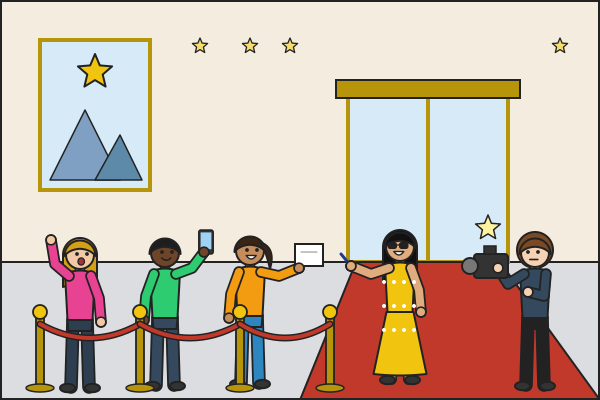
Your German class is writing a blog about celebrities. You add this picture to the blog.
What is in this photo? Write five sentences in German.
Model answer
Heute ist ein Star in der Stadt. Der Star hat lange schwarze Haare und trägt Gelb. Ein Fan mit braunen Haaren hat eine weiße Karte in der Hand. Das Mädchen links findet den Star toll. Die Türen hinten sind aus Glas.
Explanation
Describe the star, what she is wearing and what the other people are doing: tragen, haben, schreiben and finden are all you need. In der Hand (in the hand) uses the dative, because in says where something is (Ein Fan hat eine Karte in der Hand). Adjectives before a noun take an ending (ein langes gelbes Kleid; eine berühmte Schauspielerin), but a wrong ending does not stop the message, so it does not cost the mark. For to sign an autograph, a simple Foundation sentence such as Sie schreibt etwas auf die Karte gets the message across.
Mark scheme
2 marks
Levels of response: sentence 1 (AO2, 2 marks). Level 2 (2 marks): the relevant message is clearly communicated. Level 1 (1 mark): the message is relevant but has some ambiguity and causes a delay in communication. 0 marks: the message is irrelevant or cannot be understood.
Each of the five sentences is marked separately, as a whole, and must be about the picture. 2 marks: a sentence with an appropriate conjugated verb. - The same structure may be repeated with different nouns (Es gibt ...; Ich sehe ...). - Any person of the verb (ich, wir, du, sie) and any tense are accepted. - There may be errors, as long as the message is unambiguous. - A figure may be written for a number. - Anything that could possibly be true of the picture is accepted. 1 mark: - an infinitive in an otherwise appropriate sentence (Die Frau Kaffee trinken); - a noun phrase with no verb (vier Personen; ein Tisch); - an error that causes ambiguity or delay (Sie essen Kaffee); - a long sentence where one part communicates and another does not. 0 marks: - a single word; - an inappropriate verb (Ich möchte einen Tisch); - something clearly false about the picture; - an opinion about the photo that says nothing about what is in it (Ich mag das Foto = 0; Ich mag das Foto, weil es sonnig ist = 2). Spelling: - Umlauts, ß/ss and noun capitals do not matter unless the message becomes ambiguous. AQA: 'There may be linguistic errors, but the message must be communicated without ambiguity.' - ae/oe/ue for ä/ö/ü are the right letter (site rule, not AQA's). Gender identity (specification 4.7): 'Students should not be disadvantaged on the basis of their gender identity and/or how they refer to the gender identity of others in their exam responses. Students' preferred ways of referring to themselves and others through the use of pronouns, gendered language and grammatical agreements will be credited by examiners, regardless of whether such usage has been adopted by official language bodies in the target language-speaking countries.' Accept forms such as Schüler*innen, Lehrer:innen and LehrerInnen and neopronouns, and never count them as errors. Examples for this picture: 2 marks - Der Star ist vielleicht eine Sängerin. / Die Frau in Gelb lacht. / Die Fans lieben den Star. 1 mark - eine Frau in einem langen Kleid. 0 marks - Kleid. / Der Star ist allein (clearly false: there are fans and a photographer).
2 marks
Levels of response: sentence 2 (AO2, 2 marks). Level 2 (2 marks): the relevant message is clearly communicated. Level 1 (1 mark): the message is relevant but has some ambiguity and causes a delay in communication. 0 marks: the message is irrelevant or cannot be understood.
As sentence 1 (any sentence may describe any part of the picture). Examples: 2 marks - Ihr Kleid ist sehr lang. / Auf dem Kleid sind weiße Punkte. / Ihre Sonnenbrille ist schwarz (Sonnenbrille is beyond the Foundation list and is credited equally). 1 mark - ein Kleid mit weißen Punkten. 0 marks - lang. / Die Frau trägt eine Hose (clearly false: she is wearing a long dress).
2 marks
Levels of response: sentence 3 (AO2, 2 marks). Level 2 (2 marks): the relevant message is clearly communicated. Level 1 (1 mark): the message is relevant but has some ambiguity and causes a delay in communication. 0 marks: the message is irrelevant or cannot be understood.
As sentence 1 (any sentence may describe any part of the picture). Examples: 2 marks - Der Star ist sehr nett zu den Fans. / Sie möchte etwas schreiben. / Der Fan mit der Karte lacht. 1 mark - die Frau und ein Fan. 0 marks - Name. / Der Star schläft (clearly false: she is smiling at a fan).
2 marks
Levels of response: sentence 4 (AO2, 2 marks). Level 2 (2 marks): the relevant message is clearly communicated. Level 1 (1 mark): the message is relevant but has some ambiguity and causes a delay in communication. 0 marks: the message is irrelevant or cannot be understood.
As sentence 1 (any sentence may describe any part of the picture). Examples: 2 marks - Ein Mädchen links hat einen Arm oben. / Der Junge in Grün macht vielleicht ein Video. / Die Fans möchten den Star sehen. 1 mark - ein Mädchen mit hellen Haaren. 0 marks - Fans. / Die Fans sitzen (clearly false: they are standing).
2 marks
Levels of response: sentence 5 (AO2, 2 marks). Level 2 (2 marks): the relevant message is clearly communicated. Level 1 (1 mark): the message is relevant but has some ambiguity and causes a delay in communication. 0 marks: the message is irrelevant or cannot be understood.
As sentence 1 (any sentence may describe any part of the picture). Examples: 2 marks - Der Mann rechts trägt eine dunkle Jacke. / Seine Kamera ist schwarz. / Er arbeitet vielleicht für eine Zeitung. 1 mark - ein Mann in einer dunklen Jacke. 0 marks - Kamera. / Ich habe eine Kamera (inappropriate: it says nothing about the picture).
Ready to try the rest? Every answer you write is marked against the mark scheme, so you can see exactly where the marks are.
Ctrl + Enter to check
Study HelperHints first, answers after you try
Stuck on this one? Ask for a hint and I’ll point you in the right direction, without giving the answer away. Once you’ve checked your answer, I’ll show you how the marks are awarded.