Photo description: communication and the world around us
Practise 12 exam-style questions on Photo description: communication and the world around us for AQA GCSE German (Foundation Writing). Write your answer as you would in the exam and get it marked in seconds against the mark scheme, point by point, with the Study Helper on hand if you get stuck.
12 questions
10 marks each
Instant marking
No sign-up needed
12 questions, marked as you go
Sample questions with model answers
Here are 4 of the questions in this topic, each with a model answer, an explanation of why it earns the marks and the mark scheme an examiner would use.
Question 1
10 marks
Your German exchange partner in Düsseldorf posts this picture on her blog.
What is in this photo? Write five sentences in German.
Model answer
Die Oma links hat graue Haare und eine braune Tasche. Links von ihr liegt noch eine rote Tasche. Der kleine Junge hat schwarze Haare und den Mund offen. Die junge Frau rechts hat eine Tasche auf dem Rücken. Das Flugzeug hat viele kleine Fenster.
Explanation
Any sentence with a conjugated verb that is true or possible earns 2 marks, for example Die Oma links hat graue Haare. Haben is useful for describing people and what they have (Die junge Frau hat eine Tasche auf dem Rücken), and von takes the dative (links von ihr). Adjective endings follow the article: der kleine Junge, die junge Frau, eine braune Tasche, viele kleine Fenster. A phrase with no verb (drei blaue Stühle) earns only 1 mark.
Mark scheme
2 marks
Levels of response: sentence 1 (AO2, 2 marks). Level 2 (2 marks): the relevant message is clearly communicated. Level 1 (1 mark): the message is relevant but has some ambiguity and causes a delay in communication. 0 marks: the message is irrelevant or cannot be understood.
Each of the five sentences is marked separately, as a whole, and must be about the picture. 2 marks: a sentence with an appropriate conjugated verb. - The same structure may be repeated with different nouns (Es gibt ...; Ich sehe ...). - Any person of the verb (ich, wir, du, sie) and any tense are accepted. - There may be errors, as long as the message is unambiguous. - A figure may be written for a number. - Anything that could possibly be true of the picture is accepted. 1 mark: - an infinitive in an otherwise appropriate sentence (Die Frau Kaffee trinken); - a noun phrase with no verb (vier Personen; ein Tisch); - an error that causes ambiguity or delay (Sie essen Kaffee); - a long sentence where one part communicates and another does not. 0 marks: - a single word; - an inappropriate verb (Ich möchte einen Tisch); - something clearly false about the picture; - an opinion about the photo that says nothing about what is in it (Ich mag das Foto = 0; Ich mag das Foto, weil es sonnig ist = 2). Spelling: - Umlauts, ß/ss and noun capitals do not matter unless the message becomes ambiguous. AQA: 'There may be linguistic errors, but the message must be communicated without ambiguity.' - ae/oe/ue for ä/ö/ü are the right letter (site rule, not AQA's). Gender identity (specification 4.7): 'Students should not be disadvantaged on the basis of their gender identity and/or how they refer to the gender identity of others in their exam responses. Students' preferred ways of referring to themselves and others through the use of pronouns, gendered language and grammatical agreements will be credited by examiners, regardless of whether such usage has been adopted by official language bodies in the target language-speaking countries.' Accept forms such as Schüler*innen, Lehrer:innen and LehrerInnen and neopronouns, and never count them as errors. Examples for this picture: 2 marks - Die Leute fliegen vielleicht nach Spanien. / Es gibt drei blaue Stühle. / Das Flugzeug hat viele kleine Fenster. 1 mark - drei blaue Stühle. 0 marks - Stuhl. / Es ist Nacht (clearly false: it is daytime).
2 marks
Levels of response: sentence 2 (AO2, 2 marks). Level 2 (2 marks): the relevant message is clearly communicated. Level 1 (1 mark): the message is relevant but has some ambiguity and causes a delay in communication. 0 marks: the message is irrelevant or cannot be understood.
As sentence 1 (any sentence may describe any part of the picture). Examples: 2 marks - Die Oma links hat graue Haare. / Sie hat eine braune Tasche. / Links von ihr liegt noch eine rote Tasche. 1 mark - eine Oma mit zwei Taschen. 0 marks - Tasche. / Ich möchte eine Tasche (inappropriate verb).
2 marks
Levels of response: sentence 3 (AO2, 2 marks). Level 2 (2 marks): the relevant message is clearly communicated. Level 1 (1 mark): the message is relevant but has some ambiguity and causes a delay in communication. 0 marks: the message is irrelevant or cannot be understood.
As sentence 1 (any sentence may describe any part of the picture). Examples: 2 marks - Der kleine Junge hat schwarze Haare. / Er hat den Mund offen. / Der Junge ist vielleicht sechs Jahre alt. 1 mark - ein kleiner Junge mit schwarzen Haaren. 0 marks - klein. / Der Junge sitzt auf einem Stuhl (clearly false: he is standing).
2 marks
Levels of response: sentence 4 (AO2, 2 marks). Level 2 (2 marks): the relevant message is clearly communicated. Level 1 (1 mark): the message is relevant but has some ambiguity and causes a delay in communication. 0 marks: the message is irrelevant or cannot be understood.
As sentence 1 (any sentence may describe any part of the picture). Examples: 2 marks - Der Mann hat kurze schwarze Haare. / Er reist vielleicht allein. / Der Mann ist vielleicht der Vater. 1 mark - Der Mann allein reisen. 0 marks - Mann. / Der Mann trägt eine Jacke (clearly false: he wears a shirt).
2 marks
Levels of response: sentence 5 (AO2, 2 marks). Level 2 (2 marks): the relevant message is clearly communicated. Level 1 (1 mark): the message is relevant but has some ambiguity and causes a delay in communication. 0 marks: the message is irrelevant or cannot be understood.
As sentence 1 (any sentence may describe any part of the picture). Examples: 2 marks - Die junge Frau rechts hat eine Tasche auf dem Rücken. / Sie trägt ein Kopftuch. / Sie lächelt. 1 mark - eine junge Frau mit einer Tasche. 0 marks - Ich mag das Foto (nothing about what is in it). / Die Frau rechts schläft (clearly false).
Question 2
10 marks
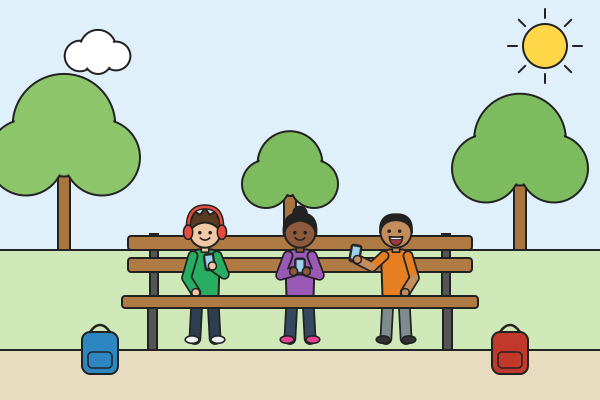
A school in Göttingen has this picture on its website, on a page about mobile phones.
What is in this photo? Write five sentences in German.
Model answer
Der Junge links hat braune Haare und weiße Schuhe. Das Mädchen in der Mitte hat ein blaues Handy. Sie trägt eine dunkle Hose. Der Junge rechts hat den Mund offen und trägt eine graue Hose. Die Bank im Park ist lang und braun.
Explanation
Each of the five sentences earns 2 marks if it uses a conjugated verb and says something true or possible about the photo, for example Das Mädchen in der Mitte hat ein blaues Handy. Use links, rechts and in der Mitte to say which person you mean, and vary the verbs (hat, trägt, ist). Watch the adjective endings after ein and eine (ein blaues Handy, eine graue Hose) and in the plural with no article (weiße Schuhe). A phrase such as eine lange Bank, with no verb, earns only 1 mark.
Mark scheme
2 marks
Levels of response: sentence 1 (AO2, 2 marks). Level 2 (2 marks): the relevant message is clearly communicated. Level 1 (1 mark): the message is relevant but has some ambiguity and causes a delay in communication. 0 marks: the message is irrelevant or cannot be understood.
Each of the five sentences is marked separately, as a whole, and must be about the picture. 2 marks: a sentence with an appropriate conjugated verb. - The same structure may be repeated with different nouns (Es gibt ...; Ich sehe ...). - Any person of the verb (ich, wir, du, sie) and any tense are accepted. - There may be errors, as long as the message is unambiguous. - A figure may be written for a number. - Anything that could possibly be true of the picture is accepted. 1 mark: - an infinitive in an otherwise appropriate sentence (Die Frau Kaffee trinken); - a noun phrase with no verb (vier Personen; ein Tisch); - an error that causes ambiguity or delay (Sie essen Kaffee); - a long sentence where one part communicates and another does not. 0 marks: - a single word; - an inappropriate verb (Ich möchte einen Tisch); - something clearly false about the picture; - an opinion about the photo that says nothing about what is in it (Ich mag das Foto = 0; Ich mag das Foto, weil es sonnig ist = 2). Spelling: - Umlauts, ß/ss and noun capitals do not matter unless the message becomes ambiguous. AQA: 'There may be linguistic errors, but the message must be communicated without ambiguity.' - ae/oe/ue for ä/ö/ü are the right letter (site rule, not AQA's). Gender identity (specification 4.7): 'Students should not be disadvantaged on the basis of their gender identity and/or how they refer to the gender identity of others in their exam responses. Students' preferred ways of referring to themselves and others through the use of pronouns, gendered language and grammatical agreements will be credited by examiners, regardless of whether such usage has been adopted by official language bodies in the target language-speaking countries.' Accept forms such as Schüler*innen, Lehrer:innen and LehrerInnen and neopronouns, and never count them as errors. Examples for this picture: 2 marks - Die Bank im Park ist lang und braun. / Der Himmel ist blau. / Rechts oben scheint die Sonne. 1 mark - eine lange Bank. 0 marks - Bank. / Die Bank ist leer (clearly false: three people are sitting on it).
2 marks
Levels of response: sentence 2 (AO2, 2 marks). Level 2 (2 marks): the relevant message is clearly communicated. Level 1 (1 mark): the message is relevant but has some ambiguity and causes a delay in communication. 0 marks: the message is irrelevant or cannot be understood.
As sentence 1 (any sentence may describe any part of the picture). Examples: 2 marks - Der Junge links hat braune Haare. / Er hat rote Kopfhörer. / Seine Schuhe sind weiß. 1 mark - ein Junge mit roten Kopfhörern. 0 marks - Kopfhörer. / Ich möchte Kopfhörer (inappropriate verb).
2 marks
Levels of response: sentence 3 (AO2, 2 marks). Level 2 (2 marks): the relevant message is clearly communicated. Level 1 (1 mark): the message is relevant but has some ambiguity and causes a delay in communication. 0 marks: the message is irrelevant or cannot be understood.
As sentence 1 (any sentence may describe any part of the picture). Examples: 2 marks - Das Mädchen in der Mitte hat ein blaues Handy. / Sie trägt eine dunkle Hose. / Sie lächelt. 1 mark - Das Mädchen lächeln. 0 marks - Mädchen. / Das Mädchen steht (clearly false: she is sitting).
2 marks
Levels of response: sentence 4 (AO2, 2 marks). Level 2 (2 marks): the relevant message is clearly communicated. Level 1 (1 mark): the message is relevant but has some ambiguity and causes a delay in communication. 0 marks: the message is irrelevant or cannot be understood.
As sentence 1 (any sentence may describe any part of the picture). Examples: 2 marks - Der Junge rechts hat den Mund offen. / Er trägt eine graue Hose. / Er ist vielleicht der Bruder von dem Mädchen. 1 mark - ein Junge mit einer grauen Hose. 0 marks - grau. / Der Junge rechts schläft (clearly false).
2 marks
Levels of response: sentence 5 (AO2, 2 marks). Level 2 (2 marks): the relevant message is clearly communicated. Level 1 (1 mark): the message is relevant but has some ambiguity and causes a delay in communication. 0 marks: the message is irrelevant or cannot be understood.
As sentence 1 (any sentence may describe any part of the picture). Examples: 2 marks - Die Jugendlichen sind vielleicht in der Mittagspause. / Es ist vielleicht Sommer. / Ich finde das Foto gut, weil die Bäume so grün sind. 1 mark - Sommer im Park. 0 marks - Ich mag das Foto (nothing about what is in it). / Die Bäume sind rot (clearly false: they are green).
Question 3
10 marks
Your German penfriend in Ulm sends you this picture.
What is in this photo? Write five sentences in German.
Model answer
Das Mädchen wohnt in Ulm, aber die Großeltern wohnen vielleicht in England. Das Mädchen trägt weiße Schuhe. Die Oma trägt ein rotes T-Shirt und lächelt. Der Opa hat nicht viele Haare. An der Wand ist ein Bild mit Bergen.
Explanation
Two marks are earned by any sentence with a conjugated verb that describes the photo, for example Der Opa hat nicht viele Haare. A sentence that could be true is accepted, such as Die Großeltern wohnen vielleicht in England, where the verb agrees with the plural subject (die Großeltern wohnen). Use an der Wand for things on the wall, and mit + dative plural for what a picture shows (ein Bild mit Bergen). A noun phrase such as ein Bild mit Bergen has no verb and scores 1 mark.
Mark scheme
2 marks
Levels of response: sentence 1 (AO2, 2 marks). Level 2 (2 marks): the relevant message is clearly communicated. Level 1 (1 mark): the message is relevant but has some ambiguity and causes a delay in communication. 0 marks: the message is irrelevant or cannot be understood.
Each of the five sentences is marked separately, as a whole, and must be about the picture. 2 marks: a sentence with an appropriate conjugated verb. - The same structure may be repeated with different nouns (Es gibt ...; Ich sehe ...). - Any person of the verb (ich, wir, du, sie) and any tense are accepted. - There may be errors, as long as the message is unambiguous. - A figure may be written for a number. - Anything that could possibly be true of the picture is accepted. 1 mark: - an infinitive in an otherwise appropriate sentence (Die Frau Kaffee trinken); - a noun phrase with no verb (vier Personen; ein Tisch); - an error that causes ambiguity or delay (Sie essen Kaffee); - a long sentence where one part communicates and another does not. 0 marks: - a single word; - an inappropriate verb (Ich möchte einen Tisch); - something clearly false about the picture; - an opinion about the photo that says nothing about what is in it (Ich mag das Foto = 0; Ich mag das Foto, weil es sonnig ist = 2). Spelling: - Umlauts, ß/ss and noun capitals do not matter unless the message becomes ambiguous. AQA: 'There may be linguistic errors, but the message must be communicated without ambiguity.' - ae/oe/ue for ä/ö/ü are the right letter (site rule, not AQA's). Gender identity (specification 4.7): 'Students should not be disadvantaged on the basis of their gender identity and/or how they refer to the gender identity of others in their exam responses. Students' preferred ways of referring to themselves and others through the use of pronouns, gendered language and grammatical agreements will be credited by examiners, regardless of whether such usage has been adopted by official language bodies in the target language-speaking countries.' Accept forms such as Schüler*innen, Lehrer:innen and LehrerInnen and neopronouns, and never count them as errors. Examples for this picture: 2 marks - Das Mädchen wohnt vielleicht in Ulm. / Die Großeltern wohnen vielleicht in England. / Das Mädchen hat einen großen Schreibtisch. 1 mark - ein großer Schreibtisch. 0 marks - Ulm. / Das Mädchen sitzt auf dem Boden (clearly false: she is on a chair).
2 marks
Levels of response: sentence 2 (AO2, 2 marks). Level 2 (2 marks): the relevant message is clearly communicated. Level 1 (1 mark): the message is relevant but has some ambiguity and causes a delay in communication. 0 marks: the message is irrelevant or cannot be understood.
As sentence 1 (any sentence may describe any part of the picture). Examples: 2 marks - Das Mädchen trägt weiße Schuhe. / Sie hat Kopfhörer. / Ihre Hose ist dunkel. 1 mark - ein Mädchen mit Kopfhörern. 0 marks - Schuhe. / Ich möchte einen Schreibtisch (inappropriate verb).
2 marks
Levels of response: sentence 3 (AO2, 2 marks). Level 2 (2 marks): the relevant message is clearly communicated. Level 1 (1 mark): the message is relevant but has some ambiguity and causes a delay in communication. 0 marks: the message is irrelevant or cannot be understood.
As sentence 1 (any sentence may describe any part of the picture). Examples: 2 marks - Die Oma trägt ein rotes T-Shirt. / Sie lächelt. / Der Opa hat den Mund offen. 1 mark - Oma mit einem roten T-Shirt. 0 marks - Oma. / Die Großeltern schlafen (clearly false).
2 marks
Levels of response: sentence 4 (AO2, 2 marks). Level 2 (2 marks): the relevant message is clearly communicated. Level 1 (1 mark): the message is relevant but has some ambiguity and causes a delay in communication. 0 marks: the message is irrelevant or cannot be understood.
As sentence 1 (any sentence may describe any part of the picture). Examples: 2 marks - Der Opa hat nicht viele Haare. / Sein Hemd ist blau. / Der Opa ist vielleicht siebzig Jahre alt. 1 mark - ein Opa mit einem blauen Hemd. 0 marks - alt. / Der Opa hat lange Haare (clearly false: he is nearly bald).
2 marks
Levels of response: sentence 5 (AO2, 2 marks). Level 2 (2 marks): the relevant message is clearly communicated. Level 1 (1 mark): the message is relevant but has some ambiguity and causes a delay in communication. 0 marks: the message is irrelevant or cannot be understood.
As sentence 1 (any sentence may describe any part of the picture). Examples: 2 marks - An der Wand ist ein Bild mit Bergen. / Auf dem Tisch steht eine Tasse. / Die Tasse ist orange. 1 mark - ein Bild mit Bergen. 0 marks - Ich mag das Foto (nothing about what is in it). / Auf dem Bild gibt es das Meer (clearly false: it shows mountains).
Question 4
10 marks
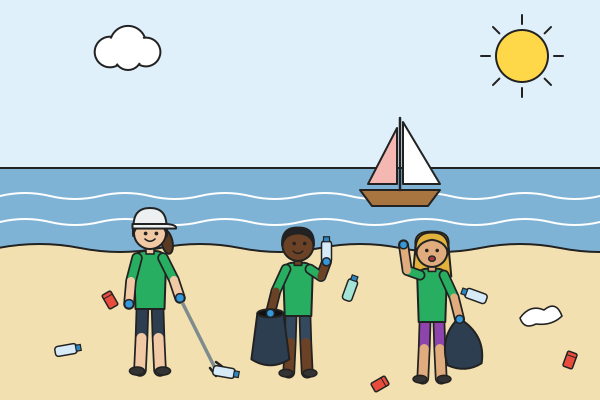
A school in Kiel, on the Baltic coast of Germany, posts this picture on its blog after a beach clean-up.
What is in this photo? Write five sentences in German.
Model answer
Das Mädchen links hat braune Haare. Alle tragen grüne T-Shirts. Der Junge in der Mitte lächelt. Das Mädchen rechts trägt eine kurze Hose. Das kleine Schiff auf dem Meer ist braun.
Explanation
Any sentence that has a conjugated verb and fits the photo scores 2 marks, for example Alle tragen grüne T-Shirts. With a plural subject the verb ends in -en (alle tragen), and plural adjectives with no article end in -e (grüne T-Shirts). Auf dem Meer and am Strand use the dative for where something is. A single word such as Kiel scores 0, and a sentence that is clearly false (Das Meer ist rot) also scores 0.
Mark scheme
2 marks
Levels of response: sentence 1 (AO2, 2 marks). Level 2 (2 marks): the relevant message is clearly communicated. Level 1 (1 mark): the message is relevant but has some ambiguity and causes a delay in communication. 0 marks: the message is irrelevant or cannot be understood.
Each of the five sentences is marked separately, as a whole, and must be about the picture. 2 marks: a sentence with an appropriate conjugated verb. - The same structure may be repeated with different nouns (Es gibt ...; Ich sehe ...). - Any person of the verb (ich, wir, du, sie) and any tense are accepted. - There may be errors, as long as the message is unambiguous. - A figure may be written for a number. - Anything that could possibly be true of the picture is accepted. 1 mark: - an infinitive in an otherwise appropriate sentence (Die Frau Kaffee trinken); - a noun phrase with no verb (vier Personen; ein Tisch); - an error that causes ambiguity or delay (Sie essen Kaffee); - a long sentence where one part communicates and another does not. 0 marks: - a single word; - an inappropriate verb (Ich möchte einen Tisch); - something clearly false about the picture; - an opinion about the photo that says nothing about what is in it (Ich mag das Foto = 0; Ich mag das Foto, weil es sonnig ist = 2). Spelling: - Umlauts, ß/ss and noun capitals do not matter unless the message becomes ambiguous. AQA: 'There may be linguistic errors, but the message must be communicated without ambiguity.' - ae/oe/ue for ä/ö/ü are the right letter (site rule, not AQA's). Gender identity (specification 4.7): 'Students should not be disadvantaged on the basis of their gender identity and/or how they refer to the gender identity of others in their exam responses. Students' preferred ways of referring to themselves and others through the use of pronouns, gendered language and grammatical agreements will be credited by examiners, regardless of whether such usage has been adopted by official language bodies in the target language-speaking countries.' Accept forms such as Schüler*innen, Lehrer:innen and LehrerInnen and neopronouns, and never count them as errors. Examples for this picture: 2 marks - Die Schule ist in Kiel. / Alle tragen blaue Handschuhe. / Links oben ist eine Wolke. 1 mark - blaue Handschuhe. 0 marks - Kiel. / Niemand trägt Handschuhe (clearly false: all three wear blue gloves).
2 marks
Levels of response: sentence 2 (AO2, 2 marks). Level 2 (2 marks): the relevant message is clearly communicated. Level 1 (1 mark): the message is relevant but has some ambiguity and causes a delay in communication. 0 marks: the message is irrelevant or cannot be understood.
As sentence 1 (any sentence may describe any part of the picture). Examples: 2 marks - Das Mädchen links hat braune Haare. / Sie trägt eine weiße Mütze. / Sie lächelt. 1 mark - ein Mädchen mit einer weißen Mütze. 0 marks - Mütze. / Das Mädchen links schläft (clearly false).
2 marks
Levels of response: sentence 3 (AO2, 2 marks). Level 2 (2 marks): the relevant message is clearly communicated. Level 1 (1 mark): the message is relevant but has some ambiguity and causes a delay in communication. 0 marks: the message is irrelevant or cannot be understood.
As sentence 1 (any sentence may describe any part of the picture). Examples: 2 marks - Der Junge in der Mitte lächelt. / Er hat kurze schwarze Haare. / Er trägt eine dunkle kurze Hose. 1 mark - ein Junge mit kurzen Haaren. 0 marks - Junge. / Ich möchte einen Strand (inappropriate verb).
2 marks
Levels of response: sentence 4 (AO2, 2 marks). Level 2 (2 marks): the relevant message is clearly communicated. Level 1 (1 mark): the message is relevant but has some ambiguity and causes a delay in communication. 0 marks: the message is irrelevant or cannot be understood.
As sentence 1 (any sentence may describe any part of the picture). Examples: 2 marks - Das Mädchen rechts trägt eine kurze Hose. / Sie hat lange Haare. / Sie hat den Mund offen. 1 mark - das Mädchen mit langen Haaren. 0 marks - Hose. / Das Mädchen rechts sitzt (clearly false: she is standing).
2 marks
Levels of response: sentence 5 (AO2, 2 marks). Level 2 (2 marks): the relevant message is clearly communicated. Level 1 (1 mark): the message is relevant but has some ambiguity and causes a delay in communication. 0 marks: the message is irrelevant or cannot be understood.
As sentence 1 (any sentence may describe any part of the picture). Examples: 2 marks - Das kleine Schiff auf dem Meer ist braun. / Am Strand gibt es drei rote Dosen. / Ich finde das Foto toll, weil die Schüler helfen. 1 mark - drei rote Dosen. 0 marks - Ich mag das Foto (nothing about what is in it). / Das Meer ist rot (clearly false: it is blue).
Ready to try the rest? Every answer you write is marked against the mark scheme, so you can see exactly where the marks are.
Ctrl + Enter to check
Study HelperHints first, answers after you try
Stuck on this one? Ask for a hint and I’ll point you in the right direction, without giving the answer away. Once you’ve checked your answer, I’ll show you how the marks are awarded.