Practise 12 exam-style questions on Photo description: people and lifestyle for AQA GCSE German (Foundation Writing). Write your answer as you would in the exam and get it marked in seconds against the mark scheme, point by point, with the Study Helper on hand if you get stuck.
12 questions
10 marks each
Instant marking
No sign-up needed
12 questions, marked as you go
Sample questions with model answers
Here are 4 of the questions in this topic, each with a model answer, an explanation of why it earns the marks and the mark scheme an examiner would use.
Question 1
10 marks
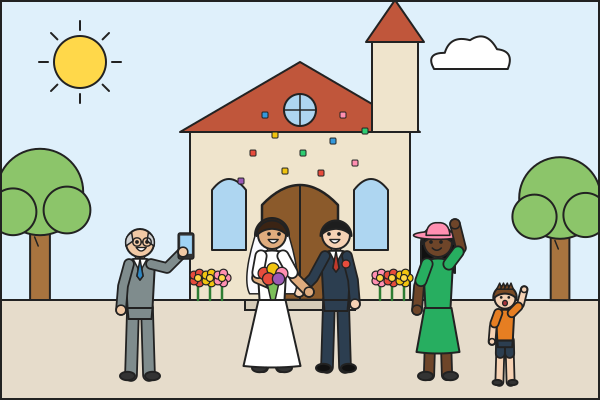
Your friend in Winterthur has posted this picture of her sister's wedding on social media.
What is in this photo? Write five sentences in German.
Model answer
Die Schwester von meiner Freundin heiratet heute. Ihr Mann trägt Blau. Ein kleiner Junge rechts lacht laut. Die Frau im grünen Kleid ist auch sehr froh. Ich finde die Kirche klein, aber schön.
Explanation
Each sentence earns 2 marks if it has a conjugated verb and is true or possible for the picture: Die Leute feiern, Der Mann links hat graue Haare, Die Kirche ist alt. Hochzeit (wedding), heiraten (to get married), Paar (couple) and Kleid (dress) are all on the Foundation list, and words beyond it such as Braut or Blumen are credited equally. After im (in dem) the adjective takes -en: im grünen Kleid. A noun phrase alone (eine grosse Tür) scores 1 mark, and a single word scores 0.
Mark scheme
2 marks
Levels of response: sentence 1 (AO2, 2 marks). Level 2 (2 marks): the relevant message is clearly communicated. Level 1 (1 mark): the message is relevant but has some ambiguity and causes a delay in communication. 0 marks: the message is irrelevant or cannot be understood.
Each of the five sentences is marked separately, as a whole, and must be about the picture. 2 marks: a sentence with an appropriate conjugated verb. - The same structure may be repeated with different nouns (Es gibt ...; Ich sehe ...). - Any person of the verb (ich, wir, du, sie) and any tense are accepted. - There may be errors, as long as the message is unambiguous. - A figure may be written for a number. - Anything that could possibly be true of the picture is accepted. 1 mark: - an infinitive in an otherwise appropriate sentence (Die Frau Kaffee trinken); - a noun phrase with no verb (vier Personen; ein Tisch); - an error that causes ambiguity or delay (Sie essen Kaffee); - a long sentence where one part communicates and another does not. 0 marks: - a single word; - an inappropriate verb (Ich möchte einen Tisch); - something clearly false about the picture; - an opinion about the photo that says nothing about what is in it (Ich mag das Foto = 0; Ich mag das Foto, weil es sonnig ist = 2). Spelling: - Umlauts, ß/ss and noun capitals do not matter unless the message becomes ambiguous. AQA: 'There may be linguistic errors, but the message must be communicated without ambiguity.' - ae/oe/ue for ä/ö/ü are the right letter (site rule, not AQA's). Gender identity (specification 4.7): 'Students should not be disadvantaged on the basis of their gender identity and/or how they refer to the gender identity of others in their exam responses. Students' preferred ways of referring to themselves and others through the use of pronouns, gendered language and grammatical agreements will be credited by examiners, regardless of whether such usage has been adopted by official language bodies in the target language-speaking countries.' Accept forms such as Schüler*innen, Lehrer:innen and LehrerInnen and neopronouns, and never count them as errors. Examples for this picture: 2 marks - Heute ist ein wichtiger Tag. / Die Schwester von meiner Freundin heiratet. / Die Leute feiern. 1 mark - eine Hochzeit mit Familie. / das Paar heiraten. 0 marks - Hochzeit. / Es regnet (clearly false: the sun is shining).
2 marks
Levels of response: sentence 2 (AO2, 2 marks). Level 2 (2 marks): the relevant message is clearly communicated. Level 1 (1 mark): the message is relevant but has some ambiguity and causes a delay in communication. 0 marks: the message is irrelevant or cannot be understood.
As sentence 1 (any sentence may describe any part of the picture). Examples: 2 marks - Die zwei in der Mitte sind jetzt Mann und Frau. / Die Braut hat braune Haare (Braut, Bräutigam, Blumen and Hut are beyond the Foundation list and are credited equally). / Das Kleid ist lang. 1 mark - ein langes Kleid. 0 marks - Kleid. / Ich möchte ein Kleid (inappropriate verb).
2 marks
Levels of response: sentence 3 (AO2, 2 marks). Level 2 (2 marks): the relevant message is clearly communicated. Level 1 (1 mark): the message is relevant but has some ambiguity and causes a delay in communication. 0 marks: the message is irrelevant or cannot be understood.
As sentence 1 (any sentence may describe any part of the picture). Examples: 2 marks - Der Mann links hat graue Haare. / Er ist alt und lacht. 1 mark - ein alter Mann mit grauen Haaren. 0 marks - alt. / Der Mann links spielt Gitarre (clearly false).
2 marks
Levels of response: sentence 4 (AO2, 2 marks). Level 2 (2 marks): the relevant message is clearly communicated. Level 1 (1 mark): the message is relevant but has some ambiguity and causes a delay in communication. 0 marks: the message is irrelevant or cannot be understood.
As sentence 1 (any sentence may describe any part of the picture). Examples: 2 marks - Die Kirche hat eine grosse Tür. / Die Sonne ist links oben. / Die Kirche ist alt. 1 mark - eine grosse Tür. 0 marks - Tür. / Die Kirche ist schwarz (clearly false: it is cream and red).
2 marks
Levels of response: sentence 5 (AO2, 2 marks). Level 2 (2 marks): the relevant message is clearly communicated. Level 1 (1 mark): the message is relevant but has some ambiguity and causes a delay in communication. 0 marks: the message is irrelevant or cannot be understood.
As sentence 1 (any sentence may describe any part of the picture). Examples: 2 marks - Die Frau rechts trägt ein grünes Kleid. / Der Junge rechts ist klein und laut. / Ich mag das Foto, weil die Kirche schön ist. 1 mark - Ich mag das Foto, weil die Kirche. 0 marks - Ich mag das Foto (nothing about what is in it). / froh.
Question 2
10 marks
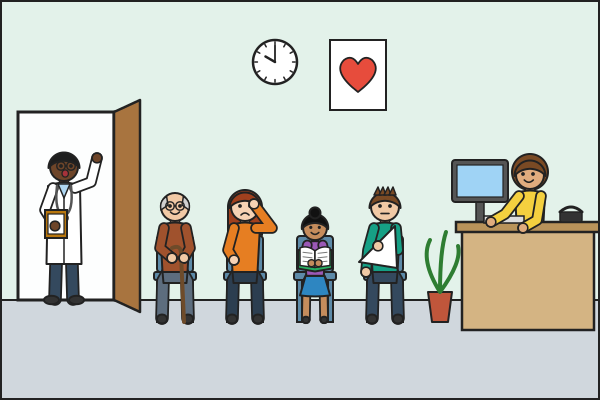
Your Swiss friend's father is a doctor in Lucerne. Your friend sends you this picture of the waiting room at his practice.
What is in this photo? Write five sentences in German.
Model answer
Der Vater von meinem Freund steht links an der Tür. Der alte Mann trägt Braun und lächelt. Eine Frau hat ihre Hand am Kopf. Das Mädchen trägt einen blauen Rock. Die Wand ist grün und der Boden ist grau.
Explanation
Each sentence earns 2 marks if it has a conjugated verb and fits the picture, for example Der alte Mann lächelt or Eine Frau hat ihre Hand am Kopf. Arzt and Ärztin, krank, Kopfschmerzen and Wartezimmer (from warten and Zimmer) are useful words for this picture. Aussehen is a separable verb, so in a main clause the prefix goes to the end: Er sieht nicht froh aus. A noun phrase (eine grüne Wand) scores only 1 mark, and a single word such as Tür scores 0.
Mark scheme
2 marks
Levels of response: sentence 1 (AO2, 2 marks). Level 2 (2 marks): the relevant message is clearly communicated. Level 1 (1 mark): the message is relevant but has some ambiguity and causes a delay in communication. 0 marks: the message is irrelevant or cannot be understood.
Each of the five sentences is marked separately, as a whole, and must be about the picture. 2 marks: a sentence with an appropriate conjugated verb. - The same structure may be repeated with different nouns (Es gibt ...; Ich sehe ...). - Any person of the verb (ich, wir, du, sie) and any tense are accepted. - There may be errors, as long as the message is unambiguous. - A figure may be written for a number. - Anything that could possibly be true of the picture is accepted. 1 mark: - an infinitive in an otherwise appropriate sentence (Die Frau Kaffee trinken); - a noun phrase with no verb (vier Personen; ein Tisch); - an error that causes ambiguity or delay (Sie essen Kaffee); - a long sentence where one part communicates and another does not. 0 marks: - a single word; - an inappropriate verb (Ich möchte einen Tisch); - something clearly false about the picture; - an opinion about the photo that says nothing about what is in it (Ich mag das Foto = 0; Ich mag das Foto, weil es sonnig ist = 2). Spelling: - Umlauts, ß/ss and noun capitals do not matter unless the message becomes ambiguous. AQA: 'There may be linguistic errors, but the message must be communicated without ambiguity.' - ae/oe/ue for ä/ö/ü are the right letter (site rule, not AQA's). Gender identity (specification 4.7): 'Students should not be disadvantaged on the basis of their gender identity and/or how they refer to the gender identity of others in their exam responses. Students' preferred ways of referring to themselves and others through the use of pronouns, gendered language and grammatical agreements will be credited by examiners, regardless of whether such usage has been adopted by official language bodies in the target language-speaking countries.' Accept forms such as Schüler*innen, Lehrer:innen and LehrerInnen and neopronouns, and never count them as errors. Examples for this picture: 2 marks - Der Vater von meinem Freund ist Arzt. / Das ist ein Wartezimmer. / Der Arzt trägt eine weisse Jacke. 1 mark - ein Arzt an der Tür. 0 marks - Tür. / Es gibt keinen Arzt (clearly false: the doctor is on the left).
2 marks
Levels of response: sentence 2 (AO2, 2 marks). Level 2 (2 marks): the relevant message is clearly communicated. Level 1 (1 mark): the message is relevant but has some ambiguity and causes a delay in communication. 0 marks: the message is irrelevant or cannot be understood.
As sentence 1 (any sentence may describe any part of the picture). Examples: 2 marks - Ein alter Mann hat graue Haare. / Der alte Mann lächelt. 1 mark - ein alter Mann mit grauen Haaren. 0 marks - grau. / Der alte Mann schwimmt (clearly false).
2 marks
Levels of response: sentence 3 (AO2, 2 marks). Level 2 (2 marks): the relevant message is clearly communicated. Level 1 (1 mark): the message is relevant but has some ambiguity and causes a delay in communication. 0 marks: the message is irrelevant or cannot be understood.
As sentence 1 (any sentence may describe any part of the picture). Examples: 2 marks - Eine Frau hat ihre Hand am Kopf. / Die Frau hat rote Haare. / Das Mädchen hat schwarze Haare. 1 mark - eine Frau mit roten Haaren. 0 marks - rot. / Das Mädchen spielt am Handy (clearly false).
2 marks
Levels of response: sentence 4 (AO2, 2 marks). Level 2 (2 marks): the relevant message is clearly communicated. Level 1 (1 mark): the message is relevant but has some ambiguity and causes a delay in communication. 0 marks: the message is irrelevant or cannot be understood.
As sentence 1 (any sentence may describe any part of the picture). Examples: 2 marks - Der Junge hat kurze braune Haare. / Er sieht nicht froh aus. / Die Person rechts lacht. 1 mark - ein Junge mit braunen Haaren. 0 marks - Junge. / Ich möchte einen Stuhl (inappropriate verb).
2 marks
Levels of response: sentence 5 (AO2, 2 marks). Level 2 (2 marks): the relevant message is clearly communicated. Level 1 (1 mark): the message is relevant but has some ambiguity and causes a delay in communication. 0 marks: the message is irrelevant or cannot be understood.
As sentence 1 (any sentence may describe any part of the picture). Examples: 2 marks - Die Wand ist grün. / Der Boden ist grau. / Ich finde das Wartezimmer schön, weil es hell ist. 1 mark - eine grüne Wand. 0 marks - grün. / Es ist drei Uhr (clearly false: the clock shows ten o'clock).
Question 3
10 marks
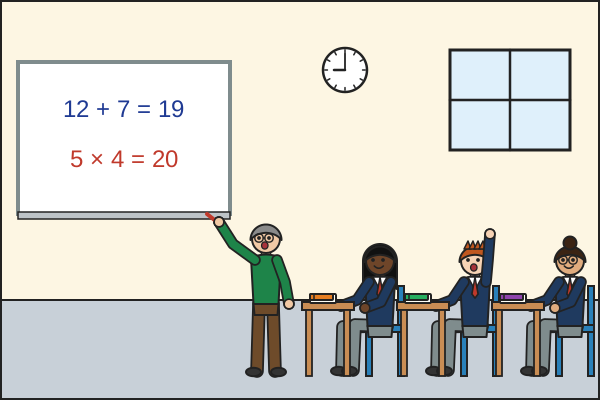
Your friend in Kassel is surprised that pupils in Britain wear a school uniform. You send this picture of your maths lesson.
What is in this photo? Write five sentences in German.
Model answer
Auf dem Foto siehst du meine Klasse. Wir tragen blaue Jacken und weiße Hemden. Unsere Hosen sind grau. Die Aufgabe ist leicht: Fünf mal vier ist zwanzig. Links sitzt ein Mädchen mit langen schwarzen Haaren.
Explanation
Each sentence earns 2 marks if it has a conjugated verb and fits the picture, for example Der Lehrer erklärt die Aufgabe or Wir tragen blaue Jacken. Uniform, tragen, Lehrer, Schüler, Mathe and Stunde are on the Foundation list, and the sums on the board make good sentences too: Fünf mal vier ist zwanzig. After Auf dem Foto the verb comes second (Auf dem Foto siehst du meine Klasse), and mit takes the dative: mit roten Haaren. A noun phrase (eine blaue Jacke) scores only 1 mark, and a single word scores 0.
Mark scheme
2 marks
Levels of response: sentence 1 (AO2, 2 marks). Level 2 (2 marks): the relevant message is clearly communicated. Level 1 (1 mark): the message is relevant but has some ambiguity and causes a delay in communication. 0 marks: the message is irrelevant or cannot be understood.
Each of the five sentences is marked separately, as a whole, and must be about the picture. 2 marks: a sentence with an appropriate conjugated verb. - The same structure may be repeated with different nouns (Es gibt ...; Ich sehe ...). - Any person of the verb (ich, wir, du, sie) and any tense are accepted. - There may be errors, as long as the message is unambiguous. - A figure may be written for a number. - Anything that could possibly be true of the picture is accepted. 1 mark: - an infinitive in an otherwise appropriate sentence (Die Frau Kaffee trinken); - a noun phrase with no verb (vier Personen; ein Tisch); - an error that causes ambiguity or delay (Sie essen Kaffee); - a long sentence where one part communicates and another does not. 0 marks: - a single word; - an inappropriate verb (Ich möchte einen Tisch); - something clearly false about the picture; - an opinion about the photo that says nothing about what is in it (Ich mag das Foto = 0; Ich mag das Foto, weil es sonnig ist = 2). Spelling: - Umlauts, ß/ss and noun capitals do not matter unless the message becomes ambiguous. AQA: 'There may be linguistic errors, but the message must be communicated without ambiguity.' - ae/oe/ue for ä/ö/ü are the right letter (site rule, not AQA's). Gender identity (specification 4.7): 'Students should not be disadvantaged on the basis of their gender identity and/or how they refer to the gender identity of others in their exam responses. Students' preferred ways of referring to themselves and others through the use of pronouns, gendered language and grammatical agreements will be credited by examiners, regardless of whether such usage has been adopted by official language bodies in the target language-speaking countries.' Accept forms such as Schüler*innen, Lehrer:innen and LehrerInnen and neopronouns, and never count them as errors. Examples for this picture: 2 marks - Die Schüler tragen eine blaue Jacke. / Das ist meine Klasse. / Unsere Uniform ist sehr schön. 1 mark - eine blaue Jacke. 0 marks - Jacke. / Die Schüler tragen keine Uniform (clearly false).
2 marks
Levels of response: sentence 2 (AO2, 2 marks). Level 2 (2 marks): the relevant message is clearly communicated. Level 1 (1 mark): the message is relevant but has some ambiguity and causes a delay in communication. 0 marks: the message is irrelevant or cannot be understood.
As sentence 1 (any sentence may describe any part of the picture). Examples: 2 marks - Fünf mal vier ist zwanzig. / Zwölf und sieben ist neunzehn. / Die Aufgaben sind leicht. 1 mark - fünf mal vier. 0 marks - zwanzig. / Es ist drei Uhr (clearly false: the clock shows nine o'clock).
2 marks
Levels of response: sentence 3 (AO2, 2 marks). Level 2 (2 marks): the relevant message is clearly communicated. Level 1 (1 mark): the message is relevant but has some ambiguity and causes a delay in communication. 0 marks: the message is irrelevant or cannot be understood.
As sentence 1 (any sentence may describe any part of the picture). Examples: 2 marks - Der Lehrer erklärt die Aufgabe. / Er trägt ein grünes Hemd. / Der Lehrer ist alt und nett. 1 mark - ein alter Lehrer. 0 marks - alt. / Ich möchte einen Lehrer (inappropriate verb).
2 marks
Levels of response: sentence 4 (AO2, 2 marks). Level 2 (2 marks): the relevant message is clearly communicated. Level 1 (1 mark): the message is relevant but has some ambiguity and causes a delay in communication. 0 marks: the message is irrelevant or cannot be understood.
As sentence 1 (any sentence may describe any part of the picture). Examples: 2 marks - Ein Junge hat eine Frage. / Der Junge mit roten Haaren spricht. / Er weiß die Antwort (heben, to raise, is beyond the Foundation list and is credited equally). 1 mark - ein Junge mit einer Frage. 0 marks - Frage. / Der Junge schläft (clearly false).
2 marks
Levels of response: sentence 5 (AO2, 2 marks). Level 2 (2 marks): the relevant message is clearly communicated. Level 1 (1 mark): the message is relevant but has some ambiguity and causes a delay in communication. 0 marks: the message is irrelevant or cannot be understood.
As sentence 1 (any sentence may describe any part of the picture). Examples: 2 marks - Drei Schüler sitzen an ihren Tischen. / Das Mädchen links lächelt. / Die Bücher sind bunt. 1 mark - drei Schüler und drei Tische. 0 marks - Buch. / Die Schüler schwimmen (clearly false).
Question 4
10 marks
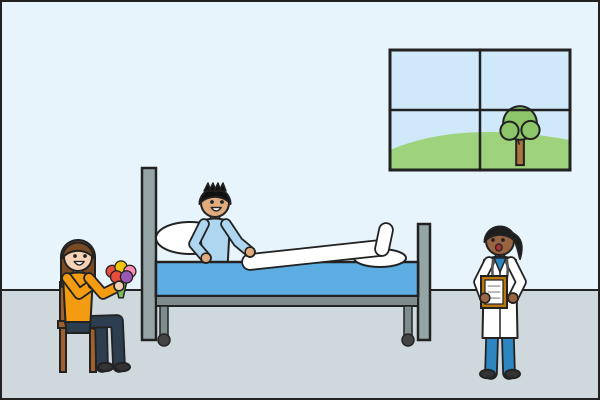
Your Swiss friend in St. Gallen broke his leg playing football. His sister posts this picture of her visit to the hospital online.
What is in this photo? Write five sentences in German.
Model answer
Das Bein von meinem Freund ist gebrochen. Er hat schwarze Haare und trägt Blau. Seine Schwester trägt eine dunkle Hose. Rechts steht eine Ärztin mit schwarzen Haaren. Die Wand im Zimmer ist blau.
Explanation
Each sentence earns 2 marks if it has a conjugated verb and fits the picture, for example Sein Bein ist gebrochen or Rechts steht eine Ärztin. Krankenhaus, Bett, Bein, Arzt and Ärztin, and gebrochen (broken) are on the Foundation list; a female doctor is eine Ärztin. Von + dative does the work of the genitive at Foundation: das Bein von meinem Freund. A noun phrase (eine dunkle Hose) scores only 1 mark, and a single word scores 0.
Mark scheme
2 marks
Levels of response: sentence 1 (AO2, 2 marks). Level 2 (2 marks): the relevant message is clearly communicated. Level 1 (1 mark): the message is relevant but has some ambiguity and causes a delay in communication. 0 marks: the message is irrelevant or cannot be understood.
Each of the five sentences is marked separately, as a whole, and must be about the picture. 2 marks: a sentence with an appropriate conjugated verb. - The same structure may be repeated with different nouns (Es gibt ...; Ich sehe ...). - Any person of the verb (ich, wir, du, sie) and any tense are accepted. - There may be errors, as long as the message is unambiguous. - A figure may be written for a number. - Anything that could possibly be true of the picture is accepted. 1 mark: - an infinitive in an otherwise appropriate sentence (Die Frau Kaffee trinken); - a noun phrase with no verb (vier Personen; ein Tisch); - an error that causes ambiguity or delay (Sie essen Kaffee); - a long sentence where one part communicates and another does not. 0 marks: - a single word; - an inappropriate verb (Ich möchte einen Tisch); - something clearly false about the picture; - an opinion about the photo that says nothing about what is in it (Ich mag das Foto = 0; Ich mag das Foto, weil es sonnig ist = 2). Spelling: - Umlauts, ß/ss and noun capitals do not matter unless the message becomes ambiguous. AQA: 'There may be linguistic errors, but the message must be communicated without ambiguity.' - ae/oe/ue for ä/ö/ü are the right letter (site rule, not AQA's). Gender identity (specification 4.7): 'Students should not be disadvantaged on the basis of their gender identity and/or how they refer to the gender identity of others in their exam responses. Students' preferred ways of referring to themselves and others through the use of pronouns, gendered language and grammatical agreements will be credited by examiners, regardless of whether such usage has been adopted by official language bodies in the target language-speaking countries.' Accept forms such as Schüler*innen, Lehrer:innen and LehrerInnen and neopronouns, and never count them as errors. Examples for this picture: 2 marks - Sein Bein ist gebrochen. / Seine Schwester besucht ihn. / Mein Freund hat Schmerzen. 1 mark - ein gebrochenes Bein. 0 marks - Bein. / Mein Freund steht im Garten (clearly false: he is in bed).
2 marks
Levels of response: sentence 2 (AO2, 2 marks). Level 2 (2 marks): the relevant message is clearly communicated. Level 1 (1 mark): the message is relevant but has some ambiguity and causes a delay in communication. 0 marks: the message is irrelevant or cannot be understood.
As sentence 1 (any sentence may describe any part of the picture). Examples: 2 marks - Er trägt ein blaues Hemd. / Er hat schwarze Haare. / Das Bett ist grau. 1 mark - ein blaues Hemd. 0 marks - Hemd. / Ich möchte ein Bett (inappropriate verb).
2 marks
Levels of response: sentence 3 (AO2, 2 marks). Level 2 (2 marks): the relevant message is clearly communicated. Level 1 (1 mark): the message is relevant but has some ambiguity and causes a delay in communication. 0 marks: the message is irrelevant or cannot be understood.
As sentence 1 (any sentence may describe any part of the picture). Examples: 2 marks - Seine Schwester trägt eine dunkle Hose. / Sie lächelt. / Sie ist sehr nett. 1 mark - eine dunkle Hose. 0 marks - Schwester. / Die Schwester liegt im Bett (clearly false). Blumen and Gips are beyond the Foundation list and are credited equally.
2 marks
Levels of response: sentence 4 (AO2, 2 marks). Level 2 (2 marks): the relevant message is clearly communicated. Level 1 (1 mark): the message is relevant but has some ambiguity and causes a delay in communication. 0 marks: the message is irrelevant or cannot be understood.
As sentence 1 (any sentence may describe any part of the picture). Examples: 2 marks - Rechts steht eine Ärztin. / Die Ärztin hat schwarze Haare. / Sie hat ein Papier in der Hand. 1 mark - eine Ärztin mit schwarzen Haaren. 0 marks - Ärztin. / Die Ärztin schläft (clearly false).
2 marks
Levels of response: sentence 5 (AO2, 2 marks). Level 2 (2 marks): the relevant message is clearly communicated. Level 1 (1 mark): the message is relevant but has some ambiguity and causes a delay in communication. 0 marks: the message is irrelevant or cannot be understood.
As sentence 1 (any sentence may describe any part of the picture). Examples: 2 marks - Das Fenster ist gross. / Die Wand ist blau. / Ich mag das Foto, weil seine Schwester da ist. 1 mark - Ich mag das Foto, weil seine Schwester. 0 marks - Ich mag das Foto (nothing about what is in it). / gross.
Ready to try the rest? Every answer you write is marked against the mark scheme, so you can see exactly where the marks are.
Ctrl + Enter to check
Study HelperHints first, answers after you try
Stuck on this one? Ask for a hint and I’ll point you in the right direction, without giving the answer away. Once you’ve checked your answer, I’ll show you how the marks are awarded.