Practise 12 exam-style questions on Photo description: people and lifestyle for AQA GCSE French (Foundation Writing). Write your answer as you would in the exam and get it marked in seconds against the mark scheme, point by point, with the Study Helper on hand if you get stuck.
12 questions
10 marks each
Instant marking
No sign-up needed
12 questions, marked as you go
Sample questions with model answers
Here are 4 of the questions in this topic, each with a model answer, an explanation of why it earns the marks and the mark scheme an examiner would use.
Question 1
10 marks
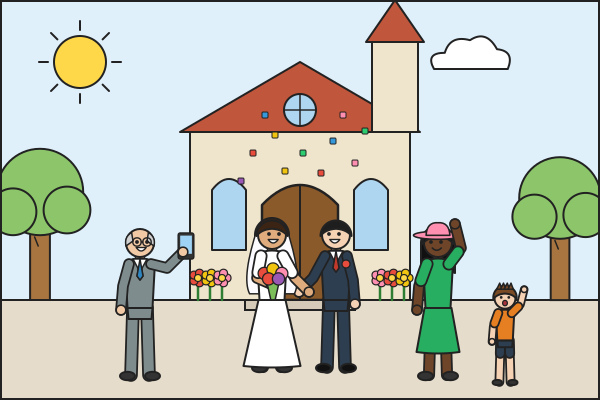
You are sending a photo to your French penfriend. Here is your picture.
What is in this photo? Write five sentences in French.
Model answer
C'est un mariage devant une église. Les mariés sont très heureux. Un vieil homme prend une photo avec son portable. Il fait beau et il y a du soleil. J'aime la photo parce que c'est une belle fête.
Explanation
Write five separate sentences, each with a conjugated verb, about what you can see: the couple, the guests, the church, the weather. C'est un mariage, il y a des fleurs, l'homme prend une photo and il fait beau each earn 2 marks, and les mariés means the couple who are getting married. A phrase with no verb (beau temps) or an infinitive (l'homme prendre une photo) scores 1, and 'J'aime la photo' on its own scores 0 because it says nothing about what is in the picture - add a reason (parce que les mariés sont heureux).
Mark scheme
2 marks
Levels of response: sentence 1 (AO2, 2 marks). Level 2 (2 marks): the relevant message is clearly communicated. Level 1 (1 mark): the message is relevant but has some ambiguity and causes a delay in communication. 0 marks: the message is irrelevant or cannot be understood.
Each of the five sentences is marked separately, as a whole, and must be about the picture. 2 marks: a sentence with an appropriate conjugated verb (voici/voilà may replace the verb); the same structure may be repeated with different nouns (il y a ...); any person of the verb and any tense are accepted; there may be errors as long as the message is unambiguous; a figure may be written for a number; anything that could possibly be true of the picture is accepted. 1 mark: an infinitive in an otherwise appropriate sentence (ils manger); a noun phrase with no verb (une table; cinq personnes); an error that causes ambiguity or delay (they are eating coffee); a long sentence where one part communicates and another does not. 0 marks: a single word (table; cinq); an inappropriate verb (je voudrais une table); something clearly false about the picture; an opinion about the photo that says nothing about what is in it (j'aime la photo = 0; j'aime la photo parce qu'il fait beau = 2). Accents: a missing or wrong accent does not matter unless it makes the message ambiguous; students typing on a keyboard may leave accents out. Students' own ways of referring to themselves and others (pronouns, gendered language, agreements) are credited. Examples: 2 marks - Il y a cinq personnes. / C'est un mariage. / Il y a un garçon à droite. 1 mark - un mariage. / Les mariés être contents. 0 marks - mariage. / Je voudrais un mariage (inappropriate verb).
2 marks
Levels of response: sentence 2 (AO2, 2 marks). Level 2 (2 marks): the relevant message is clearly communicated. Level 1 (1 mark): the message is relevant but has some ambiguity and causes a delay in communication. 0 marks: the message is irrelevant or cannot be understood.
As sentence 1 (any sentence may describe any part of the picture). Examples: 2 marks - Ils sont devant une église. / Il y a des arbres et des fleurs. / Je suis au mariage de mon oncle. 1 mark - devant une église. 0 marks - église. / Ils sont à la plage (clearly false).
2 marks
Levels of response: sentence 3 (AO2, 2 marks). Level 2 (2 marks): the relevant message is clearly communicated. Level 1 (1 mark): the message is relevant but has some ambiguity and causes a delay in communication. 0 marks: the message is irrelevant or cannot be understood.
As sentence 1 (any sentence may describe any part of the picture). Examples: 2 marks - Le vieil homme prend une photo. / Le garçon lève le bras. / Les mariés se donnent la main. 1 mark - L'homme prendre une photo. 0 marks - photo. / L'homme mange un gâteau (not in the picture).
2 marks
Levels of response: sentence 4 (AO2, 2 marks). Level 2 (2 marks): the relevant message is clearly communicated. Level 1 (1 mark): the message is relevant but has some ambiguity and causes a delay in communication. 0 marks: the message is irrelevant or cannot be understood.
As sentence 1 (any sentence may describe any part of the picture). Examples: 2 marks - Il fait beau. / Il y a du soleil. / Il fait chaud. 1 mark - beau temps. 0 marks - soleil. / Il neige (clearly false).
2 marks
Levels of response: sentence 5 (AO2, 2 marks). Level 2 (2 marks): the relevant message is clearly communicated. Level 1 (1 mark): the message is relevant but has some ambiguity and causes a delay in communication. 0 marks: the message is irrelevant or cannot be understood.
As sentence 1 (any sentence may describe any part of the picture). Examples: 2 marks - La mariée est en blanc. / J'aime la photo parce que les mariés sont heureux. / C'est une belle fête. 1 mark - La mariée en blanc. 0 marks - J'aime la photo. / blanc.
Question 2
10 marks
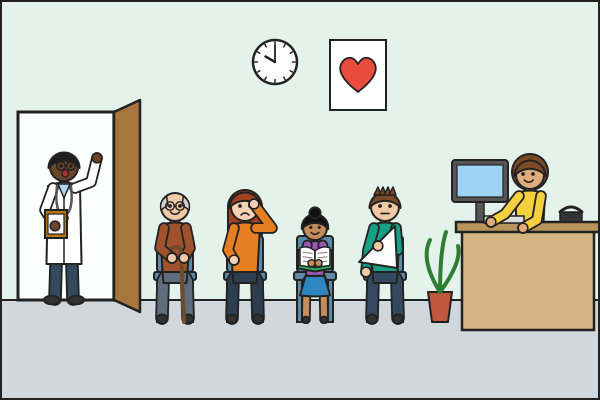
You are sharing photos with your Swiss e-pal. Here is your picture.
What is in this photo? Write five sentences in French.
Model answer
Je vois quatre personnes sur des chaises. Ils attendent le médecin. La femme a mal à la tête et le garçon a mal au bras. Il est dix heures. Je n'aime pas la photo parce que les gens sont malades.
Explanation
Each sentence earns 2 marks if it has a conjugated verb and fits the picture: who is there, where they are, what they are doing, what is wrong with them, the time. Avoir mal à is very useful here (la femme a mal à la tête, le garçon a mal au bras), as are ils attendent le médecin, il y a un ordinateur and il est dix heures. An infinitive (ils attendre) or a phrase with no verb (la femme triste) scores 1; a single word (malade) scores 0.
Mark scheme
2 marks
Levels of response: sentence 1 (AO2, 2 marks). Level 2 (2 marks): the relevant message is clearly communicated. Level 1 (1 mark): the message is relevant but has some ambiguity and causes a delay in communication. 0 marks: the message is irrelevant or cannot be understood.
Each of the five sentences is marked separately, as a whole, and must be about the picture. 2 marks: a sentence with an appropriate conjugated verb (voici/voilà may replace the verb); the same structure may be repeated with different nouns (il y a ...); any person of the verb and any tense are accepted; there may be errors as long as the message is unambiguous; a figure may be written for a number; anything that could possibly be true of the picture is accepted. 1 mark: an infinitive in an otherwise appropriate sentence (ils manger); a noun phrase with no verb (une table; cinq personnes); an error that causes ambiguity or delay (they are eating coffee); a long sentence where one part communicates and another does not. 0 marks: a single word (table; cinq); an inappropriate verb (je voudrais une table); something clearly false about the picture; an opinion about the photo that says nothing about what is in it (j'aime la photo = 0; j'aime la photo parce qu'il fait beau = 2). Accents: a missing or wrong accent does not matter unless it makes the message ambiguous; students typing on a keyboard may leave accents out. Students' own ways of referring to themselves and others (pronouns, gendered language, agreements) are credited. Examples: 2 marks - Il y a un médecin. / Je vois un vieil homme. / Il y a six personnes. 1 mark - un médecin et une fille. 0 marks - médecin. / Il y a un bébé (not in the picture).
2 marks
Levels of response: sentence 2 (AO2, 2 marks). Level 2 (2 marks): the relevant message is clearly communicated. Level 1 (1 mark): the message is relevant but has some ambiguity and causes a delay in communication. 0 marks: the message is irrelevant or cannot be understood.
As sentence 1 (any sentence may describe any part of the picture). Examples: 2 marks - Ils sont chez le médecin. / Il y a un ordinateur. / Il est dix heures. 1 mark - des chaises bleues. 0 marks - chaise. / Ils sont au cinéma (clearly false).
2 marks
Levels of response: sentence 3 (AO2, 2 marks). Level 2 (2 marks): the relevant message is clearly communicated. Level 1 (1 mark): the message is relevant but has some ambiguity and causes a delay in communication. 0 marks: the message is irrelevant or cannot be understood.
As sentence 1 (any sentence may describe any part of the picture). Examples: 2 marks - Ils attendent le médecin. / La fille a un livre. / J'attends avec ma mère. 1 mark - Ils attendre le médecin. 0 marks - attendre. / Ils dansent (clearly false).
2 marks
Levels of response: sentence 4 (AO2, 2 marks). Level 2 (2 marks): the relevant message is clearly communicated. Level 1 (1 mark): the message is relevant but has some ambiguity and causes a delay in communication. 0 marks: the message is irrelevant or cannot be understood.
As sentence 1 (any sentence may describe any part of the picture). Examples: 2 marks - La femme a mal à la tête. / Le garçon a mal au bras. / Le vieil homme est malade. 1 mark - La femme mal à la tête. 0 marks - malade. / Il y a un chien (not in the picture).
2 marks
Levels of response: sentence 5 (AO2, 2 marks). Level 2 (2 marks): the relevant message is clearly communicated. Level 1 (1 mark): the message is relevant but has some ambiguity and causes a delay in communication. 0 marks: the message is irrelevant or cannot be understood.
As sentence 1 (any sentence may describe any part of the picture). Examples: 2 marks - Je n'aime pas la photo parce que les gens sont malades. / La femme est triste. / Le médecin est en blanc. 1 mark - La femme triste. 0 marks - J'aime la photo. / triste.
Question 3
10 marks
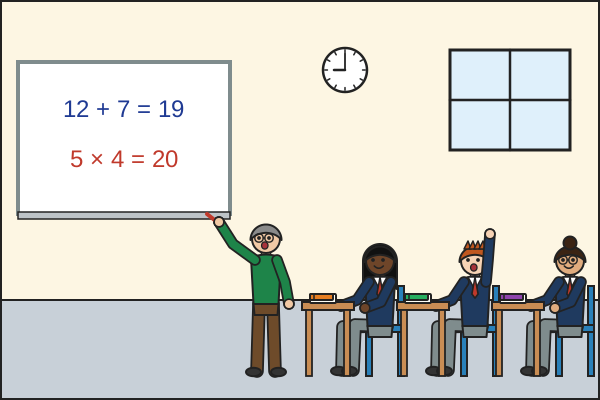
Your Senegalese e-pal wants to see a photo of your school. Here is your picture.
What is in this photo? Write five sentences in French.
Model answer
C'est un cours de maths au collège. Le professeur est à côté du tableau. Les trois élèves portent un uniforme. Un garçon lève la main. J'aime la photo parce que la classe est calme.
Explanation
Each sentence needs a conjugated verb and must be about what you can see: the teacher, the pupils, the classroom, the lesson, the uniform. Le professeur parle, un garçon lève la main, les élèves portent un uniforme, c'est un cours de maths and il est neuf heures all earn 2 marks. A list of nouns (un professeur et trois élèves) or an infinitive (un garçon lever la main) scores 1, and a single word scores 0.
Mark scheme
2 marks
Levels of response: sentence 1 (AO2, 2 marks). Level 2 (2 marks): the relevant message is clearly communicated. Level 1 (1 mark): the message is relevant but has some ambiguity and causes a delay in communication. 0 marks: the message is irrelevant or cannot be understood.
Each of the five sentences is marked separately, as a whole, and must be about the picture. 2 marks: a sentence with an appropriate conjugated verb (voici/voilà may replace the verb); the same structure may be repeated with different nouns (il y a ...); any person of the verb and any tense are accepted; there may be errors as long as the message is unambiguous; a figure may be written for a number; anything that could possibly be true of the picture is accepted. 1 mark: an infinitive in an otherwise appropriate sentence (ils manger); a noun phrase with no verb (une table; cinq personnes); an error that causes ambiguity or delay (they are eating coffee); a long sentence where one part communicates and another does not. 0 marks: a single word (table; cinq); an inappropriate verb (je voudrais une table); something clearly false about the picture; an opinion about the photo that says nothing about what is in it (j'aime la photo = 0; j'aime la photo parce qu'il fait beau = 2). Accents: a missing or wrong accent does not matter unless it makes the message ambiguous; students typing on a keyboard may leave accents out. Students' own ways of referring to themselves and others (pronouns, gendered language, agreements) are credited. Examples: 2 marks - Il y a quatre personnes. / Il y a un professeur et trois élèves. / Je vois deux filles et un garçon. 1 mark - un professeur et trois élèves. 0 marks - professeur. / Il y a dix élèves (clearly false).
2 marks
Levels of response: sentence 2 (AO2, 2 marks). Level 2 (2 marks): the relevant message is clearly communicated. Level 1 (1 mark): the message is relevant but has some ambiguity and causes a delay in communication. 0 marks: the message is irrelevant or cannot be understood.
As sentence 1 (any sentence may describe any part of the picture). Examples: 2 marks - Ils sont dans une salle de classe. / Il y a un tableau. / Il est neuf heures. 1 mark - une salle de classe. 0 marks - tableau. / Ils sont à la piscine (clearly false).
2 marks
Levels of response: sentence 3 (AO2, 2 marks). Level 2 (2 marks): the relevant message is clearly communicated. Level 1 (1 mark): the message is relevant but has some ambiguity and causes a delay in communication. 0 marks: the message is irrelevant or cannot be understood.
As sentence 1 (any sentence may describe any part of the picture). Examples: 2 marks - Le professeur parle. / Un garçon lève la main. / Les élèves travaillent. 1 mark - Un garçon lever la main. 0 marks - parler. / Les élèves dansent (clearly false).
2 marks
Levels of response: sentence 4 (AO2, 2 marks). Level 2 (2 marks): the relevant message is clearly communicated. Level 1 (1 mark): the message is relevant but has some ambiguity and causes a delay in communication. 0 marks: the message is irrelevant or cannot be understood.
As sentence 1 (any sentence may describe any part of the picture). Examples: 2 marks - Les élèves portent un uniforme. / Il y a des livres sur les tables. / C'est un cours de maths. 1 mark - Les élèves un uniforme. 0 marks - uniforme. / Il y a un ordinateur (not in the picture).
2 marks
Levels of response: sentence 5 (AO2, 2 marks). Level 2 (2 marks): the relevant message is clearly communicated. Level 1 (1 mark): the message is relevant but has some ambiguity and causes a delay in communication. 0 marks: the message is irrelevant or cannot be understood.
As sentence 1 (any sentence may describe any part of the picture). Examples: 2 marks - J'aime la photo parce que j'adore les maths. / La classe est calme. / Les élèves sont sérieux. 1 mark - J'aime la photo parce que les maths. 0 marks - J'aime la photo. / maths.
Question 4
10 marks
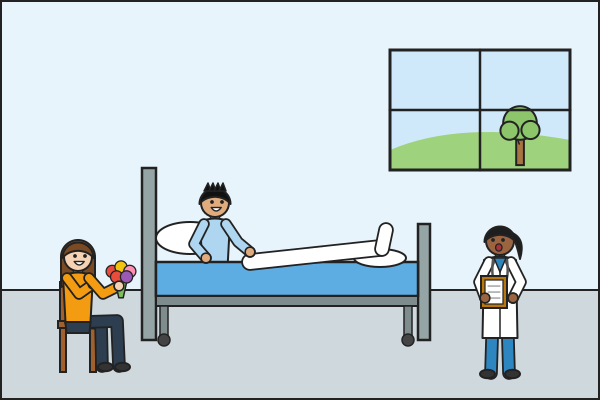
You and your friends from Brussels are sharing photos online. Here is your picture.
What is in this photo? Write five sentences in French.
Model answer
Il y a trois personnes dans une chambre d'hôpital. Le garçon dans le lit a mal à la jambe. Une femme apporte des fleurs. Le médecin parle au garçon. J'aime la photo parce que le garçon sourit.
Explanation
Each of the five sentences needs a conjugated verb and must be about the picture: the people, the hospital room, what they are doing, what is wrong with the patient, an opinion linked to the scene. Il y a un médecin, le garçon est dans un lit, il a mal à la jambe, la femme a des fleurs and le médecin parle au garçon all score 2 marks. 'Mal à la jambe' with no verb or 'le médecin parler' (infinitive) scores 1, and a single word scores 0.
Mark scheme
2 marks
Levels of response: sentence 1 (AO2, 2 marks). Level 2 (2 marks): the relevant message is clearly communicated. Level 1 (1 mark): the message is relevant but has some ambiguity and causes a delay in communication. 0 marks: the message is irrelevant or cannot be understood.
Each of the five sentences is marked separately, as a whole, and must be about the picture. 2 marks: a sentence with an appropriate conjugated verb (voici/voilà may replace the verb); the same structure may be repeated with different nouns (il y a ...); any person of the verb and any tense are accepted; there may be errors as long as the message is unambiguous; a figure may be written for a number; anything that could possibly be true of the picture is accepted. 1 mark: an infinitive in an otherwise appropriate sentence (ils manger); a noun phrase with no verb (une table; cinq personnes); an error that causes ambiguity or delay (they are eating coffee); a long sentence where one part communicates and another does not. 0 marks: a single word (table; cinq); an inappropriate verb (je voudrais une table); something clearly false about the picture; an opinion about the photo that says nothing about what is in it (j'aime la photo = 0; j'aime la photo parce qu'il fait beau = 2). Accents: a missing or wrong accent does not matter unless it makes the message ambiguous; students typing on a keyboard may leave accents out. Students' own ways of referring to themselves and others (pronouns, gendered language, agreements) are credited. Examples: 2 marks - Il y a trois personnes. / Je vois un médecin. / Il y a un garçon malade. 1 mark - un garçon malade. 0 marks - malade. / Il y a quatre médecins (clearly false).
2 marks
Levels of response: sentence 2 (AO2, 2 marks). Level 2 (2 marks): the relevant message is clearly communicated. Level 1 (1 mark): the message is relevant but has some ambiguity and causes a delay in communication. 0 marks: the message is irrelevant or cannot be understood.
As sentence 1 (any sentence may describe any part of the picture). Examples: 2 marks - Ils sont à l'hôpital. / Il y a une fenêtre. / Le garçon est dans un lit. 1 mark - un lit et une fenêtre. 0 marks - hôpital. / Ils sont au restaurant (clearly false).
2 marks
Levels of response: sentence 3 (AO2, 2 marks). Level 2 (2 marks): the relevant message is clearly communicated. Level 1 (1 mark): the message is relevant but has some ambiguity and causes a delay in communication. 0 marks: the message is irrelevant or cannot be understood.
As sentence 1 (any sentence may describe any part of the picture). Examples: 2 marks - La femme a des fleurs. / Le médecin parle au garçon. / Je suis à l'hôpital avec ma mère. 1 mark - Le médecin parler au garçon. 0 marks - parler. / Le garçon fait du sport (clearly false).
2 marks
Levels of response: sentence 4 (AO2, 2 marks). Level 2 (2 marks): the relevant message is clearly communicated. Level 1 (1 mark): the message is relevant but has some ambiguity and causes a delay in communication. 0 marks: the message is irrelevant or cannot be understood.
As sentence 1 (any sentence may describe any part of the picture). Examples: 2 marks - Le garçon a mal à la jambe. / Le lit est bleu. / Il fait beau dehors. 1 mark - mal à la jambe. 0 marks - jambe. / Il neige dehors (clearly false).
2 marks
Levels of response: sentence 5 (AO2, 2 marks). Level 2 (2 marks): the relevant message is clearly communicated. Level 1 (1 mark): the message is relevant but has some ambiguity and causes a delay in communication. 0 marks: the message is irrelevant or cannot be understood.
As sentence 1 (any sentence may describe any part of the picture). Examples: 2 marks - Le garçon est content. / J'aime la photo parce que les fleurs sont belles. / Le médecin est gentil. 1 mark - J'aime la photo parce que les fleurs. 0 marks - J'aime la photo. / fleurs.
Ready to try the rest? Every answer you write is marked against the mark scheme, so you can see exactly where the marks are.
Ctrl + Enter to check
Study HelperHints first, answers after you try
Stuck on this one? Ask for a hint and I’ll point you in the right direction, without giving the answer away. Once you’ve checked your answer, I’ll show you how the marks are awarded.