
Level:
Correct: 0
Incorrect: 0
Marks: 0/0

Nuclei and isotopes

Practise 15 exam-style questions on Nuclei and isotopes for OCR GCSE Combined Science (Physics Paper 6). Write your answer as you would in the exam and get it marked in seconds against the mark scheme, point by point, with the Study Helper on hand if you get stuck.

  • 15 questions
  • 1–6 marks each
  • Instant marking
  • No sign-up needed
15 questions, marked as you go

Sample questions with model answers

Here are 4 of the questions in this topic, each with a model answer, an explanation of why it earns the marks and the mark scheme an examiner would use.

Question 1

1 mark

Natural bromine is a mixture of two isotopes, bromine-79 and bromine-81. Their nuclei are ⁷⁹₃₅Br and ⁸¹₃₅Br.

How many more neutrons are there in a nucleus of bromine-81 than in a nucleus of bromine-79?

Choose your answer.

  • A 2
  • B 35
  • C 44
  • D 46

Model answer

A (2)

Explanation

Isotopes of an element have the same number of protons (35 for bromine), so they differ only in their number of neutrons. The neutrons are mass number − atomic number: 46 for bromine-81 and 44 for bromine-79, a difference of 2. A quick check: the mass numbers differ by 81 − 79 = 2, and all of that difference must be neutrons.

Mark scheme
  1. 1 mark

    A / 2

    The only correct answer is A: a bromine-81 nucleus has 81 − 35 = 46 neutrons and a bromine-79 nucleus has 79 − 35 = 44 neutrons, so it has 46 − 44 = 2 more. Both nuclei have 35 protons, so the whole difference in mass number is made by neutrons. B is not correct because 35 is the number of protons in each nucleus (the atomic number), which is the same for both; C is not correct because 44 is the number of neutrons in a bromine-79 nucleus, not the difference; D is not correct because 46 is the number of neutrons in a bromine-81 nucleus, not the difference. ALLOW the letter or the option. If more than one option is given, do not award the mark.
Question 2

2 marks

The symbols for a proton and a neutron can be written as ¹₁p and ¹₀n. In each symbol, the top number gives the relative mass of the particle and the bottom number gives its relative charge.

A nucleus of fluorine-19, ¹⁹₉F, contains 9 protons and 10 neutrons.

Use the symbols for a proton and a neutron to explain why this nucleus has a relative mass of 19 and a relative charge of +9.

Model answer

Mass: the top number is 1 for both a proton and a neutron, so each particle has a relative mass of 1. The nucleus has 9 + 10 = 19 particles, so its relative mass is 19.
Charge: the bottom number is +1 for a proton and 0 for a neutron. So the charge is 9 × (+1) + 10 × 0 = +9. Only the protons add to the charge.

Explanation

Add up the particles: every proton and neutron adds 1 to the relative mass, but only protons add to the charge, because a neutron's charge is 0. That is why the top number of ¹⁹₉F is the total of protons and neutrons, and the bottom number is the number of protons. Neutrons do not reduce the charge: they have no effect on it at all.

Mark scheme
  1. 1 mark

    each proton and each neutron has a relative mass of 1 (the top number is 1 for both), so the relative mass = 9 + 10 = 19

    ALLOW 9 × 1 + 10 × 1 = 19. ALLOW 'the relative mass is the total number of protons and neutrons, 19'. DO NOT ALLOW an answer that counts only the protons or only the neutrons for the mass.

  2. 1 mark

    each proton has a relative charge of +1 and each neutron has a relative charge of 0 (the bottom numbers), so the relative charge = 9 × (+1) + 10 × 0 = +9

    ALLOW 'neutrons have no charge, so only the 9 protons give charge: +9'. DO NOT ALLOW 'the neutrons cancel out some of the charge' (CON). IGNORE references to electrons.

Question 3

2 marks

Cobalt-59 and cobalt-60 are isotopes of cobalt.

A teacher uses a Geiger-Müller tube connected to a counter to measure three count rates:
• with nothing near the tube (the background count rate)
• with a lump of cobalt metal next to the tube; all the nuclei in this metal are cobalt-59
• with a sealed cobalt-60 source next to the tube.

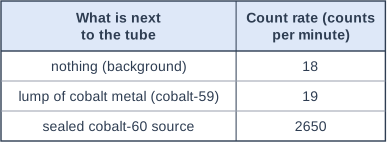
The table shows her results.

Explain what the results show about the nuclei of cobalt-59 and cobalt-60.

Table with columns "What is next to the tube", "Count rate (counts per minute)". What is next to the tube: nothing (background); Count rate (counts per minute): 18 | What is next to the tube: lump of cobalt metal (cobalt-59); Count rate (counts per minute): 19 | What is next to the tube: sealed cobalt-60 source; Count rate (counts per minute): 2650.

Model answer

Cobalt-60 nuclei are unstable (radioactive). With the cobalt-60 source the count rate is 2650 counts per minute, which is much higher than the background count rate of 18 counts per minute, so the source must be giving out radiation.
Cobalt-59 nuclei are stable (not radioactive). The count rate of 19 counts per minute is about the same as the background count rate, so the tube is only detecting background radiation.

Explanation

Always compare a count rate with the background count rate: a count rate close to background means no extra radiation. So two isotopes of the same element can behave differently: cobalt-60 nuclei are unstable and emit radiation, while cobalt-59 nuclei are stable. Both have 27 protons; a cobalt-60 nucleus has one more neutron.

Mark scheme
  1. 1 mark

    cobalt-60 is radioactive / emits radiation / has unstable nuclei, because its count rate (2650 counts per minute) is much higher than the background count rate (18 counts per minute)

    The comparison with the background count rate (or with the count rate for cobalt-59) is needed for this mark. ALLOW 'gives out alpha, beta or gamma radiation'.

  2. 1 mark

    cobalt-59 is not radioactive / does not emit radiation / is stable, because its count rate (19 counts per minute) is (about) the same as the background count rate (18 counts per minute)

    ALLOW 'the counter only detects background radiation with cobalt-59'. ALLOW 'the difference of 1 count per minute is just random variation'. DO NOT ALLOW 'cobalt-59 is slightly radioactive because 19 is more than 18' (CON).

Question 4

3 marks

Uranium-238 is the most common isotope of uranium. Its nucleus contains 92 protons and 146 neutrons.

The mass of a proton and the mass of a neutron are each about 1.7 × 10⁻²⁷ kg.

Calculate the mass of a uranium-238 nucleus.

A uranium-238 atom has almost the same mass as its nucleus. Explain why.

Model answer

Number of particles in the nucleus = 92 + 146 = 238
Mass = 238 × 1.7 × 10⁻²⁷ = 4.0 × 10⁻²⁵ kg (4.046 × 10⁻²⁵ kg)
The atom also has 92 electrons, but each electron has a very small mass compared with a proton or a neutron, so they add almost nothing. Almost all the mass of the atom is in its nucleus.

Explanation

Protons and neutrons have about the same mass, so multiply the total number of particles in the nucleus (the mass number, 238) by the mass of one particle. Using only the 92 protons, or only the 146 neutrons, gives too small an answer. Electrons have only about 1/2000 of the mass of a proton, which is why the mass of an atom is almost all in its nucleus.

Mark scheme
  1. 1 mark

    (mass =) (92 + 146) × 1.7 × 10⁻²⁷ / 238 × 1.7 × 10⁻²⁷; or a correct final answer of 4.0 × 10⁻²⁵ kg (any value from 3.97 × 10⁻²⁵ kg to 4.05 × 10⁻²⁵ kg) with no working

    An answer of 4.0 × 10⁻²⁵ kg, or any value from 3.97 × 10⁻²⁵ kg to 4.05 × 10⁻²⁵ kg (including 4.046 × 10⁻²⁵ kg and 4 × 10⁻²⁵ kg), with no working scores marking points 1 and 2 only. ALLOW use of 1.67 × 10⁻²⁷ kg (giving 3.97 × 10⁻²⁵ kg). DO NOT ALLOW 92 × 1.7 × 10⁻²⁷ (protons only, 1.6 × 10⁻²⁵ kg) or 146 × 1.7 × 10⁻²⁷ (neutrons only, 2.5 × 10⁻²⁵ kg): these score 0 for the calculation.

  2. 1 mark

    evaluation: 4.046 × 10⁻²⁵ (kg) / 4.05 × 10⁻²⁵ (kg) / 4.0 × 10⁻²⁵ (kg)

    ALLOW any value from 3.97 × 10⁻²⁵ kg to 4.05 × 10⁻²⁵ kg, including 4 × 10⁻²⁵ kg. ALLOW the value written as a decimal (0.000 000 000 000 000 000 000 000 4046 kg) or typed as 4.0 times 10 to the power -25 or 4.0E-25. IGNORE units.

  3. 1 mark

    electrons have a very small mass (compared with protons and neutrons)

    ALLOW 'an electron has about 1/2000 of the mass of a proton'. ALLOW 'the 92 electrons add almost nothing to the mass'. DO NOT ALLOW 'almost all the mass of the atom is in the nucleus' on its own, because it repeats the question. DO NOT ALLOW 'electrons have no mass' (CON).

Ready to try the rest? Every answer you write is marked against the mark scheme, so you can see exactly where the marks are.

Study Helper Hints first, answers after you try

Stuck on this one? Ask for a hint and I’ll point you in the right direction, without giving the answer away. Once you’ve checked your answer, I’ll show you how the marks are awarded.