
Level:
Correct: 0
Incorrect: 0
Marks: 0/0

Energy resources and trends in their use

Practise 16 exam-style questions on Energy resources and trends in their use for OCR GCSE Combined Science (Physics Paper 6). Write your answer as you would in the exam and get it marked in seconds against the mark scheme, point by point, with the Study Helper on hand if you get stuck.

  • 16 questions
  • 1–6 marks each
  • Instant marking
  • No sign-up needed
16 questions, marked as you go

Sample questions with model answers

Here are 4 of the questions in this topic, each with a model answer, an explanation of why it earns the marks and the mark scheme an examiner would use.

Question 1

1 mark

Tidal power stations use the rise and fall of the sea level to generate electricity.

What causes the tides?

Choose your answer.

  • A earthquakes and volcanoes under the sea bed
  • B the gravitational pull of the Moon on the sea
  • C the heating of the sea water by the Sun
  • D the wind blowing across the surface of the sea

Model answer

B (the gravitational pull of the Moon on the sea)

Explanation

The tides are caused mainly by the gravitational pull of the Moon on the oceans, so the sea level rises and falls about twice every day. The Moon will keep pulling on the oceans, so the tides will not run out: they are a renewable energy resource. Do not confuse the tides with waves, which are made by the wind.

Mark scheme
  1. 1 mark

    B / the gravitational pull of the Moon on the sea

    The only correct answer is B: the Moon's gravity pulls on the water of the oceans, so the sea level rises and falls about twice every day (the Sun's gravity has a smaller effect). A is not correct because earthquakes and volcanoes do not happen every day, so they cannot cause the regular rise and fall of the tides. C is not correct because heating by the Sun causes evaporation and winds, not the tides. D is not correct because the wind makes waves on the surface of the sea, not the tides. ALLOW the letter or the option. If more than one option is given, do not award the mark.
Question 2

2 marks

Street lights in a town are switched on at midnight. These energy resources can be used to generate electricity:

natural gas   nuclear fuel   the Sun   wind

Give the one energy resource from the list that could NOT be used to generate electricity for the street lights at midnight.

Explain your answer.

Model answer

The Sun. At midnight it is dark, so there is no sunlight for solar panels to transfer to electricity.

Explanation

Solar panels need light, so they generate nothing at night. Wind turbines can still turn at night if it is windy, and gas-fired and nuclear power stations can generate at any time of day. So the Sun is the only resource in the list that could not be used at midnight.

Mark scheme
  1. 1 mark

    the Sun / solar (power) / solar panels

    If more than one energy resource is given, do not award this mark (wind, natural gas and nuclear fuel can all be used at midnight).

  2. 1 mark

    there is no sunlight / it is dark at midnight, so solar panels generate no electricity

    Dependent on point 1. ALLOW the Sun has set / the Sun is not shining at night / solar panels need light. IGNORE solar power is unreliable (on its own, with no reason linked to night).

Question 3

2 marks

In 2024, most cars on UK roads used petrol or diesel, but the number of electric cars, which are charged from the mains supply, was increasing.

Explain why using electric cars instead of petrol or diesel cars can reduce the use of fossil fuels.

Model answer

Petrol and diesel are made from crude oil, which is a fossil fuel, and they are burned in the car's engine. The electricity used to charge an electric car can be generated from renewable resources such as wind and the Sun, so no fossil fuel has to be burned.

Explanation

Electricity is not itself an energy resource: it is generated from a resource. An electric car uses fewer fossil fuels only when its electricity comes from resources such as wind, the Sun or nuclear fuel, instead of from burning gas or coal. A petrol or diesel car always burns a fuel made from crude oil.

Mark scheme
  1. 1 mark

    petrol and diesel are made from crude oil, a fossil fuel (which is burned in the car's engine)

    ALLOW petrol and diesel are fossil fuels. ALLOW petrol and diesel cars burn oil.

  2. 1 mark

    the electricity for charging can be generated from renewable resources (such as wind or the Sun) / from nuclear fuel, so no fossil fuel needs to be burned

    ALLOW a named renewable resource or nuclear fuel. IGNORE electric cars release no carbon dioxide (on its own). DO NOT ALLOW electricity is renewable / electricity is an energy resource.

Question 4

4 marks

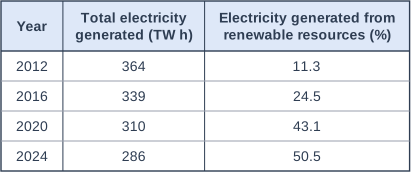
The table shows the total electricity generated in the UK, and the percentage of it generated from renewable energy resources, in four years. (Data: Department for Energy Security and Net Zero (DESNZ), Energy Trends September 2026, Table 6.1.)

Describe the two trends shown in the table.

Suggest one reason for each trend.

Table with columns "Year", "Total electricity generated (TW h)", "Electricity generated from renewable resources (%)". Year: 2012; Total electricity generated (TW h): 364; Electricity generated from renewable resources (%): 11.3 | Year: 2016; Total electricity generated (TW h): 339; Electricity generated from renewable resources (%): 24.5 | Year: 2020; Total electricity generated (TW h): 310; Electricity generated from renewable resources (%): 43.1 | Year: 2024; Total electricity generated (TW h): 286; Electricity generated from renewable resources (%): 50.5.

Model answer

The total electricity generated in the UK decreased, from 364 TW h in 2012 to 286 TW h in 2024. The percentage generated from renewable resources increased, from 11.3 % to 50.5 %.
The total decreased because appliances and lamps, such as LED lamps, became more efficient, so less electricity was needed.
The renewable percentage increased because many more wind turbines and solar panels were built, to reduce the carbon dioxide released by burning fossil fuels.

Explanation

Describe each trend in the table separately: one column goes down and the other goes up. Then give a different reason for each: using less electricity (more efficient appliances) explains the falling total, and building more wind and solar to cut carbon dioxide emissions explains the rising renewable share. Do not mix the two up: the falling total does not mean that less renewable electricity was generated.

Mark scheme
  1. 1 mark

    the total electricity generated decreased (from 364 TW h in 2012 to 286 TW h in 2024)

    Max 4. Points 1 and 2 describe the trends. 1 mark for any one of points 3 and 4 (a reason for the decrease in the total), max 1. 1 mark for any one of points 5 to 8 (a reason for the increase in the percentage from renewable resources), max 1. If more than one answer is given, a wrong one cancels a right one (this applies to the reasons for each trend separately). Data are not needed for points 1 and 2, but ALLOW correct data such as 'it fell by 78 TW h'.

  2. 1 mark

    the percentage of electricity generated from renewable resources increased (from 11.3 % in 2012 to 50.5 % in 2024)

    ALLOW more electricity was generated from renewable resources. ALLOW about half was renewable by 2024 / the percentage more than quadrupled. DO NOT ALLOW the total electricity from renewables decreased.

  3. 1 mark

    less electricity was needed because appliances and lighting became more efficient (for example LED lamps)

    ALLOW people / homes / factories used less electricity (for example to save money or because there is less heavy industry). IGNORE the population decreased (it did not).

  4. 1 mark

    more electricity was imported from other countries (so less had to be generated in the UK)

    ALLOW the UK bought electricity from other countries.

  5. 1 mark

    more wind turbines / solar panels were built

    ALLOW more wind farms / solar farms / more renewable power stations were built.

  6. 1 mark

    to reduce the carbon dioxide released (by burning fossil fuels) / to reduce climate change or global warming

    ALLOW to reduce greenhouse gases / to reduce pollution from power stations.

  7. 1 mark

    fossil fuels are non-renewable / will run out

    ALLOW to use less coal, oil and gas, which are running out.

  8. 1 mark

    coal-fired power stations were closed (and replaced by renewable resources)

    ALLOW fewer fossil fuel power stations were used.

Ready to try the rest? Every answer you write is marked against the mark scheme, so you can see exactly where the marks are.

Study Helper Hints first, answers after you try

Stuck on this one? Ask for a hint and I’ll point you in the right direction, without giving the answer away. Once you’ve checked your answer, I’ll show you how the marks are awarded.