Level:
Correct: 0
Incorrect: 0
Marks: 0/0

Describing waves and wave speed

Practise 17 exam-style questions on Describing waves and wave speed for OCR GCSE Combined Science (Physics Paper 6). Write your answer as you would in the exam and get it marked in seconds against the mark scheme, point by point, with the Study Helper on hand if you get stuck.

  • 17 questions
  • 1–6 marks each
  • Instant marking
  • No sign-up needed
17 questions, marked as you go

Sample questions with model answers

Here are 4 of the questions in this topic, each with a model answer, an explanation of why it earns the marks and the mark scheme an examiner would use.

Question 1

1 mark

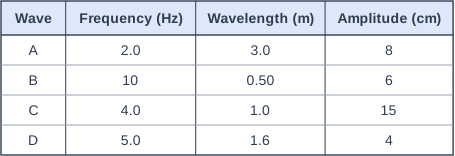
The table shows information about waves on four different stretched ropes, A, B, C and D.

Which wave has the greatest wave speed?

Use the equation: wave speed = frequency × wavelength

Choose your answer.

  • A wave A
  • B wave B
  • C wave C
  • D wave D
Table with columns "Wave", "Frequency (Hz)", "Wavelength (m)", "Amplitude (cm)". Wave: A; Frequency (Hz): 2.0; Wavelength (m): 3.0; Amplitude (cm): 8 | Wave: B; Frequency (Hz): 10; Wavelength (m): 0.50; Amplitude (cm): 6 | Wave: C; Frequency (Hz): 4.0; Wavelength (m): 1.0; Amplitude (cm): 15 | Wave: D; Frequency (Hz): 5.0; Wavelength (m): 1.6; Amplitude (cm): 4.

Model answer

D (wave D)
A: 2.0 × 3.0 = 6.0 m/s
B: 10 × 0.50 = 5.0 m/s
C: 4.0 × 1.0 = 4.0 m/s
D: 5.0 × 1.6 = 8.0 m/s

Explanation

Work out frequency × wavelength for every wave and compare the answers. Wave D is fastest at 8.0 m/s. The longest wavelength (A), the highest frequency (B) or the biggest amplitude (C) does not on its own tell you which wave is fastest: the speed depends on both the frequency and the wavelength, and not on the amplitude.

Mark scheme
  1. 1 mark

    D / wave D

    The only correct answer is D: wave speed = frequency × wavelength gives wave A 2.0 × 3.0 = 6.0 m/s, wave B 10 × 0.50 = 5.0 m/s, wave C 4.0 × 1.0 = 4.0 m/s and wave D 5.0 × 1.6 = 8.0 m/s, so wave D is the fastest. A is not correct: wave A has the longest wavelength, but its speed is only 6.0 m/s; B is not correct: wave B has the highest frequency, but its speed is only 5.0 m/s; C is not correct: wave C has the largest amplitude, but the amplitude is not used to work out the wave speed (4.0 m/s). ALLOW the letter or the option. If more than one option is given, do not award the mark.

Question 2

2 marks

A student writes in her notes:

'The frequency of a wave tells you how fast the wave travels.'

Explain why the student is wrong.

Model answer

Frequency is the number of waves that pass a point each second, so it tells you how often the waves come, not how fast they move. How fast a wave travels is its wave speed: the distance a crest moves each second. The speed also depends on the wavelength (wave speed = frequency × wavelength), so a wave with a high frequency but a short wavelength need not travel any faster.

Explanation

Frequency (in hertz) counts waves each second; wave speed (in m/s) measures distance each second. The two are linked only through the wavelength. For example, all the notes from a guitar travel through the air at the same speed, although the high notes have a higher frequency and a shorter wavelength. Mixing up 'how often' with 'how fast' is the mistake in the student's notes.

Mark scheme
  1. 1 mark

    frequency is the number of (complete) waves passing a point each second / the number of waves made by the source each second

    1 mark for each of points 1 to 3, max 2. ALLOW the number of vibrations (oscillations) each second / how often the waves pass. DO NOT ALLOW the distance a wave travels each second (that is the wave speed) or the time for one wave (that is the period).

  2. 1 mark

    how fast a wave travels is its wave speed: the distance a crest (the wave) travels each second

    ALLOW the wave speed tells you how far the wave moves in one second (in metres per second).

  3. 1 mark

    the wave speed depends on the wavelength as well as the frequency (wave speed = frequency × wavelength), so a wave with a higher frequency does not always travel faster / waves with different frequencies can travel at the same speed

    ALLOW high notes and low notes travel through the air at the same speed. ALLOW a wave with a high frequency and a short wavelength can travel slowly. IGNORE 'frequency is measured in hertz' unless it is linked to waves each second.

Question 3

2 marks

The table shows information about two waves.

Work out the values of X and Y.

Use the equation: wave speed = frequency × wavelength

Table with columns "Wave", "Frequency (Hz)", "Wavelength (m)", "Wave speed (m/s)". Wave: Ripples on a pond; Frequency (Hz): 3.0; Wavelength (m): X; Wave speed (m/s): 0.36 | Wave: Wave on a stretched spring; Frequency (Hz): Y; Wavelength (m): 0.60; Wave speed (m/s): 2.4.

Model answer

X: wavelength = wave speed ÷ frequency = 0.36 ÷ 3.0 = 0.12 m
Y: frequency = wave speed ÷ wavelength = 2.4 ÷ 0.60 = 4.0 Hz

Explanation

Both values need the equation rearranged. For X, wavelength = wave speed ÷ frequency = 0.36 ÷ 3.0 = 0.12 m. For Y, frequency = wave speed ÷ wavelength = 2.4 ÷ 0.60 = 4.0 Hz. Check each answer by putting it back into the equation: 3.0 × 0.12 = 0.36 and 4.0 × 0.60 = 2.4, which match the table.

Mark scheme
  1. 1 mark

    X = 0.12 (m)

    An answer of X = 0.12 with no working scores marking point 1 only. An answer of Y = 4.0 with no working scores marking point 2 only. Working for X: wavelength = wave speed ÷ frequency = 0.36 ÷ 3.0 = 0.12. ALLOW 12 cm. DO NOT ALLOW 1.08 (0.36 × 3.0) or 8.3 (3.0 ÷ 0.36). IGNORE units.

  2. 1 mark

    Y = 4.0 (Hz) / 4 (Hz)

    Working: frequency = wave speed ÷ wavelength = 2.4 ÷ 0.60 = 4.0. DO NOT ALLOW 1.44 (2.4 × 0.60) or 0.25 (0.60 ÷ 2.4). IGNORE units.

Question 4

3 marks

A seagull floats on the sea. Waves pass the seagull and it moves up and down.

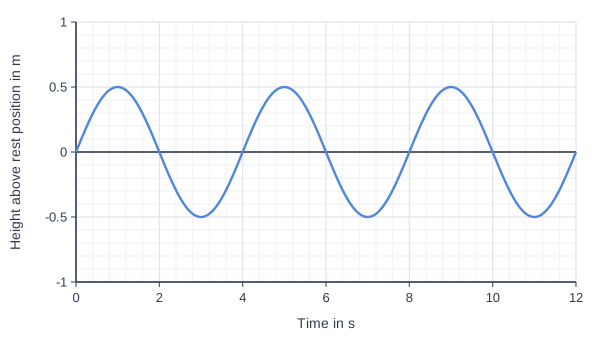
A wildlife camera films the seagull. The graph is made from the film. It shows the seagull's height above its rest position at different times.

The waves travel at 6.4 m/s.

Calculate the wavelength of the waves.

Use the equation: wave speed = frequency × wavelength

Graph of height above rest position in m (y-axis, -1 to 1) against time in s (x-axis, 0 to 12), on a grid. A wave is drawn as a smooth, regular sine-shaped curve centred on the zero line: its crests reach 0.5 m and its troughs -0.5 m.

Model answer

From the graph, one complete wave takes 4.0 s (3 waves in 12 s), so the period is 4.0 s.
frequency = 1 ÷ 4.0 = 0.25 Hz
wavelength = wave speed ÷ frequency = 6.4 ÷ 0.25 = 25.6 m

Explanation

The graph has time along the bottom, so the length of one complete wave on it is the period, not the wavelength. Read it over several waves for accuracy: 3 waves take 12 s, so the period is 4.0 s and the frequency is 0.25 Hz. Then wavelength = 6.4 ÷ 0.25 = 25.6 m. Reading the amplitude, or multiplying 6.4 by 0.25, are the usual slips.

Mark scheme
  1. 1 mark

    period read from the graph: 4.0 s / frequency = 3 ÷ 12 = 0.25 Hz; or a correct final answer of 25.6 m or 26 m with no working

    An answer of 25.6 m or 26 m with no working scores 3 marks. The graph shows 3 complete waves in 12 s, so the period is 4.0 s and the frequency is 0.25 Hz. ALLOW frequency = 1 ÷ 4.0 = 0.25 Hz. DO NOT ALLOW the amplitude (0.5 m) used as the period or the frequency.

  2. 1 mark

    rearrangement and substitution: wavelength = 6.4 ÷ 0.25 / wavelength = 6.4 × 4.0; or a correct final answer of 25.6 m or 26 m with no working

    ALLOW ECF from a wrong period or frequency read from the graph (for example a period of 2.0 s gives 6.4 × 2.0 = 12.8 m, which scores points 2 and 3). DO NOT ALLOW 6.4 × 0.25 (1.6 m) or 6.4 ÷ 4.0 (1.6 m).

  3. 1 mark

    evaluation: 25.6 (m) / 26 (m)

    ALLOW ECF from a wrong period or frequency only. IGNORE units, as the question does not ask for them.

Ready to try the rest? Every answer you write is marked against the mark scheme, so you can see exactly where the marks are.

Study Helper Hints first, answers after you try

Stuck on this one? Ask for a hint and I’ll point you in the right direction, without giving the answer away. Once you’ve checked your answer, I’ll show you how the marks are awarded.